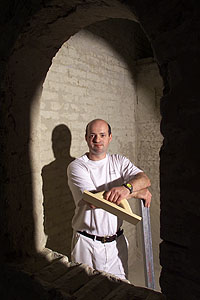
 When most people take their first steps with using lights they try to make the photographs shadowless. The ability to do this is very useful, but sometimes it’s far better to place your own shadows exactly where you want them.
Some subjects need to be given a distinct treatment. This portrait of an award winning student was crying out for an unusual image and it was obvious that he would do pretty much anything I asked. The college where he had been studying plastering was a large space divided up into small rooms that the students then practiced their craft in. It was dark and dull coloured with no reflective surfaces so it was pretty much an ideal location for me to work in (apart from the dust).
I quickly spotted a whole series of arches and windows that would serve as a perfect frame to the photograph and set a Lumedyne light up inside the small room.The beauty of working with battery powered kit is that you don’t have to find power points, which were few and far between in the workshop area.I first tried to shoot with a softbox on the flash unit, but the dull colours and the subjects plain T-shirt made it a pretty boring shot so I decided to shoot without any form of light modifier and removed the softbox in order to get the hard shadow.
The flash exposure was f5.6 at 200 ISO with the softbox in place, but this leapt to f13 with just the metal reflector in place. There was so little available light that everything not lit by the flash was in total darkness. This effect was perfect for the shot. (more…)
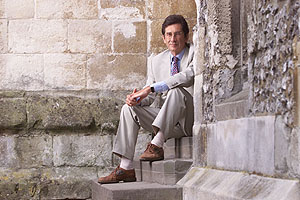 It’s quite often the case that the available light looks great, but that there just isn’t enough of it. The trick here is to use flash to supplement the ambient light without replacing it. When you have the headmaster of one of the world’s oldest and grandest schools it isn’t difficult to choose a location in which to make his portrait.
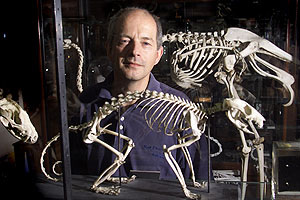 Having glass or any reflective surface in a photograph normally strikes fear into the heart of most photographers. This portrait has at least ten panes of glass in shot, but careful lighting and liberal use of the LCD screen on my digital camera made the glass nearly invisible.
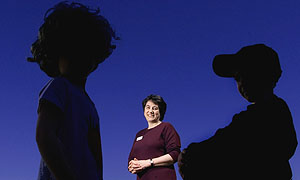 This is going over old ground somewhat, but I think that given a second and third example of techniques discussed before and combined here you start to get a deeper understanding of how various techniques can be intertwined.
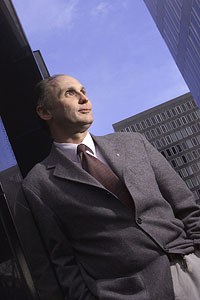 Sometimes you have no other option than to get your flash unit out of it’s hot shoe and make it perform like a studio style strobe. Whether it’s the Canon 550ex, the Nikon SB28DX or another make altogether there are some simple steps you can take to produce cultured and interesting images.
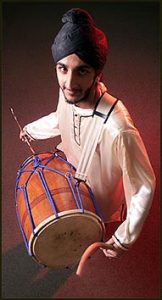 When you have just spent three hours driving to a job going over what the picture editor and the designer said to you about the pictures that were required it is inevitable that you start to make some plans. This job was certainly such an occasion.
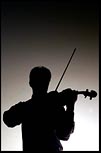
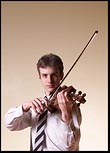
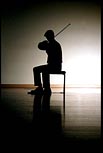 The way that an image is destined to be used dictates how you shoot it. This example talks about the difference in approach to shooting what is essentially the same subject, but for two different uses. I went to this southwest London school to shoot a “fly on the wall” documentary article about a music project to fill a couple of pages in a tabloid sized magazine.
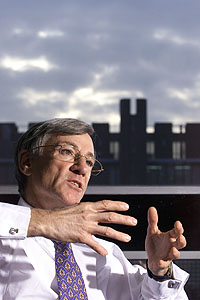 The “Interview Portrait” is one of the most difficult tasks that I am asked to undertake. Of course it’s easy enough to just turn up and shoot a picture, but actually making a proper portrait is a really difficult task. This portrait was frame 64 out of 73, frames 1- 30 were the safe shots and 31 – 73 were far more experimental.
 Neil Turner Photographer