I’ve been blogging now for over a quarter of a century. I’m not directly aware that it has brought me much work as a photographer but it has definitely led to some interesting teaching gigs and quite a bit of consultancy too. Most importantly, it has given me an outlet for what I want to say, a great deal of satisfaction and a profile within the industry far higher than I would have ever had without it.
Back in the year 2000 I didn’t know that I was blogging because I had never heard the term. The word ‘blog’ entered my consciousness during a discussion with a good friend of mine who couldn’t understand why I hadn’t monetised my monthly posting of technique and opinion pieces on my website. He pointed out that other people were doing it and asked why I wasn’t? That would have been in, or around, the beginning of 2004. There were a couple of reasons; the first was that I didn’t own the copyright to the images that I was posting and was only able to run the website with the permission of my then employers. The second was that I didn’t want commercial factors to influence what I posted and when I posted it – something that I imagined would take the fun out of it.
The website had evolved from something that I had started using members.aol.com webspace and a very basic web design application that they provided free of charge. That would have been in early 1999 and every month I was uploading between six and ten of the most interesting images that I had shot in the previous twenty-eight days. I learned quite a bit of html coding and moved to some professional web design software, my own domain and some rented web space as dg28.com was born in a very different form than it exists today.
(more…)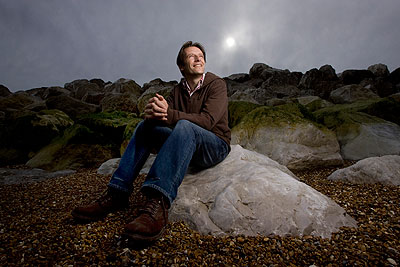 I was born by the sea, I live by the sea and I really enjoy shooting portraits by the sea. This example was of a young teacher who has moved his family to the coast to get a better way of life and he had given an interview to the paper about the way he lives – cycling to work, spending time with his family and generally making the most of the beaches in his area. My brief was simple – shoot a nice portrait on the beach!
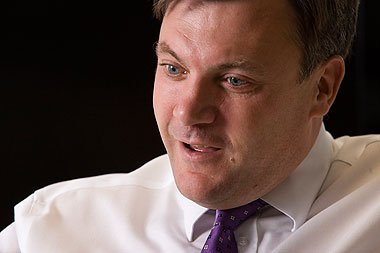 I have to shoot a lot of portraits during interviews and there have been several technique examples on this web site about the techniques and decisions that need to be made when doing that kind of work. This one isn’t about lighting set-ups or pre-planning – this is simply about seeing an angle and making the most out of it. This gentleman is Ed Balls: Member of Parliament and Secretary of State for Children, Schools and Families in Gordon Brown’s Government. The reporter had a short time to ask him questions from our readers and to conduct an interview around his responses. I had to shoot with my back to a glass wall and against the light. I set up a Lumedyne with a simple shoot through umbrella almost directly opposite the Secretary of State and behind the reporter. I had limited space in which to move and shoot.
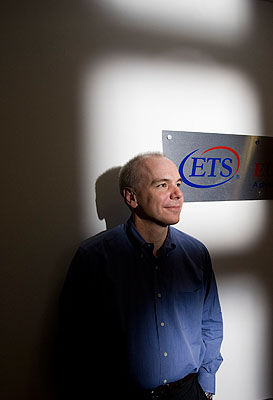 I was inspired to share the “how” for this picture because of a comment from a colleague who said that I had been “lucky to find such a nice pool of light”. I was amused, annoyed and complimented all at the the same time because I created this light and he obviously thought that it looked as if it was a natural effect. Much of the best lighting looks as if it were not lit… so how was this one achieved?
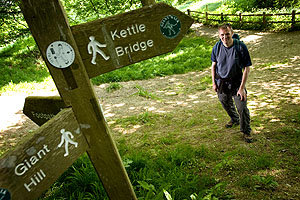 The great thing about creative flash is that you can play around and pretty much make it up as you go along. Learning from each set up as you go isn’t just a useful side effect it is the whole point. Just recently I have been hiding the flash in the picture a lot. This basically means that the light souce isn’t off to the side of the frame – it’s strategically hideen somewhere right there. I use doors and walls, poles and posts and even other people to mask the location of the flash, but it is there. This portrait of a teacher who does a lot of walking in the hills near his Dorset home is a useful case study. We had already shot quite a few really nice images of him using flash to overpower the daylight (see technique example here) and one of him walking without flash that you can see below: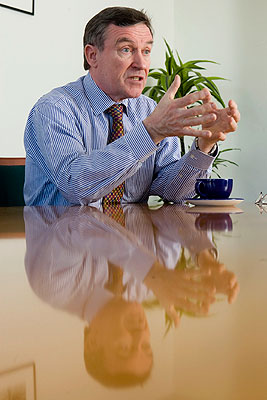
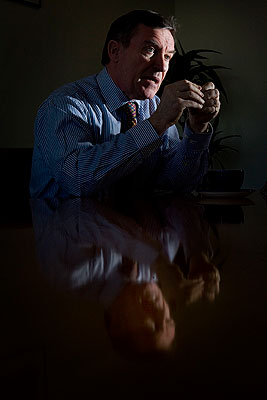 It has been a while since I added any new technique pages to the site so here is one that I have been meaning to do for quite a while. The idea here is to have two seperate lighting set-ups for one interview portrait without having to constantly move around the room adjusting lights. This interview was with a senior businerssman who chairs a body that decides how much teachers’ pay rises will be each year. The reporter wasn’t all that comfortable with me shooting through the interview but it was what the picture editor wanted, so that’s what I did. This job required a bit of quick thinking so that I could get two different set-ups in place.
 Neil Turner Photographer