Original dg28

Pool of Light

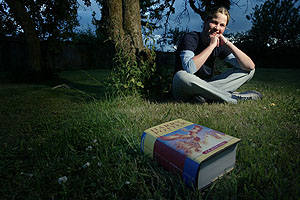
Creating a pool of light is one of the most effective ways of emphasising part of an image. There are many ways to achieve this, but for the traveling photographer who has to carry their own kit a small piece of aluminium foil has to be one of the simplest.

This portrait of a young book reviewer needed to have atmosphere. She had read “The Order of The Phoenix” in less than two days to complete her review of the books and it made sense to use light in the gathering dusk to give the image something extra.

Under the trees the light reading was only 1/30th of a second at f8, but that gave a bleached out sky. The sky on 1/250th at f8 was a better tone, but rather grey. I decided to add some colour by putting some 85B gel over my Lumedyne flash head and exposing the pictures on a tungsten white balance. This gave the sky and all other areas not covered by the flash a pleasing blue hue. The shifted colour on it’s own was not enough to give the drama that I wanted, so I took the piece of folded aluminium foil that I always carry from my bag and formed it into a tube. (more…)
Contrast, Colour and Glass

Most photographers take a deep breath and touch wood for good luck when they are aked to shoot pictures with glass in them. The arrival in the world of digital cameras with LCD screens has taken away a lot of the guess work about where and how the reflections of the light and the rest of the world fall.

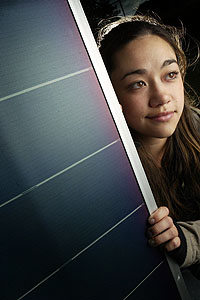
This portrait of a “young achiever” and a solar panel needed to be shot at a time when there was little or no light around. The British summer oftens throws up days when the available light exposure just doesn’t have enough contrast to make good photographs. The picture editor’s instructions called for some form of drama so I decided to shoot the picture with plenty of refelcted light on the panel itself.

My first reaction was to use a flash with a snooted reflector that gave a spot light feel. I tried a few frames with this set up, but the gradation of the highlight on the panel as well as the harsh shadow on the girl’s face didn’t work and it was time to try plan B.
My Lumedyne flash units always have their diffuser caps over the reflectors while in transit to protect the tubes and plan B is always to shoot with the diffuser in place and no other form of light modifier. The effect was still too harsh, so I was left with the option of using a softer light modifier such as a soft box or an umbrella. My first thought was to go for a soft box, but all of mine are rectangular in shape and I was worried that the light on the solar panel wouldn’t have a the kind of “hot spot” that I wanted. (more…)

The View From Above 2

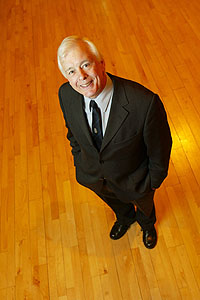
In a remarkably similar composition to the previous technique page this example uses some ambient light with it’s own very strong colour to give an unusual atmosphere whilst adding enough flash light to keep the subject’s skin tones correct.

You would be correct in guessing that orange is one of my favourite colours when it comes to both graphics and photographs. It works well when converted to CMYK for newspaper and magazine reproduction and carries over very well as a web safe colour on the Internet. It also has the advantage of being the colour that that many types of incandescent bulbs show up when you shoot with a daylight balanced digital camera or film. The colour temperature of most household bulbs ranges from around 3000K to 3600K, but certain types of industrial lighting is even warmer at around 2800K.

The wooden floor had just been polished to a wonderful finish and, just like last month’s technique, I decided to get up high and shoot down. The only problems that this presents are; a) getting myself high enough, and b) getting the light high enough.

The first of these two dilemmas was easily overcome by using a large gymnastic stool (a bit like the stools that elephants stand on in the circus) that was already in the room. (more…)

The View From Above

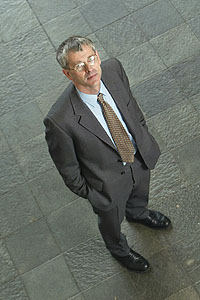
One of the simplest techniques that I use is to shoot a portrait from above. The temptation with this kind of shot is to use a very wide angle lens and a small step ladder, but the combined risks of your own feet straying into the composition and achieving ugly distortion mean that I prefer to save the technique for times when I can get a lot higher up. Environmental portraiture does exactly what it says – it portrays people in their environment and uses the clues from the surroundings to say something about the subject. Sometimes you need to come in closer, to concentrate on the subject’s face with no distractions. This need can often be dictated to you by the lack of a suitable environment, the background occasionally offers up few clues and many distractions.

I have written before on this site about the usefulness of the floor as a clean background. The head teacher in this image runs one of the biggest and poorest schools in east London, but the main building is relatively new and offered up some good backdrops. I shot pictures in a range of different areas, but this slate floor gave me what I was looking for.

This was the fourth and final way that I tried to shoot the portrait and the uniformity of the grey slate floor gave me a very simple option. The school has a walkway about 4.5 metres (15 feet) above the main entrance and we waited until the pupils were in lessons before setting up the shot.

I was using a new Lumedyne “Signature” series flash unit for this job and I set up the flash at the maximum height that the stand would allow which is about 2.4 metres (8 feet) from the ground. (more…)

Accent Colour

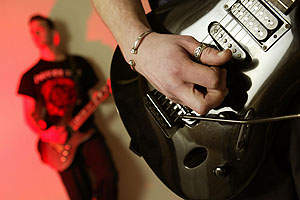
We have discussed the use of background colour in news images and this is another example of the selective use of an accent colour. This time the mood required is a bit of “rock and roll”, at a music college on the south coast of England.

The brief was simple, we needed a generic image of modern music that was reasonably graphic in it’s composition. The facilities at the college consisted of rehearsal rooms and recording studios but the only space available was the corridor between the various areas. Of all the instruments available, this guitar was the most photogenic and it’s owner’s hands were just right for the picture.

I tried the simple composition of a close up with the hand and strings, but it needed something else in the background to suggest the rock music element. The second guitarist out of focus in the background made the composition slightly more interesting, but the black clothing, black guitars and white walls left the image lacking in colour. Having a second lightsource for this kind of job is essential. I had decided to use a Lumedyne head, bounced off of a white wall as the main light – giving an even spread of light on the guitar and guitarist in the foreground. A second Lumedyne on the background with a red filter over the head was placed to give the colour and a shadow on the out of focus guitarist in the background, but the main light was spilling onto the background diluting the impact of the red filter. (more…)

Lighting a Conference Platform

When you work for newspapers, you go to a lot of press conferences and other events where you get a man or woman in a grey suit speaking from a platform. The people who design the sets don’t consider the needs of the stills photographer, and rarely give a thought to television either. getting the light right presents us with all sorts of dilemmas.
Lighting the conference with flash becomes impossible when there are hundreds of photographers there trying to do the same, but if there less than twenty the chances are that you can do exactly what you want to do without clashing with each other.
There are many systems on the market for remotely triggering your flash and the Pocket Wizard Multi-max has to be the king with 32 channels to choose from. I have tried it, and loved it but this example was lit using the Canon ST-E2 trnsmitter and a single Canon 550ex flash unit. The principle is similar, so if you are a Nikon user (like the other two photographers that were shooting the same event) read on – it’s still relevant. The system that you choose has to have some form of coded signal unless you want your flash to be triggered by every other flash gun in the place. Ordinary slave cells won’t do. (more…)

Still Life and Movement

One of the things about being a staff photographer is that you often get asked to shoot little still life images, in the corner of the offices with very little space and even less equipment. Add short notice to that cocktail and producing pictures to be proud of becomes rather tricky.
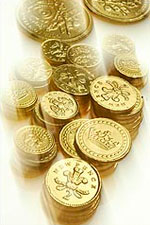
Coming up with interesting images to illustrate rather academic or vague stories presents all sorts of problems. A lot of these kinds of pictures get sourced from stock libraries, but it’s often the case that there is nothing entirely suitable available at a price that’s worth paying.

The picture editor had been out shopping to find some toy money and with the approach of Christmas there was a lot of foil covered chocolate money in the shops. She bought both the plastic and the chocolate so that I would have all sorts of options when I came to play around with lights and lenses.

Neither the picture editor or myself had read the story when we started, so I decided to give her a range of pictures that would not only be useful for this story, but also have other uses in the future. I keep a couple of Elinchrom 250 monobloc flash heads in a cupboard in the office along with stands and a 70cm softbox for these occasions so I commandeered some space and started to play. (more…)

More About Shooting Glass

Photography couldn’t exist without glass. Lenses are reliant on it for their optics and mirrors use it too. We all love our LCD displays on our digital cameras, but when we are actually photographing glass many of us turn to jelly. I have written before about shooting through it, but a job that I shot this month involved shooting a big glass jar.

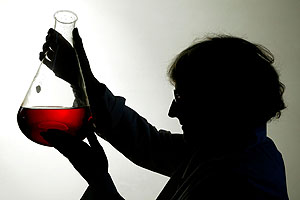
When I was sent to photograph this school laboratory assistant I was given a pretty free reign to do what I wanted.
The Picture Editor had told me that we already had some “straight” pictures of her on file so I could be as creative as I liked. That’s sometimes a bit of a poisoned chalice, but I’m always up for a bit of a challenge so I decided to try to do something a bit different.

When I arrived at the school, I met the lady I was photographing and was taken to her small preparation room next to the main laboratories. It’s always at this point that I start looking for clues about what to include in the photograph and the room was full of glassware. Test tubes, beakers and conical flasks were everywhere so I decided that glass was needed in the images. (more…)