technique

Accent Colour

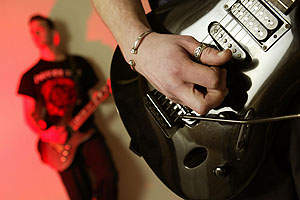
We have discussed the use of background colour in news images and this is another example of the selective use of an accent colour. This time the mood required is a bit of “rock and roll”, at a music college on the south coast of England.

The brief was simple, we needed a generic image of modern music that was reasonably graphic in it’s composition. The facilities at the college consisted of rehearsal rooms and recording studios but the only space available was the corridor between the various areas. Of all the instruments available, this guitar was the most photogenic and it’s owner’s hands were just right for the picture.

I tried the simple composition of a close up with the hand and strings, but it needed something else in the background to suggest the rock music element. The second guitarist out of focus in the background made the composition slightly more interesting, but the black clothing, black guitars and white walls left the image lacking in colour. Having a second lightsource for this kind of job is essential. I had decided to use a Lumedyne head, bounced off of a white wall as the main light – giving an even spread of light on the guitar and guitarist in the foreground. A second Lumedyne on the background with a red filter over the head was placed to give the colour and a shadow on the out of focus guitarist in the background, but the main light was spilling onto the background diluting the impact of the red filter. (more…)

Lighting a Conference Platform

When you work for newspapers, you go to a lot of press conferences and other events where you get a man or woman in a grey suit speaking from a platform. The people who design the sets don’t consider the needs of the stills photographer, and rarely give a thought to television either. getting the light right presents us with all sorts of dilemmas.
Lighting the conference with flash becomes impossible when there are hundreds of photographers there trying to do the same, but if there less than twenty the chances are that you can do exactly what you want to do without clashing with each other.
There are many systems on the market for remotely triggering your flash and the Pocket Wizard Multi-max has to be the king with 32 channels to choose from. I have tried it, and loved it but this example was lit using the Canon ST-E2 trnsmitter and a single Canon 550ex flash unit. The principle is similar, so if you are a Nikon user (like the other two photographers that were shooting the same event) read on – it’s still relevant. The system that you choose has to have some form of coded signal unless you want your flash to be triggered by every other flash gun in the place. Ordinary slave cells won’t do. (more…)

Still Life and Movement

One of the things about being a staff photographer is that you often get asked to shoot little still life images, in the corner of the offices with very little space and even less equipment. Add short notice to that cocktail and producing pictures to be proud of becomes rather tricky.

Coming up with interesting images to illustrate rather academic or vague stories presents all sorts of problems. A lot of these kinds of pictures get sourced from stock libraries, but it’s often the case that there is nothing entirely suitable available at a price that’s worth paying.

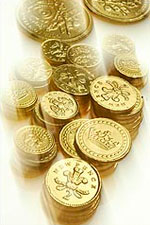
The picture editor had been out shopping to find some toy money and with the approach of Christmas there was a lot of foil covered chocolate money in the shops. She bought both the plastic and the chocolate so that I would have all sorts of options when I came to play around with lights and lenses.

Neither the picture editor or myself had read the story when we started, so I decided to give her a range of pictures that would not only be useful for this story, but also have other uses in the future. I keep a couple of Elinchrom 250 monobloc flash heads in a cupboard in the office along with stands and a 70cm softbox for these occasions so I commandeered some space and started to play. (more…)

More About Shooting Glass

Photography couldn’t exist without glass. Lenses are reliant on it for their optics and mirrors use it too. We all love our LCD displays on our digital cameras, but when we are actually photographing glass many of us turn to jelly. I have written before about shooting through it, but a job that I shot this month involved shooting a big glass jar.

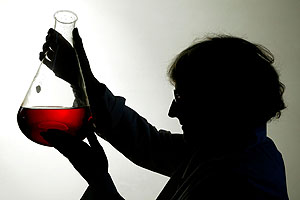
When I was sent to photograph this school laboratory assistant I was given a pretty free reign to do what I wanted.
The Picture Editor had told me that we already had some “straight” pictures of her on file so I could be as creative as I liked. That’s sometimes a bit of a poisoned chalice, but I’m always up for a bit of a challenge so I decided to try to do something a bit different.

When I arrived at the school, I met the lady I was photographing and was taken to her small preparation room next to the main laboratories. It’s always at this point that I start looking for clues about what to include in the photograph and the room was full of glassware. Test tubes, beakers and conical flasks were everywhere so I decided that glass was needed in the images. (more…)

Using a Small Flash 4

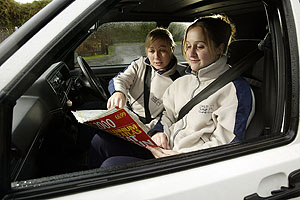
By now I have become a dab hand at shooting with the 550ex so I tried lighting this picture through a (stationary) car windscreen. The story was about car sharing and it was raining extremely hard, so I decided that it was OK for me and my kit to get wet, but not the two young women in the picture.

I had a Turbo powered 550ex on a Manfrotto stand on the bonnet (hood) of the car. The outside exposure was 1/45th of a second at f4.5 at 200 ISO so I needed to balance the interior to the same. I wasn’t too hopeful of the E-TTL coping with this one, but I tried…and it worked!!! A spot-on exposure first time using the FEL (flash exposure lock).

The problem was that the girl in the foreground’s hair blended with the dark roof and interior fabric of the car. I set a second 550ex on a stand with a gold coloured Omni-bounce outside the car, directly behind her head to give her some “rim light”. (more…)

Using a Small Flash 3

Encouraged by my efforts with the fill flash on the previous page made me try a more subtle version with this portrait.

The location was by a graffiti covered building on the banks of the River Thames where the light was very dull and lifeless. I decided that a 550ex with an Omni-bounce was the way to go again and with the flash at about 80 degrees from the axis of the lens, pointing nearly straight up and at the subjects eye level.

The set up was pretty similar to the previous one, but this time the E-TTL didn’t give particularly consistent exposures so I set the flash to 1/2 power manual. The available light exposure was 1/125th of a second at f4 on 200 ISO and I was keen to keep the depth of field pretty small.

I tried a couple of frames with the flash one metre (40 inches) from the subject and the exposure was still a little hot. Rather than change the power output on the speedlite, I moved the stand back about 30 cm (12 inches) and tried again. (more…)

Using a Small Flash 2

I have always been keen on using light in my work as a news photographer, and I have preferred using my Lumedyne kit for a few years now. Having changed over to the EOS1D last month, and being keen on doing things in different ways I have been playing a lot this month with lighting my work with one or more Canon speedlite.

I don’t want to completely alienate the many Nikon users that regularly read these technique pieces, but this example will drift into being a bit Canon specific from time to time. Sorry about that, and I hope that Nikon bring out the kind of kit that allows you to do all of this really soon!

At this time of year I spend a huge amount of my working day in schools – even more than I normally do – and the light in some of them is actually pretty good so it is occasionally possible to get away with the available light or with a small amount of camera mounted fill flash. Unfortunately, the way that I compose a lot of pictures means that on-camera flash is a real nonstarter so I have been experimenting with using Canon 550ex speedlites on Manfrotto stands and triggering them with an ST-E2 transmitter. (more…)

Does Clutter Work?

It has to be one of the most quoted cliches that “rules are made to be broken” and closely following behind it is the notion that something might be the “exception that proves the rule”. I have never been one to avoid a cliche…

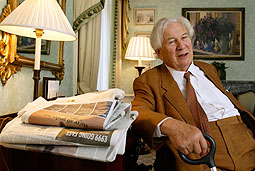
The rule in question? I have always maintained that pictures are better without clutter. I have even written somewhere on the web that anything that doesn’t add to the composition of a photograph detracts from it.

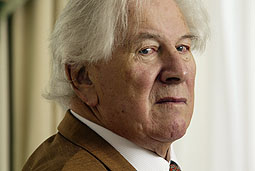
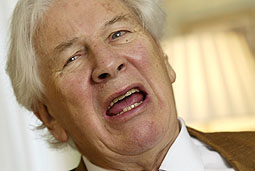
In the case of this set of portraits of the octogenarian actor, Sir Peter Ustinov, the clutter of his hotel suite somehow makes the portrait. For those of who don’t know of the great man – he is an actor, writer, performer, broadcaster and raconteur who has been in the public eye for over sixty years. More importantly, he is someone that I’ve always wanted to photograph.

Just for a change (irony) I was given about twenty minutes in a hotel suite to make this portrait for one of the regular slots in one of our magazines. The good news that shooting for a regular slot is that you know the shape in advance and where any copy or gutters will fall. This slot always uses a horizontal image, but it can be either a half length or a tight image so it’s always best to shoot both. (more…)