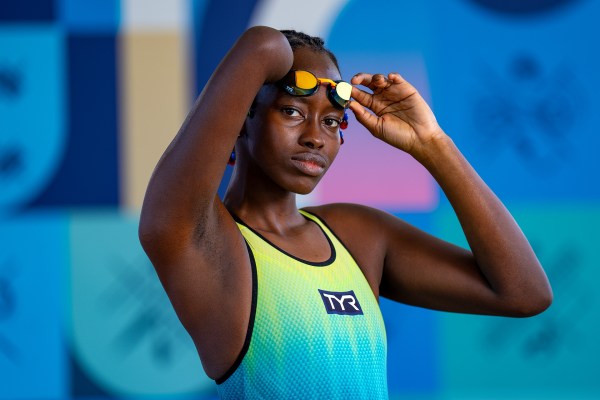
I hope that most people reading this are aware that my photography career has lots of elements to it. I have shot pictures for some 38 years now but for the last ten years I have also worked as an editor on large sports projects with Bob Martin and his team. One of the best parts of that work is going to Olympic and Paralympic events with the Olympic Information Service and this year we went to Paris to provide some coverage of the Paralympics and to work as mentors for eight young photographers. Bob Martin, Joel Marklund and Adrian Dennis did a great job as their photographic mentors and Sammie Thompson, Joe Toth and I guided them through our live workflow giving them a chance to get to grips with working as live editors for a couple of days each as well as sorting out their images. You can see what the team produced here.
My role was very much as one of three editors and so I didn’t take any camera or lighting gear with me. That’s not unusual for one of these gigs but we had a bit of a scheduling conflict and so I got to shoot a set of Para Athlete portraits. Bob Martin had a full set of Profoto battery powered lights and the only spare cameras available (as the loan desks from Canon, Nikon and Sony hadn’t opened yet) were Sony A1s belonging to my colleague Joe Toth. A camera is just a camera and lights are certainly just lights and so we made our way to the Athletes village with a list of people to shoot and the instruction to ‘get it done properly’. I love shooting portraits and so I was actually quite excited by the task but having to shoot with a very unfamiliar Sony and equally unfamiliar Profotos gave it all something of an edge.
Joe and I had an hour to get ourselves ready for the first set of pictures and we ended up using a huge mural underneath a bridge as our backdrop. I had played the previous evening with the Profoto B10 and B10X heads as well as the light modifiers and felt reasonably confident with those. I asked Joe to set the Sony A1 up with a 70-200 f2.8 G lens so that it was as near to what I’m used to as possible and after a few test frames we were off.
The first athlete was the amazing and incredibly cooperative Fleur Jong from the Netherlands who gave us a very generous ten minutes including a change from her tracksuit into competition kit complete with blades. She was followed by another twelve athletes from a range of countries who gave us between three and twenty minutes of their time – fitting us in between a round of interviews with reporters and video crews and their busy pre-games training schedules.
It was fun and we were very glad to be working in the shade on such a sunny summer’s day. So what about the gear?
The Profotos didn’t miss a beat and they were really nice to work with. I wasn’t wild about the way the light modifiers fitted and the speed rings for the soft boxes were something you’d need a lot more practice with before you could start to say that they were as good to use as the heads themselves. The batteries did really well and in all honesty they are easily as good as anything else I have ever used – even my slightly long-in-the-tooth Elinchrom ELBs. Mono bloc heads don’t give you the same option to weight a stand down with the pack that my lights do and adjusting the power on the head when it is at the top of an eight foot stand isn’t as convenient either (and yes, I did have the triggers that have the option to adjust power settings remotely but they weren’t something I had the time to master).
That brings me to shooting with a Sony mirrorless for the first time. In two hours I didn’t get comfortable with the A1. I had an expert on hand to do the set up and so I was saved from the complex menu system. The zoom ring turned the wrong way and I found getting my verticals vertical a bit of an ongoing challenge and so I never got back to close to being comfortable with the ergonomics. I have edited thousands of Sony A1 images as half of the team at Wimbledon this year were shooting with them. I’m equally familiar with just about every Nikon and Canon pro file too and so the image quality was exactly as expected – which for the avoidance of doubt is excellent.
I didn’t come away with a desire to swap all of my Canon kit in for Sony. In fact, on my return home I took delivery of a Canon EOS R5 MkII but that’s a blog post for another day.
 Neil Turner Photographer
Another great and informative blog post. Thank you very much.
Forgive my ignorance. But when I click on the page containing a photos, it has a number followed by the word “assets”. What does this refer to?
LikeLike
Not sure. I can’t replicate the issue
LikeLike