The company that has insured my camera gear for the last eighteen years has just had to pay out for accidental damage for only the second time since I joined them in 2008. When I was looking for a quick phrase about why you need insurance as a creative professional this sentence from their website came up from a Google search:
“Insurance allows you to concentrate on production knowing that your creative assets are protected and you don’t have to worry about the unexpected happening.”
There are plenty of ways to think about equipment and getting some cover for it. A lot has been written on social media in the last few months by my colleagues who have found that some underwriters use some extremely awful and underhand tactics to avoid paying out on what, only a few years ago, would have been cut-and-dried claims for theft. I have no idea what my particular insurer’s angle on theft claims is because I have never made one but, as our American friends say, they are two-for-two on accidental damage.
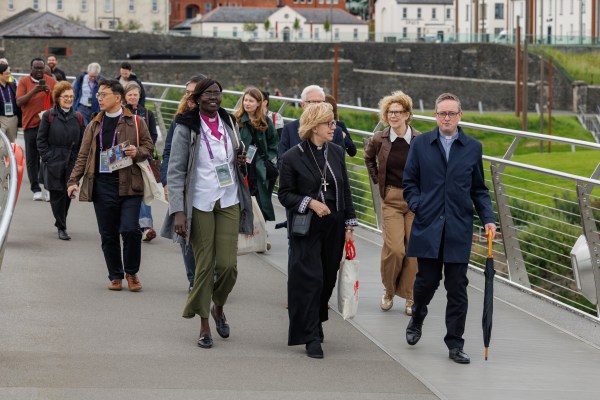
This time around I was photographing a group of delegates to an International Anglican Church conference as they walked across the Peace Bridge in Derry/Londonderry. It was day four of an eight day assignment in Northern Ireland. I was swapping between one Canon EOS R5 MkII with an RF 70-200 f4L lens to a second R5 MkII with an RF 14-35 f4L lens when I dropped the body complete with the longer lens.
Both the body and the lens were damaged to the extent that they were unusable for the remainder of assignment and needed to go to Canon UK for some repairs. That meant shooting the rest of that day with a single body with the 14-35 lens as well as an RF 50mm f1.4 that I had in my rucksack. The rest of my gear, including R6 MkII back up camera body and my RF 24-105 f4L and RF 100-500L lenses along with the other primes were all back in my hotel room in Belfast. I was able to cover the rest of the job with the amount of kit I had but the remainder of that one day away from the capital was decidedly touch and go.
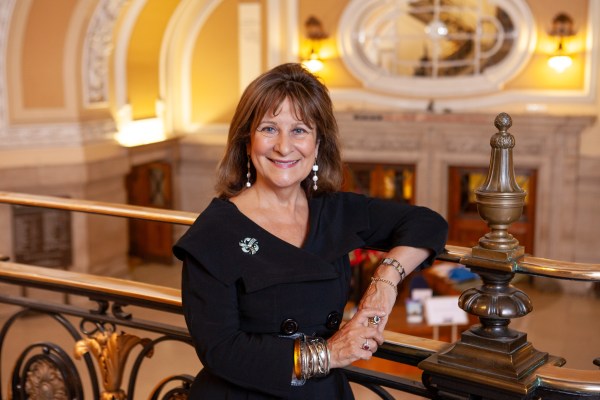
© Photo Neil Turner November 2012
The more observant among you will have noticed that one of the people in the last frame that I shot with the 70-200 (as well as the first subsequent one with the 14-35) was the Archbishop of Canterbury. If I’d needed a witness who saw what had happened I don’t think I could have asked for a better one. The same can be said for the previous time, in November 2012, that I had to make a claim for a dropped camera. That one had been a Canon EOS5D MkII with an EF 16-35 f2.8L lens and the witness would have been Helena Kennedy KC, Baroness Kennedy of The Shaws – the famous Scottish Barrister. Because of the location where I was working I had to shoot her portrait on an EF 24-70 f2.8L lens and the other EOS5D MkII that I had with me. Coincidentally I took delivery of my first EOS5D MkIII a few days later. Happily, neither claim was met with a request for witnesses and both were paid out with little or no hesitation.
All of this leads me to the big question: should professional photographers bother with equipment insurance? Apart from the peace of mind that I find being insured gives me, what about the financial common sense? To answer that self-set question I have spent some time working out how much I have spent on insurance and comparing that with how much I have claimed and it’s quite an interesting answer.
I have averaged everything that I can find out and you also need to remember that equipment costs and insurance premiums have both become considerably more expensive over the eighteen years that I am approximating for. For the avoidance of doubt these are average figures for the years 2008-2026
- Average value of equipment insured: £27,000.00 ex VAT
- Average premiums paid per year: £470.00
- Total premiums paid in 18 years: £8,460.00
- Total amount paid out in claims: £1,870.00
- Average claim value per year: £103.89
- Difference between premium and claims: £6,590.00
£6,590.00 – that’s quite a difference. Of course if my home had been burgled and all of my kit had gone it would be an entirely different story. I have been lucky to have only had two accidents and no thefts (averagely superstitious Englishman rapidly touches a lump of wood to avoid bringing on bad luck). If I had stuck several hundred pounds a year into a savings account and used that money to repair or replace damaged/stolen kit I would be better off.
In 18 years my total premiums have amounted to only 31.33% of the value of the kit. Put another way that averages out to about 1.7% of the gear value each year. I think with that little nugget I will stop quoting statistics. I have enjoyed a great deal of peace of mind and I am, on balance, happy to have been insured but I recognise that many of you will look at this and decide that insuring camera gear isn’t really worthwhile.
Footnotes:
1. I’d like to thank Aaduki Multimedia Insurance for their support and professionalism over the years and the great team at Canon UK and Canon Professional Services for their excellent and speedy repairs to my kit.
2. There’s no real substitute for owning some spare gear – especially if you travel for work as much as I do. Having every focal length between 24mm and 200mm double covered definitely saved my bacon on this trip. Many others were triple covered.
3. One of the many reasons why I swapped using Canon R6 MkII cameras for most of my work to the R5 MkIIs was the ability to copy the settings from one camera to the other quickly and with a memory card. I took this opportunity to set my un-damaged R5 MkII up precisely how I want my cameras and save those settings for posterity both on an old SD card as well as on Dropbox. Getting my repaired (and factory reset) R5 MkII back to exactly how I’d want it took less than two minutes and required not having to sit there comparing sub-menu after sub-menu. Of course Content Transfer Professional sorted out the clocks and base IPTC too.

