Author: dg28

I've been a full-time editorial & corporate photographer since 1986 and I'm still as passionate about the work now as I was then. These days I also write about photography, teach photography and act as a consultant on all things photographic - so, basically, photography is my professional life.

Using a Small Flash 2

I have always been keen on using light in my work as a news photographer, and I have preferred using my Lumedyne kit for a few years now. Having changed over to the EOS1D last month, and being keen on doing things in different ways I have been playing a lot this month with lighting my work with one or more Canon speedlite.

I don’t want to completely alienate the many Nikon users that regularly read these technique pieces, but this example will drift into being a bit Canon specific from time to time. Sorry about that, and I hope that Nikon bring out the kind of kit that allows you to do all of this really soon!

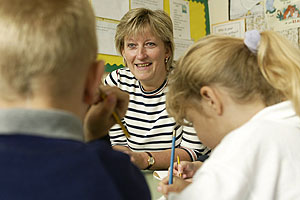
At this time of year I spend a huge amount of my working day in schools – even more than I normally do – and the light in some of them is actually pretty good so it is occasionally possible to get away with the available light or with a small amount of camera mounted fill flash. Unfortunately, the way that I compose a lot of pictures means that on-camera flash is a real nonstarter so I have been experimenting with using Canon 550ex speedlites on Manfrotto stands and triggering them with an ST-E2 transmitter. (more…)

Does Clutter Work?

It has to be one of the most quoted cliches that “rules are made to be broken” and closely following behind it is the notion that something might be the “exception that proves the rule”. I have never been one to avoid a cliche…
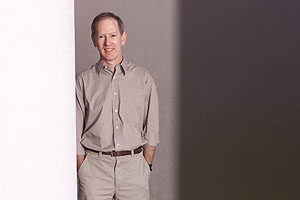
The rule in question? I have always maintained that pictures are better without clutter. I have even written somewhere on the web that anything that doesn’t add to the composition of a photograph detracts from it.

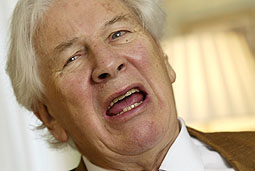
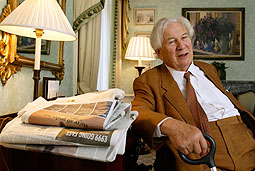
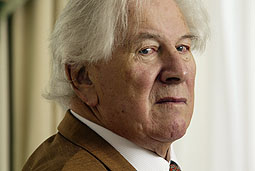
In the case of this set of portraits of the octogenarian actor, Sir Peter Ustinov, the clutter of his hotel suite somehow makes the portrait. For those of who don’t know of the great man – he is an actor, writer, performer, broadcaster and raconteur who has been in the public eye for over sixty years. More importantly, he is someone that I’ve always wanted to photograph.

Just for a change (irony) I was given about twenty minutes in a hotel suite to make this portrait for one of the regular slots in one of our magazines. The good news that shooting for a regular slot is that you know the shape in advance and where any copy or gutters will fall. This slot always uses a horizontal image, but it can be either a half length or a tight image so it’s always best to shoot both. (more…)

Shooting for Composites

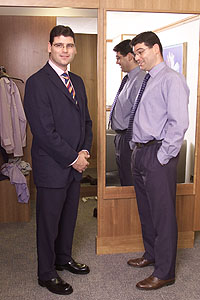
As a good and honest news photographer I would never alter a photograph without clearly announcing in the caption that I had done so – and in capital letters too. This story about two teachers given a makeover so that their appearance at work fitted in with their position was best illustrated with before and after pictures, so why not make it a single image?

The idea was very simple, shoot the same scene twice – once with the subject in the left had half of the frame and once with him in the right hand half. Cut the images in two and join the two halves with him in together without being able to see the join. Simple plan, so many potential pitfalls.

I decided to do it as simply as I could and that meant having a physical line down the image along which to make the join, although the small space gave me a few worries about the patterned carpet. Having planned this idea in advance, I took my Manfrotto tripod with me as well as my usual Lumedyne flash units. I had never met the subjects before, and hadn’t asked the store if they would cooperate with my idea so it could have gone horribly wrong!

One of the great advantages of shooting digitally is that you can show people your ideas as you go, you can involve them in the conspiracy that is a heavily constructed image. My first task was to do some fly on the wall pictures of the subjects choosing some clothes as they walked around the store. I could write an essay on the nightmare that is the wide variety of white balances that can occur within a few feet in a large department store (and maybe I will one day!), but for now lets get back to the story. (more…)

Working With Layouts

Editorial photography, by it’s very nature, involves shooting pictures to work alongside words and working with the layout. The most common request is to allow space within the image to run copy and/or headlines across. This has always been a common request, but with the incursion of design into day to day news pages news photographers are having to shoot with this in mind too.
Just about the easiest way of leaving space in a photograph to run copy over is to have a large area of of plain colour. Obviously plain colours come in, well, every colour under the sun and some work better as a background for copy than others.
The safest bet with magazines and newspapers alike has to be white. It stands to reason that a magazine that has a default black typeface will handle black type on a white background better than anything else. The next most obvious colour is black. Most publications can handle “reversing out” copy in white on a black background, but some have trouble with it and it’s always worth asking before you shoot.

Studio photographers have always been able to give themselves the option of a plain background, but us location chaps have to take what we can get and the story of this picture will, I hope, illustrate the thought process behind giving the layout team as many options as possible. (more…)

Artist Portrait

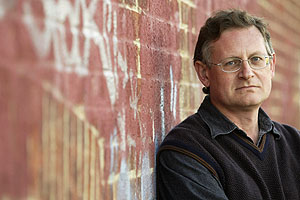
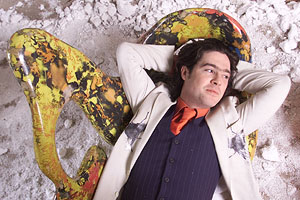
If you ever get the chance to photograph an artist with their work I hope that they are as much fun and as cooperative as Finn Stone. Shooting somebody who is themselves aware of the subtlety of visual imagery means that you can reason with them, explain what you are doing hopefully carry them with you.

I have written on this website and elsewhere about how important it is to formulate your ideas about a portrait before you arrive and to refine/change those ideas very shortly after getting there. The small industrial unit that doubles as this artists studio was covered with bits of crumbled polystyrene (Styrofoam), shreds of fibre glass and paint. The presence of these creates a difficult environment for sensitive camera equipment so it was important to keep everything as far away from them (especially the highly static polystyrene crumbs) as possible.

This photograph was the second idea that I tried during the three quarters of an hour that I spent photographing him. The first was to use the various bits of furniture and sculpture to look through at him and having successfully bagged a selection of images I moved onto this idea. (more…)

Wave That Flag

I used to know my way around a press pen at big events, but I haven’t had much practice recently so when this job came up in the diary I was a little less confident about what I was going to get than I normally am.

The protocol that surrounds official visits by presidents, kings and queens around the world is pretty well defined and sufficiently restrictive that good pictures are pretty common, but great ones are rare indeed. I find the crowds and lesser dignitaries far more interesting subjects than the stars of the show because they are far more excited and far more interested in having their pictures taken anyway.

The average child in the United Kingdom might see the Queen once every twenty years, so even if they are from a non-royalist background the chance to witness a visit will inevitably get them pretty excited. This school group were in place ready for the arrival of the Royal party and the weather wasn’t too good. I was drawn to the colour of the small plastic flags that they had been given and as soon as I looked towards them from the press pen they turned around and started waving the flags. (more…)

The Old Master Look

Every once in a while someone throws down a technical gauntlet and I always find myself picking it up. I like the challenge I suppose, and I’m usually waiting for the challenge to be made. On this occasion it came from left field with no real warning, but a challenge is a challenge….

The students at this acting school had been set a project where they were given a painting and had to reconstruct the scene as precisely as they could at the end of a short drama that they had to write which set the scene. A painting done in Spain by an Englishman a long time ago was the challenge that the students had accepted and they showed off their command of drama and Spanish for my journalist colleague and myself with great professionalism.

Unfortunately their command of lighting was less well developed. The few dim lights that there were mimicked the painting to the human eye but meant an exposure of two seconds at f2.8 (400 ISO) with the camera.
Being the kind of photographer who rarely has an assistant I had come without a tripod, so I was forced to light the scene myself. They had a print of the painting so I had to study it very quickly and make a plan. I have written before about reading other people’s work, but I had never had to do that quite so literally with any other job! The composition was their department so I concentrated on the light making mental notes of it’s direction, colour, contrast and intensity. (more…)

Flash, Camera, Action

Some images are so obviously set up that there is little point in trying to make them seem otherwise. This job was all about a teacher who was in training for the London Marathon and was timed so that the pictures would be shot ready for the story to appear just two days before the event.

The photograph was commissioned by a picture editor who knew the area well, so I had to sure that the location featured in the final image.

Late afternoon is one of my favourite times of day for shooting photographs so I was pleased that the job was booked for about an hour or so before sunset, but less pleased to find out that I wouldn’t be able to make use of that sunset because the teacher had another engagement to make by then.

I picked him up from the school where he works as a modern languages teacher, and by the time I got there he was already changed into his training kit. We drove the mile or so to the shingle beach and I started out shooting some long lens pictures of him running along the crest of the shingle bank. (more…)