Writing a blog for over a quarter of a century means occasionally repeating yourself and/or celebrating anniversaries of things. Back in 2011 a regular follower of my posts used my “Ask Me a Question” link to enquire about what was in my day-to-day camera bag. I duly wrote a post called “In My Camera Bag” in which I listed everything that was in my go-to bag of choice at the time. A couple of Canon EOS5D MkII bodies, two 580ex II flash units and 16-35, 24-70 and 70-200 f2.8 L lenses lived in a LowePro Stealth Reporter 650AW bag along with a Mac laptop and quite a few accessories. That was a heavy bag.
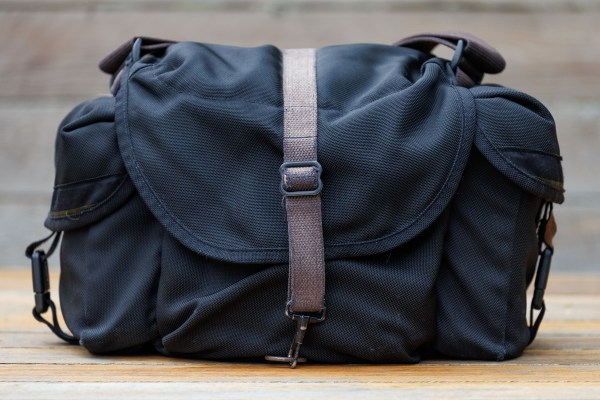
Fast forward seven years to 2018 and my much loved and rather ancient Domke J3 camera bag (pictured above) was filled with two EOS5D MkIV bodies, 16-35, 24-70 and 70-200 f4L lenses with two 600EX RT II flashes. By this time my laptops were carried in a tiny little rucksack because I’d been through some bad experiences with a spinal issue and didn’t necessarily need to carry it all of the time. I’m not sure when I bought the bag but it was well over twenty years ago and when I wrote the 2018 remix version of what I carried in my camera bag of it was already my well-worn favourite.
So, a further seven years on, here are some short updates on a few bits of kit that still spend a considerable amount of time in the same old bag.
- Canon EOS R6 MkII camera bodies
- Canon EOS R5 MkII camera bodies
- Canon RF 14-35 f4L lens
- Canon RF 24-105 f4L lens
- Canon RF 70-200 f4L lens
- Canon RF 100-500 f4.5 – 7.1 L lens
- Canon EL5 Speedlites
- Canon ST-E10 Speedlite transmitters
Out of the two R6 MkII and two R5 MkII bodies there will be a total of two in the bag at any given time. I leave it packed with one of each just in case I get a short notice job and need to run out of the door but I rarely work that way and so I will pack the right bodies for the job before I leave and keep the others in the rolling bag with the rest of the spare kit because not all of it can be accommodated at the same time, and even if it could that would be a seriously heavy bag. Laptops live in small rucksacks or a Think Tank rolling bag depending on what I’m doing. I’m not going to mention the other gear sitting in a cupboard in my office but there are a few camera bodies, a dozen or so lenses and more flash units than any sane person should own. So, if you like the shortened version of the kit review – it goes like this:
Nothing I am going to write about any of the gear is radically different from what I thought when I first owned them so if you have been following this blog for a while you might just want to skip the rest of this post!
Canon EOS R6 MkII camera – When I upgraded to the R6 MkIIs from the R6s I blogged “There wasn’t one thing that made me make the swap – it was a list of little upgrades here and there that made my mind up for me” and I included the small increase in megapixels, the new style hot shoe and access to the ST-E10 trigger, dual pixel RAW and a better FTPS and SFTP system in my reasoning. On the downside I wasn’t so keen on the moving of the on/off switch and the lack of a voice-caption facility on the downside. That was 29 months ago and at one stage I owned three of these bodies which travelled all over the country and to many parts of the world with me.
Not once have they let me down – even in the extreme humidity of Panama and punishing heat in Zanzibar (and several other countries). For the price, I have found them to be amazing little cameras that partner brilliantly with almost all of the range of lenses that I use. I have shot pictures in dark cathedrals at 25,600 ISO with them and been pretty happy with the results. Over time I have got used to the relocated on/off switch but the lack of voice captions and the lack of a lock on the diopter dial still make this camera less than perfect.
The rumour mill has been saying that a MkIII is imminent for almost a year now but it’s hard to see what updates could make it a more interesting proposition other than a swap to the far superior CF Express Type B plus the addition of voice captions and a diopter lock.
Canon EOS R5 MkII camera – I have been using these for a far shorter time, having taken delivery of my first one a mere 11 months ago. They are superb cameras although there’s still no diopter lock (the R1 has it so Canon know how to build one in) and the suggestions I made when I did my “one month in” blog post all still hold true. Surprisingly, when I have used the R6 MkII and an R5 MkII side by side I find myself preferring the mode dial on the cheaper camera to the top LCD screen on the more expensive one. It’s easier to operate with gloves on and I find it easier to read in almost all lighting situations. I suspect that others will disagree with this and so I accept that it’s a quirk of mine.
The latest firmware update has done something that I don’t like with the FTP though. Originally, when you sent a file with an accompanying voice caption, the sound file (.WAV) wouldn’t transmit until the image file was complete. I found that this was a handy way for editors to know they had a complete file before moving, downloading or working on the CR3 or JPG. That has been swapped to sending the sound file first. I am aware that a lot of very important users (wire agencies) prefer this and so it would be a good idea to make this a custom preference rather than swapping everyone over to a different order. I mentioned another custom preference option when I wrote my initial thoughts about this camera and I’d still love to see the ability to “grey out” some menu items such as the self-timer and to disable the stills/video switch because both can be easily activated by accident. (The same goes for all Canon mirrorless cameras by the way).
The image quality is superb right up to 3,200 ISO where it tails off a bit compared to the R1, R3 and R6 MkII but I tend to use the R5 MkIIs for portraits and other jobs where I am either using lights or where the light is good anyway. I also use them with one client who needs voice captions on a regular basis.
Given how good the noise reduction software has become I would probably choose the R5 MkIIs over the R6 MkIIs if I actually had to but my ideal camera is a bit of a hybrid of the two.
Canon RF 14-35 f4L lens – I thought that I had written about this gem of a lens before but, apparently, I hadn’t. I bought it to replace my much loved EF 16-35 f4L when I was swapping over to RF lenses. I almost didn’t bother given the limited use I seem to have of lenses wider than a 24mm but one or two jobs where having the wider option convinced me to make the switch. The RF 14-35 is sharp, relatively lightweight and very usable with good ergonomics and what little distortion it produces is easily sorted by the lens profile for Adobe Camera RAW. I really like this lens and haven’t missed the 16-35 that it replaced.
Canon RF 24-105 f4L lens – It’s hard to explain just how much time this lens spends on my cameras. When I first bought it I would have preferred a 24-70 f4L to directly replace my EF lens. I wasn’t sure about getting a 24-105 at all as I had never liked the EF option with that focal range. For quite a while I struggled with the ergonomics of this lens and never felt that I loved using it. I called it “useful” rather than “must have” but, as time has passed, I have grown to quite like it and appreciate just how much of my work is actually shot with it. It makes a perfect partner for the RF 100-500 as well as the 70-200. If Canon did bring out an RF 24-70 f4L I would definitely think about swapping as long as it was a fair bit lighter because I like lens and camera combinations to balance and the RF 24-105 f4L isn’t a great match for the R6 MkII when that is the main criteria by which you are making a judgement.
Canon RF 70-200 f4L lens – Small, lightweight, great contrast and sharp. What more could you ask for from a lens that spends an awful lot of time attached to one of your cameras? When I made the switch to f4 zooms back in 2015 I was worried about losing the whole stop between f2.8 and f4 and so I have kept an f2.8L option. When I say kept, I have two 70-200 f2.8L lenses in the cupboard that don’t see the light of day because this tiny RF option and its predecessor EF one are just perfect for the way that I work. I haven’t written a blog specifically about this lens but I have mentioned it several times as I have documented my mirrorless journey.
Canon RF 100-500 f4.5 – 7.1 L lens – Where do I start to sum up what I originally suggested was the “ultimate compromise lens”? I wrote that when I talked about buying it a little over 14 months ago. I go through phases of using it on an almost daily basis and then having it sit in the back-up kit case for weeks at a time. Nothing about my opinion on the lens has changed in over a year of use. I’m still not 100% comfortable with the variable maximum aperture and I still find the lack of a lock on the zoom ring annoying because the variable tension option doesn’t go as far as being able to lock it and I am not keen on walking around with the neck of the barrel sticking out as the camera and lens swing on my shoulder. Used on a decent monopod the balance is great, even with a camera as small as the R6 MkII. This lens almost demands a MkII version with the little kinks ironed out.
Canon EL5 Speedlite – Of all of the bits of kit I’m mentioning in this posting my opinion about this flash unit varies the most. Originally I was unimpressed but the recycle times and the build quality made up for the lack of accessories or even a charger for the superb LP-EL battery. I’ve been using a pair of these since January 2024 (22 months) and I still like them. My biggest issue with them, once I got over the lack of a charger, is the lack of accessories for them. The old 600 exII RT and the top-of-the-range EL1 came with a set of clip on caps which either diffused the light or shifted the colour towards either warm or full tungsten. The price of the EL5 probably makes including these options a bit tricky but the lack of anything sold by Canon or from third party suppliers to make up for the shortfall has become something that bugs me a bit. This is a great bit of compromise gear (there’s that work again) but I’d like to see an accessory kit available for it.
Canon ST-E10 Speedlite transmitter – I have gone on about this brilliant little accessory so many times that I have become the world’s only ST-E10 bore. Put bluntly, it’s my favourite small accessory that any camera manufacturer or third party supplier has ever made. As part of my initial thoughts about the R6 MkII I waxed lyrical about the ST-E10 saying the following “If you haven’t seen one yet then there’s a picture below. It doesn’t need any batteries and the menu shows up on the camera’s rear screen instead of on a tiny LCD so instead of pressing tiny buttons with inelegant fingers you get to use the controls on the camera instead. It has great range (Canon claim up to 30 metres and I have successfully used it at about 12 in a real world setting) and it is really well thought out. So far it only works with the cameras that have the new smart hot shoe (so the R3 and anything newer) and works with EL flashes as well as those with the letters RT in the model name. I’ve been using it with my trusty 600ex RTII Speedlites and it really hasn’t missed a beat.” I still think that they (I have three) are great and have recommended them to many colleagues.

Mentions in dispatches – that’s all of the major bits of kit but there are a few other things in the bag that I’d like to comment on. The first is Canon’s latest LP-E6 battery, the LP-E6P. It has a lot more staying power than any of the previous iterations of the LP-E6 and, although it was designed for the R5 MkII, it does a great job in the R6 MkII as well. I regularly buy and try third party battery options in the hope that someone has made something more cost-effective than the genuine Canon batteries but it never seems to happen. I’d like to mention Think Tank memory card and battery wallets and camera straps. They make my life just that little bit easier and would highly recommend them alongside their super-tough rolling bags and rucksack bags (of which combined I have six). Finally I have come to trust and exclusively use Sandisk memory cards. SD in the R6 MkIIs and a combination of SD and CF Express B in the R5 MkIIs.
Having the latest and greatest gear doesn’t make you a great photographer but having the right kit for the work that you do really helps.
 Neil Turner Photographer