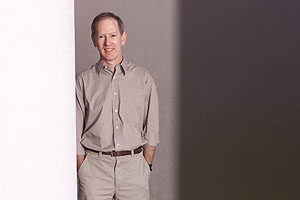
 Editorial photography, by it’s very nature, involves shooting pictures to work alongside words and working with the layout. The most common request is to allow space within the image to run copy and/or headlines across. This has always been a common request, but with the incursion of design into day to day news pages news photographers are having to shoot with this in mind too.
Just about the easiest way of leaving space in a photograph to run copy over is to have a large area of of plain colour. Obviously plain colours come in, well, every colour under the sun and some work better as a background for copy than others.
The safest bet with magazines and newspapers alike has to be white. It stands to reason that a magazine that has a default black typeface will handle black type on a white background better than anything else. The next most obvious colour is black. Most publications can handle “reversing out” copy in white on a black background, but some have trouble with it and it’s always worth asking before you shoot.
Studio photographers have always been able to give themselves the option of a plain background, but us location chaps have to take what we can get and the story of this picture will, I hope, illustrate the thought process behind giving the layout team as many options as possible. (more…)
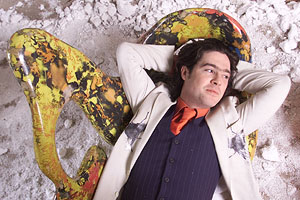 If you ever get the chance to photograph an artist with their work I hope that they are as much fun and as cooperative as Finn Stone. Shooting somebody who is themselves aware of the subtlety of visual imagery means that you can reason with them, explain what you are doing hopefully carry them with you.
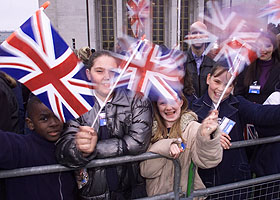 I used to know my way around a press pen at big events, but I haven’t had much practice recently so when this job came up in the diary I was a little less confident about what I was going to get than I normally am.
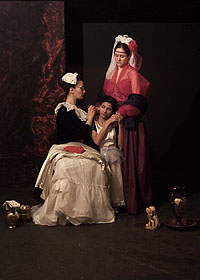 Every once in a while someone throws down a technical gauntlet and I always find myself picking it up. I like the challenge I suppose, and I’m usually waiting for the challenge to be made. On this occasion it came from left field with no real warning, but a challenge is a challenge….
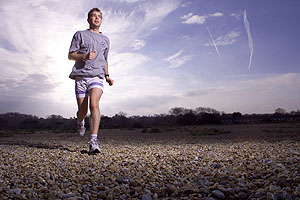 Some images are so obviously set up that there is little point in trying to make them seem otherwise. This job was all about a teacher who was in training for the London Marathon and was timed so that the pictures would be shot ready for the story to appear just two days before the event.
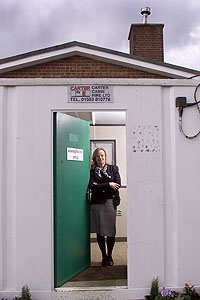 In a very similar vein to last month’s technique page I am going to talk about this portrait of a school head teacher that required a fair bit of messing around to get it right. It seems to me sometimes that the further you get the flash away from the camera, the more interesting the result!
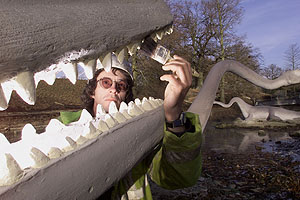 I get a sore throat telling people that flash isn’t just a way of lighting the whole scene. It can, if used properly, pick out a small detail and give it real emphasis. Studio photographers and cinematographers have always known this, so it’s time that us little guys adopt the technique for ourselves. Taking a flash unit off of the camera for the first time is both a frightening and a liberating experience. When that little cartoon lightbulb goes on just above your head you instantly become a better photographer. You might not use the technique, but you know about it and therefore have it as part of your arsenal.
 It is regularly the case that the simplest looking image actually requires a lot of thought, mental arithmetic and good old fashioned compromise. This picture has a number of compromises.
 Neil Turner Photographer