opinion

The 11″ Apple MacBook Air

A couple of weeks ago I took the plunge and bought a new laptop. I have been looking at small lightweight notebooks for quite a while and I have been trying to work out out whether the iPad or any of the other tablets would be OK for the work that I do. You see, I am getting a little bit older and I want to carry less weight – partly because I seem to be getting on and off of planes a lot more and partly because I would like to use trains instead of automatically driving everywhere.

Until very recently nobody made the right piece of kit. Apple have been promising to come close with the first and second generation MacBook Air models as well as the 13″ MacBook Pro but, somehow, none of their kit has quite got it right. I have looked at Windows notebook and sub-notebook models from a range of manufacturers and both HP and Sony have come close.

Then along came the third generation Apple MacBook Air and I am delighted by the 11″ model that I now own. I bought an i5 powered model with 4Gb of RAM and a 128Gb SSD drive and I am blown away by the performance – even compared to my 2010 15” MacBook Pro with an i5 processor and 8Gb of RAM.

When I got the new Air I posted on a Facebook group that I would report back about it. Two weeks later and having done a few jobs with it I thought that it was time to post my opening thoughts about it. It came with OSX Lion loaded which threatened to present a few compatibility issues with older versions of applications. Indeed, my main workhorse application Photo Mechanic was being reported as having one or two issues with slide shows. Two days after getting the Air Camera Bits released a Beta version of the software designed for OSX Lion and I have been using it ever since. In fact the second Beta is now loaded and it all seems to be going swimmingly. Issue number one sorted.

Issue number two concerned the software that controlled the two 3G USDPA mobile broadband dongles that I rely on when I am on the road. The 3 network posted an update for their drivers within a day or two and so I was left waiting for Vodafone to follow suit. It wasn’t a deal-breaker though because I have a Mifi unit for the Vodafone network and the new Air seems to work flawlessly with that. A few days ago a fellow Apple enthusiast and Vodafone customer Edmond Terakopian noticed that Vodafone had quietly put an update on their website and that meant that issue number two was sorted as well.

Issue number three was to do with loading Apple’s own Final Cut Express. It just would not load onto the MacBook Air and work. The first attempt to load it ended with having software in the Apps folder that wouldn’t open without getting a compatibility error message and the second attempt left me without even that. I searched some forums looking for the answer and the Apple community finally pointed me in the direction of an upgrade to Apple’s plug-in manager which let issue number three finally sorted.

What happened next is still a mystery. It seems as if getting Final Cut Express working stopped Aperture from functioning. Every time I try to launch Aperture I get an error message telling me to check with the developer to see if the version of Aperture is compatible with the latest OSX. Well, as far as I know I have the latest version having downloaded it from the App Store. Issue number four is most definitely NOT sorted!

That’s enough of problems – what about the good stuff? Well, the Air is small and light and pretty quick considering the specification. It runs my basic applications (Photo Mechanic, Photoshop CS5 for Adobe Camera RAW and Transmit) very well and the gloss screen is far less of an issue than I feared it might be. The lack of a Firewire 800 port means that my workflow has had to change a little – I am not ingesting everything as a matter of course on this laptop. Instead I am using the UDMA enabled Lexar USB card reader to do a rapid initial edit and only import the pictures that have a chance of making it into the edit – cutting a stage out of my usual workflow.

Someone, somewhere wrote that the best camera is the one that you have with you and with the MacBook Air that same description will be applied to laptops. So many times in the past I have left my laptops in the car or at home because they are heavy enough to notice. Even with the small power supply I would be happy to carry the Air almost all of the time.

The big bonus, apart from the size and weight of the MacBook Air is its solid state hard drive – which is a revelation. To say that it is fast to boot would be an understatement. To say that it is quick to perform it’s tasks would be to equally shortchange it’s efficiency. I hope that I will always get SSDs from now on, they make all sorts of sense and they are tougher, quieter and see to produce a lot less heat. Finally, a laptop you can use on your lap without getting second degree burns! This new MacBook Air is as quick as my seemingly far better specified MacBook Pro. It weighs very little, has excellent battery life and stays cool.

Given the choice between buying either a MacBook Pro OR a MacBook Air I would probably say that a Pro with a SSD would be the best option if it is your only computer. I am lucky, the Air isn’t my only computer and it isn’t crammed full of Apps that I use twice a month so it is running sweetly and I love it.

Insurance fine print for photographers

Yesterday morning I received a renewal reminder from the company that insures my camera gear. Twenty minutes later I read a posting on a photographers’ discussion forum warning that some of the companies who offer specialist cover for press photographers equipment were saying that they were not going to pay out for equipment stolen, lost or damaged during the recent civil disturbances in London. I put on my “Vice Chairman of The BPPA” hat and got straight on the phone to the company that the association recommends to it’s members.

I had a long conversation with one of the directors of this major camera and public liabilities insurance brokerage regarding their position on claims from photographers who had equipment damaged or stolen during the recent violence.

He explained that they placed business with three separate insurance underwriters and that they were attempting to get a statement agreed by all three so that they could let us know what the definitive position was. As this was being negotiated, the Prime Minister was speaking during the emergency debate in the House of Commons. David Cameron mention the word ‘riot’ and said that there would be payments made under the 1886 Riot (Damages) Act. This led two of the underwriters to pull back from agreeing the statement until they could get clarification about the limitations of where and how the 1886 Act would be applied.

The insurance broker’s own interpretation of the Act says that at no time was a ‘riot’ declared and therefore they couldn’t see how payments under it could be expected. This left them having to make the decision to press the underwriters for their interpretations of the situation but the Association of British Insurers have not issued their guidance yet and therefore none of the insurance companies are prepared to stick their necks out either. I mentioned that one of the other brokers had told a photographer that their claim would be paid. He was surprised by this given that none of the London underwriters had made a decision yet.

We went on to talk about the cost of policies where full riot cover would be included and his estimate was that the current policies costing between 2% and 3% of the value of the kit insured would rise to between 15% and 20% and possibly more. He said that they would be happy to find any deals out there but that the existence of the 1886 Riot Act would remain a complicating factor.

This got me thinking about the other insurance policies that I have to cover me and my business and, as I had just renewed my policy, I thought that I’d check my car insurance. On first reading I couldn’t find anything that mentioned driving to or parking at a scene of civil disturbance but then I saw a catch all phrase about “knowingly placing the vehicle and/or it’s contents at risk”. A quick phone call later and I could see that driving to a riot for work would be a bad idea because my car insurers would not pay out if there was any damage or if the car were stolen. If a riot happened in my street or in a place where I had been on other business that would be OK – it’s the “knowingly” bit that would be an issue.

Next on my list was my own personal cover and, once again, I asked for clarification to be told that deliberately seeking out disorder would invalidate my cover. It was with a heavy heart and a sense of inevitability that my “all risks, business and domestic” travel insurance turned out to be a “not quite all risks” policy.

The moral of the story is simple: Do not assume that you are covered to do your job if that job takes you into harm’s way because it is very likely that neither you or your possessions are.

Social networking. Is it working?

I’ve been to seminars and I’ve read the opinions of experts. I’ve been to workshops and I have wasted time listening to gossip – and I still don’t really have a grasp of how I should be doing social media. I’m on Twitter and I am on Facebook but the one that I have put the most effort into is LinkedIn. Of course I could have been fooled by the ‘professional’ and ‘business’ tags that get applied to that particular on line network but, hallelujah, it has actually paid off and brought some work in. Great news, but then so has Twitter.

I’ve had a website – this website – for almost twelve years now and so I guess that you could say that I completely ‘get’ the need to be on line. On top of ‘getting it’ I also enjoy it and the ease with which we can all share information and network is amazing but I am finding it hard to break out of my comfort zone – talking with photographers about photography.

Where I need to concentrate my effort is in marketing myself to existing and potential customers but that’s the part of the business that I don’t enjoy. Spending a morning ringing Art Directors, Picture Editors and other buyers trying to get to see them with a portfolio used to be something that I endured because I always loved the bit that (hopefully) came next – meeting people, talking to them and showing them my work. These days the return on time invested in making calls is very poor. Eight calls this morning and nothing. Nobody wants to see my work.

There was a time when I thought that emailing people would work – based on the fact that just after I turned freelance again in 2008 I sent out twenty emails to potential customers and got six replies, three portfolio viewings and a good number of commissions. That day must have been a fluke because it has never worked again since.

Recently I have tried local business networking groups and one industry specific networking group. I met a lot of people, handed out a lot of business cards and it looks as if there will be some work coming from it.

So, back to the social media thing: I still have high hopes for it. I have started getting and giving recommendations on LinkedIn and I have started to join non-photographer discussion groups. My tweets are getting better and I seem to be getting more followers. I am a professional and I always advocate that people use a professional so that’s my next step. I’m going to get a pro’ in to sort out my on line profile so watch this space – and the many other spaces that I virtually hang-out in

Twenty years ago… TODAY

Whilst memory lane is the venue I thought that I’d add this photograph of the former British Prime Minister, John Major along with his cabinet colleagues Kenneth Clarke and Michael Howard taken on the 20th of May 1991. This isn’t a particularly interesting picture except that it is from the set that became the very first ever colour front page on the Times Educational Supplement. This was almost three years before I actually joined the paper on the staff but it has always been a matter of pride that I was the one who shot the picture that changed the paper for ever.

John Major with members of his cabinet. ©Neil Turner, May 1991

This picture was at the press conference where John Major and his Government launched their new policy for post sixteen education. It wasn’t that long after Mr Major had taken over from Margaret Thatcher as Prime Minister and press photographers were still trying to get the hang of the new man and his rather relaxed style. It’s amazing to think that the man in the foreground (Ken Clarke) is once again a member of the government all of these years later and still clearly loving the cut and thrust of political life.

When we first started to shoot colour for the paper we just adapted the way that we already shot pictures for a variety of news magazines – on colour transparency stock. It was always funny to be rubbing shoulders with other photographers, almost all of whom were shooting fast black and white film, and having to get good pictures in often poor light with either 100 ISO Fuji RDP transparency film or Kodak’s rather good 160 ISO tungsten balanced slide film. This one was shot on the Kodak tungsten film pushed one f-stop to 320 ISO – which was about as high as you could go without getting washed up pictures. Back in the day the transparency would have been scanned by an expert on a very expensive drum scanner and the separate plates for the pages would have been made by other technicians. How things have changed.

London had a couple of very good 24 hour labs in those days and shooting transparency was, in a lot of ways, pretty relaxing once you had got the exposure correct. All you had to do was drop off the film, go and have a cup of coffee and pick up your processed images about an hour and a half later. The TES offices were very close to my favourite lab – Metro – and so you could either let the paper collect your film or go along yourself and do an edit before they saw them.

I have been filing some old pictures and found this one completely by chance twenty years down the line. I guess that my journey down memory lane is still going on!

1995 author portraits with new gear

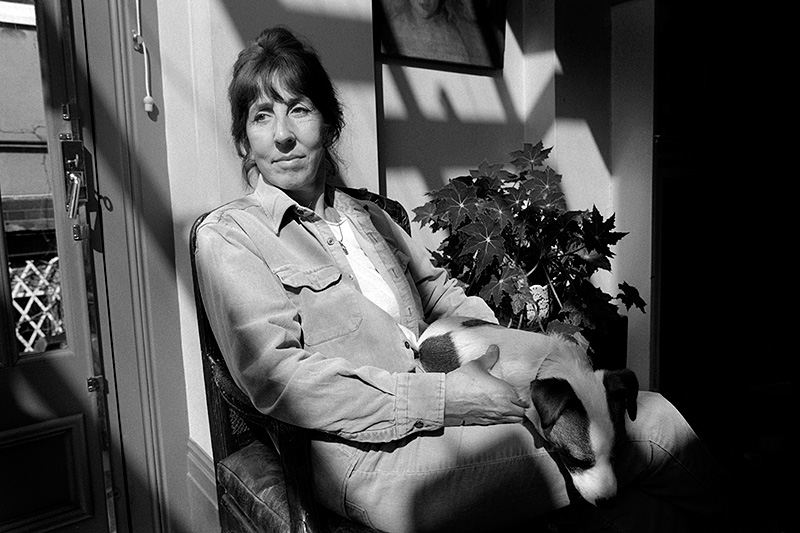
It’s funny how you remember pictures that you have taken. I was rummaging through a box of Kodak Photo CDs that were in my loft and found a set of portraits of the wonderful children’s illustrator and author Helen Oxenberry that I took in March 1995 for The Times Educational Supplement. The pictures were taken during a period where I seemed to be photographing the entire back catalogue of authors and illustrators whose work was aimed at children and there are four things that I distinctly remember about these particular portraits.

Helen Oxenberry with her dog, ©Neil Turner, March 1995

The first thing that I remember is that this was the first live job that I shot using Canon cameras. A few days before, I had taken delivery of a box full with 2 shiny new EOS1N bodies, a 28-70 f2.8L, a 20mm f2.8 USM and a 300mm f2.8L as well as two 540EZ flash units and a lot of other bits and pieces. The 70-200 f2.8L that we had ordered arrived a day or so after this shoot.

The excitement and mild terror of shooting with brand new gear that I had only tried out for the first time over the weekend was very real and so I also took along a Leica M6 with a 35mm f2 lens and a roll of Ilford XP2 black and white film that I had half used on another author portrait the previous week. The picture that you see above is a scan of the negative, made using an automated Kodak scanner that was set up for scanning colour negative film but I quite like the quality that this print-free process gave me.

Helen Oxenberry at her home. ©Neil Turner, March 1995

The second thing that I remember about this job was that she was a really lovely lady and that she made good coffee. When I arrived she was very apologetic that she had forgot to tell my Picture Editor that she lived in one of London’s more vicious residents’ parking permit areas and that there weren’t any public spaces nearby. I smiled and told her that I only lived 100 metres away and had the right permit, which seemed to confuse her – I imagine that she was trying to work out how a photographer could possibly afford Hampstead!

My third memory was that just after leaving I turned the radio on in the car and there was a programme about children’s literature where another author called Michael Rosen was talking about Helen Oxenberry. The phone rang and it was the Picture Editor telling me that I was going to photograph an author called Michael Rosen the next day!

The fourth and final memory was going back to Helen Oxenberry’s house about a month later to photograph her husband – another brilliant illustrator and author called John Burningham who went on to apologise for the lack of parking…

Another old picture from the loft

©Neil Turner, October 1988

I keep on finding old pictures that I want to talk about so if you are bored by this stuff – I apologise. I have started getting my loft ready for some 21st century insulation and that means getting every last box and filing cabinet out… and of course that means having a peak in them as you go.

The two piers in my home town of Bournemouth have played a huge part in my life and in my photography. My family spent a huge amount of time during the summer months on the beach and I used to play the arcades with my pocket money when Boscombe Pier had a building on the end which housed all manner of slot machines and one-armed bandits.

This picture is, I guess, street photography but on a pier. It was taken on the day that I first used a truly wide angle lens on a Leica M6 – the 28mm f2.8. I would guess that it was October 1988 and I spent a lot of time wandering around just shooting for the fun of it. The roll of Tri-X film that this frame is on holds a wide variety of pictures but this has always been my favourite. The shot has no big meaning – just a pensioner enjoying the late afternoon sunshine but it never fails to make me smile.

Testing a new camera bag

Much has been written about the shared fetish of professional photographers for equipment and their passion for finding the ever elusive perfect camera bag. We all know that its a myth, yet we all keep on plugging away buying new bag after new bag in the hope that we will somehow stumble upon THE ONE – the bag that is lightweight but protective, small but takes a huge amount of kit, good looking without attracting the wrong kind of attention. Recently I was offered the chance to try out an interesting new bag without laying out the cash first…

©Neil Turner, April 2011

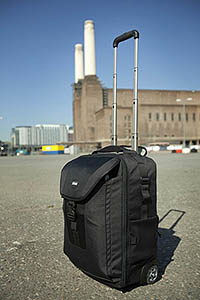
I had responded to a blog posting on another photographer’s website about bags, back pain and my lack of experience with either rucksack or rolling bags when I got an email from the Think Tank team offering me the chance to try out their Airport Take Off which has wheels and back pack straps. I have looked at the Think Tank gear many times since it came onto the market and, to be honest, the only thing that has stopped me investing in one was failing to decide between back pack and rolling models.

These bags come with a curiously compelling life size poster of a couple of sample layouts of gear. One side shows some Canon kit packed into the main compartment and the other shows a set of very impressive Nikon gear. I spent almost two hours packing and re-packing my Canon gear until I was happy and I was amused that my configuration was nothing like either of the two samples. That doesn’t matter the “serving suggestion” poster helped me to work out my own system a lot quicker that I would otherwise have done – it’s only a detail, but its a nice touch.

The following day I went off for the very first time as a photographer with a rolling bag. The job was at London’s Battersea Power Station and it was the launch of a new video game called DiRT3 and the pictures were going to be of a couple of top class drivers doing some fast action slides, drifts and turns around the place. It was a very hot day (well, by London in April standards) and the amount of dust that the event promised to create was going to test everything.

There were photographers and film crews everywhere and, as an aside, I have never seen so many Canon DSLRs in one place being used to shoot video.

The 200 metre walk from the car park to the press area was easy enough and I started to work from the bag. I had 3 camera bodies, 4 lenses, 2 flash units, a MacBook Pro laptop and all of the bits and pieces that you would imagine needed packed into the bag and I found it surprisingly easy to work with the bag and a belt pack. I kept the Think Tank zipped up when I wasn’t accessing it and my prediction of much dust came true. There was not a speck of dust in the bag after an hour so I didn’t bother using the rain cover, which I would have done if I had been worried about dust getting in.

I was at the job for well over 8 hours and my back didn’t complain once. I was editing in the shade of a Ford tent quite a lot of the time and I even used the Airport Take Off as a seat for a while. To cut a very long story short, the bag passed the test with flying colours and it worked superbly well as a rolling bag on day one.

Day two was a shoot on a beach so sand rather than dust was one issue and the need to use the bag as a back pack rather than relying on the wheels was the other. It was a reasonably straightforward portrait and the bag again performed very well. I was dipping in and out a lot more on this shoot and keeping the bag zipped up wasn’t really possible. I would have used a top opening shoulder bag for this shoot in the past and, on balance, the top opening bag would have been easier to work out of. This is the compromise. This bag is easy to carry, easier to roll and in terms of getting to and from the job is far and away the best bag that I have ever used. On the first job where I was working with cameras over shoulders all day I didn’t miss the traditional bag style but on job two I did miss it a little.

I’m still deciding whether the ease of transportation outweighs the slight inconvenience of working from the bag and I suspect that the answer will be that it depends on what I’m doing that day. On the two other occasions that I used the Airport Take Off with camera gear in it the ease of transportation won rather easily, so it was 3-1 to the Think Tank rolling back pack.

Camera gear layout (left), Elinchrom Ranger Quadra layout (right) ©Neil Turner, April 2011

I think that by this stage I had made my mind up that the Airport Take Off is a great bag for carrying camera gear so I decided to see what it was like with my standard lighting kit in it. That consists of an Elinchrom Ranger Quadra pack, two heads, spare battery, triggers, charger, cables and various accessories. The bag swallowed the kit with plenty of room to spare and I almost managed to fit a second Quadra pack in too. With two packs it was heavy and, to be truthful, I rarely work with two packs anyway. This configuration is SUPERB. From the first minute of the first day I knew that I had found a new way to carry my lighting kit. It packs in easily, you can get it out quickly and the system that Think Tank supply for attaching a tripod doubles very well as a way of attaching a stand bag with two Manfrotto medium weight stands and a good sized soft box – and that’s without using the front pocket which is designed for a laptop.

Yesterday I went out with the bag fully loaded with lighting kit, with my MacBook Pro in the front pocket and a Domke J3 camera bag with two bodies, two lenses and a Speedlight resting on top as I rolled the bag to my destination. I can see that this is how I’m going to roll from now on (apologies for the pun) for a big percentage of my jobs.

I haven’t had the bag for long enough to have tested its durability. There are a few bits that I will be watching such as the folding handle and the plastic pouches on the inside of the lid (which now hold AA batteries, a flash meter and plenty of coloured gels). The handle is a miracle of engineering but I worry that it may not be as durable as the rest of the bag. Having said this, and knowing that the people behind the company are working photographers, I’m not put off at all. A little over a week in and I’m as happy as I have ever been with a bag – the fact that I’m likely to use it for a purpose that I hadn’t intended is a mere side issue!

Pier divers in Bournemouth

Several (actually all) of my recent blog postings have been about old pictures that I have found lying around or in searches for something else and why they are important to me. The latest one shows some young guys diving of of Bournemouth Pier in the early 1990s and it was part of a set that I did for a trades union magazine. The commission was as simple as it was vague – to produce images of the seafront at Bournemouth that could be used in a preview of the union’s annual conference that was being held in the town.

Bournemouth Pier divers. ©Neil Turner, June 1992

Commissions in those days always attracted expenses and that invariably included the cost of film and processing. The job was only a half-day but what a beautiful half day it was. The sun shone, the beaches were packed and nobody seemed to mind me wandering over and shooting their picture. The people diving from the pier made some great pictures but the dangerous nature of what they were doing meant that the client didn’t even want to consider them.

Shooting slide film in those days carried certain risks, not the least of which was that there was only one original. If that got lost or if the client decided to hold on to it there was nothing that could be done about it. Affordable scanners didn’t really exist and getting duplicate transparencies made was very expensive. These days we can just keep as many copies as we have hard drives and in the days of black and white it was always easy enough to knock out an extra print but there was that scary and even precarious time where you had to get the exposure spot on, hope that the film was processed correctly and that the couriers wouldn’t lose the package containing your work. It is quite amusing to think that “fast turnaround” was measured in hours and the three days or so that it would have taken me to get these images from the camera to the client would have seemed eminently reasonable.

How times have changed!

I’ve always liked this picture. It was shot on a Nikon F4S camera with a 24mm f2 Nikkor using Fuji RDP100 transparency film