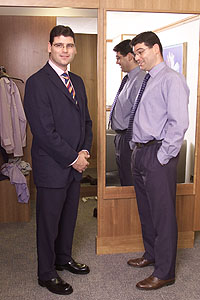
As a good and honest news photographer I would never alter a photograph without clearly announcing in the caption that I had done so – and in capital letters too. This story about two teachers given a makeover so that their appearance at work fitted in with their position was best illustrated with before and after pictures, so why not make it a single image?
The idea was very simple, shoot the same scene twice – once with the subject in the left had half of the frame and once with him in the right hand half. Cut the images in two and join the two halves with him in together without being able to see the join. Simple plan, so many potential pitfalls.
I decided to do it as simply as I could and that meant having a physical line down the image along which to make the join, although the small space gave me a few worries about the patterned carpet. Having planned this idea in advance, I took my Manfrotto tripod with me as well as my usual Lumedyne flash units. I had never met the subjects before, and hadn’t asked the store if they would cooperate with my idea so it could have gone horribly wrong!
One of the great advantages of shooting digitally is that you can show people your ideas as you go, you can involve them in the conspiracy that is a heavily constructed image. My first task was to do some fly on the wall pictures of the subjects choosing some clothes as they walked around the store. I could write an essay on the nightmare that is the wide variety of white balances that can occur within a few feet in a large department store (and maybe I will one day!), but for now lets get back to the story. (more…)
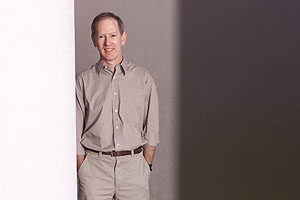 Editorial photography, by it’s very nature, involves shooting pictures to work alongside words and working with the layout. The most common request is to allow space within the image to run copy and/or headlines across. This has always been a common request, but with the incursion of design into day to day news pages news photographers are having to shoot with this in mind too.
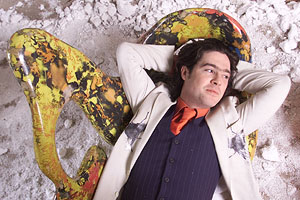 If you ever get the chance to photograph an artist with their work I hope that they are as much fun and as cooperative as Finn Stone. Shooting somebody who is themselves aware of the subtlety of visual imagery means that you can reason with them, explain what you are doing hopefully carry them with you.
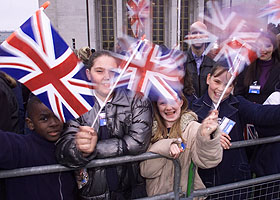 I used to know my way around a press pen at big events, but I haven’t had much practice recently so when this job came up in the diary I was a little less confident about what I was going to get than I normally am.
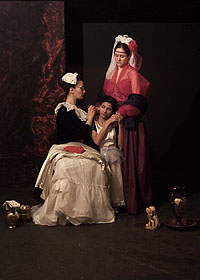 Every once in a while someone throws down a technical gauntlet and I always find myself picking it up. I like the challenge I suppose, and I’m usually waiting for the challenge to be made. On this occasion it came from left field with no real warning, but a challenge is a challenge….
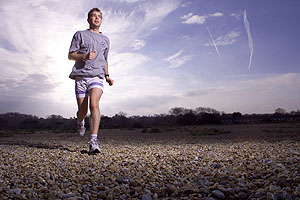 Some images are so obviously set up that there is little point in trying to make them seem otherwise. This job was all about a teacher who was in training for the London Marathon and was timed so that the pictures would be shot ready for the story to appear just two days before the event.
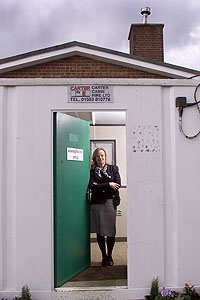 In a very similar vein to last month’s technique page I am going to talk about this portrait of a school head teacher that required a fair bit of messing around to get it right. It seems to me sometimes that the further you get the flash away from the camera, the more interesting the result!
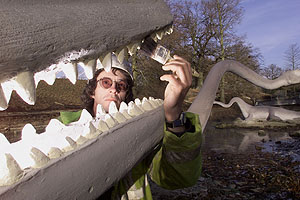 I get a sore throat telling people that flash isn’t just a way of lighting the whole scene. It can, if used properly, pick out a small detail and give it real emphasis. Studio photographers and cinematographers have always known this, so it’s time that us little guys adopt the technique for ourselves. Taking a flash unit off of the camera for the first time is both a frightening and a liberating experience. When that little cartoon lightbulb goes on just above your head you instantly become a better photographer. You might not use the technique, but you know about it and therefore have it as part of your arsenal.
 Neil Turner Photographer