portrait

Owning up to some bad habits

“It’s all about light”. That’s a message that I hope everyone who visited the technique pages on my web site will take away. When you are the one who controls that light, you have a large number of options open to you. This month I have been trying a new toy and I thought that I’d use that as an excuse to write about how and why I choose the quality of the light.

©Neil Turner/TSL | London | December 2004

The first thing I have to do is own up to some fairly bad habits:

The first is that I go through personal fashions in the way I light and in the kit that I carry with me. One month I’ll use softboxes and then the next month I’ll use umbrellas. One week I will keep the flash as only one element of the scene and the next the flash will overwhelm the ambient light.

My second bad habit is that I will light women in a different way to men. 99% of the time I will use a much softer set up for female subjects than I would for males.

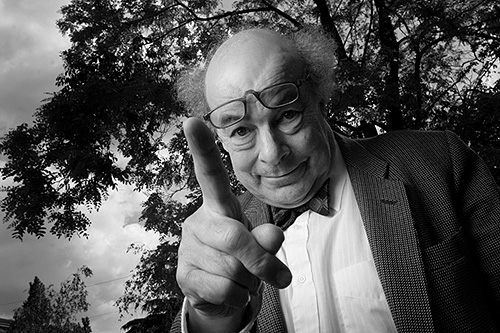
Thirdly, I’m aware that I tend to use a harder light on older skin (especially men). Older people seem to have a lot less moisture in their skin and so their faces have a lot less shine.

I’m much more likely to direct a spectacles wearer about the angle of their head, simply to avoid getting bad reflections in their glasses. I also try to find out if people wear contact lenses and get them to look more squarely at me to avoid getting any strange shapes in their eyes.

So far I’m painting myself as a bit of a lazy photographer. I like to think that it’s not laziness – more a realistic attitude towards getting the shot right. When you are shooting people, you often end up shooting a very different picture than the one that you first envisaged so my bad habits are there to simply give me an easy starting point. Getting on with the shoot is part of my style. I rarely spend very much time wandering around formulating ideas, largely because I am regularly expected to set up, shoot and break down in a matter of minutes. Having the “safe shot” in the bag is something of a religion to me and I find that giving in to my “bad habits” makes my practice a lot easier.

Many photographers use the same technique day in and day out. I cannot claim to do everything differently every day, and sometimes I feel like a chef who has a limited range of ingredients that I can select, mix and adapt to create new and interesting combinations. Every once in a while a new ingredient becomes available, a new toy to play with. Does that make me gadget boy? Or does it simply help to keep my work fresh?
The last refuge of the desperate photographer

Originally posted in January 2009, this piece is one of the ‘new’ technique pieces that I published around that time.

The use of the silhouette as a deliberate ploy in photography was once branded as “the last refuge of the desperate photographer” – a label that I have always contested. I have used the technique many times when I have not been allowed to identify the subject of the picture (usually children or vulnerable adults whose identity needs to be concealed) but I also use it when there is a need for an image with real impact. Creating a silhouette with flash isn’t difficult, using the technique sparingly can be.

Once you have made the decision to try a silhouette using flash, there are a few basics that you need to consider:

  • The subject must have little or no available light on them
  • You must have a background that can be lit easily
  • If the background has important detail you need enough depth of field to keep both subject and background sharp
  • The subject to be silhouetted should be in sharp focus and have a distinct outline

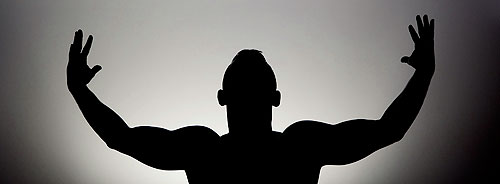
Once the basics are in place, then there are creative decisions to be made such as composition, placement of flash. This first example is of a member of my family who spends time at the gym so that he can show the world his physique. We were chatting one day and he said that he wanted something striking for the top of his Facebook page. I showed him a couple of ideas using silhouettes and we shot this…

©Neil Turner, October 2008

I was shooting with a Canon EOS1D MkII and a Canon 24-70 f2.8L lens. I wasn’t able to move myself around too much without shifting furniture and would have preferred to be shooting nearer the telephoto end of the range to deliberately remove any clutter. As it was, the lens was at 34mm (add the 1.3x factor and you get a 44.2 full frame equivalent field of view) and I cropped the image to the “letterbox” shape.

In this case I used the subject himself to mask the flash which was a Canon 550ex speedlight triggered in manual mode by a Canon ST-E2 transmitter. The first few frames had the background (a wall in my dining room) pretty evenly lit, which was a bit boring. The background is unimportant in this image and so the depth of field doesn’t matter too much. The exposure was 1/90th of a second at f13 on 200 ISO. I don’t recall why the exposure was 1/90th instead of 1/250th to utterly eliminate any available light but in a normal situation I would have gone for 1/250th.

I have some grid attachments for my Lumedyne flash heads and so I taped one of those over the flash to give me more of a circular pool of light. I aimed the flash slightly upwards so that I achieved the effect that you see above. It’s a very simple image that works for the intended purpose very well.

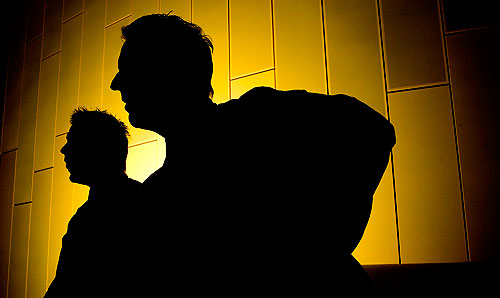
The second example is from a story I shot for a magazine about two brothers who work together at a school in London. I had shot hundreds of images of the buildings and a lot of portraits of the elder brother who is the boss. I had a lot of more conventional portraits of the two of them together as well so I decided to try this two person silhouette which shows the special cladding used throughout the central core of the building.

©Neil Turner, September 2008

The cladding itself has a yellow colour and so I decided to place a Lumedyne flash unit directly behind the seat that they were sitting on. It was very close to the wall, which give far steeper fall off of the light and a more dramatic outline. I find that the best place to focus for a silhouette is on the edge of the subject rather than the normal eye or face. I was shooting with a 16-35 f2.8L lens on a Canon EOS1D MkII at the wide end of the scale and the exposure here was 1/250th at f9.5. The flash was dialed down to 1/8th power and at that aperture I had easily enough depth of field to get the brothers both sharp and to have easily enough detail in the background.

Magazines seem to like this kind of image if they have a spread to fill or they want something a bit different for the contents page. You don’t always have to use flash to create silhouettes but the conditions required in nature to get a good one aren’t easy to arrange! Low level winter sunshine here in the UK is good and of course dusk and dawn without cloud cover anywhere in the world are great. I have also used illuminated signs and billboards when they are bright enough but for the sheer degree of simplicity and control, these flash-lit examples are hard to beat.

Getting the viewer’s attention without them knowing how?

From time to time I deliver seminars to fellow photographers and I give lectures to students, PR people and just about anyone who will listen. If I get long enough, there is a central theme to what I try to say. It really amounts to defining the difference between a photographer and somebody with a camera. It’s about how we see the world and how we show others that world.

Professor Heinz Wolff. ©Neil Turner/TSL, May 2005

Photographers do more than push that button. We bring creativity, experience and thought to the process to give our images something that “just push the button” photographs would rarely ever have. At this point in a live lecture there are usually a few worried faces, a few that are toying with calling out b***s*** and a majority that are just puzzled. Let me explain.

What a successful photograph has is a view of the world or of people that the viewer instantly recognises but will give them an interpretation that they would not see with either the naked eye or their own pictures. Successful pictures contain the information that the photographer wanted to include but exclude all sorts of stuff that doesn’t need to be there. Good photographers use a whole bunch of techniques to deliver a view that is familiar but sufficiently different to make the viewer look again. By now the audience members who will benefit from the lecture are trying to work out what I mean by techniques. A two dimensional image of three dimensional reality frozen in time is what still photography will always give – that’s “just” physics. We can do so much more.

In days gone by photographs were always an interpretation of the world because they contained no colour. The vast majority of the population see in colour and so delivering them a picture in tones of black, white and grey has always been the simplest way to make the real unreal but recognisable. Make the black and white print properly and you are really starting to produce the kind of pictures that I am talking about.

Converting an image to monochrome is the oldest and simplest technique but we have so many others. Shooting from different angles lets the photographer show their vision. I wrote an essay many years ago called “six feet up is bad” which basically said that photographs taken from a normal adult standing height had a much harder time of making the viewer see something in a scene that they wouldn’t have seen themselves. Take the picture from below two feet or above eight feet and your perspective shifts and the photograph stands a better chance of catching the viewer’s subconscious eye. Similarly, using longer or wider lenses than the human eye would relate to gives the photographer a way to pass on their vision. Using shallow depths of field or interesting light, having saturated colours or leaving colour casts normally corrected by the human eye all give us extra tools and techniques for making our images far more interesting.

Of course you can go too far – but that’s all part of what makes photography so interesting. Use too many tricks in the same image and you just end up with a statement about how you took a picture rather than having a great picture.

On almost every assignment I shoot wide and I shoot tight. I shoot from low angles and from height. I light a lot more of my work than most photographers but I try to give my clients choice between obviously and subtly lit images. If I do shoot a picture at f5.6 in average light on a 50mm lens from five feet ten inches of of the ground with the subject ten feet away it’s quite a shock to me!

The most successful images are those that get the viewer’s attention without them knowing why.