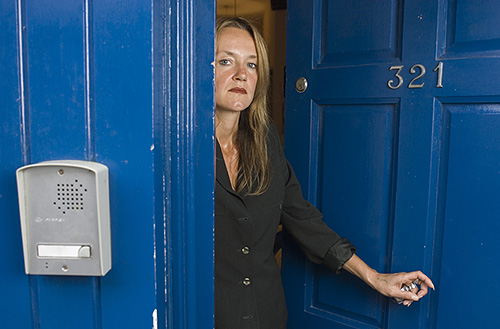
Visiting business “guru” lecturer Richard Roberts from GE Capital explains the subprime mortgage crisis to sixth form business and economics students at a Camden secondary school. This was shot as part of a story about a school doing everything it could to give their sixth form students as many extra opportunities as possible. The set included portraits of the head teacher, vox-pops of other students and audience shots of the sixth formers.
technique
Define the word ‘portrait’?
The word portrait is used by photographers all over the world, but it’s meaning is a little blurred. Many use the term to describe photographs of people’s head and shoulders and others use it to refer to any old picture of a person so I want to tie down what I mean by potraiture and then talk a little bit about the subject.
In my book a portrait is a photograph deliberately used to say something about the person in the picture. A simple ‘mug shot’ can be a portrait, but only if it says something about the subject and isn’t just an identity card style image. Even a characteristic expression is enough to turn the bland ID card photograph into a portrait. You then have a wide range of images that can legitimately be called a portrait until you get to the other extreme where a photograph of someone becomes more about an activity or a mood than about that person. Although there doesn’t have to be any interaction between the photographer and the subject for the picture to be a portrait, it really helps. I have read all sorts of nonsense about the kind of lens you have to use to make a portrait, or the kind of light that you must use. None of these things matters, a good portrait can be made using any lens and using a huge variety of lighting situations.
There are many traps in making good portraits, and I fall regularly into at least one of them, but the bottom line is that the photographer needs to free themself of as many constraints as possible in order to achieve creative results. With this in mind here are a list of do’s and don’ts that might help you to shoot good portraits – starting with my most regular failing:
- Resist the temptation to always use the same style and fit each subject into it giving you the same picture over and over with different faces in.
- Each face is different, so allow the light to help to show that. Not everyone benefits from soft lighting and good portraits are made better with thoughtful lighting.
- Don’t crowd the sitter. If you get right in someone’s face, you will put them on edge and spoil the photograph – of course if you purposefully want to make someone uncomfortable, then go ahead. A relaxed sitter makes the shot easier to get.
- Think about relating the sitter to their surroundings. One of the easiest ways of saying something about your subject is to shoot them in their own environment.
- Think about using props. Well selected items can really add to the message of the portrait- it could be an author with a copy of their book or a child with their favourite toy, be imaginative.
- Resist the tempation to always use the same focal length lens. Nothing annoys me more than to read conversations about “the ideal lens for portraiture”, it does not exist.
- Try a wide variety of compositions, portraits can be stunning if the subject occupies only a tiny percentage of the image, and can be equally strong if just their eyes fill the frame.
- There is no rule that says that ‘you must flatter your subject’ but harsh lighting and cruel angles should be kept for those situations where they are suitable.
To be effective a portrait must say more about the sitter than it does about the photographer and it must say more about the sitter than it does about what they are doing. Most great portraits have interesting but not overpowering light. If the first thing that you notice is the lighting then the photograph is not a complete success, if the first thing that you notice is the ‘nice blotchy backcloth’ then the portrait has truly failed.
Portraits, ID pictures and PR
I spend about forty percent of my working life shooting portraits for newspapers and magazines. It is my main passion as well as my career….
You will probably not be surprised to hear that I have some strong opinions about the art / science / craft (delete where applicable in your work) of photography. As an editorial photographer I am really lucky because there are three parties involved when I am shooting someone. There’s me, there’s the subject and there’s the paper – and that is really important to me and to the freedom I have to shoot the picture.
Social photographers usually have only two parties involved in the process – themself and the subject who often doubles as the customer. They are suddenly having to please the person who is sitting there in front of the camera. I really hate having to shoot portraits of family and friends because that’s even worse – imagine having the hassle of shooting a picture of someone who you love and care about and portraying them in a way that they may not have chosen. The freedom of being able to be objective and detached is a wonderful thing!
I have been involved in many arguments, both in person and on the web, about exactly when a photograph of a person becomes a portrait. It is really difficult to give a list of criteria about what constitutes a portrait, but somehow you can just look at a picture and say “yes” or “no” pretty much straight away.
I think that there are three categories of pictures of people. There are photographs that are merely record of what someone looks like that are perfect for ID badges or criminal records that say little or nothing about the subject. There are photographs where what is happening in the picture is more important than who is in it, such as a picture of someone playing sport or a musical instrument. Thirdly there are portraits, where there is enough in the image besides the subject to give a few clues about the subject, but not so much that the viewer is left thinking about what, rather than who. As a location only portraitist I have the added luxury of having the subject’s surroundings to help the image work. Studio photographers have to work really hard with fake props and painted backcloths to do what I can do very easily. Mass produced accessories, even student gowns, add little or nothing to the information that the photographer can give about their subject and can detract from the individuality of an image. You may have noticed that I haven’t mentioned any particular focal length of lens or lighting rig, and that’s deliberate. You can shoot a great portrait with any lens, and in any place – it’s all about your relationship with the subject.
Portraiture is something that you either find easy or you don’t. There are things that you can learn to make the whole process less painful and there are ways of shooting that eliminate risk (and creativity) if you really find that saying something about your subject isn’t what you were cut out to do with your camera. My advice is to talk to your subject, look around the room or the garden for something that they relate to and shoot a lot of frames. You can add a lot of athmosphere with lighting, but if you get the pose, props and position right you have the battle half won. Get your “bedside manner” right and you can call yourself a portrait photographer.
The relationship between the photographer, their subject and their client is vitally important. Editorial photography usually has three parties and it’s a great way to create good images. A while ago I shot a PR portrait of two businessmen. It had to be done in fifteen minutes and the deadline for the pictures to be with the designer was very tight. PR is a strange hybrid of social and editorial photography. There are usually more than two parties involved and they want editorial style shots but they have to be flattering to the subject. It doesn’t matter if the client is a PR company or if you are being paid directly by the company that you are there to promote – the images have to be positive and show no flaws. Is that a two party or a three party relationship? I would call it two and a half.
“Nothing unusual about this job?” I hear you ask. The answer is OH YES! The number of parties involved was as many as six and the decision making process was made harder by the two people in the pictures having the final decision about which image was chosen. Let me explain…
The end client was a European division of a multinational company who needed a picture shot in London. They had asked their London office to arrange a photographer to supply the pictures to the designer who was in another country (that’s three parties so far). The two men in the picture both had a say in the shoot (parties four and five) and then, of course, there was me (party number six). I had to set up the shot without the two businessmen but with the London PR people present. The two men arrived and I shot for ten minutes with two differing backgrounds and then offloaded my RAW files into my laptop. There then followed a quick Photo Mechanic slide show for the two subjects and the London PR where they selected two possible images in which they felt they looked good. We finally settled on the very last frame that I had shot – taken, ironically, about a minute after the two subjects started to make noises about leaving to catch a flight!
It was then a simple case of converting the RAW file on site and sending it as a high resolution email attachment to the designer, copying everyone else who hadn’t seen the choice in at the same time. That, ladies and gentlemen, was a complicated relationship. Editing the images later to send a choice of twenty to the client I decided that there was a better file but by then it was too late.
The difficulty for me with this job was that one of the two subjects vetoed several of the images because he didn’t think he looked right in them and the other subject vetoed one or two as well. The old adage about asking a committee to design a horse and ending up with a camel comes to mind. If too many people have a right to say no, you inevitably end up with the least offensive and least interesting picture!
Shooting in less than favourable weather.
Another re-posting; this time posted in April 2009 but from a job that I shot in 2006…
One of the best things about being a photographer is that you get to do some pretty odd things. Sometimes you climb to the top of a tall building and have a look at the view. At other times you get to meet interesting and amazing people and take their pictures. At other times you have to get up early on a bleak winter’s day, go to the beach, wade into the water just after dawn to get the tide and the picture. It all adds to the fun of the job.
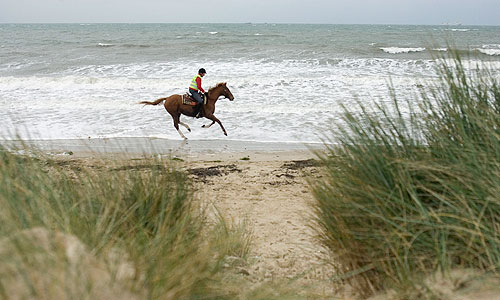
I shot this commission a while ago and I have been meaning to write it up since then. The story was about a school head teacher who owns a horse that she keeps in stables near the sea. She refers to her horse as her “work life balance” – something that we all need, but few of us have quite such a visible symbol of it!
Being a teacher, she is at school most days. During the holidays she gets away to the coast and rides whenever she can and if the tide is right she can ride on the beach. It was an October morning and we met at dawn in the car park near the stables. My brief was to get a double page spread for a magazine which showed her enjoying herself.
Of course photographers rarely get to choose the weather and it was raining with a reasonably strong wind. The tide was just right (we checked the tables in advance) and so we started to shoot some pictures of her riding on the sand. It’s a stretch of coast that I know well and I knew that there was a high chance of poor weather. There’s nothing that you can do when the deadline is tight except to shoot the best pictures that you can.
The picture above was taken towards the end of the session and by this time it was getting lighter. The exposure was up to 1/500th of a second at f3.5 on a 24-70 f2.8L lens. We had started at 1/125th at f2.8 and the light was doubling every twenty minutes or so. Unusually for me I shot this job without lights, without flash – just good old ambient. Had there been any sunshine, there would have been the complicating factor of having to shoot almost directly into the sun if I wanted to stay on the beach.
Most of the pictures were taken on a 70-200 f2.8L lens and I made use of a monopod whilst the light was low. I shoot on beaches quite a lot and I always take a large piece of plastic to sit my camera bag and anything else that I put down onto. If the plastic sheet is big enough, you can also use it to wrap everything but sand still gets in and salt still seems to coat everything.
I always try to give picture editors a lot of choice and to give them small “drop-in” pictures to use if they need a second or third image for an article. The wider the variety of magazines and papers that I work for, the more I find that the drop-in picture gets used in unusual and creative ways. Magazine clients appreciate choice.
The reason that I wanted to mention this job was the combination of the early start, the poor light, the wind, the rain and getting absolutely soaking wet wading knee deep into the sea. Maybe it was because of all of these factors that I enjoyed it – who knows.
I wrote a while ago about my addiction to Timberland boots and I was very grateful for them on this job. My jeans were wet but my feet stayed dry.
Drop-in pictures.
This one was first published in April 2009…
We are in the middle of a recession – a pretty big one at that. Sensible professional photographers all over the world are looking at their business models, talking to their clients and trying to give themselves an edge. A few are trying to compete on price which might work in some markets but will almost certainly destroy others. The rest of us are just looking at what we do and how we do it in the hope that we can raise our collective game.
One thing that I have always done is to give picture editors what they have asked for and then give them something that they might well be able to use but hadn’t asked for. Current fashions in mainstream magazine design seem to call for a range of what we call “drop-in” pictures. Small supporting details that help to break up the copy and also tell the story.
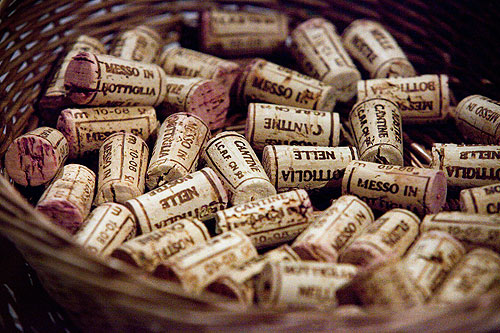
This example of a basket of wine corks came from a commission to shoot a conference which featured a full scale banquet in the very splendid surroundings of one of the Oxford Colleges. It’s not an exciting picture but it really helps to tell the story. It can be used large or small or not at all. It took a minute to shoot, another minute to edit and forty five seconds to transmit. It helped to break up a set of images of middle aged men in black suits eating by candlelight and stands out in the clients image browsing software as “different”.
Same client, very different project. This was a story about an ecologically managed office complex where they were still making improvements. A simple shot of the builder’s muddy boots helps the story along. They didn’t use this frame but it was submitted in much the same way that the image of the corks was and almost certainly had the same effect on screen.
This final example, shot for an education magazine, had an entirely different effect. Shot as a supporting image – the designer saw it and decided to base the entire layout around it. The story was about using Makaton, a relatively simple sign language, to help teach primary school pupils a broad range of things. They ran headlines and copy over the pale background in a very imaginative way – a use for a very simple picture that I had never envisaged.
To sum up: when you shoot the kind of editorial work that I do it takes no time at all to add these simple images to an edit. They will be useful in years to come as stock images and they give designers and picture editors options that they hadn’t asked for. Some people might say that I’m giving “my edge” away here but I hope that I offer clients a package deal with at least four edges. I always tell students to whom I give talks about the job that I do that they need to think beyond simply what they have been asked for. It is a given that you give the client what they asked for but I have never heard one complain that you have given them something more.
Photography Monthly portrait
The new editor of Photography Monthly set me a very interesting challenge a few weeks ago – he wanted me to take a classic portrait by Terence Donovan from the 1960s and recreate it using modern equipment. That was fun and quite a challenge but then he asked me to shoot a similar picture using 2011 techniques that I would be happy to submit to a magazine today. That’s the picture above but if you want the whole story you will have to get the next (January 2012) edition of the magazine.
Walking with speed lights
This time last year I got a call from the Editor of Photography Monthly magazine looking for a feature article about what a keen photographer might do when they go out for a walk with their camera. Between us we hit on the concept of “walking with speed lights”. The idea was a simple one: I went for a walk on a blustery winter’s day with one camera, a couple of lenses, a couple of hot-shoe type flash units (two Canon 580exII strobes) and a few other bits and pieces.
Near where I live there is a beauty spot called Hengistbury Head so I set off and just shot the pictures that I saw. As dusk started to approach I became fascinated by a whole row of boulders that I must have walked past five hundred times in my life and never really noticed. I decided to light a couple of them against the beautiful winter sunset and keep trying until I got a shot I liked. The article called for nothing to take more than a few minutes because it would be cold and/or wet and so I grabbed this picture in five minutes before heading off to the next idea.
At the end of Hengistbury Head is Mudeford Spit at the entrance to Christchurch Harbour where some of the most desirable and valuable beach huts in the country sit in the sand. My idea was to light just one of them and let the rest of the scene go a stop or more under exposed. I chose this hut because there is a tuft of grass behind which I could bury my flash (wrapped in a cheap clear plastic freezer bag). I had a great day out, shot some pictures AND got paid…
I hope to post a full description of who what where and when after Christmas…
Loving f1.8…
If you are a reader of this blog and have followed any of my technique articles over the last few years you will, no doubt, have an impression of me as a photographer who lights most of his work – especially portraits. That would, I guess, be a fair impression based on my body of work but the last couple of years have seen a shift in my style and I thought that it would be cool to share a couple of more recent pictures with you.
This gentleman is an author and a ceramic artist whose portrait I shot recently for a Dutch newspaper in London. The bulk of the pictures were taken during the interview and the light in his loft studio was very lovely. The deep joy of modern full-frame cameras is that you can shoot beautiful quality at 1600 ISO and beyond and whether or not to light something has gone from being a technical necessity to a creative decision. Ten years ago, anything over 400 ISO was awful and five years ago the ceiling was probably not much over 800 ISO. These days we have so much freedom that even a committed lighting nut like me often goes with the ambient option.
My ‘nut’ credentials were further emphasised on this job however: I chose to shoot a lot of the pictures at 100 ISO like we used to do in the days of shooting transparencies just to see if I could.
So while the excellent reporter was asking the questions and getting some interesting and thoughtful responses I was moving around with my two Canon EOS5D MkII cameras with prime lenses on making interesting portraits. Most of the pictures were made with a Canon 85mm f1.8USM lens (is there a better bargain lens on the market?) but I also shot with a 50mm f1.4USM and a 28mm f1.8USM (both cut-price gems too) whilst using my position to alter the crop and not simply relying on a zoom ring. I’d never say that this is a better or worse way of working – it is just different. I was loving the freedom of shooting at, or near, the widest aperture and the shot above was taken at 1/80th of a second at f1.8 at 100 ISO.
Much has been written about the failings of the focusing on the EOS5D MkII but I have to say that for my work I rarely stray off of the centre focusing point, which seems to be pretty accurate and easily quick enough for me – especially when using a fast lens. I concentrated very hard on the subject’s eyes and an overwhelming percentage of the pictures were bang in focus where it mattered. Shallow depth of field on people pictures has always excited me and I made full use of it on this job.
This simple headshot was part of a project that I did for Photography Monthly magazine’s August 2011 edition. The idea was to shoot some very simple headshots without any lighting. The edition of the magazine is still current as I write this but the idea was very simple: get the subject into reasonably open shade and shoot with the same camera and 85mm lens combination as the previous picture. The trick here is to have interestingly out of focus backgrounds – in this case it is grass with dappled light and an absolutely crisp area of focus.
This portrait was shot at 1/640th of a second on 400 ISO at f1.8. I had set out with this young actor to shoot some new headshots and then write about it for the magazine. If they put the piece on line, I will link to it.