photojournalism

Christmas at f1.4

Main Street, Hawkshead Village. ©Neil Turner

Whilst enjoying a few days away with the whole family in the Lake District over the holidays I shot a few pictures for my own pleasure and for the family album. For no other reason than “I wanted to” most of them were taken at the maximum aperture that the lens could manage – which, given that I mostly used a 50mm f1.4, was f1.4!!! It was great to be away from the big city for a while and take in the countryside and wander through some small towns and villages.

This was taken in Hawkshead Village – a large part of which was refreshingly closed…

Angry teacher portrait

©Neil Turner/TSL, April 2005

Back in April 2005 The TES had a great article written by a newly qualified teacher about how to avoid getting angry with pupils at an inner-city secondary school. It was clearly written from personal experience by a dedicated and keen young teacher working at a relatively tough school. He wanted to teach, he wanted to be good at it and he was working hard to achieve his goals.

When I arrived at the school it was the end of the day and both of us were a bit tired. We talked about how to illustrate the story and we decided that it would be great fun and have the desired amount of impact if he just stood there and yelled at me: full-on screaming. It was loud and, as it turned out, great therapy for him. All of the pent up emotion from the day came out is one long, loud and hilarious stream.

On my way home there was, coincidentally, a radio programme about anger management. None of the experts mentioned standing in an almost empty room screaming at a photographer while you had your picture taken. I couldn’t help thinking that they had missed out of an important therapy!

There’s nothing especially clever about the picture – a slightly desaturated image, lit simply an composed carefully but it had enormous impact on the page thanks to some brave and clever design.

Folio photo #05: CEO portrait with tungsten light, August 2006

©Neil Turner/TSL, August 2006

In 2006 Ian Smith was the Chief Executive Officer (CEO) of Oracle the software company based in the City of London. This business portrait was actually taken for the Times higher Education Supplement who were running a piece about Oracle’s connections with the education industry. The portrait itself was shot in under two minutes but I had set up with a ‘stand-in’ who posed for some test pictures for fifteen minutes before Mr Smith was available.

The really interesting thing about this portrait is that it was shot with deliberately mixed lighting: tungsten gelled flash on the subject and daylight behind with the camera on a custom white balance which was only concerned with the flash. I use this set of pictures a lot when I am teaching my location lighting seminars.

Mad sky, madder lighting…

Even though it was well over 12 years ago I can still remember standing on a pavement outside a rather dull new building on the University of Southampton campus which wasn’t actually open or even finished and thinking “how am I going to pull this one off?” Normally with architecture news jobs you can rely on having somebody walking past or an interesting view from inside out but on this one… nothing.

©Neil Turner/TSL, October 1999

I messed about for half an hour trying to get an angle on the structure that didn’t show cranes, builders doing the finishing touches or plastic barriers. Miserable failure. There was one redeeming feature though – the sky was a beautiful deep and even blue. I’m no great fan of polarising filters but this was calling out for that kind of treatment so I grabbed my flash gear from the car and decided to underexpose the sky and get as much light into the foreground as I could. That meant giving full power up into the street lamp that helped the composition which also meant that I could underexpose the sky nicely.

©Neil Turner/TSL, October 1999

After that my mind started racing and I decided to go for something so over the top that even I would have bet the Picture Editor would have laughed as she put it into the dustbin.

The red in the street lamp was achieved by using a red narrow cut colour effects lighting gel over the flash, which was on full power and raised as high as I could get it so that the red would balance against the saturated and underexposed sky.

This was the first time that I had tried anything like this and the great thing is that I was wrong. They used the mad picture…

Folio photo #04: BMX rider, May 2011

©Neil Turner

©Neil Turner, May 2011

BMX rider Keegan Walker practicing his skills at the Ringwood skate park in the evening after work. This was shot as part of a technique ‘how to do it’ article for Photography Monthly magazine. I’ve had a really interesting relationship with the magazine for the past couple of years in which they have given me free reign to go and shoot pictures that I want to, write about how I did them and simultaneously earn some money AND get some pretty decent portfolio pictures too.

While shooting this particular assignment I found myself having to ask Keegan to be a little more conservative with the height he was getting off of the ramp. Too much space in between him and the ramp just looked silly – believe me, this guy is really good and was very capable of getting more ‘air’ than you see in my pictures. This shot was right at the end of the session when the sun had just gone down and the light was fading fast – my absolute favourite time of day to shoot pictures.

Folio photo #03: Primed for disaster

©Neil Turner, March 2009

Visiting business “guru” lecturer Richard Roberts from GE Capital explains the subprime mortgage crisis to sixth form business and economics students at a Camden secondary school. This was shot as part of a story about a school doing everything it could to give their sixth form students as many extra opportunities as possible. The set included portraits of the head teacher, vox-pops of other students and audience shots of the sixth formers.

Define the word ‘portrait’?

The word portrait is used by photographers all over the world, but it’s meaning is a little blurred. Many use the term to describe photographs of people’s head and shoulders and others use it to refer to any old picture of a person so I want to tie down what I mean by potraiture and then talk a little bit about the subject.
©Neil Turner/TSL, June 2006

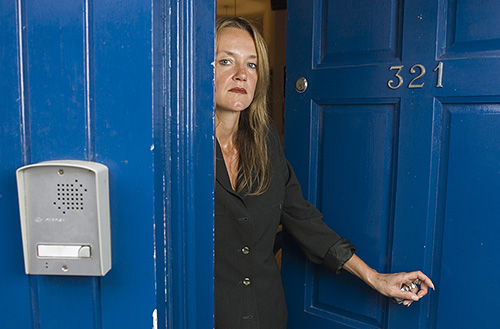
In my book a portrait is a photograph deliberately used to say something about the person in the picture. A simple ‘mug shot’ can be a portrait, but only if it says something about the subject and isn’t just an identity card style image. Even a characteristic expression is enough to turn the bland ID card photograph into a portrait. You then have a wide range of images that can legitimately be called a portrait until you get to the other extreme where a photograph of someone becomes more about an activity or a mood than about that person. Although there doesn’t have to be any interaction between the photographer and the subject for the picture to be a portrait, it really helps. I have read all sorts of nonsense about the kind of lens you have to use to make a portrait, or the kind of light that you must use. None of these things matters, a good portrait can be made using any lens and using a huge variety of lighting situations.

There are many traps in making good portraits, and I fall regularly into at least one of them, but the bottom line is that the photographer needs to free themself of as many constraints as possible in order to achieve creative results. With this in mind here are a list of do’s and don’ts that might help you to shoot good portraits – starting with my most regular failing:

  • Resist the temptation to always use the same style and fit each subject into it giving you the same picture over and over with different faces in.
  • Each face is different, so allow the light to help to show that. Not everyone benefits from soft lighting and good portraits are made better with thoughtful lighting.
  • Don’t crowd the sitter. If you get right in someone’s face, you will put them on edge and spoil the photograph – of course if you purposefully want to make someone uncomfortable, then go ahead. A relaxed sitter makes the shot easier to get.
  • Think about relating the sitter to their surroundings. One of the easiest ways of saying something about your subject is to shoot them in their own environment.
  • Think about using props. Well selected items can really add to the message of the portrait- it could be an author with a copy of their book or a child with their favourite toy, be imaginative.
  • Resist the tempation to always use the same focal length lens. Nothing annoys me more than to read conversations about “the ideal lens for portraiture”, it does not exist.
  • Try a wide variety of compositions, portraits can be stunning if the subject occupies only a tiny percentage of the image, and can be equally strong if just their eyes fill the frame.
  • There is no rule that says that ‘you must flatter your subject’ but harsh lighting and cruel angles should be kept for those situations where they are suitable.

To be effective a portrait must say more about the sitter than it does about the photographer and it must say more about the sitter than it does about what they are doing. Most great portraits have interesting but not overpowering light. If the first thing that you notice is the lighting then the photograph is not a complete success, if the first thing that you notice is the ‘nice blotchy backcloth’ then the portrait has truly failed.

Folio photo #02: Girls’ education project, Rajasthan

©Neil Turner/TSL, May 2005

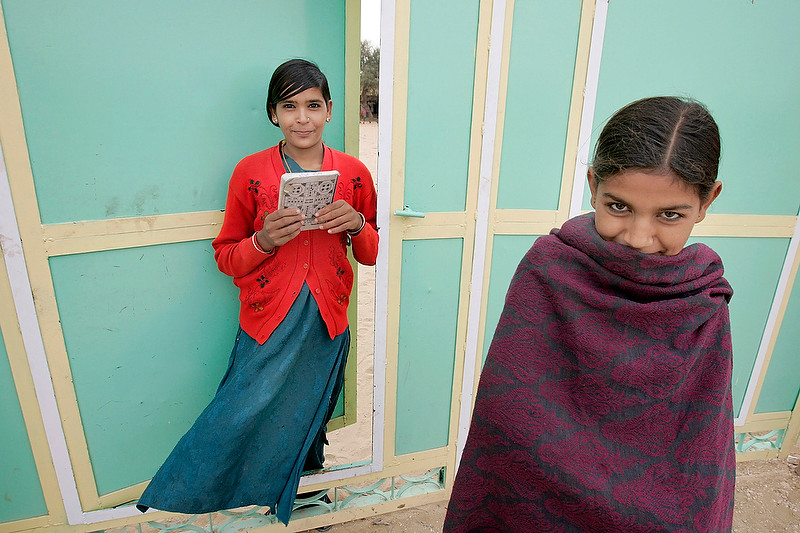
The UK based charity SAVE THE CHILDREN funds a scheme in northern Rajasthan to allow girls between 12 and 15 years old who do not get access to education to come to a boarding centre for a few months in which time they cover the syllabus normally expected to take five years. The students take it in turns to do chores such as fetching water and washing clothes but still take books to read as they work. This picture was taken at dawn when some of the girls were already reading whilst others were fetching water, fuel and cooking breakfast.