Archive photo

Street photography 1989 style

“Street photography is back” was the title of an email that I received today. Funny, I never knew that it went away. Having said that, the current exhibition taking place at The Museum of London has given the genre a bit of a boost. There are so many great exponents of street photography working in London today that even I have to admit that it isn’t so much back as resurgent. This got me thinking about some of my own work from early on in my career. I remember sitting in my office one day and a very old friend rang me and asked if I have any pictures of street markets that his younger sister could borrow for a school project. I had a few but, in the absence of anything better to do, I went off to Leather Lane market and shot a couple of rolls of film.

©Neil Turner

At that time I was part of a small agency and we had a rapidly growing library of images that was starting to make us some money. Stock photography was a good marketplace back in the late 1980s and early 1990s and I thought that it wouldn’t hurt to add a few market pictures.

This was my favourite frame of the lot. Shot on a Nikon FM2 with a 35mm f2 Nikkor lens and Kodak Tri-X film – a copy of this print made on old-fashioned bromide paper still hangs on my own office wall. The reasons that I like it are many and varied but the fact that it was born of a simple request from a very good friend (in fact, two years later he was my Best Man at my wedding) gives it extra weight for me. The fact that it has made me quite a bit of money as a stock image certainly doesn’t detract from its appeal but the other thing that makes me love this picture is that it reminds me just how simple photography can be. A mechanical camera with a fixed focal length lens, no automation whatsoever and time. Street photography is all about opportunity and patience.

Waiting for the moment to happen is part of the way that I shoot anyway but I also spend a lot of time looking around trying to anticipate good compositions, watching for the way that light hits surfaces and people. I have a very clear recollection of how this picture was made. I had seen the man walk up through the market and grabbed a couple of frames of him as he walked and shopped. Then I saw this nice gap between stalls and concentrated on framing it and I have the same composition with at least five different people passing through. Finally the interesting person that I really wanted came back and I clicked one frame of him (no motor drives on my FM2s that day). The little black border around the print is the rebate of the film which means, for those of you who are too young to have shot much in the pre-digital era, that this is the whole frame as it was shot – no post production cropping.

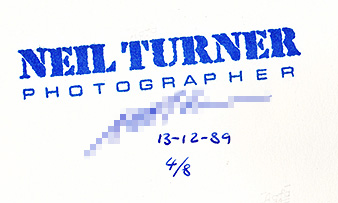
When I scanned the print this morning I noticed that this was one of a short edition of hand-prints that I made of this frame and you can see the stamp and date that were on the back with my pixelated signature.
©Neil Turner

Simple and happy days but I don’t particularly want them back. Opening a box of prints brought back the smell of the darkroom and the associated cough rather too vividly. I haven’t made a black and white print in a traditional darkroom since January 1994 and I don’t miss it one bit!
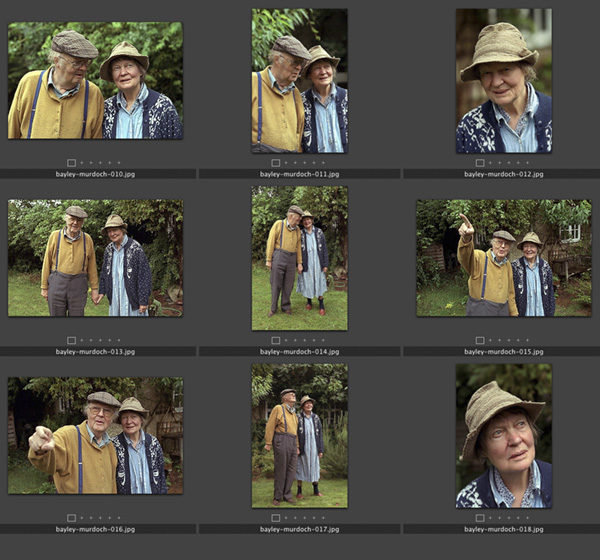
Contact sheet: Dame Iris Murdoch and John Bayley, Oxford, September 1998

When this set of photographs, one of the last of her, was taken Dame Iris was in the latter stages of Alzheimer’s and her husband described her as being like “a very nice 3-year-old,”. She died in Oxford on February 8, 1999. In his memoir “Elegy for Iris” John Bayley portrays his brilliant wife lovingly but unsentimentally. He was in turn very much in love with her and very caring about her when I spent a brief time shooting this set of pictures. She was unaware of who I was or what I was doing but his hand was always in hers and she seemed to accept that everything was OK because of that.

The original caption simply read: Professor John Bayley and Dame Iris Murdoch photographed in the back garden of their home in Oxford. 09.09.1998 photo: Neil Turner/Times Higher Education Supplement. ©News International

The Times Higher Education Supplement was running a review of Professor Bayley’s book about his wife and the Picture Editor had asked me to drive to Oxford to shoot his portrait. While I was driving between London and Oxford I was told that at least two other photographers would be shooting before me and that it was “unlikely” that Dame Iris would be in the pictures. I don’t mind doing portraits of authors on those days when you form an orderly queue with reporters and television crews for your chance to do the same five minute job but this one seemed a little less “organised”.

I arrived in that part of Oxford where it seems every second home is owned by a Nobel Prize winner or a celebrity academic to find their house looking a little sorry for itself. The front garden, the fences and the paintwork all needed some TLC and I quite like to shoot portraits around those areas. I had twenty minutes to wait and started to think about the light, the colours and watch for other photographers and journalists to come out. Nobody appeared so I grabbed my gear and knocked on the door. When Professor Bayley answered, he looked like the gardener but spoke exactly how you might imagine an Oxford Professor would.

In the film “Iris” which stars Dame Judi Dench as the older Iris Murdoch the house is untidy. Actually having been there I can tell you that untidy doesn’t even come close. There were books and newspapers everywhere. Televisions were on the BBC in almost every room and there was Dame Iris herself sitting quietly at the kitchen table. I was nervous about asking if she would be available for the pictures but Professor Bayley seemed to know what I wanted to ask and told me that he wanted her to be in the pictures with him but that she found flash disturbing. I was shooting 35mm colour negative film at the time and so we decided that the house was too dark and too untidy to be a good location for a portrait. Ironically these days I would have probably done some pictures on my 5D MkIIs using the small amount of available light indoors at 3200 ISO but there was no way that 800 ISO colour negative would cope.

The beauty of these pictures is that nobody from the publishers had been round to tidy up, dress them up or even attempt to sanitise the images. Because of that we were able to make some lovely portraits. We chatted about garden birds, foliage and the English weather. It was a surreal time.

In the end I shot 72 frames (two rolls of 200 ISO Fuji Colour Negative film) which I drove back to London where the film was processed by the newspaper darkroom and all scanned onto a Kodak Photo CD at a resolution unthinkable for a digital camera at the time – the equivalent of a 6 megapixel camera when the Kodak DCS520 was just becoming available with it’s 1.9 megapixel chip. The cameras used here were a Canon EOS1V and an EOS1N with 28-70 f2.8L and 70-200 f2.8L lenses.

The power of pictures

Photography is a powerful medium. As a reader of a newspaper, a viewer of websites or someone looking at images on a gallery wall there can be no mistaking the ability of good pictures to make you think, make you want to know more and create empathy with the scene before you. If you were there and actually took the picture it can be even more true. I have been going back through some very old images of mine and I have been transported all over the world by transparencies and negatives. I remember details of stories that I had otherwise forgotten and its the small stories rather than the big news events that have caught my imagination.

©Neil Turner/TSL

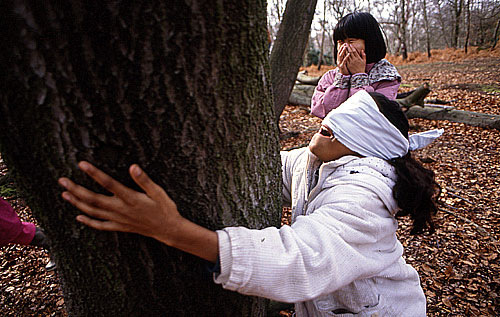
This particular story brings back very strong memories. We have made fun of “tree huggers” over the years – despite the fact that getting close to nature does all of us some good. The children in this story were on a day out from their inner-city school visiting Epping Forest. For those who have never been, it’s a public open space in the London area, covering almost 6,000 acres with lots of small woods and copses.

The interesting thing about this visit is that very few of the thirty children had ever been amongst trees before. Many of them had never been off of the estate where they lived and regarded the woods as where the baddies in children’s literature always lived. They were somewhere between apprehensive and scared as they entered the first small coppice but after two hours they were in a bigger wood and letting their imaginations run wild, playing a range of games and getting around to hugging a few trees for good measure.

I can still remember the delight that they all felt. I can still remember the noises that they made – the laughter, the squeals and the childish innocence of it all. Of course your reaction to this picture will be different. Not knowing the story behind it probably marks it out as a rather odd image – possibly even a disturbing one and that’s my real point…

I’ve written before about the many uses of a picture. They can tell the whole story, they can make you want to know what the story is and read the accompanying words or they can simply be something to break up the page. A picture without accompanying words needs to be self explanatory. A picture like this one is worth so much more with a good caption than without.

These days I do quite a bit of teaching. Some of it is with working photographers but most of it is with photography students hoping to make a living in the business. My heart sinks when I start talking about IPTC captions and IPTC data and the students look blank faced. Professionals shouldn’t send out their images without proper captions or without proper copyright information but neither should keen amateurs or students. All images have value and giving them captions will always add to that value – even if it is just to confirm when and where they were taken.

Good captions and back stories are a good idea!