Archive photo

Seaside towns beginning with ‘B’…

I was born in Bournemouth, went to school in Bournemouth and I live there most of the time. I am, as they say, a Bawmuff Boy. There are a couple of other major seaside towns that also begin with ‘B’. Brighton is 94 miles along the coast and I have shot at least twice as many commissions there than in my home town in the last 25 years. Blackpool, on the other hand, is a long way from either Bournemouth or London and somewhere that I have only ever been sent to for party political conferences. Because of the distance I’ve never seen the place as it should be seen – without an overload of grey men in grey suits.
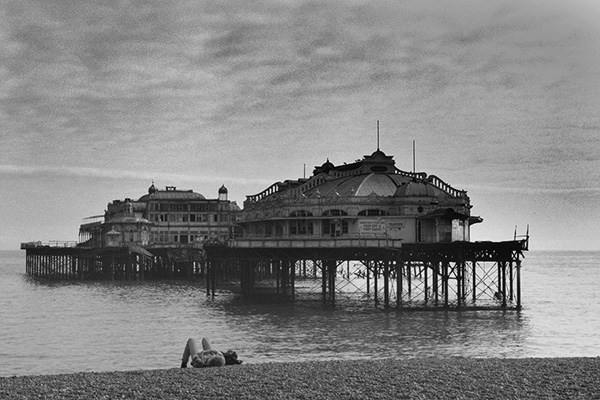
©Neil Turner/TSL. Brighton, July 1995 - a view that no longer exists.

I really like Brighton – it is a photogenic place and it seems to be a really media-savvy sort of town too. On one occasion in the summer of 1995 I was even sent there to shoot stock images of the place to accompany general articles about the town (now a city I believe) and about the county of East Sussex. It was the first in a series of similar days when the diary was empty and I went to Cambridge, Oxford, Birmingham, Bristol and Norwich during that summer. It’s not very often you get quite such relaxed brief but it was actually quite a challenge – generic images in three hours and away again. Cambridge and Oxford were a lot easier but Brighton was the one I’d choose to do again. If I were given a free hand it would have to be Blackpool though. Every time I see it on TV I think to myself “so many pictures to be taken…”
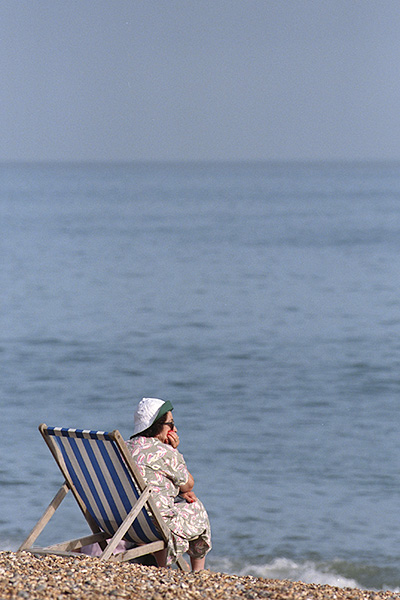
©Neil Turner/TSL. Brighton, July 1995

©Neil Turner/TSL. Brighton, July 1995. Timeless...

Archive photo: Private investigator. December1990

©Neil Turner/Insight. December 1990. London

Back at the end of 1990 I was sent to accompany a reporter to do an interview with a private investigator. He was an ex-Metropolitan Policeman who had a very good reputation and track record in finding runaway children. He was possibly the severest looking person I had ever met and his penchant for big fat cigars did wonders for his image. The truth is that he was actually a very caring man and both the reporter and I liked him a lot.

When I did a quick “Google” for the man I found that he had given another interview to the newspaper ten years later and that he was still as forthright as he had been. I would imagine that he has since retired but I still look very fondly at this picture and remember it’s place in one of my old portfolios.

This was shot using ambient light at his office in Southwark. I was probably using a Nikon FM2 with a 180mm f2.8 Nikkor which I had at the time and the film is Kodak Tri-X. This was scanned from a fibre-based print which was printed full frame with the rebate showing.

The early days of digital

I took delivery of my first Kodak DCS520 digital camera in late November 1998. It was a revelation. I had used a previous model (DCS3) which was pretty poor and I wasn’t really that convinced about the whole process. After three days, I was a convert – the kind of convert who then sees it as their role to evangelise about their new-found wisdom/insight/faith. Based on the Canon EOS1n camera, the Kodak conversion replaced the whole of the back of the camera and quite a big chunk of the electronics too. It was expensive, relatively slow and it only had 1.9 megapixels. It had a tiny low resolution LCD screen on the back and it used enormous and expensive batteries that rarely lasted a whole day but I absolutely loved it from that first week!

©Neil Turner/TSL. 10th December 1998

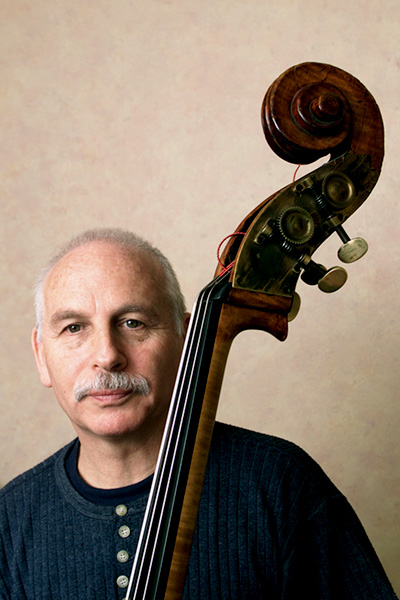
This was one of the first proper portraits that I shot with my first DCS520 (known as the Canon D2000 in some countries) and it was of a double bassist and jazz teacher in his own home. My conversion was so dramatic and so complete that I even remember sulking a little when I had to shoot on film for the glossy sections of the newspaper. We worked with these early cameras for nearly four years until the Canon EOS1D came out. Nikon had introduced the D1 in that period and the see-saw battle for supremacy between the two big manufacturers with input from Kodak and Sony began in ernest.

I quite often get asked what the big trigger was for digital in the newspaper industry. There are a few factors;

  • The arrival of cameras capable of shooting quality images
  • The money saved by newspapers getting rid of darkroom staff
  • The arrival of new health and safety laws that meant waste chemicals became very expensive to dispose of
  • The speed of turnaround of digital pictures
  • The ease of archiving digital images

Talking with others who used the Kodak DCS series camera from that era we all agree about one thing – how good Kodak’s software was. What a shame that they threw away their lead in professional digital photography. If they had even kept their software development going, they could possibly have avoided needing to file for bankruptcy protection in the US courts last week. I look back at the early days of digital with a real fondness – they really were the most exciting of times. There’s something very cool and very rewarding about being in the second row of pioneers!

Archive photo: Brixton, July 1990

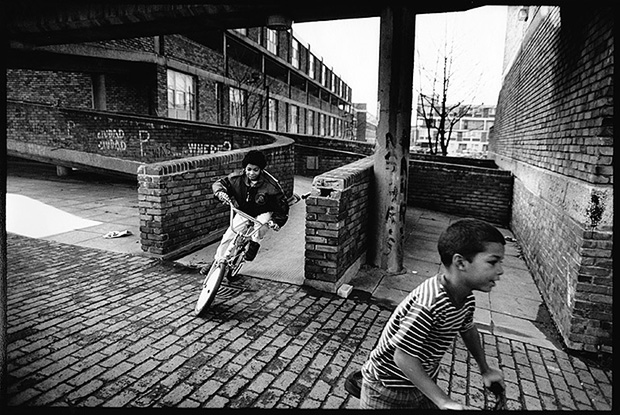
©Neil Turner. July 1990, Angell Town Estate, Brixton

I was shooting a piece about the work being done by some amazing community volunteers in conjunction with outreach workers employed by the Local Education Authority around one of Brixton’s many estates and we were being ‘buzzed’ by some boys on bicycles just out enjoying themselves. Neither of the boys in this picture were the subjects of the work involved so the picture didn’t really add to the story but I have always liked it and I thought that it would make a good picture to post here.

I had posted this image on Twitter a while ago and I think that I mis-captioned the date. Checking the negatives today, it should have said July 1990.

The camera would have probably been a Nikon F3P with a 24mm f2 Nikkor and Kodak Tri-X film but I am not entirely sure because at the same time I had FM2 bodies and a Leica M6 as well.

Archive photo: Frances Partridge, London, May 1995

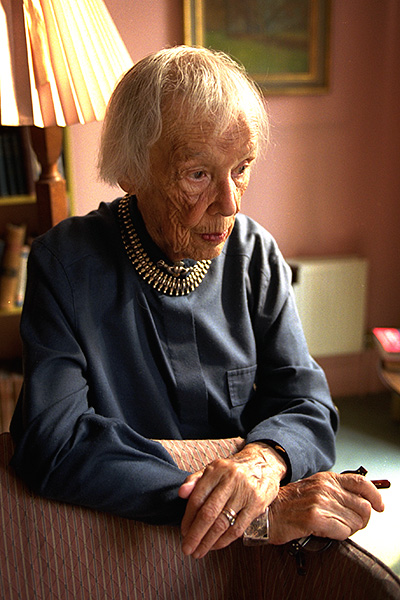
Frances Partridge was the last surviving member of The Bloomsbury set when she died, aged 103 in 2004. She had lived an amazing life full of love and tragedy and had known the brightest and the best people of her generation. She was a writer and a famous diarist. I photographed her when she was a mere 93 in 1995 at her home in London.

©Neil Turner/TSL. London, 10th May 1995

When I arrived she seemed agitated, which I didn’t think was unusual given her age and the fact that she had a stranger in her home but it became obvious that something specific was bothering her. She told me that her only corkscrew had broken and that she hadn’t been able to have a glass of wine. Like all good photographers I had a Swiss Army penknife and so I was able to open her bottle – which cheered her up a little. The thing that really made the rest of the job go very well was that I was able to fix her corkscrew so that she would be able to have he wine the following day too.

Mrs Partridge looked old and she knew it. She had spent most of her life surrounded by artists and writers and had been photographed many, many times. She celebrated her age and was keen that I portray her in my own way. We spent a good deal of time working out where she should be in her flat and the light coming in in early May changed every few minutes. I tried to shoot as little flash as I could – not because she didn’t like it but because somehow I thought that ambient light was more in keeping with the ethos of the Bloomsbury group.

Geek moment… I was using two Canon EOS1n cameras with 28-70 and 70-200 f2.8 lenses and Fuji 800 ISO colour negative film without flash and the frames shot with flash were in Fuji 200 ISO colour negative film. The scans were done with a Kodak auto feed scanner onto a Photo CD.

Archive photo: Inner London Education Authority, April 1990

When the Conservative Government finally abolished the Inner London Education Authority (ILEA) which had shared County Hall with the Greater London Council (GLC) Mrs Thatcher could finally look out of the House of Commons and not be reminded of the opposition that her party had faced from across the river. I was sent to shoot a picture of one of the last people still working at ILEA who had done an interview for the Times Educational Supplement about his work wrapping up the affairs of London’s last unitary body (until the Labour government reestablished a London Mayor’s office in May 2000).

I went equipped with a notional headline of “will the last person to leave County Hall please turn out the lights” and I was very pleased when it turned out that the desk where he was working was in a windowless room in the basement of the beautiful if tatty building. I was even more pleased when I had processed my film and had a look at my pictures.

©Neil Turner. September 1990

For the camera geeks: Nikon F3P with 85mm f1.4 Nikkor and Kodak Tri-X film

Archive photo: Student demo, London, November 1988

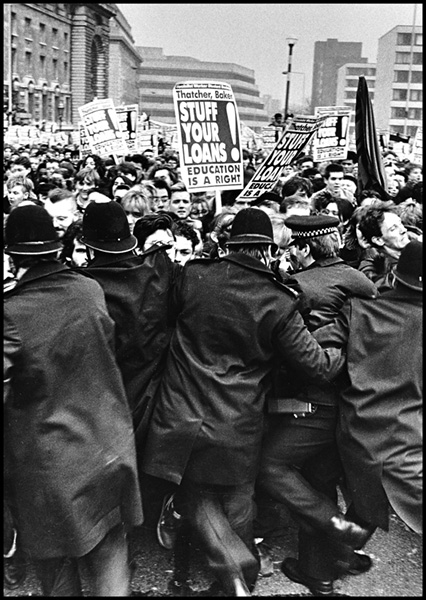
On the day that I got my very first mobile phone I was sent to photograph a student anti-loans demonstration in London. Nobody was expecting anything other than a march by angry students on a very grey day in London. Part of the way through the march there was a large break away group that decided to head for Parliament – which was not on the agreed route. By the time they had broken away and reached the west side of Westminster Bridge the Metropolitan Police already had a cordon across with vans, horses and a large number of officers. Scuffles, charges and fights ensued but the police line held and the students never made it to Parliament – less than 200 metres away.

Photo: © Neil Turner | 24 November 1988

Contrast this photo with the student riots of 2011: the police are wearing no special clothing, no high visibility jackets, no shields and there was no overt photographing or filming of the students either. No buildings were ransacked, damaged or invaded and the whole thing felt relatively civilised. It did feel weird to be able to talk to reporters, other photographers and even the picture desk on the phone in the middle of a mini-riot: my phone was a Motorola 8000s which was known as the “City Brick” because it was so big and bulky.

Unfortunately, the story doesn’t have a happy ending (apart from two front pages and a ‘congratulations’ from the editor). A few years before, I had broken a toe playing cricket and during the demo I had the same toe re-broken when a police horse moved backwards and trapped me between it and a van, crushing my toe. As a freelance, I couldn’t afford any time off so I limped from job to job over the following three or four weeks to Christmas. I also had a lens damaged and wasn’t properly insured so my old 35mm f2.8 Nikkor was replaced with a newer 35mm f2.

The camera and lens combo here was a Nikon FM with a 35mm f2.8 Nikkor using Kodak Tri-X film.

Archive photo: Special needs school, March 1990

Following on from the March 1990 Conductive Education picture that I posted earlier in the week I remembered another special needs picture that I shot a short while later. As it turns out, exactly four weeks later. This shot isn’t as technically sound or as well composed as the previous picture but it does mean a lot to me – because there is a real story to go with it.

© Neil Turner | 30 March 1990 | Southampton

This boy had a target of learning to do up his own zip and was determined to succeed for the camera. I was touched by him and his determination and so I stayed with him whilst he kept trying. After nearly ten minutes he succeeded and I was very nearly in tears. One of the staff had been watching and she was in tears. I have never forgotten that moment.

For the geeks out there, the camera was a Nikon F3P, the lens was a 24mm f2 Nikkor and it was shot on Kodak Tri-X film.