news

Five levels of image manipulation

The Curve section of the EPUK website has always been a great source of information for photographers already working in editorial markets and for those who would like to do so in the future. I have written a few pieces for them over the years and my latest piece is about five different levels of image manipulation and how they should be used in newspapers and magazines.

As we celebrate the twentieth birthday of Photoshop we should take a few minutes to think about how the subject of image manipulation is regarded both inside and outside of our profession. In truth there is a sizeable majority of the population who think that every image that they see has been heavily retouched or altered.

Documentary, news and reportage photographers have a real battle to convince a sceptical world that their images tell the truth.

You might find it helps you to form your own thoughts on image manipulation by looking at these five categories of altering pictures and deciding for yourself which are appropriate for the kind of work that you do, and then using them to educate clients, friends and colleagues about how we as an industry view this very important subject.

  1. Normal darkroom practices – correction of colour, tone, contrast and saturation to reflect the way the image should look. Light dodging and burning.
  2. Darkroom interpretation – changes limited to colour, heavier dodging and burning, unnatural saturation and contrast that make the image an interpretation of reality.
  3. Minor alterations – adding or removing elements to or from the image, other than by cropping, that do not change the essential message of the image.
  4. Major alterations – adding or removing elements to or from the image that heighten or change the essential message of the image.
  5. Image montage – using elements of more than one image to make a photograph that is no longer a genuine representation of the scene.

For the purposes of news I would say that 1 is OK, and that 2 might be.

By the time you get to 3 then I would say that was unacceptable for news – unless there is a label attached or there are good public interest reasons for the manipulation (such as preserving the anonymity of vulnerable people).

The real danger here is that much of the public assume everything we do is altered. It does us no favours for this assumption to go unchallenged. The real sadness is that so many photographers supplying news images ignore the ethical implications – largely because they know no better.

Image manipulation is a serious subject and one that should be addressed by every photographer every time they sit at their screen and every time they see their work in print
Teamwork

Great news photography doesn’t just stem from a good photographer. There is are a whole number of people that come together in the planning, execution and reproduction of top class images and the real downside of being a freelancer is that I miss being part of a really great team.

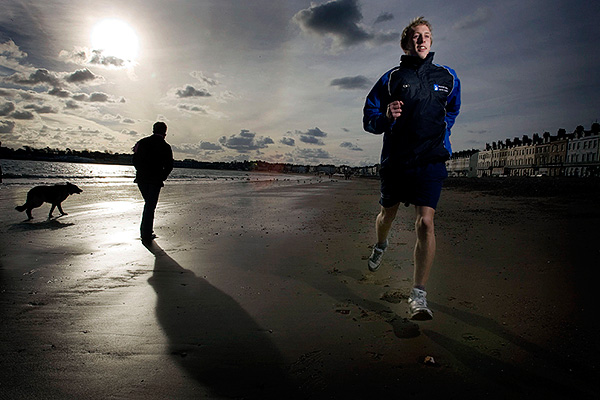
©Neil Turner/TSL | Weymouth, Dorset | December 2007

Being a photographer is usually part of a process. Images are commissioned, stories are bought and sold, edits are done and newspapers are printed. It’s a big and complicated jigsaw and being the person who operates the camera has to be the best part. There is no such thing as a run of the mill commission, but the process often goes like this;

  • The story is commissioned
  • The arrangements are made
  • The photographer is briefed
  • The photographs are taken
  • The edit is done
  • The pages are laid out
  • The newspaper/magazine is printed

There can be upwards of thirty people involved in the whole process and it’s important that the communication is good and that it goes in all directions. Some photographers aren’t as lucky as I am – this piece from the Sports Shooter site is a tongue in cheek rant against bad communications and poor commissioning. Unfortunately lot’s of photographers fail to live up to their obligations, indeed many don’t even recognise that they even have those obligations. It is up to us to talk to the picture editor, the journalist and ask the right questions. Getting the correct information from everyone else in the chain gives the photographer the best possible opportunity to shoot the right photographs and to tell the story in the best way possible. A failure to communicate ties the creative hands of the photographer and drastically reduces their chance of making a great set of pictures.

Sometimes the commissioning editor will forget an important detail, and at other times spelling mistakes and wrong addresses will get in the way of the pictures. Checking details, double checking spellings and discussing the story with the editorial staff will always prove to be time well spent:

  • It helps with the story under discussion
  • It improves your own relationship with the editorial team
  • It goes a little way to improving photographer editorial relations on a world scale!

Of course the picture desk need to do their bit in this vital piece of symbiosis because photographers really appreciate being given accurate information, input into the story and feedback after publication. Two way conversations work, and the industry needs more of them.

There are, apparently, two types of news photographers…

News photography isn’t a huge industry. It employs a few thousand people here in the UK and it’s amazing how many of those know each other, or at least know of each other. That having been said, it’s also amazing that so few people can be divided into so many small pockets. Sports photographers, news photographers, local newspaper photographers and features photographers all come to mind as sub-divisions of the business. Whilst talking to a couple of colleagues the other day I was made aware of another division. A division that you seem to fall on one side or the other of according to the way you see and shoot pictures.

John Redwood MP – back in the day. ©Neil Turner, January 1994

Apparently I’m a “light and shader” whilst my two colleagues referred to themselves as “tight and brights”. They told me that the division here in the UK was broadly along the lines of tabloid versus broadsheet, mass market versus serious. This explanation was both amusing and, in a lot of ways, pleasing. I like to think of myself as a more serious photographer – one whose use of light and shade is central to their style but I was a bit worried that they seemed to be writing off what they do at the same time.

Make no mistake, these are two top class photographers, each with a staff job on one of the two biggest selling newspapers in the country. They provide their picture editors with the right images day in and day out that satisfy the constraints of the designs and the tastes of the readers. Both are also intelligent and articulate journalists and so I did start to wonder whether they were just taking the mickey out of me – implying that I take myself and my work too serioiusly.

The chances are that it is a little of everything. I suspect that they and the other tight and brighters like to differentiate themselves from the mainstream and I also suspect that they envy the small amount of extra creative freedom that the light and shaders seem to get. It also makes you realise how hard the job of wire service and agency photographers must be – satisfying two very distinct markets at the same time and having to have an eye for different types of images on the same job.

No doubt there are other divisions between photographers. I can think of a few other ways of dividing us up: I once heard one of my photographic heroes talking about the “that will do gang” – referring to an attitude amongst some professionals whereby they will do enough to satisfy their brief without going the extra yards let alone the extra mile in order to produce the best work possible that he contended was what made doing the job so satisfying and what made hime rush to get out of bed almost every working day.

I know what he means. I found myself getting excited about shooting an interesting portrait a week or so ago – excited enough that it would be slightly uncool to admit it. I love taking pictures and I love to make use of light and shade. I’ve got to shoot some tight and bright images later this week and I will think of my two tabloid colleagues when I do.

The last refuge of the desperate photographer

Originally posted in January 2009, this piece is one of the ‘new’ technique pieces that I published around that time.

The use of the silhouette as a deliberate ploy in photography was once branded as “the last refuge of the desperate photographer” – a label that I have always contested. I have used the technique many times when I have not been allowed to identify the subject of the picture (usually children or vulnerable adults whose identity needs to be concealed) but I also use it when there is a need for an image with real impact. Creating a silhouette with flash isn’t difficult, using the technique sparingly can be.

Once you have made the decision to try a silhouette using flash, there are a few basics that you need to consider:

  • The subject must have little or no available light on them
  • You must have a background that can be lit easily
  • If the background has important detail you need enough depth of field to keep both subject and background sharp
  • The subject to be silhouetted should be in sharp focus and have a distinct outline

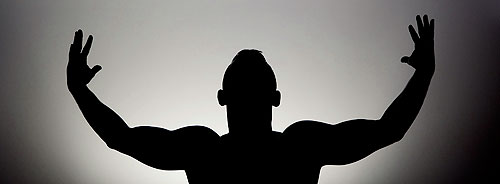
Once the basics are in place, then there are creative decisions to be made such as composition, placement of flash. This first example is of a member of my family who spends time at the gym so that he can show the world his physique. We were chatting one day and he said that he wanted something striking for the top of his Facebook page. I showed him a couple of ideas using silhouettes and we shot this…

©Neil Turner, October 2008

I was shooting with a Canon EOS1D MkII and a Canon 24-70 f2.8L lens. I wasn’t able to move myself around too much without shifting furniture and would have preferred to be shooting nearer the telephoto end of the range to deliberately remove any clutter. As it was, the lens was at 34mm (add the 1.3x factor and you get a 44.2 full frame equivalent field of view) and I cropped the image to the “letterbox” shape.

In this case I used the subject himself to mask the flash which was a Canon 550ex speedlight triggered in manual mode by a Canon ST-E2 transmitter. The first few frames had the background (a wall in my dining room) pretty evenly lit, which was a bit boring. The background is unimportant in this image and so the depth of field doesn’t matter too much. The exposure was 1/90th of a second at f13 on 200 ISO. I don’t recall why the exposure was 1/90th instead of 1/250th to utterly eliminate any available light but in a normal situation I would have gone for 1/250th.

I have some grid attachments for my Lumedyne flash heads and so I taped one of those over the flash to give me more of a circular pool of light. I aimed the flash slightly upwards so that I achieved the effect that you see above. It’s a very simple image that works for the intended purpose very well.

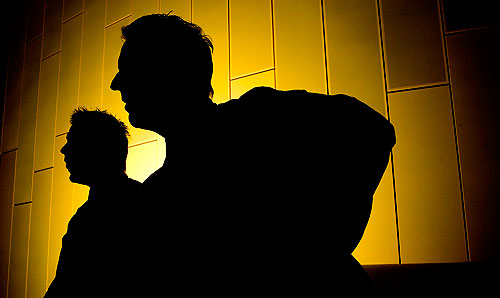
The second example is from a story I shot for a magazine about two brothers who work together at a school in London. I had shot hundreds of images of the buildings and a lot of portraits of the elder brother who is the boss. I had a lot of more conventional portraits of the two of them together as well so I decided to try this two person silhouette which shows the special cladding used throughout the central core of the building.

©Neil Turner, September 2008

The cladding itself has a yellow colour and so I decided to place a Lumedyne flash unit directly behind the seat that they were sitting on. It was very close to the wall, which give far steeper fall off of the light and a more dramatic outline. I find that the best place to focus for a silhouette is on the edge of the subject rather than the normal eye or face. I was shooting with a 16-35 f2.8L lens on a Canon EOS1D MkII at the wide end of the scale and the exposure here was 1/250th at f9.5. The flash was dialed down to 1/8th power and at that aperture I had easily enough depth of field to get the brothers both sharp and to have easily enough detail in the background.

Magazines seem to like this kind of image if they have a spread to fill or they want something a bit different for the contents page. You don’t always have to use flash to create silhouettes but the conditions required in nature to get a good one aren’t easy to arrange! Low level winter sunshine here in the UK is good and of course dusk and dawn without cloud cover anywhere in the world are great. I have also used illuminated signs and billboards when they are bright enough but for the sheer degree of simplicity and control, these flash-lit examples are hard to beat.

Photocalls… aaaargghhh!

On the day when several US wire services took the principled decision not to distribute images from the White House that they had not themselves taken I thought that the timing was right to resurrect one of my own opinion pieces which expresses how I, and many of my colleagues, feel about the pre-arranged photocall. At their very best they can provide useable photographs, but the rest of the time they merely offer up banal images. The question is…does it have to be this way?

Organising photocalls should be a separate profession, but it isn’t. Public relations firms seem to have the knack of setting up ridiculous tableaux with pointless props and “C” list celebrities whilst many companies have their own in-house marketing teams who try to shoehorn as many executives in grey suits into a photograph as possible.

No matter how many of the assembled highly skilled and hugely experienced professional photographers tell the PRs that their idea of a photograph will never make it into their newspapers, the PR people still seem to make it a matter of pride to stop us getting good pictures.

Just when you think it couldn’t become more farcical they hand out the press releases. Many of these documents weigh more than a decent SLR (lens included) and a large photocall may well account for a couple of trees (branches included). How many times do we have to tell the PR people that a single sheet of paper with the relevant names and a one paragraph summary of the event would be a lot more desirable? (and environmentally friendly!). These days the release could even be on a USB memory stick or even passed around by bluetooth, which goes even further to reduce the carbon footprint of the event.

In these days of digital photography and laptops you would think that they would at least organize a bit of space so that some of us could use it to acquire and send our pictures – maybe even lay on some wi-fi. Apparently what is actually needed is some fatty canapes, white tablecloths and wine at 11am. We would really appreciate some thought about parking (not plentiful in London) and rapidly approaching deadlines, but the PR would rather fuss about name badges and being seen to be working hard trying to accommodate some obscure request from someone with little or no need to be there. PRs – get your priorities right!

So, if you are organizing a photocall soon here are some tips:

  • Make sure that the photocall notice is issued in good time and doesn’t make inflated claims about what is on offer.
  • Organize parking or make it clear where the nearest public parking can be found.
  • Keep any signs and logos to a minimum – if it doesn’t need to be there, get rid of it.
  • Welcome photographers and give them a run through of what might be likely to happen.
  • Listen to the constructive criticisms of experienced photographers who will suggest changes and improvements to your plans.
  • Make sure that the photographers are given enough time and space to do their jobs. Keep bystanders at bay and, if you have employed your own photographer, make sure that they allow the invited photographers priority.
  • Provide an accurate and concise press release – it could be on a USB flash stick to save paper and help photographers cut and paste correct spellings
  • Arrange space, power points and even wi-fi connections to enable photographers to file their images

Photocalls are the jobs that none of us want to be sent on. It need not be like that, but a small army of PRs out there seem determined to promote mediocrity and banality.