anecdote

Possibly the oddest picture I ever took…

©Neil Turner/TSL | London | January 2006

The story was simple: we were doing an anonymous interview with a man who needed to remain unidentifiable for legal reasons and we had to shoot a picture of him at a time and a place that wouldn’t give his identity away. It seemed to be important that it was actually him in the picture and that became obvious when I had to shoot a proper portrait at the same time just in case the court case was decided and we needed a proper picture of him to go with a future follow-up article. Still with me?

The reporter arranged that I meet the subject at a London tube station and to get around the problems of finding someone whose name you don’t know and who you don’t have a picture of I always describe myself and what I’m likely to be carrying and wearing because a) I’m probably going to be there first and b) I’m probably going to be easier to spot (being big and carrying a lot of kit).

The venue turned out to be quite close to where he works and we decided that if any of his colleagues happened to spot us the cover story was that we were doing a fashion vox-pop on what the well-dressed office worker was wearing that season. The cloak and dagger details just kept multiplying.

I decided to go with a silhouette (you can read my thoughts on them here) and just for good measure I added an extra twist with a bit of motion blur too. The result was quite striking if bafflingly anonymous!

The technique is pretty simple. It was a dull winter’s morning in the city and we found a under cover area. I used a Lumedyne flash kit to light the brick pillar and silhouetted the subject against it. Without the flash, he would still have been a shadowy outline but so would the pillar and the picture would have been pointless.

The light that was coming from either side of the pillar was OK but it wasn’t plentiful and so I decided to give it a bit of movement blur by zooming the lens whilst the shutter was open. I ended up with an exposure of 1/8th of a second at f13 on 200 ISO using a Canon EOS1D MkII with a Canon 16-35 f2.8L lens triggering the flash with a pair of Pocket Wizards. Zooming during an exposure as relatively short as 1/8th of a second means that you have to have quite a few attempts to get it right and it also pays to tell the subject what you are doing if you don’t want them to think that you are a lunatic!

In the end I was very happy with this genuinely odd picture. I had arrived at the assignment with almost no idea what I was going to do and pretty much made it up as I went along. That’s why I love my job…

Fun picture: stray apostrophes, London.

When the news broke that UK booksellers Waterstone’s were going to drop the apostrophe from their logo to “make things simpler” the story was greeted with a mix of horror, outrage and cynicism. I was part of the cynical camp: what better way to get your company on the news than to pull a stunt like that? Leak a story that you might be about to do something and then sit back and watch it go viral and, more importantly, go viral amongst the very people who would be your core market. It was either brilliant, fortunate or (the least likely in my view) a genuine story.

©Neil Turner/TSL | London | October 2003

I was reminded of the last time that I was involved in a “stray apostrophe” outrage story. Back in 2003, yet another report on the use of punctuation in grammar singled out signs and posters for special criticism and so I was asked to go and find some examples. For a city reputed to have “thousands” of examples I struggled and it wasn’t until I was in the second hour of driving around looking that I finally found this gem on a secondhand video, DVD and CD shop near King’s Cross. The shop was on a one way system with almost no chance of stopping and very little parking nearby but I was desperate and so I went around again, found a parking meter and shot some pictures of the sign. The cafe next door was also the perfect place to have a quick coffee and send my pictures. Job done.

Folio photo #12: Vic Reeves, Kent, May 2006

©Neil Turner/TSL, May 2006

Comedian and writer Vic Reeves (aka Jim Moir) photographed in the back garden of his home in Kent on the day that he and his wife were moving out. We had to shoot in the garden because the house was full of removal men, boxes and the controlled chaos and stress that goes with moving house. He was the complete and consummate professional and I greatly enjoyed photographing him for a feature that was about his time at school. His biography of his early life was just being published as the feature came out.

Archive photo: Inner London Education Authority, April 1990

When the Conservative Government finally abolished the Inner London Education Authority (ILEA) which had shared County Hall with the Greater London Council (GLC) Mrs Thatcher could finally look out of the House of Commons and not be reminded of the opposition that her party had faced from across the river. I was sent to shoot a picture of one of the last people still working at ILEA who had done an interview for the Times Educational Supplement about his work wrapping up the affairs of London’s last unitary body (until the Labour government reestablished a London Mayor’s office in May 2000).

I went equipped with a notional headline of “will the last person to leave County Hall please turn out the lights” and I was very pleased when it turned out that the desk where he was working was in a windowless room in the basement of the beautiful if tatty building. I was even more pleased when I had processed my film and had a look at my pictures.

©Neil Turner. September 1990

For the camera geeks: Nikon F3P with 85mm f1.4 Nikkor and Kodak Tri-X film

Two portraits, one poet and a fifteen year gap…

Working as a photographer you often shoot pictures of people before they become famous and then get to shoot them again once they have “made it”. I don’t know if you can really categorise a poet as ‘famous’ but the British Poet Laureate is about as famous as you can get for poetry. In 2008 and towards the end of his term as Laureate, I photographed Andrew Motion at his London home but this wasn’t my first “one-to-one” with him. Back in 1992 when he was already established as a poet, and just ahead of the publication of his biography of Phillip Larkin, I had taken pictures of him at a different London home.

©Neil Turner/Insight | London | 14th September 1992

A lot of people are a lot more accommodating and easier to photograph before they become famous. They are often friendlier, more likely to offer you a cup of tea and are generally easier to work with. That wasn’t the case with Mr Motion. Back in 1992 I had caught him on a bad day – or at least a day when he had far more pressing matters to attend to than getting his picture taken whereas fifteen and a half years later he was well used to being photographed and had developed an easy manner when dealing with people like me. It could be that I was also fifteen and a half years older and more able to handle myself but whatever the reasons, shooting him in 2008 was a lot easier.

©Neil Turner/TSL | London | 28th March 2008

Of course the technology had moved on: in 1992 I was shooting with Nikon F4S cameras and some lumpy f2.8 Nikkor zoom lenses (35-70 f2.8 and 80-200 f2.8) on black and white film. By 2008 I was onto Canon EOS1D MkII and 20D cameras with some lovely L series Canon lenses and shooting digitally. The quality difference is also very noticeable and I wouldn’t want to shoot film on a job like this again.

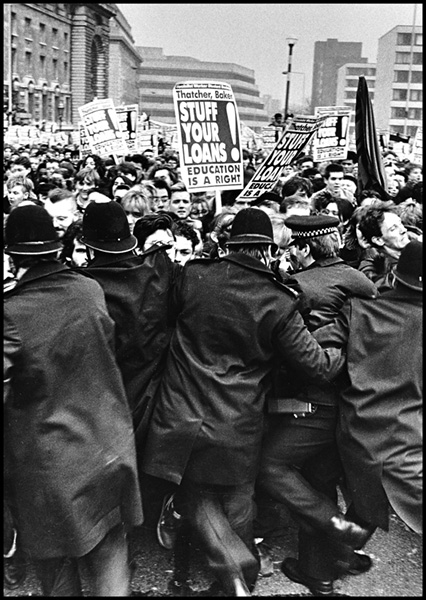
Archive photo: Student demo, London, November 1988

On the day that I got my very first mobile phone I was sent to photograph a student anti-loans demonstration in London. Nobody was expecting anything other than a march by angry students on a very grey day in London. Part of the way through the march there was a large break away group that decided to head for Parliament – which was not on the agreed route. By the time they had broken away and reached the west side of Westminster Bridge the Metropolitan Police already had a cordon across with vans, horses and a large number of officers. Scuffles, charges and fights ensued but the police line held and the students never made it to Parliament – less than 200 metres away.

Photo: © Neil Turner | 24 November 1988

Contrast this photo with the student riots of 2011: the police are wearing no special clothing, no high visibility jackets, no shields and there was no overt photographing or filming of the students either. No buildings were ransacked, damaged or invaded and the whole thing felt relatively civilised. It did feel weird to be able to talk to reporters, other photographers and even the picture desk on the phone in the middle of a mini-riot: my phone was a Motorola 8000s which was known as the “City Brick” because it was so big and bulky.

Unfortunately, the story doesn’t have a happy ending (apart from two front pages and a ‘congratulations’ from the editor). A few years before, I had broken a toe playing cricket and during the demo I had the same toe re-broken when a police horse moved backwards and trapped me between it and a van, crushing my toe. As a freelance, I couldn’t afford any time off so I limped from job to job over the following three or four weeks to Christmas. I also had a lens damaged and wasn’t properly insured so my old 35mm f2.8 Nikkor was replaced with a newer 35mm f2.

The camera and lens combo here was a Nikon FM with a 35mm f2.8 Nikkor using Kodak Tri-X film.

Archive photo: Special needs school, March 1990

Following on from the March 1990 Conductive Education picture that I posted earlier in the week I remembered another special needs picture that I shot a short while later. As it turns out, exactly four weeks later. This shot isn’t as technically sound or as well composed as the previous picture but it does mean a lot to me – because there is a real story to go with it.

© Neil Turner | 30 March 1990 | Southampton

This boy had a target of learning to do up his own zip and was determined to succeed for the camera. I was touched by him and his determination and so I stayed with him whilst he kept trying. After nearly ten minutes he succeeded and I was very nearly in tears. One of the staff had been watching and she was in tears. I have never forgotten that moment.

For the geeks out there, the camera was a Nikon F3P, the lens was a 24mm f2 Nikkor and it was shot on Kodak Tri-X film.

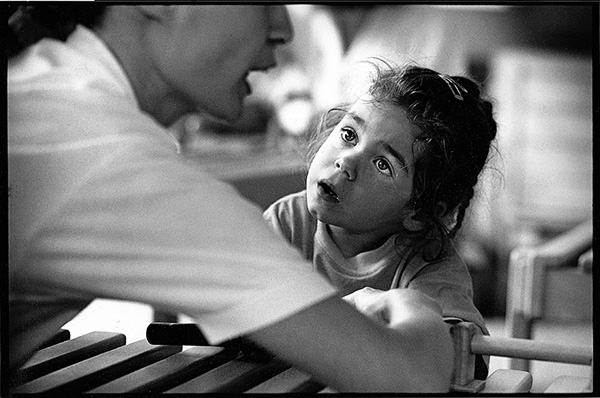
Archive photo: Conductive education, Sussex, March 1990

Please note that I have made a small correction to the caption. The pictures were taken a year later than I originally thought.

©Neil Turner, March 1990

This assignment opened my eyes to a whole world of education. I was fascinated by the ‘special needs’ systems that had grown up in the UK to try to provide a combination of tuition and therapies for children whose families were trying to do the very best for them. On this job I was working with a committed reporter who did her best to bring me up to speed on all of the terminology used in the field and years later I found myself telling younger reporters how things were. To this day, disability remains a topic that I get real satisfaction from showing to the world.

Young child who has cerebral palsy having a physiotherapy session at a residential school in West Sussex under the Conductive Therapy regime. This technique was brought to the UK from Hungary where therapists, known as conductors, use a range of very intensive methods to try to get children who have very badly compromised motor skills to walk unaided.

Judging from the date, I expect that this picture was shot on a Nikon FM2 with a 135mm f2 Nikkor. The film is Kodak Tri-X.