Neil

Fun photo: Free cash machine

If only…

Moordown, Bournemouth. ©Neil Turner, December 2011

When Time Out did real news…

Right back in the early days of Insight Photographers, the small agency that we ran from an office in the rather un-trendy (how times change) Hoxton area of London, we used to shoot a lot of stories for Time Out magazine. Some weeks they would have five or six pages of real news and they used to commission some nice work too. One of my favourites from that era was this picture of a man who was part of a group of residents and squatters trying to stop the Department of Transport from bulldozing their houses to build a new piece of road in the Archway/Highgate area intended to speed up the journey up the A1 from Holloway (bear with me if the geography of north London bores you). When I arrived on a hot day from the a brisk walk up from the underground station the bailiffs had gone.

Archway Jack. ©Neil Turner/Insight, May 1989

I found this chap looking rather pleased with himself and asked what had gone on. He just smiled and said “we’ve seen them off”. I asked him if it was OK if I shot his portrait and he agreed. After that, I got my notebook out and asked him his name. He thought about it for a few seconds and then said “call me Jack… Archway Jack”. Of course I asked if that was his real name but he smiled and walked off trying to whistle a tune.

The News Editor somehow tracked him down, got some good quotes from him and the story probably got more space than a simple eviction piece would have. A definite case of “just because the story you were expecting didn’t work out, it doesn’t mean you haven’t got a good story anyway”. All of the Time Out news reporters and editors that I recall went on to do great things. I guess that it was a mix of choosing the right people and being a great place to hone those journalism skills. Quite a few of the freelance photographers that they used did OK too.

This was shot on Kodak Tri-X film using a Nikon FM2 camera and a 24mm f2 Nikkor lens

Resolution, and not just for the new year…

When a member of my family asked me earlier this week what my ‘new year resolution’ was, I was tempted to answer “300 dpi”. I would have laughed but I’m afraid that the rest of the family would have just given me that old-fashioned look that says “Neil is laughing at his stupid jokes again”. For the record I want to get fitter, lose some weight, shoot better pictures and love everyone.

To photographers, designers and anyone else who handles photographs resolution is an important concept. Get a few photographers together and someone will complain about a client whose comprehension of the concept of resolution is so poor that they have rejected huge files just because they hadn’t been saved at 300 dpi. What is 300 dpi anyway? Does it have any relevance in todays’ digital world?

Put simply, DPI is an output term. It describes the number of dots per inch that the printing system will place onto the paper and, generally speaking, the more dots you have the better the quality. Of course if you have cheap paper that soaks up ink too many dots just produces a mulchy mess. Newspaper quality is a case in point: try to stick more than the right amount of ink down and the paper will get soggy and rip whilst going through the presses. Your inkjet printer at home might be capable of 2,880 dots per inch but that doesn’t mean that you have to save your pictures at that size. So much software these days has the ability to re-size and re-interpret images to make them work.

Don’t get me wrong, it is always best to send pictures to commercial printers or reproduction houses at the right size at the correct resolution and properly sharpened but some of the nonsense talked by people who don’t understand is very frustrating.

Photographs are actually measured in pixels per inch or pixels per centimetre but even that misses the point. What actually matters is the number of pixels that make up the image. You can have a picture that measures 3,000 pixels along one side and 2,000 pixels along the other (6 million pixels in all) and that is really the important fact. At 72 pixels per inch (the normal internet resolution) that would appear as a huge picture. If the same 3k x 2k pixel image was saved at 150 pixels per inch (about normal for newsprint) it would still be 50cm wide whereas at 300 ppi it would be 25cm wide. Actually switching between resolutions is easy and it makes no difference to the image quality (unless you repeatedly re-save in a lossy format such as Jpeg). All that really matters is the number of pixels.

Even going back to the days of scanning negatives on the venerable Kodak RFS machines into Photoshop version 2.5 where an original 35mm image measured 24mm x 36mm (that’s 864 sq mm) meant that every picture was still 24mm x 36mm but had a resolution measuring up 2500 ppi it was a few clicks of the mouse to change the picture to the required resolution at the required size with no damage done – with the possible exception that the low power of the computers meant that it took more than a few seconds.

Exactly who trained these people who don’t get this concept is beyond me. It is as simple as it is logical. My new year resolution is, therefore NOT 300dpi. I’m going for 254 ppi or 100 ppcm along with a bookmarked link to this blog piece so that I can refer people to it as, and when, required.

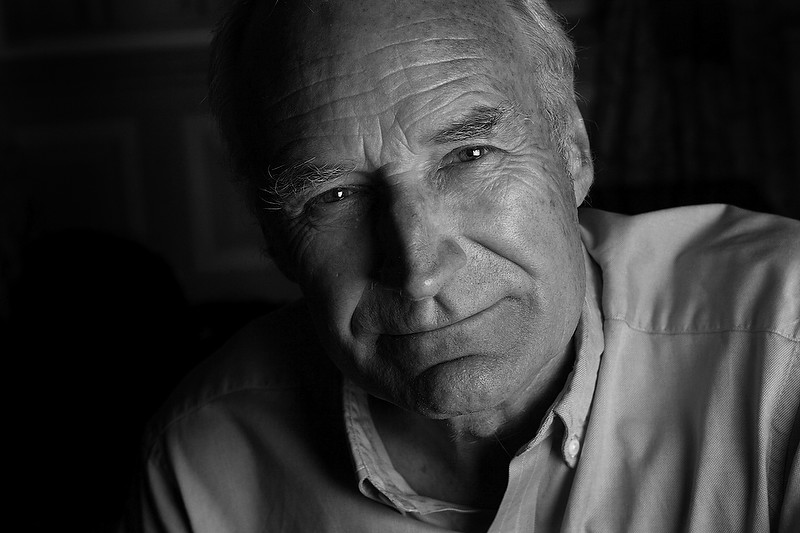
Folio photo #08: Peter Snow, London, May 2004

©Neil Turner/TSL, May 2004

Peter Snow, BBC sephologist, journalist and newsreader photographed after an interview at a central London hotel for a “My Best Teacher” feature for the TES Magazine.

He had a book and a TV series with his historian son at the time and the interview was one of a long series that he had already done that day. The room was cramped and poorly lit and so I used a medium sized soft box very close to him to keep as much light off of the background as possible. One picture editor that I worked with used to call this very tight crop the “egg cup” because it was as if someone had flattened the top just like one.

Wordsworth fun picture, December 2011

Lake District, December 2011. ©Neil Turner

The motto of Christmas 2011… and post No.50!

Folio photo #04: BMX rider, May 2011

©Neil Turner

©Neil Turner, May 2011

BMX rider Keegan Walker practicing his skills at the Ringwood skate park in the evening after work. This was shot as part of a technique ‘how to do it’ article for Photography Monthly magazine. I’ve had a really interesting relationship with the magazine for the past couple of years in which they have given me free reign to go and shoot pictures that I want to, write about how I did them and simultaneously earn some money AND get some pretty decent portfolio pictures too.

While shooting this particular assignment I found myself having to ask Keegan to be a little more conservative with the height he was getting off of the ramp. Too much space in between him and the ramp just looked silly – believe me, this guy is really good and was very capable of getting more ‘air’ than you see in my pictures. This shot was right at the end of the session when the sun had just gone down and the light was fading fast – my absolute favourite time of day to shoot pictures.

Welcome to the new Blog…

I have finally done it. The pre-blog was intended to last about six months and it made it past three years. I have finally found the time to migrate a lot of the newer posts to this shiny new WordPress version with all of the bells and whistles that you’d expect from a templated site.

When I get time, I will migrate even more of the old content over to here so that it can be better indexed, more easily searched for and release some space on my main dg28 site. To those of you who have followed the blog patiently checking back from time to time I’d like to say ‘thank you for your patience’ and to let you know that the RSS feed is up and running.

It’s not really that funny…

I’ve just had yet another conversation with a keen photographer who wants to become a photojournalist. For the sake of anonymity, let’s call him Charlie. I have quite a few of these chats and they regularly leave me feeling in need of a joke or two to help overcome the worries I have for some of these (mostly) young people looking for the right career. Last year I uploaded a load of photographer based jokes to a web forum where a lot of news, sports and press photographers hang out. You know the kind of thing:

Q. How many photojournalists does it take to change a lightbulb?
A. None – they aren’t allowed to change anything…

The silly thing is that I spent several minutes agonizing over whether to answer the question as ‘we’ or ‘they’. Am I a photojournalist or aren’t I? In the end, I chickened out and went with they telling myself that just because I used ‘they’ it didn’t mean that I couldn’t count myself in. Typical cop-out!

There were plenty more jokes in a similar vein:

Q. How many art directors does it take to change a lightbulb?
A. Does it have to be a lightbulb?

Q. How many newspaper photographers does it take to change a lightbulb?
A. No time for that, just stick the ISO up to 6400 and shoot it with available light.

I think that the list (and my colleagues’ patience) eventually stretched to ten lightbulb jokes and I’m pretty sure that I could have managed a few more.

Anyway, let’s get back to the point of this blog post. I was talking to Charlie (our potential student) a few weeks ago and I was telling him how tough the market is right now and how competitive it is to even get a foot on the ladder. I pointed out that news photography and photojournalism were careers in which you were most unlikely to ever make a lot of money and I even told him the other photographer joke that I know: “What is the best way to make a small fortune in photojournalism? Start with a large fortune!”

Charlie was still keen and was still interested in studying the subject but there was something about him and his manner that made me think that he still didn’t really understand what the job was really about and how tough it would be – even if the economy made a rapid recovery and even if advertising revenues came back to newspapers and magazines in sufficient quantities to help remove some of the financial pressures that we battle with every day. We shook hands, I gave him my card and offered to talk again if needs be.

He rang me this morning saying that he had been to a university for an interview where they were offering him a place on a three-year degree course at huge expense and that my opinion of the current market was not shared by the teachers he had met there. They had sold him the dream and he was considering buying into it. Don’t get me wrong, being a photographer and working for the media is often exciting, regularly rewarding and always unpredictable but I am worried by educators selling courses that are largely not fit for purpose. These days a three year degree is a huge investment to make and I have written before about the pros and cons of formal study versus the kind of shorter course (that I now teach on) versus learning as you go.

My main advice to Charlie was to consider what the worst thing that could happen if he did the course and in three years time he had £30,000 worth of debts and no clear idea how he was going to start to earn enough to repay the money. That was a question his parents had asked and he said he had ignored. Now that someone from within the business was asking it he seemed to take it more seriously. It was a telephone conversation but I could sense that his passion for photography had become more real since we had first met. It seemed to me that he had been bitten by the bug.

We talked a little more and I suddenly remembered two more photographer lines that always make me smile:

(Tongue in cheek)

You know when you are a photographer when…

Somebody asks you what your favourite colour is and you consider answering “18% grey”.
Somebody asks what your lucky number is and you find yourself wanting to say “1.4”.

There you go – I’m smiling again. Good luck Charlie… (even if that’s not your real name)