work

Education… over on EPUK…

I write a lot for other websites and towards the end of last year the Editor of the Editorial Photographers UK site asked me to write something about photography education. It started like this:

What price your dream?

In Britain a staggering 1600 photography courses will be touting for students in 2012. Neil Turner, professional photographer and tutor on a new photojournalism course that starts in Bournemouth this month, asks whether enough of these courses actually prepare students for the harsh realities of professional photography today.

If you get a dozen professional photographers together and ask them about the state, standard and suitability of photographic education in this country you’ll get two dozen anecdotes about graduates who don’t know their arse from their f-stop, and a consensus that higher education is failing the students and the industry. Is this true? Are we missing something, or is the system getting it wrong big-time?

If you’d like to read the rest, you can go to THE EPUK WEBSITE

…and we’re off

20120101-200818.jpg

©Neil Turner, March 2010

The sub heading of this blog is “me writing about photography because I want to” and that’s the truth. Post number 47 and it’s the start of month two.

2012 is underway and I’m planning to do quite a lot of blogging as the year goes by. I’m going to talk about education, press photography, photojournalism, light, technology, workflow, software, cameras and just about anything else that I come across in the day job.

If you read the blog and come up with any questions for me please let me have them. In the mean time, let’s hope that 2012 serves us all well.

Waiting for the light, June 2011

There’s good light, there’s bad light and there is the right light. Sometimes the right light isn’t the good light and so on and so on…

Beautiful pool of light in the Jubilee Place shopping mall

Beautiful pool of light in the Jubilee Place shopping mall at Canary Wharf. © Neil Turner

One day earlier this year I was waiting for the right light to shoot a picture of crowded shopping mall when the ‘good light’ turned up. I took a picture that the client had no use for but it amused me and kept me interested. Pools of ambient light in just the right place happen on the right day, in the right place at the right time – if the weather is right. The rest of the time, if your patience isn’t good enough or the parking meter is running out you have to shoot with whatever is there or provide your own light.

I have enough patience to get the shot that the client asked for and I had enough spare time to wait for someone to walk through this shot. I have twenty variations on it with sixteen different people walking through but I like the way that this man looks.

Folio photo #04: BMX rider, May 2011

©Neil Turner

©Neil Turner, May 2011

BMX rider Keegan Walker practicing his skills at the Ringwood skate park in the evening after work. This was shot as part of a technique ‘how to do it’ article for Photography Monthly magazine. I’ve had a really interesting relationship with the magazine for the past couple of years in which they have given me free reign to go and shoot pictures that I want to, write about how I did them and simultaneously earn some money AND get some pretty decent portfolio pictures too.

While shooting this particular assignment I found myself having to ask Keegan to be a little more conservative with the height he was getting off of the ramp. Too much space in between him and the ramp just looked silly – believe me, this guy is really good and was very capable of getting more ‘air’ than you see in my pictures. This shot was right at the end of the session when the sun had just gone down and the light was fading fast – my absolute favourite time of day to shoot pictures.

Table top still life and the news photographer

Most press photographers will have lost count of the number of times they have been called into the office of the newspaper they are working for to ‘do a quick still life’. These vary from the simplest product shot to some interesting concept ideas. I thought that I’d share a few with you here:

This slideshow requires JavaScript.

As you can see, I sometimes go to town with them and the stories you see illustrated here are about:

  • The risks of cloning and everyone looking and doing the same (rubber ducks)
  • Managing your credit (cutting up credit card)
  • Handling your savings (fist full of bank notes)
  • The aftermath of a school fire (melted clock)
  • A debate about healthy eating versus too many sweets (cauliflower and mars bar)
  • Reading the fine print in a new employment contract (magnifying glass)
  • Taking a chance with the school your child is going to (rolling the dice)
  • The high cost of housing in certain parts of the country (Monopoly houses on the map)

The main idea is to us decent light, keep the idea simple and not be tempted to try to do too large a picture in the cramped and messy confines of the office. I deliberately added the rolling dice idea because we had some giant dice available, I had an intern to help throw them and there was a nice piece of open ground nearby on a lovely sunny day.

Studio based still life photography is a tough discipline and we still get asked to do creative stuff that should be done “properly”. It has been said that press photographers make great all-rounders because we have to think on our feet and adapt all of the time: I won’t be arguing against that one!

Folio photo #03: Primed for disaster

©Neil Turner, March 2009

Visiting business “guru” lecturer Richard Roberts from GE Capital explains the subprime mortgage crisis to sixth form business and economics students at a Camden secondary school. This was shot as part of a story about a school doing everything it could to give their sixth form students as many extra opportunities as possible. The set included portraits of the head teacher, vox-pops of other students and audience shots of the sixth formers.

Professionalism 101 (or P101 for short)

©Neil Turner/TSL

The hardest part of the transition from good photographer to professional photographer is in understanding the difference between the two. I once wrote that the best definition of “professional” is someone who gets the shot 99.9% of the time and has a damned good excuse for the rest. Still true, but professionalism has another side to it – one that can be learned pretty easily.

Clients are used to dealing with professionals: Slick presentation, questions being answered before they are asked and great customer service. These are all things that we expect as consumers and in business we expect even more. As a professional, you are in a market place and you have to compete.

We work in an image-conscious business and we live in an increasingly image-conscious world. Even as self-employed freelancers we need to have corporate identities of our own. The vast majority of our clients have proper business cards and 99.9% of them have email addresses that tell you who they are and who they work for.

I am constantly amazed by the number of decent photographers who hand out slightly apologetic home-made inkjet printed cards and I’m shocked by the number of Yahoo and Hotmail accounts that people rely on. Webmail is useful but it does nothing to positively affirm you as a professional. Buying and running your own web domain is not difficult or expensive and it really helps to give potential customers the impression that you are in business and that you have been for some time. If your email address matches your portfolio website there is a certain synergy. If your on-line presence is a gallery on Flickr and your email is london-snapper@webmail.com then you really are missing a trick.

Keeping everything the same, presenting a corporate image and playing the game doesn’t detract from your photography. Quite the opposite; it removes a potential barrier to clients taking you seriously. Having a well-designed and easily navigated portfolio on the internet is almost as important as owning a camera. Being a member of at least one of the professional bodies that offer searchable freelance directories is also a very good idea.

Moving on in the story a little, you have met the client, they like your folio and they give you some work. Professionalism moves up a gear and this is your first job for them so you cannot make presentational mistakes now. Be clear when accepting the commission what the fees and expenses are, what rights you are selling them and what they are expecting from you. Get technical specifications, deadlines, delivery addresses (FTP, email or postal) sorted out and then go and do what you are there to do – shoot the pictures.

Let’s say, for arguments sake that the job requires a CD with twenty high-resolution, post-produced RGB JPEG files in the post. P101 says that the client will be used to proper presentation and so your CD should not be a PC World own brand disc with a few illegible words written in marker pen in a cracked plastic case. Printing proper CD labels is very cheap. Getting discs printed on an upmarket Inkjet printer isn’t expensive and having a few hundred professionally screen-printed will not break the bank. Slim CD cases are OK but softer plastic flexible cases are better and they will cope with the postal system far better. Of course the disc should be labelled with the date but the main impression should be that this came from Joe Bloggs – professional. The packaging should be professional, the label on the outside should be neat and tidy and you should have a properly printed compliment slip in there too.

None of this makes you a better photographer, none of this will actually impress the client. But none of this costs much money either. What it will do is not raise any negative thoughts. The hand written scrawl on the cheap disc stands a good chance of making a negative impression – yet hundreds of photographers still do it.

So what about what is actually on the disc. There are the pictures of course. It’s important to make sure that they meet any specification given to you by the client and it’s also vital to make sure that the client can open the disc on whatever system they use – but what else? Make space on the disc for a PDF file containing licensing information and a second PDF with the caption details (it’s amazing how many picture buyers still don’t understand or see the metadata that you embed in the images). For some clients a set of clearly marked low resolution, screen sized sRGB JPEGs can be useful too.

Going deeper still, think about the metadata that you attach to the files. Professionals have to add IPTC caption details. Who, what, why, when and where. No matter which imaging application you use you have to put into words what is in the picture – which balding middle aged man is which, where they were taken with a date and possibly a time. You also have to add your details. Stamp your identity right there in the metadata. Use the © symbol liberally so that everyone knows who owns the pictures. The tricky thing here is to know which box you put this information into. Many newspapers want you to put everything into the main caption/description box. Others only want the names and places in the main box. Most magazines and commercial clients don’t have a preference. If in doubt put it all in the main caption/description box and add it all in the other relevant boxes too.

Metadata has another face – EXIF. These are the shooting details that your camera will add to digital files. Some are useful – time, day and date. Others are annoying – which lens, shutter speed, white balance. Does the client need to know this stuff? Probably not – so delete it.

This is not rocket science 101. This is, however, a very competitive market. P101 says that you have to do everything that you can to give the client confidence that you are a pro and that you will deliver the goods. I was giving a talk on this very topic at a college when a very-self-assured young man told me that he wasn’t interested in any of this “plastic b******t” and that his clients would have to take him for what he was – an excellent photographer. This kind of approach might have worked twenty years ago but it doesn’t have a snowball-in-hell’s chance in the 21st Century.

Having a “USP” (unique selling point) is a great idea as a photographer, but being the one who eschews good presentation and good practice is a pointlessly high-risk strategy. If you want to take pictures for a living, you have to get people to pay you. Most of the people who control the market place wear suits and respond well to corporate image. It’s a game and you would be well advised to play it.
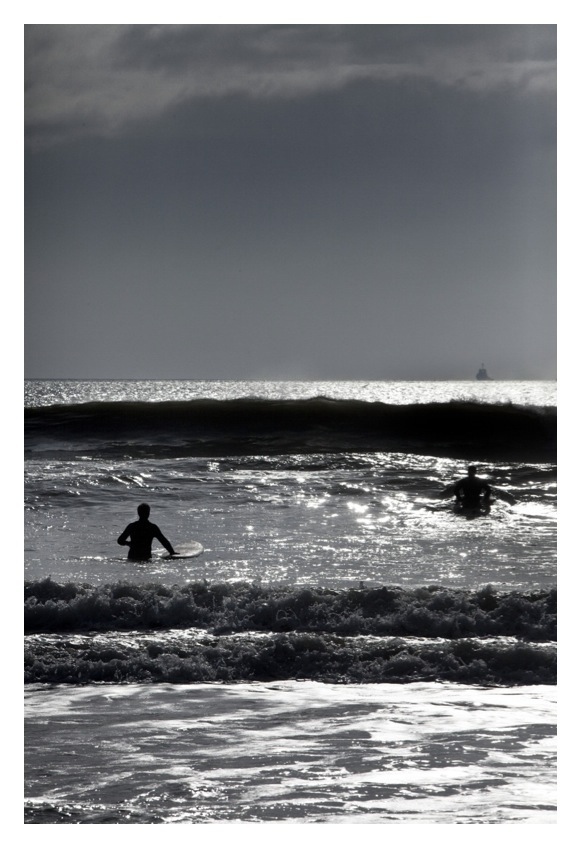
Shooting in less than favourable weather.

Another re-posting; this time posted in April 2009 but from a job that I shot in 2006…

One of the best things about being a photographer is that you get to do some pretty odd things. Sometimes you climb to the top of a tall building and have a look at the view. At other times you get to meet interesting and amazing people and take their pictures. At other times you have to get up early on a bleak winter’s day, go to the beach, wade into the water just after dawn to get the tide and the picture. It all adds to the fun of the job.

©Neil Turner/TSL

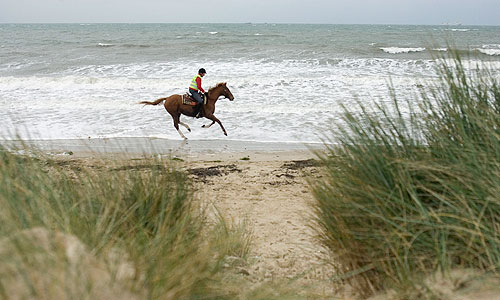
I shot this commission a while ago and I have been meaning to write it up since then. The story was about a school head teacher who owns a horse that she keeps in stables near the sea. She refers to her horse as her “work life balance” – something that we all need, but few of us have quite such a visible symbol of it!

Being a teacher, she is at school most days. During the holidays she gets away to the coast and rides whenever she can and if the tide is right she can ride on the beach. It was an October morning and we met at dawn in the car park near the stables. My brief was to get a double page spread for a magazine which showed her enjoying herself.

Of course photographers rarely get to choose the weather and it was raining with a reasonably strong wind. The tide was just right (we checked the tables in advance) and so we started to shoot some pictures of her riding on the sand. It’s a stretch of coast that I know well and I knew that there was a high chance of poor weather. There’s nothing that you can do when the deadline is tight except to shoot the best pictures that you can.

The picture above was taken towards the end of the session and by this time it was getting lighter. The exposure was up to 1/500th of a second at f3.5 on a 24-70 f2.8L lens. We had started at 1/125th at f2.8 and the light was doubling every twenty minutes or so. Unusually for me I shot this job without lights, without flash – just good old ambient. Had there been any sunshine, there would have been the complicating factor of having to shoot almost directly into the sun if I wanted to stay on the beach.

Most of the pictures were taken on a 70-200 f2.8L lens and I made use of a monopod whilst the light was low. I shoot on beaches quite a lot and I always take a large piece of plastic to sit my camera bag and anything else that I put down onto. If the plastic sheet is big enough, you can also use it to wrap everything but sand still gets in and salt still seems to coat everything.

©Neil Turner/TSL

I always try to give picture editors a lot of choice and to give them small “drop-in” pictures to use if they need a second or third image for an article. The wider the variety of magazines and papers that I work for, the more I find that the drop-in picture gets used in unusual and creative ways. Magazine clients appreciate choice.

©Neil Turner/TSL

The reason that I wanted to mention this job was the combination of the early start, the poor light, the wind, the rain and getting absolutely soaking wet wading knee deep into the sea. Maybe it was because of all of these factors that I enjoyed it – who knows.

I wrote a while ago about my addiction to Timberland boots and I was very grateful for them on this job. My jeans were wet but my feet stayed dry.