press

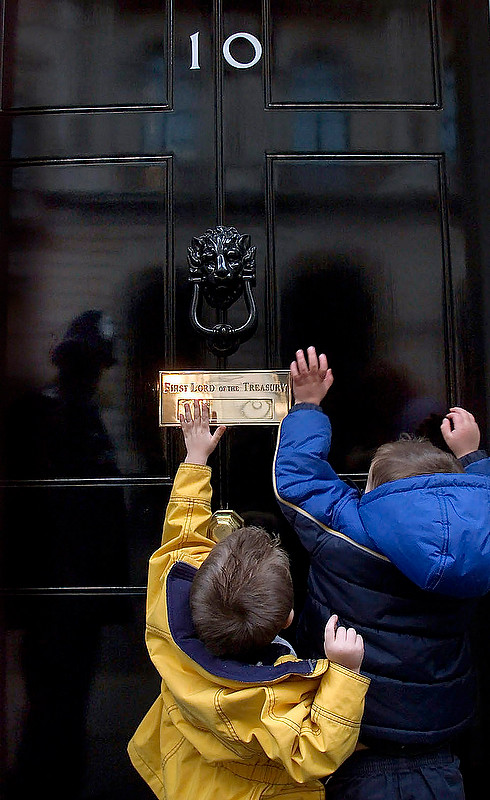
Folio photo #06: 10 Downing Street, November 2001.

©Neil Turner/TSL November 2001

Children from a Leicestershire nursery school try to hand in their petition against closure to No.10 Downing Street.

This was a very ordinary story about yet another petition being handed in at No.10 which became extraordinary when the Police Officer on duty allowed the two children to try to knock on the door and then stood back and laughed as they kept trying.

It was a very cute moment on a day where the world’s media were not watching and the reflection of the officer in the shiny black door makes this a favourite picture of mine. They never reached the door knocker and so the officer eventually helped them out by knocking it for them.

Folio photo #05: CEO portrait with tungsten light, August 2006

©Neil Turner/TSL, August 2006

In 2006 Ian Smith was the Chief Executive Officer (CEO) of Oracle the software company based in the City of London. This business portrait was actually taken for the Times higher Education Supplement who were running a piece about Oracle’s connections with the education industry. The portrait itself was shot in under two minutes but I had set up with a ‘stand-in’ who posed for some test pictures for fifteen minutes before Mr Smith was available.

The really interesting thing about this portrait is that it was shot with deliberately mixed lighting: tungsten gelled flash on the subject and daylight behind with the camera on a custom white balance which was only concerned with the flash. I use this set of pictures a lot when I am teaching my location lighting seminars.

Mad sky, madder lighting…

Even though it was well over 12 years ago I can still remember standing on a pavement outside a rather dull new building on the University of Southampton campus which wasn’t actually open or even finished and thinking “how am I going to pull this one off?” Normally with architecture news jobs you can rely on having somebody walking past or an interesting view from inside out but on this one… nothing.

©Neil Turner/TSL, October 1999

I messed about for half an hour trying to get an angle on the structure that didn’t show cranes, builders doing the finishing touches or plastic barriers. Miserable failure. There was one redeeming feature though – the sky was a beautiful deep and even blue. I’m no great fan of polarising filters but this was calling out for that kind of treatment so I grabbed my flash gear from the car and decided to underexpose the sky and get as much light into the foreground as I could. That meant giving full power up into the street lamp that helped the composition which also meant that I could underexpose the sky nicely.

©Neil Turner/TSL, October 1999

After that my mind started racing and I decided to go for something so over the top that even I would have bet the Picture Editor would have laughed as she put it into the dustbin.

The red in the street lamp was achieved by using a red narrow cut colour effects lighting gel over the flash, which was on full power and raised as high as I could get it so that the red would balance against the saturated and underexposed sky.

This was the first time that I had tried anything like this and the great thing is that I was wrong. They used the mad picture…

Some 11 year old thoughts on lens selection…

Choosing the right lens for the job – written in 2000 for http://www.DPReview.com and it still pretty much stands up today – which cannot be said for everything that I thought that I knew when I’d only been in the profession for 14 years!

There are two ways that you can choose which of your lenses to stick on the camera:

  • You can say “there’s my subject and here I am, let’s see which focal length on my zoom works best”.  Sometimes at sports matches and political events you have your position and that is that, or…
  • You could say “I want the effect that my experience tells me a 28mm lens will give me so I’ll select that focal length and move to the right position to make that happen”.

Either of these could be a valid option and, in many cases, the first is decided for you by circumstance. Most news photographers use zoom lenses because it makes sense to have fewer lenses when you are never quite sure what kind of work you will be doing on any given day.

Personally, I use a combination of both approaches. If a position forces me to choose a certain lens then I’m with option 1. Given complete freedom to shoot what I want I’d go with 2. More often than not I’ll go with, say a 24-70mm lens intending to shoot at the 24mm end and get in a position to shoot that way. I will shoot several frames and then start to move around, zoom in and out and shoot a variety of similar images, each with subtle differences. I try to make a point of shooting with just about every focal length available to me on every job. Sometimes I am right about lenses first time but often I’m not. What had seemed like an obvious task for the 28mm ends up being a spectacular 200mm shot and vice-versa but the result is that you often end up with images that are just that bit better.

I nearly always shoot on location so I cannot preplan every detail. Going equipped with a range of lenses is vital. Your choice of lens will depend on so many questions running through your mind. How is this image going to be used? Big, small, upright, horizontal, front page? Double page, back page, website, magazine or newspaper? Is it going to have copy running over it? Will it have more than one usage?

If I cannot answer any or all of those questions, then I’ll shoot every variation I can. Shall I start with a long lens, if it’s a portrait then being further away may relax the subject and I’ll get in with the wide when they are more comfortable. Background, what’s behind them? Can I use a change of lens get rid of a poor background?

Answering self-set questions and making compromises is the key to news photography. Choosing the right lenses helps to reduce the number of technical compromises that you are forced to take, giving you more time to make the creative compromises that you want to make.
Folio photo #04: BMX rider, May 2011

©Neil Turner

©Neil Turner, May 2011

BMX rider Keegan Walker practicing his skills at the Ringwood skate park in the evening after work. This was shot as part of a technique ‘how to do it’ article for Photography Monthly magazine. I’ve had a really interesting relationship with the magazine for the past couple of years in which they have given me free reign to go and shoot pictures that I want to, write about how I did them and simultaneously earn some money AND get some pretty decent portfolio pictures too.

While shooting this particular assignment I found myself having to ask Keegan to be a little more conservative with the height he was getting off of the ramp. Too much space in between him and the ramp just looked silly – believe me, this guy is really good and was very capable of getting more ‘air’ than you see in my pictures. This shot was right at the end of the session when the sun had just gone down and the light was fading fast – my absolute favourite time of day to shoot pictures.

Table top still life and the news photographer

Most press photographers will have lost count of the number of times they have been called into the office of the newspaper they are working for to ‘do a quick still life’. These vary from the simplest product shot to some interesting concept ideas. I thought that I’d share a few with you here:

This slideshow requires JavaScript.

As you can see, I sometimes go to town with them and the stories you see illustrated here are about:

  • The risks of cloning and everyone looking and doing the same (rubber ducks)
  • Managing your credit (cutting up credit card)
  • Handling your savings (fist full of bank notes)
  • The aftermath of a school fire (melted clock)
  • A debate about healthy eating versus too many sweets (cauliflower and mars bar)
  • Reading the fine print in a new employment contract (magnifying glass)
  • Taking a chance with the school your child is going to (rolling the dice)
  • The high cost of housing in certain parts of the country (Monopoly houses on the map)

The main idea is to us decent light, keep the idea simple and not be tempted to try to do too large a picture in the cramped and messy confines of the office. I deliberately added the rolling dice idea because we had some giant dice available, I had an intern to help throw them and there was a nice piece of open ground nearby on a lovely sunny day.

Studio based still life photography is a tough discipline and we still get asked to do creative stuff that should be done “properly”. It has been said that press photographers make great all-rounders because we have to think on our feet and adapt all of the time: I won’t be arguing against that one!

Folio photo #03: Primed for disaster

©Neil Turner, March 2009

Visiting business “guru” lecturer Richard Roberts from GE Capital explains the subprime mortgage crisis to sixth form business and economics students at a Camden secondary school. This was shot as part of a story about a school doing everything it could to give their sixth form students as many extra opportunities as possible. The set included portraits of the head teacher, vox-pops of other students and audience shots of the sixth formers.

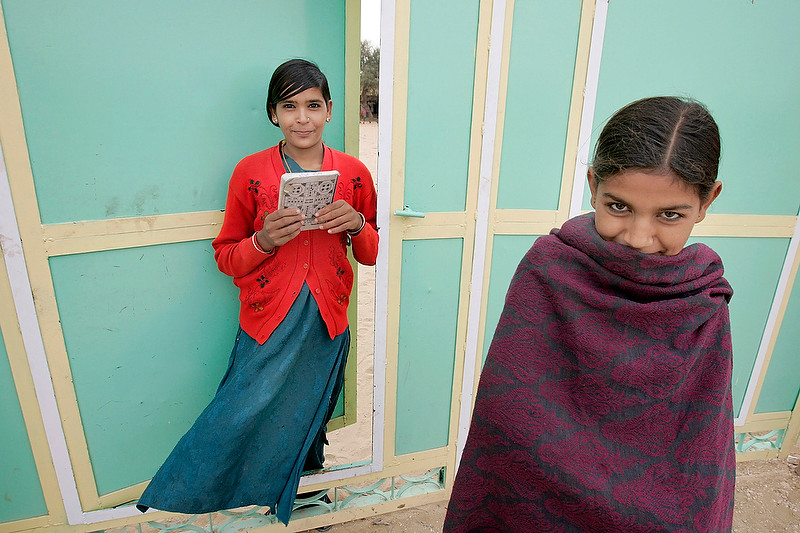
Folio photo #02: Girls’ education project, Rajasthan

©Neil Turner/TSL, May 2005

The UK based charity SAVE THE CHILDREN funds a scheme in northern Rajasthan to allow girls between 12 and 15 years old who do not get access to education to come to a boarding centre for a few months in which time they cover the syllabus normally expected to take five years. The students take it in turns to do chores such as fetching water and washing clothes but still take books to read as they work. This picture was taken at dawn when some of the girls were already reading whilst others were fetching water, fuel and cooking breakfast.