careful

Adobe Photoshop CS6 Beta

Like half of the photo geeks around the world, I have downloaded and started to play with the public beta version of Adobe’s latest version of Photoshop: CS6. This is a major revision of the software in terms of the interface which looks a lot more like Lightroom than ever before and is also a lot less “freestyle” than those used to versions such as CS3 and earlier would be familiar with. We now have a fixed window rather than the floating elements of previous versions and this will take quite a bit of time for me to get used to. It isn’t that I don’t like it, it’s just that it is a change.
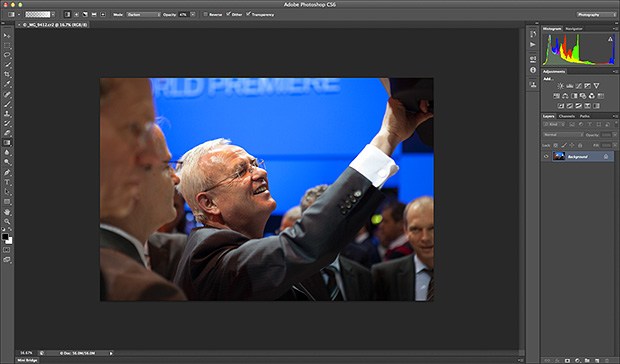
Screen shot of the main window


To be honest, my main use of Photoshop is Adobe Camera RAW. I use it to convert the RAW files that I shoot into whatever file format the job requires, fine tuning the colours, composition and various other elements as I go. At first sight Camera RAW 7 is very little changed from Camera RAW 6xx that I use every day in Photoshop CS5. At least that’s what I thought until I used it in anger on a proper edit.

Screen shot of Adobe Camera RAW 7


If you look closely at the main adjustments palette to the right of the window, you suddenly see what the changes are and what they will mean for every day workflow. Gone are the labels such as Recovery, Fill-light and Brightness to be replaced with a set including Highlights, Shadows and Whites. So far, they seem to perform very similar functions when used on every day files but I have only edited two sets of pictures (neither of which have been “live” jobs) and so it may well be that I have missed something. Here are the two palettes side by side:

Adobe Camera RAW adjustments palettes from CS5 (ACR6) on the left and CS6 beta (ACR7) on the right.


I will continue to play with CS6 and ACR7 as long as the beta phase continues and I’m sure that I will come up with plenty more observations. I only use Photoshop as an optimisation tool and I don’t do any serious retouching or image manipulation with it so don’t expect an in-depth assessment of layers, filters and content aware fill from me – there are plenty of other photo geeks out there who will be able to blog about that kind of stuff!

Define the word “PHOTOGRAPHER”

When does a person with a camera, even a person with an expensive camera, become a photographer?

Apologies if this seems to be getting a bit philosophical but it’s a question that someone casually threw at me a week or so ago and I’ve been struggling with it ever since. Let’s get the dictionary stuff out of the way…

Right now we can really get on with the real business of working out what a photographer is. I’ve always been a fan of simple definitions and I like the idea of making a comparison between things, so how about this:

Someone with a camera tries hard to get everything into the picture whilst a photographer does their level best to keep as much out of the picture as they can.

All that means is that there comes a point in your photographic journey where you realise that most pictures are much stronger when you leave absolutely everything out that doesn’t need to be in. In a paraphrase of the old saying “what doesn’t kill you makes you stronger” (which isn’t necessarily true by the way) we can come up with “what doesn’t add to the composition detracts from it”.

The dictionary definition above, which comes from the English dictionary built into the Apple OSX operating system, steers away from the word professional and I’m really glad that it does because there are an awful lot of superb photographers out there that take pictures for fun and not for a living. Being a good photographer is not the same as being a professional photographer. On balance, MOST professionals are good but there isn’t a direct relationship between earning a living and being proficient.

These days there is a belief that ‘everyone is a photographer’. I wouldn’t argue that almost everyone takes pictures and that almost all of them take two, three, four and even twenty times as many pictures as they would have done when we had to buy film. Someone who I once discussed photography with reminded of another old adage – the one about if you give enough monkeys enough paper, enough typewriters and enough time sooner or later one of them will create the complete works of Shakespeare. It doesn’t hold up here and I told him as much.

People with cameras are largely rational, intelligent and reasoning beings and so most will work out what they do and don’t like and then take better and better pictures over time. Their image making isn’t the random act of monkeys with no comprehension what they are doing – the point here is that when it comes to learning that less (content) is more (better pictures) some will figure it out for themselves , some will need to have it pointed out to them and the rest will remain blissfully ignorant of it.

For some lucky people the knowledge is instinctive. The rest of us have learned through trial and error and/or formal education to know a good picture when we see one. Those that take the next step by learning what makes it a good picture can call themselves “visually aware”. The final (and never ending) stage is to develop the skill to see the picture and make the best of it before and during the pressing of the shutter. Those people can call themselves photographers.

See also COMPOSITION

Some posts are “a bit Marmite”…

When I started to migrate my old blog over to WordPress I also began to watch the site statistics that are there to help you understand what kind of content on your blog is popular. Obviously announcing new posts on Twitter, Facebook and LinkedIn helps but the figures for days when you don’t do any plugging probably tell you more about what people search for and find.

Having shifted so many old postings (anything listed before December 8th 2011) I have been watching to see whether the ‘old’ stuff gets many viewings. The answer, sadly, is no. More interestingly, blog posts that aren’t about specific photographs don’t get a lot of viewings either.

British readers of this blog will be familiar with the concept of something being “a bit like Marmite” (or Vegimite if your are from the Antipodes). It means something you either love or hate, nobody is indifferent to it.

Drawing comparisons between a savoury spread and blog posts is probably a bit tenuous but I still like the idea! I think that there is some interesting material back there so I’ve decided to go through the viewing figures and publish links to some of my favourite and your least favourite oldies.

That’s half a dozen to be getting along with. I goes that they share a certain ‘wordiness’ but they are the kind of things that I want to to talk about and so I hope you give one or two of them a go.

Some 11 year old thoughts on lens selection…

Choosing the right lens for the job – written in 2000 for http://www.DPReview.com and it still pretty much stands up today – which cannot be said for everything that I thought that I knew when I’d only been in the profession for 14 years!

There are two ways that you can choose which of your lenses to stick on the camera:

  • You can say “there’s my subject and here I am, let’s see which focal length on my zoom works best”.  Sometimes at sports matches and political events you have your position and that is that, or…
  • You could say “I want the effect that my experience tells me a 28mm lens will give me so I’ll select that focal length and move to the right position to make that happen”.

Either of these could be a valid option and, in many cases, the first is decided for you by circumstance. Most news photographers use zoom lenses because it makes sense to have fewer lenses when you are never quite sure what kind of work you will be doing on any given day.

Personally, I use a combination of both approaches. If a position forces me to choose a certain lens then I’m with option 1. Given complete freedom to shoot what I want I’d go with 2. More often than not I’ll go with, say a 24-70mm lens intending to shoot at the 24mm end and get in a position to shoot that way. I will shoot several frames and then start to move around, zoom in and out and shoot a variety of similar images, each with subtle differences. I try to make a point of shooting with just about every focal length available to me on every job. Sometimes I am right about lenses first time but often I’m not. What had seemed like an obvious task for the 28mm ends up being a spectacular 200mm shot and vice-versa but the result is that you often end up with images that are just that bit better.

I nearly always shoot on location so I cannot preplan every detail. Going equipped with a range of lenses is vital. Your choice of lens will depend on so many questions running through your mind. How is this image going to be used? Big, small, upright, horizontal, front page? Double page, back page, website, magazine or newspaper? Is it going to have copy running over it? Will it have more than one usage?

If I cannot answer any or all of those questions, then I’ll shoot every variation I can. Shall I start with a long lens, if it’s a portrait then being further away may relax the subject and I’ll get in with the wide when they are more comfortable. Background, what’s behind them? Can I use a change of lens get rid of a poor background?

Answering self-set questions and making compromises is the key to news photography. Choosing the right lenses helps to reduce the number of technical compromises that you are forced to take, giving you more time to make the creative compromises that you want to make.

How often do you service your gear?

How often do you get your cameras, lenses or lights cleaned and serviced professionally? Every six months? Annually? Every other year? When things go wrong? Sadly, for most professional photographers it is the last one – when the kit goes wrong and needs to be fixed. Almost all of them get their cars service every ten thousand miles or when the service warning light comes on. Over half will get their central heating boilers checked and cleaned every once in a while but their cameras, the equipment on which their livelihood depends seems to get overlooked.

“My lenses are soft, I’m switching to the other brand” is a cry we have heard regularly over the last coupe of years but is it that one major manufacturer has suddenly started to make bad lenses or is it that the daily wear and tear on even the toughest kit starts to have an effect on image quality?

If the fall off is gradual enough we don’t notice. A lens might go from “wow” through “acceptable” to “oh dear” in twenty stages over thirty months and still we only seek the help of a technician when it gets to “oops”.

Modern camera chips are capable of resolving every bit if detail that our lenses can deliver. A camera such as a Canon EOS5D MkII will show up every glitch and flaw in a lens’ performance in ways that film or smaller chipped cameras never could. It will also show up tiny errors in focusing that would have gone unnoticed in times gone by.

One of my cameras celebrates it’s third birthday next week and it will go away for it’s third service a week or two later. It isn’t particularly cheap but it is a bargain when you think how much I rely on that camera to perform on a daily basis. I have a nine-year old lens that has been to either Fixation orCanon CPS six times to get this or that checked and another seven-year old lens that has made five service trips.

I have always loved the line from “Only Fools and Horses” where Trigger the road sweeper says proudly that he has had the same broom for years but that it has had 17 new heads and 14 new handles. I don’t think that camera maintenance is quite that easy but the concept should apply.

Professional kit is closer to high performance cars and needs to be treated with a bit of TLC every once in a while.

A mission statement or two

Yesterday morning, The BBC presenter and former Economics Editor Evan Davis was sharing his approach to interviewing senior business people. He said that he wanted to relax them, tempt them into talking more openly and frankly than they might want to and because so few of them are media professionals he has a form of words that he uses to let them know what his role is. He says to them “I’m not here to make you look stupid but if you decide to make yourself look stupid it isn’t my job to stop you”. That, my friends, should be the mission statement of every editorial and news photographer working right across the world. And that got me thinking about some equally succinct statements for other kinds of photography and that in turn got me thinking about definitions of types of photography.

“I’m not here to make you look stupid but if you decide to make yourself look stupid it isn’t my job to stop you”. – Evan Davis

Thanks to the verbal clarity and dexterity of Evan Davis we have news and editorial photographers pretty much covered and the next category of photographers that I wanted to think about was PR photographers. For me this comes next for two reasons: firstly that I do quite a bit of PR work myself and also because so many of the good PR photographers here in the UK have a background as press and editorial photographers. The role of the PR photographer is to shoot editorial style images that show their client in a positive light. I don’t have the same ability with words that a senior BBC journalist does but I came up with the following:

“I’m here to help make you and your business look good by concentrating on the positives and ignoring the negatives.”

The cynic in me wanted to go with “he who pays the piper call the tune” but PR photography done well is a lot more than just pointing the camera where you are told and cashing the cheque. Next in line in both my life and in the photography that I do is commercial work. I guess that this differs from PR not so much in what I shoot but for where the pictures end up which is mostly in brochures, company reports and on their websites.

“I’m here to shoot the pictures that you want in the way that you want me to shoot them and to add my own input in achieving the right images”.

This process could go on and on and I have been trying to think of a mission statement for the paparazzi but the truth is I’m not actually sure what they do and why they do it – and I’m pretty sure that some of them are in the same boat. The best and most successful paps know exactly what they are about and that’s why they get paid the big money for the right pictures. My final thoughts on these definitions and mission statements goes to the names given to themselves by wedding photographers and which of the three mission statements above applies to them. I have something of a problem with “wedding photojournalist” because, for me a photojournalist is there to record events and to help tell the story to the wider world – warts and all. It’s those last three words that I cannot believe any wedding photographer can truly sign up to. Your client is normally the bride and groom or at least a close friend or relative of theirs and I’m pretty sure that they would not be happy for every single element of the big day to be recorded and published. I have no issues with the phrases “documentary style photography” or shooting in a “photojournalistic style” but can a wedding photographer really be a detached observer and recorder of events? Please don’t get me wrong here, I have the utmost respect and admiration for the best wedding photographers who have broken with the wooden and formulaic styles that were around when I and most of my friends were getting married. The quality and volume of the work that they produce in such demanding and unrepeatable situations is amazing but I really don’t like the hijacking of the title photojournalist for what is, essentially, very good PR.

Sticks and stones

My mother told me that “sticks and stones may break your bones, but names can never hurt you” and I spent the first 40+ years of my life without questioning that piece of maternal wisdom. At the ripe old age of 46 I started to realise that certain derogatory terms, when applied to groups of people, can have a bad effect.

not going to equate my profession with religious or ethnic groups who have suffered real physical and emotional harm from the constant repetition of terms deliberately designed to insult them and from name calling intended to isolate them or to incite others to be prejudiced against them. What I am going to do is try to make a case for the quiet burial of collective nouns and occupation based slang terms for photographers that only serve to devalue what we do for a living.

Before I get into the arguments I want to say that photographers often use many of these names for each other in what is meant to be a light hearted and affectionate way. Words get borrowed, used and then abused so we are doing ourselves no favours by perpetuating them. There are a whole raft of pseudo-tabloid terms for photographers that I object to;

  • Snapper – implies that we take snaps, which we don’t. We take photographs, we make photographs and we create photographs.
  • Lensman – what does this mean? It’s just a pointless term that gets trotted out by people who cannot be bothered to use a thesaurus.
  • Camera monkey – particularly offensive, and usually used by ill informed and self important writers.
  • Pap’ – shortened form of ‘paparazzi’, which is liberally used by the ignorant to refer to a wide range of news photographers. I have nothing against the paparazzi (literally translated means buzzing flies) but I object to the pejorative connotations of the word when applied to other photographers.
  • Reptiles – used once to my face by an ‘old school’ journalist who was politely informed that I objected to the term on the grounds that it may well have been used affectionately by him, but that it may not be used so kindly by others.

The list could go on but the point that I’m trying to make here is that words used in jest by friends of our profession get picked up by others and used to denigrate us all. All of this is happening at a time when we are struggling to present a unified, dignified and professional image to a world which at best doesn’t understand what we do and at worst regards us with contempt. The terms that we use to refer to one another are important. Not as important as avoiding undercutting other professionals, not as important as selling out on copyright and not as important as belonging to professional bodies, but in a world where everyone who owns a digital compact camera thinks that they can take ‘professional quality pictures’ every small action has an effect. It’s like the old, and probably untrue, story about a butterfly beating it’s wings in China causing a hurricane in Florida – some very small actions have very large consequences.

As photographers we owe it to ourselves and to our colleagues to avoid using terms for each other that can have negative connotations. When was the last time you heard a Doctor call a colleague a “sawbones” in public? When did you ever hear a lawyer, an accountant, a teacher or a systems analyst use a potentially damaging slang term for a fellow professional? I believe that the use of slang terms is a sign of professional insecurity and we can all help ourselves and our peers by refraining form making those signs.

Names may not hurt you or me individually, but they can eat away at our profession.