public

Sticks and stones

My mother told me that “sticks and stones may break your bones, but names can never hurt you” and I spent the first 40+ years of my life without questioning that piece of maternal wisdom. At the ripe old age of 46 I started to realise that certain derogatory terms, when applied to groups of people, can have a bad effect.

not going to equate my profession with religious or ethnic groups who have suffered real physical and emotional harm from the constant repetition of terms deliberately designed to insult them and from name calling intended to isolate them or to incite others to be prejudiced against them. What I am going to do is try to make a case for the quiet burial of collective nouns and occupation based slang terms for photographers that only serve to devalue what we do for a living.

Before I get into the arguments I want to say that photographers often use many of these names for each other in what is meant to be a light hearted and affectionate way. Words get borrowed, used and then abused so we are doing ourselves no favours by perpetuating them. There are a whole raft of pseudo-tabloid terms for photographers that I object to;

  • Snapper – implies that we take snaps, which we don’t. We take photographs, we make photographs and we create photographs.
  • Lensman – what does this mean? It’s just a pointless term that gets trotted out by people who cannot be bothered to use a thesaurus.
  • Camera monkey – particularly offensive, and usually used by ill informed and self important writers.
  • Pap’ – shortened form of ‘paparazzi’, which is liberally used by the ignorant to refer to a wide range of news photographers. I have nothing against the paparazzi (literally translated means buzzing flies) but I object to the pejorative connotations of the word when applied to other photographers.
  • Reptiles – used once to my face by an ‘old school’ journalist who was politely informed that I objected to the term on the grounds that it may well have been used affectionately by him, but that it may not be used so kindly by others.

The list could go on but the point that I’m trying to make here is that words used in jest by friends of our profession get picked up by others and used to denigrate us all. All of this is happening at a time when we are struggling to present a unified, dignified and professional image to a world which at best doesn’t understand what we do and at worst regards us with contempt. The terms that we use to refer to one another are important. Not as important as avoiding undercutting other professionals, not as important as selling out on copyright and not as important as belonging to professional bodies, but in a world where everyone who owns a digital compact camera thinks that they can take ‘professional quality pictures’ every small action has an effect. It’s like the old, and probably untrue, story about a butterfly beating it’s wings in China causing a hurricane in Florida – some very small actions have very large consequences.

As photographers we owe it to ourselves and to our colleagues to avoid using terms for each other that can have negative connotations. When was the last time you heard a Doctor call a colleague a “sawbones” in public? When did you ever hear a lawyer, an accountant, a teacher or a systems analyst use a potentially damaging slang term for a fellow professional? I believe that the use of slang terms is a sign of professional insecurity and we can all help ourselves and our peers by refraining form making those signs.

Names may not hurt you or me individually, but they can eat away at our profession.

Six feet up is bad?

©Neil Turner, October 2000. Oxford.

©Neil Turner, October 2000. Oxford.

This was first published in the Autumn of 2000 on the DP Review website as a follow-up to a review I did of the original Canon G1 Powershot

It is very easy to hold the camera to your eye and take a picture. Good photography requires us all to think about where we are taking the picture from as well as what we are taking. The best photographs are made when the photographer chooses a vantage point to suit the subject, and it is surprising how few subjects are suited by the height of a human standing at their full five to six feet. This is compounded by the fact that when someone views the image they will see pretty much what they themselves would have taken because they haven’t been told about bending your knees or climbing a ladder to shoot better pictures.

It is no accident that many of the world’s best photographers wear denims most of the time, and I take pride in the fact that I spend so much of my time kneeling that I have “housemaids knee”. Sooner or later I will end up flat on my face or up on a chair to give something extra to a composition – namely a point of view that the person looking at the image would not have seen themself.

This image was shot in the beautiful University City of Oxford on a Canon G1 using the swivel LCD to get the camera at ground level without having to lie in the dirt myself. The lens was less that two inches from the cobble stones and this ultra low angle gives the image a dynamic quality that would have been missing had I been standing at my full five foot ten inches. The photograph is different from most pictures taken of this tourist magnet and I’m sure that my antics were the reason for the puzzled look on the passer by’s face.

My point is that when you get your camera out think about the height of the lens. If you end up shooting from a standing position, well that’s OK – but I will lay good money that 90% of pictures are better when taken from below four feet or over seven.

Metropolitan Police guidelines for dealing with the media

Guidelines for MPS staff on dealing with media reporters, press photographers and television crews.

Members of the media are not only members of the public; they can influence the way the Metropolitan Police Service is portrayed. It is important that we build good relationships with them, even when the circumstances are difficult. They have a duty to report many of those things that we have to deal with – crime, demonstrations, accidents, major events and incidents. This guide is designed to help you take the appropriate action when you have to deal with members of the media.

Members of the media have a duty to report from the scene of many of the incidents we have to deal with. We should actively help them carry out their responsibilities provided they do not interfere with ours.

Where it is necessary to put cordons in place, it is much better to provide the media with a good vantage point from which they can operate rather than to exclude them, otherwise they may try to get around the cordons and interfere with police operations. Providing an area for members of the media does not exclude them from operating from other areas to which the general public have access.

Members of the media have a duty to take photographs and film incidents and we have no legal power or moral responsibility t prevent or restrict what they record. It is a matter for their editors to control what is published or broadcast, not the police. Once images are recorded, we have no power to delete or confiscate them without a court order, even if we think they contain damaging or useful evidence.

If someone who is distressed or bereaved asks for police to intervene to prevent members of the media filming or photographing them, we may pass on their request but we have no power to prevent or restrict media activity. If they are trespassing on private property, the person who owns or controls the premises may eject them and may ask for your help in preventing a breach of the peace while they do so. The media have their own rules of conduct an complaints procedure if members of the public object.

To help you identify genuine members of the media, they carry identification, which they will produce to you on request.

Members of the media do not need a permit to photograph or film in public places.

To enter private property while companying police, the media must obtain permission, which must be recorded, from the person who owns or is in control of the premises. We cannot give or deny permission to members of the media to enter private premises whether the premises are directly involved in the police operation or not. This is a matter between the person who owns or is in control of the premises and the members of the media.

Giving members of the media accident to incident scenes is a matter for the Senior Investigating Officer. The gathering of evidence and forensic retrieval make access unlikely in the early stages and this should be explained to members of the media. Requests for access should be passed to the Senior Investigating Officer who should allow access in appropriate cases as soon as practicable.

Advice and assistance in dealing with members of the media is available 24 hours a day via the Press Bureau at New Scotland Yard.

Five people that I will never forget

Originally posted in July 2009, this was a very personal reflection on some very important people in my career.

I suspect that most professional photographers keep a pool of pictures that they use for promotional, exhibition and portfolio purposes. I have always had a folder full of my favourites and now that I am freelance one of my regular tasks is to update it. The death of Mr Henry Allingham who was, at the age of 113, the oldest surviving veteran of the First World War made me go through and think about some of the people that I have had the honour of meeting and photographing.

My folio folder had no fewer than five images of people who have died since being photographed by me. As a percentage, that’s not out of the ordinary and three of them were very elderly indeed. Each of the five people had a big effect on me for various reasons and I’d like to share some memories of them with you.

©Neil Turner/TSL

Dame Iris Murdoch was a brilliant novelist whose life story was made into a film “Iris” starring Dame Judy Dench. I photographed Iris Murdoch and her husband John Bayley in the garden of the home that they shared in Oxford where he was a professor of English. She was, by the time that this picture was taken in 1998, suffering from the latter stages of Alzheimers’ – which is a terrible disease that robs the intellect and then the personality of the sufferer and places a great strain on those who love and care for them.

Dr Bayley described her as being like “a very nice 3-year-old”. This picture was on the back cover of the book that he wrote about their life together.

The house had not been properly cleaned for a long time and there was a television in every room playing the same programme.

When I went to see the movie made of her life two women in the row behind me made comments about the house that they lived in and that she could not believe it could have been as bad as the film made out. The temptation to turn around and tell them that the film did not tell even half of the story was strong, but I resisted. She died in Oxford on February 8, 1999.

©Neil Turner/TSL

Sir Peter Ustinov was an actor, writer, director and raconteur. This picture was taken in his London hotel shortly before he died in 2004 aged 82. I’m not going to attempt to precis his life, but I’d like to tell my story about my time with him. I was searching for something to chat to him about and I used one of my “fallback” topics of what I had heard on the radio on my way to meet him.

Every morning BBC radio 4 has a news show called “The Today Programme” which that morning had a feature about the USA and communism. I mentioned Senator McCarthy and Sir Peter then delivered a wonderful and vitriolic soliloquy on the topic of McCarthyism – job done. I’m pretty sure that you would have had to pay a lot of money for a forty minute private performance from Sir Peter. I feel so privileged to have had it for free.

©Neil Turner/TSL

When I met and photographed Mr Henry Allingham he was already 112 years old. Despite his amazing age he was very coherent, had a very British sense of humour and was interested in everyone and everything around him.

I found meeting him very humbling and, when he died, I found myself counting the ways in which our world has changed during his lifetime. Cars, planes, computers, atomic bombs, heart-transplants have all become commonplace.

Queen Victoria was still on the throne of Great Britain when he was born and women did not get the vote until he was in his late twenties.

©Neil Turner/TSL

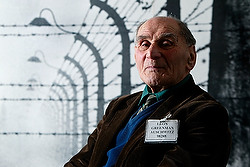
Leon Greenman OBE was the gentlest of men. Meeting him and being given a personal tour of the Holocaust Museum in London where there is a display featuring a large number of his personal possessions from before and during his time in the concentration camps had a profound and lasting effect on me.

His striped uniform with it’s Star of David, photographs of his wife and children who died in the camps, pictures of his life before the Nazis came and took the Jews away were there and he was there to talk about them in a factual but moving way.

I will never forget the day I met him and I hope that the amazing work he did to educate subsequent generations about the evils he witnessed goes on.

©Neil Turner/TSL

The death of people who have lived long and valuable lives is sad. The death of a child is far sadder. I met Fleur at a children’s hospice near Luton a few weeks before her untimely death. She was a sweet child who wanted to know all about everything.

Keech Cottage Children’s Hospice in Bedfordshire provides respite and terminal care for children with life limiting conditions. It is not a sad place. The children there are pretty much like any other children.

The families that I met had come to terms with the fact that they would lose the child that they loved and were making the most of their time together. I was welcomed, I was royally entertained and I would go back tomorrow if they’d have me.

One light, big space

It’s very useful to be able to kill two birds with one stone – especially when you have a limited amount of time. I have been very busy this month and blogging time has ben limited. I had intended to carry on my review of the ERQ and maybe post a new technique piece as well. I was sent on a job the other day that allows me to do both.

The quality that you can get at 3200 ISO with the latest generation digital cameras is amazing but sometimes you really would rather light something. I was asked to shoot some pictures of “An Evening with Alan Bennett” – an event staged to raise awareness and funds for the Christie NHS Hospital Foundation Trust. The Christie is a world renowned hospital in Manchester and they decided to hold an event in London to raise their profile. The venue was the Royal College of Physicians in London’s Regents Park. The library is a spectacular blend of 20th century modern architecture and the fixtures, fittings and books from earlier centuries. The light is kept deliberately low and that presented me with a few issues. At 3200 ISO I was only getting 1/60th at f2.8 and so I used my Elinchrom Ranger Quadra kit to give the room a lot more light.

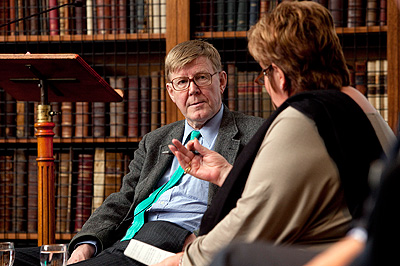
Allan Bennett talks to Jenni Murray. ©Neil Turner

My idea was simple. I set up the light as far away from the interview as I could get it and bounced the light off of a wall. This gave me a light source of about eight feet (2.4 metres) by four feet (1.2 metres) at almost 90 degrees to the subject and at a distance of over thirty feet (9 + metres). Quite a decent soft light, but very directional and it looks utterly unlit.

This is an effect that I have written about before but the power of the ERQ kit, given that it is only rated at 400 w/s, made this very easy. I was able to be quite a distance away using a 70-200 f2.IS L lens on an EOS5D MkII and frame my shots with relative ease. I was shooting between rows of chairs and invited guests and had been asked by the organisers to severely limit my use of flash so I only got half a dozen goes at the shot. This was my favourite frame and it shows the interviewer – Radio 4’s Jenni Murray – asking Alan Bennett a question right at the start of the session.

This was shot at 1/60th of a second at f5.6 at 800 ISO. The available light was non-existent and the effect is very interesting. I had been worried about the range of the Elinchrom Skyport triggers but they worked very well at a range of at least thirty feet, probably nearer to forty feet and my only gripe with them is their lack of a locking mechanism to keep them in the hot shoe. The ERQ system passe another important test here and I’m still very very happy with the kit.

The photographer’s “uniform”…

I was told the other day that I was wearing my uniform with pride. What uniform you may ask? It seems that the uniform in question was that of a freelance news photographer. I have known for many years that many of us tend to dress in similar ways: we all spend a lot of our time kneeling down or lying down to get the best angle. In the winter we all get cold when we are working outdoors and so it comes as no surprise that we all choose similar clothing. So what was I wearing?

The first thing that I did was to look down and make a mental note of my attire. Heavy duty winter coat, fleece scarf, heavy weight denim jeans and my much loved Timberland boots. They are ancient, they are warm and the tread is still pretty good. These boots have waded into the sea, they have stomped through Scandinavian snow and they have marched across many miles of the New Forest with the family. Most importantly of all, they have seen me through a lot of miles on the streets of London.

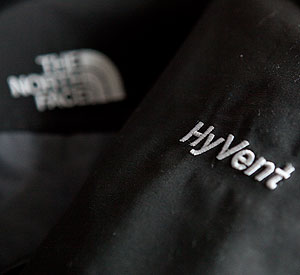
You’d be right to think of this as a uniform – how many of my colleagues have a black or grey North Face jacket on their backs? It wouldn’t be an exaggeration to say “most”! I have no idea if mine is the latest technology (its Hyvent, whatever that is) or the coolest (black and grey?) but it works amazingly well. This too has kept me warm in the northern areas of Finland in the depths of winter. In fact, I even have a warmer one that I find it hard to wear. That McMurdo parka was a big investment for me and I’ve worn it twice.

I have just remembered that I was also wearing some amazing grey fleece gloves that my brother bought me a while back. They are made by Rohan and they are perfect for a photographer. They allow you to use the camera well enough (even the tiny buttons on the back of a Canon EOS 5D MkII) and manage to keep the worst of the chill off of your hands. The trouble is that they don’t have a name on them and the Rohan website doesn’t show any gloves so I guess that the recommendation isn’t all that helpful.

I’ve written before (although I really cannot remember were) about the photographer as chameleon. The idea is that we need to adapt to our surroundings and sort of blend in. In the city, surrounded by other members of the media it is pretty simple – once you’ve seen one black winter jacket with cameras hanging from it then you’ve pretty much seen them all. It gets trickier when you are the only one there. I’ve done jobs that required a dinner suit and others which asked for high visibility vests and construction helmets (more of the latter recently) but the majority of the jobs don’t come with a written dress code. The trick is to go for the right kind of smart casual wherever possible and to cover it all up with an expensive looking coat.

What you wear says plenty about you. Looking like a photographer tends to help you be accepted as a professional and helps you shortcut the whole credibility issue. I want my Doctor to wear a white coat and my postman to have the right clothing too. If you look like an archetype, if you play along with people’s prejudices it tends to relax them. If I turn up to shoot someone’s photograph dressed like a postman or a doctor I’m going to have to work that little bit harder to convince them that I know what I’m doing and that I am a professional photographer.

So that’s my winter uniform sorted. What shall I wear this summer?