Archive photo

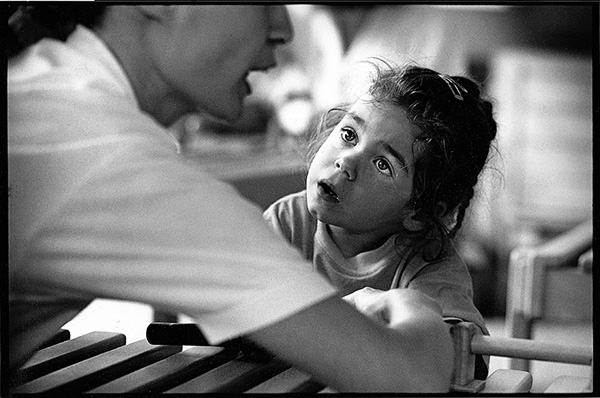
Archive photo: Conductive education, Sussex, March 1990

Please note that I have made a small correction to the caption. The pictures were taken a year later than I originally thought.

©Neil Turner, March 1990

This assignment opened my eyes to a whole world of education. I was fascinated by the ‘special needs’ systems that had grown up in the UK to try to provide a combination of tuition and therapies for children whose families were trying to do the very best for them. On this job I was working with a committed reporter who did her best to bring me up to speed on all of the terminology used in the field and years later I found myself telling younger reporters how things were. To this day, disability remains a topic that I get real satisfaction from showing to the world.

Young child who has cerebral palsy having a physiotherapy session at a residential school in West Sussex under the Conductive Therapy regime. This technique was brought to the UK from Hungary where therapists, known as conductors, use a range of very intensive methods to try to get children who have very badly compromised motor skills to walk unaided.

Judging from the date, I expect that this picture was shot on a Nikon FM2 with a 135mm f2 Nikkor. The film is Kodak Tri-X.

When Time Out did real news…

Right back in the early days of Insight Photographers, the small agency that we ran from an office in the rather un-trendy (how times change) Hoxton area of London, we used to shoot a lot of stories for Time Out magazine. Some weeks they would have five or six pages of real news and they used to commission some nice work too. One of my favourites from that era was this picture of a man who was part of a group of residents and squatters trying to stop the Department of Transport from bulldozing their houses to build a new piece of road in the Archway/Highgate area intended to speed up the journey up the A1 from Holloway (bear with me if the geography of north London bores you). When I arrived on a hot day from the a brisk walk up from the underground station the bailiffs had gone.

Archway Jack. ©Neil Turner/Insight, May 1989

I found this chap looking rather pleased with himself and asked what had gone on. He just smiled and said “we’ve seen them off”. I asked him if it was OK if I shot his portrait and he agreed. After that, I got my notebook out and asked him his name. He thought about it for a few seconds and then said “call me Jack… Archway Jack”. Of course I asked if that was his real name but he smiled and walked off trying to whistle a tune.

The News Editor somehow tracked him down, got some good quotes from him and the story probably got more space than a simple eviction piece would have. A definite case of “just because the story you were expecting didn’t work out, it doesn’t mean you haven’t got a good story anyway”. All of the Time Out news reporters and editors that I recall went on to do great things. I guess that it was a mix of choosing the right people and being a great place to hone those journalism skills. Quite a few of the freelance photographers that they used did OK too.

This was shot on Kodak Tri-X film using a Nikon FM2 camera and a 24mm f2 Nikkor lens

Twenty years ago… TODAY

Whilst memory lane is the venue I thought that I’d add this photograph of the former British Prime Minister, John Major along with his cabinet colleagues Kenneth Clarke and Michael Howard taken on the 20th of May 1991. This isn’t a particularly interesting picture except that it is from the set that became the very first ever colour front page on the Times Educational Supplement. This was almost three years before I actually joined the paper on the staff but it has always been a matter of pride that I was the one who shot the picture that changed the paper for ever.

John Major with members of his cabinet. ©Neil Turner, May 1991

This picture was at the press conference where John Major and his Government launched their new policy for post sixteen education. It wasn’t that long after Mr Major had taken over from Margaret Thatcher as Prime Minister and press photographers were still trying to get the hang of the new man and his rather relaxed style. It’s amazing to think that the man in the foreground (Ken Clarke) is once again a member of the government all of these years later and still clearly loving the cut and thrust of political life.

When we first started to shoot colour for the paper we just adapted the way that we already shot pictures for a variety of news magazines – on colour transparency stock. It was always funny to be rubbing shoulders with other photographers, almost all of whom were shooting fast black and white film, and having to get good pictures in often poor light with either 100 ISO Fuji RDP transparency film or Kodak’s rather good 160 ISO tungsten balanced slide film. This one was shot on the Kodak tungsten film pushed one f-stop to 320 ISO – which was about as high as you could go without getting washed up pictures. Back in the day the transparency would have been scanned by an expert on a very expensive drum scanner and the separate plates for the pages would have been made by other technicians. How things have changed.

London had a couple of very good 24 hour labs in those days and shooting transparency was, in a lot of ways, pretty relaxing once you had got the exposure correct. All you had to do was drop off the film, go and have a cup of coffee and pick up your processed images about an hour and a half later. The TES offices were very close to my favourite lab – Metro – and so you could either let the paper collect your film or go along yourself and do an edit before they saw them.

I have been filing some old pictures and found this one completely by chance twenty years down the line. I guess that my journey down memory lane is still going on!

1995 author portraits with new gear

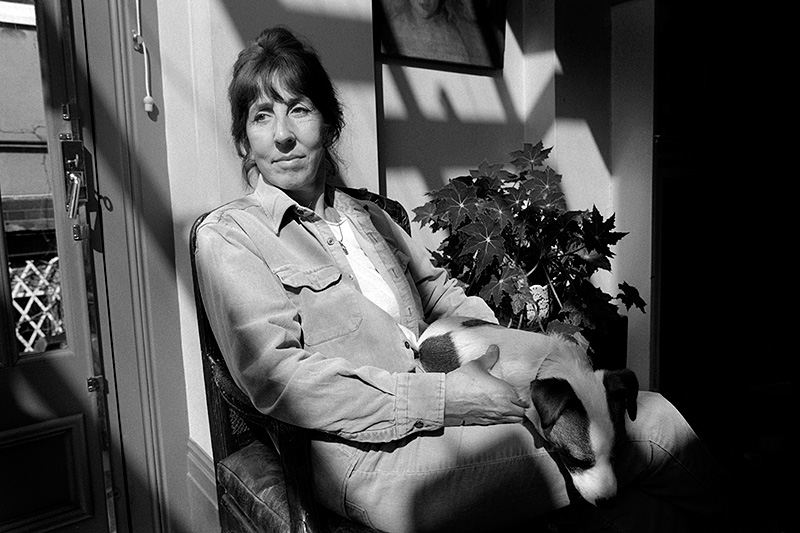
It’s funny how you remember pictures that you have taken. I was rummaging through a box of Kodak Photo CDs that were in my loft and found a set of portraits of the wonderful children’s illustrator and author Helen Oxenberry that I took in March 1995 for The Times Educational Supplement. The pictures were taken during a period where I seemed to be photographing the entire back catalogue of authors and illustrators whose work was aimed at children and there are four things that I distinctly remember about these particular portraits.

Helen Oxenberry with her dog, ©Neil Turner, March 1995

The first thing that I remember is that this was the first live job that I shot using Canon cameras. A few days before, I had taken delivery of a box full with 2 shiny new EOS1N bodies, a 28-70 f2.8L, a 20mm f2.8 USM and a 300mm f2.8L as well as two 540EZ flash units and a lot of other bits and pieces. The 70-200 f2.8L that we had ordered arrived a day or so after this shoot.

The excitement and mild terror of shooting with brand new gear that I had only tried out for the first time over the weekend was very real and so I also took along a Leica M6 with a 35mm f2 lens and a roll of Ilford XP2 black and white film that I had half used on another author portrait the previous week. The picture that you see above is a scan of the negative, made using an automated Kodak scanner that was set up for scanning colour negative film but I quite like the quality that this print-free process gave me.

Helen Oxenberry at her home. ©Neil Turner, March 1995

The second thing that I remember about this job was that she was a really lovely lady and that she made good coffee. When I arrived she was very apologetic that she had forgot to tell my Picture Editor that she lived in one of London’s more vicious residents’ parking permit areas and that there weren’t any public spaces nearby. I smiled and told her that I only lived 100 metres away and had the right permit, which seemed to confuse her – I imagine that she was trying to work out how a photographer could possibly afford Hampstead!

My third memory was that just after leaving I turned the radio on in the car and there was a programme about children’s literature where another author called Michael Rosen was talking about Helen Oxenberry. The phone rang and it was the Picture Editor telling me that I was going to photograph an author called Michael Rosen the next day!

The fourth and final memory was going back to Helen Oxenberry’s house about a month later to photograph her husband – another brilliant illustrator and author called John Burningham who went on to apologise for the lack of parking…

Another old picture from the loft

©Neil Turner, October 1988

I keep on finding old pictures that I want to talk about so if you are bored by this stuff – I apologise. I have started getting my loft ready for some 21st century insulation and that means getting every last box and filing cabinet out… and of course that means having a peak in them as you go.

The two piers in my home town of Bournemouth have played a huge part in my life and in my photography. My family spent a huge amount of time during the summer months on the beach and I used to play the arcades with my pocket money when Boscombe Pier had a building on the end which housed all manner of slot machines and one-armed bandits.

This picture is, I guess, street photography but on a pier. It was taken on the day that I first used a truly wide angle lens on a Leica M6 – the 28mm f2.8. I would guess that it was October 1988 and I spent a lot of time wandering around just shooting for the fun of it. The roll of Tri-X film that this frame is on holds a wide variety of pictures but this has always been my favourite. The shot has no big meaning – just a pensioner enjoying the late afternoon sunshine but it never fails to make me smile.

Pier divers in Bournemouth

Several (actually all) of my recent blog postings have been about old pictures that I have found lying around or in searches for something else and why they are important to me. The latest one shows some young guys diving of of Bournemouth Pier in the early 1990s and it was part of a set that I did for a trades union magazine. The commission was as simple as it was vague – to produce images of the seafront at Bournemouth that could be used in a preview of the union’s annual conference that was being held in the town.

Bournemouth Pier divers. ©Neil Turner, June 1992

Commissions in those days always attracted expenses and that invariably included the cost of film and processing. The job was only a half-day but what a beautiful half day it was. The sun shone, the beaches were packed and nobody seemed to mind me wandering over and shooting their picture. The people diving from the pier made some great pictures but the dangerous nature of what they were doing meant that the client didn’t even want to consider them.

Shooting slide film in those days carried certain risks, not the least of which was that there was only one original. If that got lost or if the client decided to hold on to it there was nothing that could be done about it. Affordable scanners didn’t really exist and getting duplicate transparencies made was very expensive. These days we can just keep as many copies as we have hard drives and in the days of black and white it was always easy enough to knock out an extra print but there was that scary and even precarious time where you had to get the exposure spot on, hope that the film was processed correctly and that the couriers wouldn’t lose the package containing your work. It is quite amusing to think that “fast turnaround” was measured in hours and the three days or so that it would have taken me to get these images from the camera to the client would have seemed eminently reasonable.

How times have changed!

I’ve always liked this picture. It was shot on a Nikon F4S camera with a 24mm f2 Nikkor using Fuji RDP100 transparency film

Back on Memory Lane again

I don’t know about you but I can put my finger on exact dates and point to pictures that changed the way that I shoot pictures. Aside from the obvious ones such as the day that I used a digital SLR for the first time and the day that I bought my first medium format camera one very special day and one picture made me think really hard about the kind of lighting that I wanted to use.

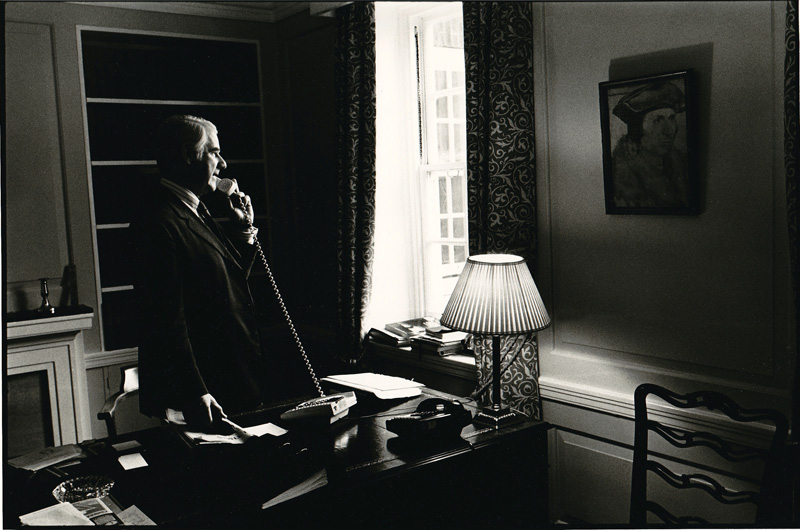
Desmond Fennell QC. ©Neil Turner

This black and white portrait of Desmond Fennell OBE QC was taken in his chambers at one of London’s famous Inns of Court – The Temple. It was shot for a newspaper and it was during a time in my career that I was using a single Elinchrom 23 flash head with a soft box and a bit of cable connecting the camera to the flash. Nothing unusual there I hear you thinking… how did this change Neil’s life?

Cue anecdote: I was sent to shoot a portrait so I took my standard gear. When I was shown in to the eminent man’s office I started to look around for a power point to plug my Elinchrom into. He answered the phone at that moment (he was chairing a major public enquiry at the time) and so I looked at the desk lamp and followed the cable to the socket in the wall. The trouble is that it was the wrong kind of socket… the UK standard three pin plug has rectangular prongs and his only socket had round holes. Square pegs, round holes… ohhh c**p.

It wasn’t that I was incapable of shooting with either a speedlight or just using the ambient light it was just a bit of a shock. This was actually the second frame that I shot – Nikon FM2 with a 35mm f2 Nikkor, Kodak Tri-X film pushed to 800 ISO.

I like to think that I learn from my professional mistakes and I like to think that after a few days a shock turns into an eye-opener and I remember coming away from this shoot with two lessons learned. The first was to always shoot some ambient light because it often makes stunning pictures – especially at quiet, off-guard moments and the second was to buy some battery powered lights. In truth, that took about three years to accomplish properly and I invested in a lot of extension leads in the mean time. I recall the day that my first Lumedyne kit went into action – complete with a Wein infra-red trigger. No cables. I shot a portrait of another lawyer and left her office singing one of the songs from the Disney version of Pinocchio – “I got no strings to hold me down…”

Street photography 1989 style

“Street photography is back” was the title of an email that I received today. Funny, I never knew that it went away. Having said that, the current exhibition taking place at The Museum of London has given the genre a bit of a boost. There are so many great exponents of street photography working in London today that even I have to admit that it isn’t so much back as resurgent. This got me thinking about some of my own work from early on in my career. I remember sitting in my office one day and a very old friend rang me and asked if I have any pictures of street markets that his younger sister could borrow for a school project. I had a few but, in the absence of anything better to do, I went off to Leather Lane market and shot a couple of rolls of film.

©Neil Turner

At that time I was part of a small agency and we had a rapidly growing library of images that was starting to make us some money. Stock photography was a good marketplace back in the late 1980s and early 1990s and I thought that it wouldn’t hurt to add a few market pictures.

This was my favourite frame of the lot. Shot on a Nikon FM2 with a 35mm f2 Nikkor lens and Kodak Tri-X film – a copy of this print made on old-fashioned bromide paper still hangs on my own office wall. The reasons that I like it are many and varied but the fact that it was born of a simple request from a very good friend (in fact, two years later he was my Best Man at my wedding) gives it extra weight for me. The fact that it has made me quite a bit of money as a stock image certainly doesn’t detract from its appeal but the other thing that makes me love this picture is that it reminds me just how simple photography can be. A mechanical camera with a fixed focal length lens, no automation whatsoever and time. Street photography is all about opportunity and patience.

Waiting for the moment to happen is part of the way that I shoot anyway but I also spend a lot of time looking around trying to anticipate good compositions, watching for the way that light hits surfaces and people. I have a very clear recollection of how this picture was made. I had seen the man walk up through the market and grabbed a couple of frames of him as he walked and shopped. Then I saw this nice gap between stalls and concentrated on framing it and I have the same composition with at least five different people passing through. Finally the interesting person that I really wanted came back and I clicked one frame of him (no motor drives on my FM2s that day). The little black border around the print is the rebate of the film which means, for those of you who are too young to have shot much in the pre-digital era, that this is the whole frame as it was shot – no post production cropping.

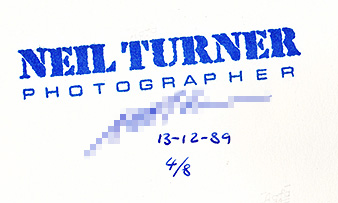
When I scanned the print this morning I noticed that this was one of a short edition of hand-prints that I made of this frame and you can see the stamp and date that were on the back with my pixelated signature.
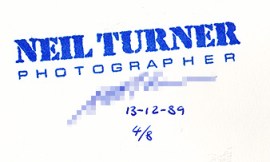
©Neil Turner

Simple and happy days but I don’t particularly want them back. Opening a box of prints brought back the smell of the darkroom and the associated cough rather too vividly. I haven’t made a black and white print in a traditional darkroom since January 1994 and I don’t miss it one bit!