photography

Photographs of children

The beautiful bold headline above Jemima Lewis’s article on the Daily Telegraph’s website reads “There is no law against photographing children”. Whilst that is sort of true, I wish that it was that easy. I have photographed over 3,500 schools in 13 different countries during my career and I wish that I had a one pound sterling for every time that someone has quoted a law about photographing kids that doesn’t exist. I can tell you now that the amount of money that I could have raised would mean that I wasn’t driving a four year old car with almost 100k miles on the clock.

So what is the law here in the UK? One of my jobs at the Times Educational Supplement was to draft a set of guidelines for the picture desk team (when we had one) and the editorial teams to follow when commissioning, researching and using images of children. We also had a budget to get a Barrister to go over the relevant facts so that the guidelines (finished in 2007) could be adopted with confidence.

There is a subtle distinction between taking and publishing pictures and of course that takes us down the whole what constitutes “publication” debate but for the purposes of what I want to talk about here let us assume that anything you take might get published.

There are essentially two laws on the UK books that mention photographing children. First of all there is the The Child Protection Act 1978 which bans indecent photographs of children – that’s as it should be – indecent images of children should never be taken and should therefore be impossible to publish but what constitutes indecent? Where does innocent become exploitative? Is swimwear on the beach or in a swimming pool somehow indecent? These are all questions that have to be assessed on a case-by-case basis because you could not draft a set of rules about these kinds of pictures. I’m pretty sure that I know when something becomes indecent and I’m also pretty sure that 99% of the population would agree.

The trickier act to take into account is the Children & Young Persons Act 1933 which, in Section 39 says that you can never publish photographs that identify children as Wards of Court or subject to mandatory orders and goes on in Section 49 to place an automatic ban on the identification of any child, their school or location involved in youth court proceedings. Photographs used in print or online that in any way go against a court order could be classified as contempt of court.

And that’s it for legislation that specifically mentions photography but it doesn’t end there because several other laws have an effect on when and where you can take pictures of kids – even your own. The owner of land or premises or the promoter of an event can, quite legally, make it a condition of entry or access that you don’t take pictures. This would be a civil matter and so you can’t be arrested for it unless you have been asked to stop doing it and leave and then refuse to do so.

More worryingly, there is a small but growing amount of case law that concerns privacy. The best advice is that photographers need to be sensitive and apply their own tests of “public interest” before shooting the pictures. Under both domestic and international law, a child’s right to be protected from harm and to have their basic physical and social needs provided for is uncontroversial. In recent years, children have also come to be viewed as holders of a wider range of rights associated with expressing their views and participate in the making of decisions that affect them directly. For example, if a child states that they do not want their picture taken, even if parental and school permission has been granted, that decision should be taken into account.

Everyone has guidelines and rules. Everyone is scared of a US style litigation based culture becoming part of our system and because of this, the knee-jerk reaction of small bodies who know no better and of some large ones that really should know better is to stop people taking pictures of their own children “just in case” they get someone else’s kid in the same picture. This will strip a whole generation of having mementos of some of the most important and formative events in their lives. The words “disproportionate” and “ludicrous” come immediately to mind.

The whole “no pictures” culture has also turned photographers into subjects of suspicion who might somehow take an innocent picture of a kid and do bad things with it. Please, that is not happening. The truth is that abusers do their thing behind closed doors. The truth is that photography is a big part of the nation’s culture and denying the ability to take pictures is devaluing our culture. So, thank you to Jemima Lewis for keeping the issue on the pages of Telegraph’s website and thank you to everyone else who thinks that she is right.

Undertaking assignments – a beginners guide

I’m not sure if this is a re-post, a re-repost or whether it is just a bit of efficient recycling of some old words. It was written in 2002 and put up on the pre-blog in 2009 anyway.

What does undertaking an assignment really mean? That was the question e-mailed to me by a third year photography degree student a while ago. At first I was shocked by her ignorance, but then I realised that nobody had really prepared me for my first one either. Some of what needs to be done is common sense and some is just experience. No two photographers work the same way, but here’s my approach…

©Neil Turner/TSL, July 2008

Let’s start small, with a simple half-day portrait, and in theory it all begins with the brief that you receive from the picture editor or commissioning editor. The first contact normally comes over the phone and can be as much as days or weeks in advance or as little as minutes or hours.

In practice you can be getting ready for this commission before it exists by simply making sure that your kit is packed, that batteries are freshly charged and that you have either enough film or spare memory card capacity to last for a few hundred frames. If you use a car for your work, make sure it’s in good repair and has enough fuel in the tank and also make sure that you’ve got cash and cards just in case you need to buy anything. In the days before SatNav I always bought lots of street maps so I now have a comprehensive A-Z of most of the United Kingdom to hand. All of this comes under the tongue in cheek heading of OPERATIONAL READINESS!!!

Now, back to that brief. You are fairly comfortable that whatever is asked of you, you can get on with it without too much fuss so when the phone rings you can concentrate on the details being given to you. In time honoured photographer tradition, there is a catchy way of remembering what you need to know – the FIVE Ws: when, who, what, why and where. In these few words you have the essence of the job – when the job is, who to contact, what you have to shoot, why you are shooting it and where the job is.

There will be other important facts like what shape (if any) has been left on the page for the picture, what the deadline is, how many images the editor wants to choose from, is the story a positive one or is it critical of somebody or something. The more information that you go armed with, the better job you will have the potential to do. If possible get written conformation of what is being asked -especially if you have never worked for that editor before. I find an e-mail is a very useful aid and most picture desks are more than happy to send a quick confirmation e-mail if you ask nicely! You know what is wanted by now, and you need to go through a mental checklist of the equipment you need to take.

  • Is your standard kit enough?
  • If it isn’t, where can you rent the right hire kit?
  • If you have to rent a lens, who will be paying – you or the paper/magazine?
  • Would you be better of on the train?
  • Do you need to take a laptop?

Make sure that you can answer all of these questions for yourself before you leave – it might pay to design a “pre-flight” checklist and get a few dozen copies printed off so that you always go through all of the questions. The car boot is packed, you have the route worked out (sat-nav is great but make sure that you have keyed in the correct location, there is more than one Ashford and at least three Newcastles) and it’s off.

Travelling time isn’t dead time. It’s great to get some ideas while you travel, the outline of what you might like to do. These ideas often come to nothing, but you are starting to think about the job ahead and that’s good. If the story is likely to be news worthy it may come up on the radio, so travel with a good news station tuned in. If you have time before you leave check things out on the internet; “Google” the person’s name – a little knowledge is very useful when it comes to breaking the ice. When you arrive it’s important to come across as if you know what you are doing. If you are using lights you need to be familiar with them and the ability to continue a conversation whilst setting them up is a useful skill.

I have written elsewhere on this site about finding a (non-contentious) subject to chat about to buy yourself time to decide what you want to do and to relax your subject. If you are (outwardly) relaxed you will get more respect and trust from your subject. It’s important to not be told by them what to do, by all means listen to their ideas but be firm about what you have been sent to do. You might have to try their idea in exchange for shooting your own – it’s all a game, so learn to play it well. When the shooting starts, be decisive and shoot as many variations as you can. Don’t be afraid to refer to your brief and it’s important that you do what was asked of you as well as the much better picture that you think of.

This is the vital bit, anything that goes wrong now will probably stay wrong, no-matter how good your Photoshop skills are. When the shoot finishes, you pack up without forgetting anything and leave. Even if the person doesn’t have an unusual name check spellings and job titles so that your captions are thorough and authoritative.

It’s not all over. No matter how long to the deadline, get those pictures delivered as soon as possible whilst taking care to edit them well and caption them accurately. The paper will have a way that they like things done so make sure that you comply with their wishes, there is no better way to lose a client than to get these basics wrong. Keep copies of all digital files and archive them well. A courtesy call to check that everything arrived OK and that the editor was happy is always a good idea until you get your feet under the table and can the client a “regular”. Obviously you need to make notes of the distance you covered, the expenses you incurred and the time spent so that when it comes to submitting your invoice you aren’t making things up. If the editor offers you feedback on the job, take it. Be positive and don’t make excuses for anything that was avoidable that went wrong.

Get those batteries back on charge as soon as possible and get the kit ready for the next one. Now the job is over.

What they don’t teach you in college

This post was originally written in 2003. Things, sadly, haven’t really changed and so I thought that it deserved yet another airing.

For better or for worse, the vast majority of people entering the photographic profession are coming from college courses. I have no problem with that, I came from one myself and so did a lot of my favourite photographers. But…

I’ve been a working photographer since 1986 and based on a few things I have picked up since then I have come up with a list of things that they should have taught us that were not on the syllabus. A whole range of vital skills that go a long way to marking out the complete professional from the aspiring “not there yet”.

Obviously when it comes to choosing which lens to use, or selecting backgrounds and props – only experience and familiarity with your kit and brief will do, and colleges are good at telling their students that. There are, however, some skills that are never even mentioned that are vital.

  • People skills: The ability to handle anyone that you are either photographing, who have influence over those being photographed or who are just getting in the way.
  • More people skills: You need to be able to charm the ‘jobsworth’ security man and persuade the reluctant PR and to do it all without breaking into a fit of temper until such times as all else has failed and you have no other option
  • Even more people skills: As a news photographer you need to be able to communicate with anyone from a starving refugee to a pampered celebrity in a meaningful and constructive way – often on the same day! You have to get them to trust you, to do what you want them to do and achieve all of this with dignity and respect.
  • Advanced people skills: As a portraitist you have to have the ability to talk to absolutely anyone and to keep the conversation going at a light but interesting level whilst setting up equipment, making vital technical decisions and shooting the job.
  • Extended people skills: You need to have a sense of your own place in the scheme of things. It’s no use throwing a prima donna tantrum if you are not getting what you want and are never going to get it. It gets even worse when the person you are arguing with is a close personal friend of the editor. Know when to give in, to make another plan and get your shot anyway.

You are probably getting my drift by now. Once you have acquired all of the technical skills and bought all of the kit that you need all that’s required is to learn how to conduct yourself. I often refer to the photographer as the “Social Chameleon”, changing colours and attitude to suit their surroundings. This should be both physical – dressing appropriately so as not antagonize the people that you are dealing with, and mental – adopting the right attitude – be it meek or aggressive, as friendly or confrontational as the situation requires.

Maybe photographers should all adopt some of the techniques used by the best sales people and mix them with skills more common in the diplomatic service. I have watched charity workers running soup kitchens and marvelled at their ability to be both understanding and firm, and I have watched police officers and been stunned by the way that they get the information that they want whilst conducting an otherwise friendly conversation.

My biggest tip on this subject is to find some common ground with whoever you are talking to and work it. It might be sport, it might be the weather or the journey that you both had to get where you have met. If I’m in someone’s home I will often talk about a piece of art or furniture on display or their pet cat or dog. It doesn’t matter what you chat about, you are chatting and barriers are coming down. Avoid contentious subjects unless you are really sure of yourself.

So there you are, what they don’t teach you in college is how to handle people. It’s not just a skill needed by photographers – it’s a life skill. I think that’s why a lot of the greatest photographers have come from other careers where they have learned about people and use those skills in their new profession.

Six feet up is bad?

©Neil Turner, October 2000. Oxford.

©Neil Turner, October 2000. Oxford.

This was first published in the Autumn of 2000 on the DP Review website as a follow-up to a review I did of the original Canon G1 Powershot

It is very easy to hold the camera to your eye and take a picture. Good photography requires us all to think about where we are taking the picture from as well as what we are taking. The best photographs are made when the photographer chooses a vantage point to suit the subject, and it is surprising how few subjects are suited by the height of a human standing at their full five to six feet. This is compounded by the fact that when someone views the image they will see pretty much what they themselves would have taken because they haven’t been told about bending your knees or climbing a ladder to shoot better pictures.

It is no accident that many of the world’s best photographers wear denims most of the time, and I take pride in the fact that I spend so much of my time kneeling that I have “housemaids knee”. Sooner or later I will end up flat on my face or up on a chair to give something extra to a composition – namely a point of view that the person looking at the image would not have seen themself.

This image was shot in the beautiful University City of Oxford on a Canon G1 using the swivel LCD to get the camera at ground level without having to lie in the dirt myself. The lens was less that two inches from the cobble stones and this ultra low angle gives the image a dynamic quality that would have been missing had I been standing at my full five foot ten inches. The photograph is different from most pictures taken of this tourist magnet and I’m sure that my antics were the reason for the puzzled look on the passer by’s face.

My point is that when you get your camera out think about the height of the lens. If you end up shooting from a standing position, well that’s OK – but I will lay good money that 90% of pictures are better when taken from below four feet or over seven.

Developing a new course

Several months ago I had a conversation with a man called Tom Hill who runs a private journalism school called Up To Speed Journalism in my home town of Bournemouth. We were looking at the options of expanding the range of courses on offer to include one for news photographers. A few weeks ago we started looking very seriously at the idea and Tom has now decided to start accepting applications for the first course which runs from January 2011.

I am delighted to have been involved in the development of the course and I will be teaching some of the elements of the course. The big tasks now are to attract the right students and to make sure that we bring the industry along with us at a time when there are very few jobs out there for new entrants to the profession. The idea is simple: to give those who come on the course the information, skills and techniques that they will need to start out on their careers as news photographers. It’s all very exciting and if you want to know more, go to the Up To Speed website where there is quite a bit of information and where you can ask questions about the course.

Colour calibrating digital camera bodies

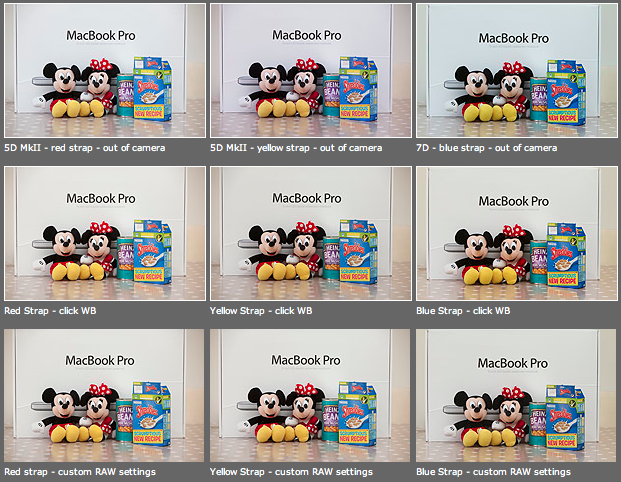
When you work with one camera and you shoot RAW all of the time it really doesn’t matter if that camera has a tendency towards magenta, yellow or cyan – the shift will be consistent and you can cope with it very easily in post-production. If, on the other hand, you work with more than one camera and each of them has a subtle shift in a different direction then your workflow can be slowed down when you have to constantly colour correct images shot under identical lighting in different directions. Like all things in photography, there is more than one way to solve this problem.

As you can see from the top row of images above – the three cameras that I use have different colour shifts with my slightly newer 5D MkII (codename yellow strap… because it has a yellow strap!) displaying quite a strong magenta shift whilst the 7D (codename blue strap, you can guess why) is a little cold and my oldest 5D MkII (red strap) is pretty neutral but maybe 1/3 of an f-stop brighter. I am going to use the red strap body as my basis for changing the colours on the other two a) because it is the most neutral to start with and b) because it has been serviced and cleaned by Canon quite recently.

Obviously these pictures were shot under controlled conditions using the same light source, the same lens on a tripod and have been converted from their RAW using no adjustments whatsoever. I shot multiple frames using each body as a sample just to make sure that there was no shift between frames on the same camera.

The second row of examples are the same RAW files with a white balance applied to exactly the same spot on the white box between Mickey and Minnie’s ears. As you can see this gets us a whole lot closer to matching the pictures for colour and this technique is fine when you have something in the frame which allows you to use the eye-dropper tool in Adobe Camera RAW (and in other similar raw conversion applications) and it is also fine when you only have a few images to process in this way. If you shoot an event where there are hundreds of frames, then you would spend an unnecessary amount of time balancing in this way.

The third row of examples utilises one of the cool features of the latest versions of Adobe Camera RAW in either Photoshop or Lightroom (and I’m sure that other software does this too) which allows you to set a default set of settings ranging from white balance to black levels, contrast, saturation to sharpening and noise control for each camera which the software detects from the serial number in the EXIF data as you bring it into the RAW conversion control pane. This is great for a lot of work and is a good option if you usually shoot on a fixed white balance.

These three techniques work for pretty much every digital camera and every scan. Some, more modern and more expensive, cameras allow you to go one crucial step further and that is to tell the camera to automatically shift by a fixed amount of colour for every frame – so that if your camera has a magenta shift like my yellow strap camera you can counterbalance that in camera and your images will show up as they should – no matter which white balance you are using at the time. The next few illustrations are based on a Canon 5D MkII using Canon’s own EOS Utility:

The illustration above top left of the three shows the home screen of the EOS Utility application and the “camera settings/remote shooting option is what you need.

This brings up the window on the top right which has an option marked WB shift that allows you to control the cross hairs and set an exact shift for the camera that is connected at the time. It is simple and very, very useful.

The illustration bottom left refers to the technique in Adobe Camera RAW (Photoshop CS4 in this case) in which you set a custom import for each camera and this is the preference pane that you need to find it.

It would be great if there was some software that allowed you to perform an exact “chip” calibration in the same way that you can calibrate a computer screen. Of course, the ability to calibrate the LCD on the back of a DSLR would be cool too but in the mean time here are three ways that you can use the combination of a good RAW converter and your camera’s built-in options to get all of your cameras working the same way as each other. It takes time, it’s fiddly but will save you a great deal of hassle over the course of a few weeks work.

Modified beauty dish

A couple of years ago I bought a slightly used 14″ beauty dish with a fitting that I couldn’t identify. I used it a couple of times with my old Lumedyne kit and kept meaning to make an adapter so that it was easy to attach and detach without looking like a “bodger”. I never got around to it – largely because the work that I was doing didn’t really call for that kind of light. A couple of months ago I came accross the dish and decided to adapt it for use with my Elinchrom Ranger Quadras.

To make it work properly with the Ranger Quadras I had to remove the orginal fitting. The dish is made out of relatively thin aluminium and it was very easy to use a hacksaw to take the whole of the fitting off. There were three screws holding the wires that keep the dome on position and I removed those to get ready to use the same holes to attach the Elinchrom fitting. This was made from a 13cm reflector which was cut through the reflector bowl in three places, allowing me to spread the metal of the reflector wider so that it could be bent to mirror the curviture of the beauty dish. I then drilled three holes in the modified Elinchrom reflector to match the three existing screw holes in the beauty dish and screwed the whole thing back together. Finally I used some gaffer tape to cover the slightly sharp edges of the Elinchrom reflector where I had cut it.

What you see in the three images above is the “finished” beauty dish. It is lightweight which is great for heads as small as the Elinchrom ones and it puts out a beautiful even light. I have shot some portraits using it but I cannot show them here yet because the client hasn’t used them in the magazine for which they were shot.

The total cost was £20.00 for the secondhand beauty dish, about £25.00 for the Elinchrom reflector that was sacrificed to make the adapter and some gaffer tape. Change from £50.00!

As a footnote, the colleague who proofread this piece for me asked why the cable has two yellow stripes around it. The answer is that I like to be able to identify bits of kit from a distance and the two stripes signifies that it is a two (and a bit) metre cable and that it was bought at the same time as the head. Newer purchases get different colours and a three metre cable would have three stripes. A simple idea but it really helps when you are working quickly and need to set up kit or make changes in a hurry.

Five levels of image manipulation

The Curve section of the EPUK website has always been a great source of information for photographers already working in editorial markets and for those who would like to do so in the future. I have written a few pieces for them over the years and my latest piece is about five different levels of image manipulation and how they should be used in newspapers and magazines.

As we celebrate the twentieth birthday of Photoshop we should take a few minutes to think about how the subject of image manipulation is regarded both inside and outside of our profession. In truth there is a sizeable majority of the population who think that every image that they see has been heavily retouched or altered.

Documentary, news and reportage photographers have a real battle to convince a sceptical world that their images tell the truth.

You might find it helps you to form your own thoughts on image manipulation by looking at these five categories of altering pictures and deciding for yourself which are appropriate for the kind of work that you do, and then using them to educate clients, friends and colleagues about how we as an industry view this very important subject.

  1. Normal darkroom practices – correction of colour, tone, contrast and saturation to reflect the way the image should look. Light dodging and burning.
  2. Darkroom interpretation – changes limited to colour, heavier dodging and burning, unnatural saturation and contrast that make the image an interpretation of reality.
  3. Minor alterations – adding or removing elements to or from the image, other than by cropping, that do not change the essential message of the image.
  4. Major alterations – adding or removing elements to or from the image that heighten or change the essential message of the image.
  5. Image montage – using elements of more than one image to make a photograph that is no longer a genuine representation of the scene.

For the purposes of news I would say that 1 is OK, and that 2 might be.

By the time you get to 3 then I would say that was unacceptable for news – unless there is a label attached or there are good public interest reasons for the manipulation (such as preserving the anonymity of vulnerable people).

The real danger here is that much of the public assume everything we do is altered. It does us no favours for this assumption to go unchallenged. The real sadness is that so many photographers supplying news images ignore the ethical implications – largely because they know no better.

Image manipulation is a serious subject and one that should be addressed by every photographer every time they sit at their screen and every time they see their work in print