portrait

Archive photo: Frances Partridge, London, May 1995

Frances Partridge was the last surviving member of The Bloomsbury set when she died, aged 103 in 2004. She had lived an amazing life full of love and tragedy and had known the brightest and the best people of her generation. She was a writer and a famous diarist. I photographed her when she was a mere 93 in 1995 at her home in London.
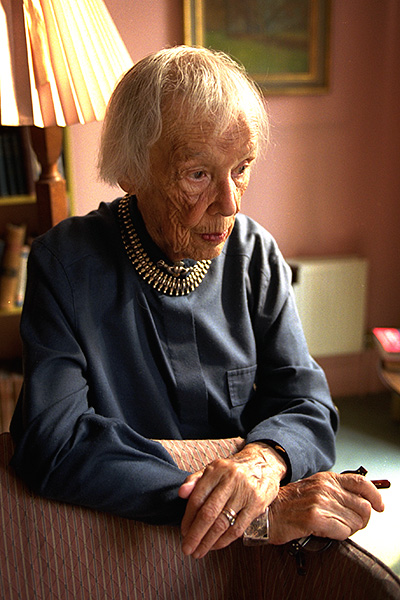
©Neil Turner/TSL. London, 10th May 1995

When I arrived she seemed agitated, which I didn’t think was unusual given her age and the fact that she had a stranger in her home but it became obvious that something specific was bothering her. She told me that her only corkscrew had broken and that she hadn’t been able to have a glass of wine. Like all good photographers I had a Swiss Army penknife and so I was able to open her bottle – which cheered her up a little. The thing that really made the rest of the job go very well was that I was able to fix her corkscrew so that she would be able to have he wine the following day too.

Mrs Partridge looked old and she knew it. She had spent most of her life surrounded by artists and writers and had been photographed many, many times. She celebrated her age and was keen that I portray her in my own way. We spent a good deal of time working out where she should be in her flat and the light coming in in early May changed every few minutes. I tried to shoot as little flash as I could – not because she didn’t like it but because somehow I thought that ambient light was more in keeping with the ethos of the Bloomsbury group.

Geek moment… I was using two Canon EOS1n cameras with 28-70 and 70-200 f2.8 lenses and Fuji 800 ISO colour negative film without flash and the frames shot with flash were in Fuji 200 ISO colour negative film. The scans were done with a Kodak auto feed scanner onto a Photo CD.
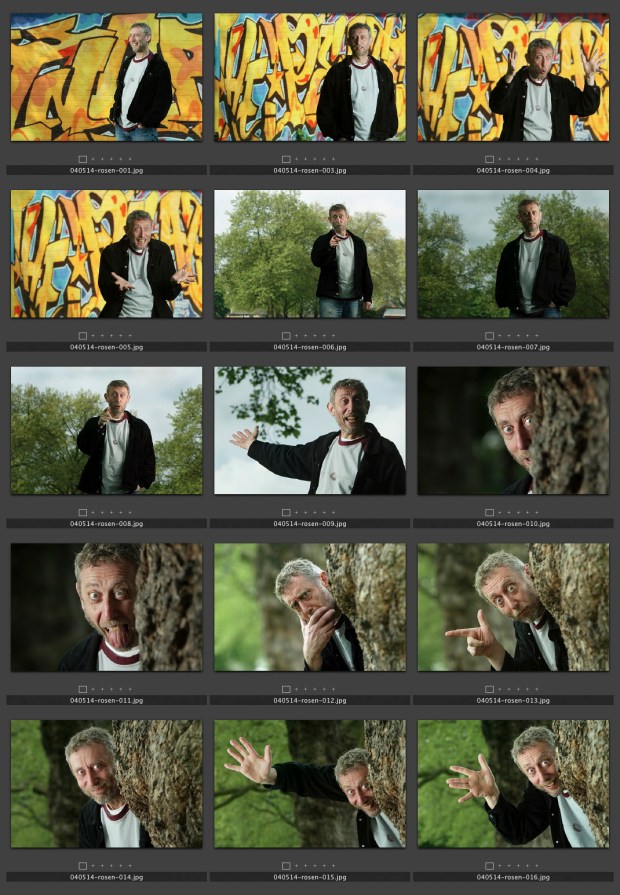
Michael Rosen portrait – the “contact sheet”

This set of portraits was shot in a London park and the graffiti covered walls were the exterior of a closed outdoor swimming pool.

©Neil Turner/TSL. May 2004, London

Several of the portraits in my portfolio were shot for the same “My Best Teacher” feature in the TES “Friday Magazine” when I was working at the newspaper. For quite a while the format was fixed and so every single frame was shot as a landscape and every photographed used was selected because it coped with the gutter or split across a double page spread.

I submitted a selection of fifteen to the Picture Editor but, quite frankly, there were about sixty pictures that could have made the cut because Michael was such a brilliant subject and such an easy person to work with. This job was featured a few days ago as one of my Folio Photos and you can read a little more there. The whole job was shot on two lenses and two cameras. The bodies were both 4.7 Mp Canon EOS1Ds and the three lenses were 24-70 f2.8L and 70-200 f2.8L IS. I also used a Canon 1.4x Extender on some frames and they were either available light or used a Lumedyne Signature series flash kit with a Chimera soft box.

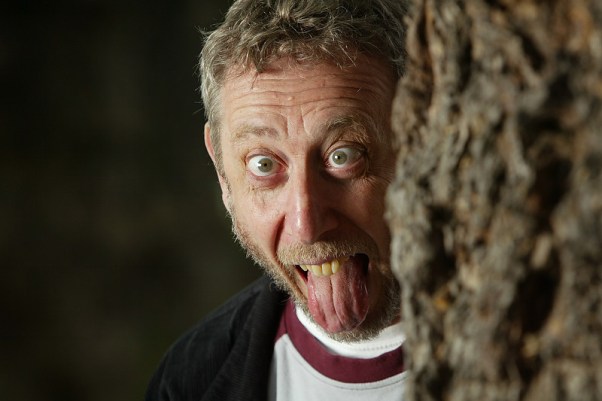
Folio photo #13: Michael Rosen, London, 2004

©Neil Turner/TSL. May 2004, London

Michael Rosen is a poet, author, broadcaster and all round brilliant bloke. I spent a good hour shooting a whole range of pictures of him at a park near his home in East London. I have photographed him about five times in total and it is always a joy to spend time with him. I have also been interviewed by him for his BBC Radio 4 programme about words and etymology. We did a special about photographer slang. This set of pictures is ripe for a future “contact sheet” too.

Geek moment: Canon EOS1D with Canon 70-200 f2.8L IS lens.

Possibly the oddest picture I ever took…

©Neil Turner/TSL | London | January 2006

The story was simple: we were doing an anonymous interview with a man who needed to remain unidentifiable for legal reasons and we had to shoot a picture of him at a time and a place that wouldn’t give his identity away. It seemed to be important that it was actually him in the picture and that became obvious when I had to shoot a proper portrait at the same time just in case the court case was decided and we needed a proper picture of him to go with a future follow-up article. Still with me?

The reporter arranged that I meet the subject at a London tube station and to get around the problems of finding someone whose name you don’t know and who you don’t have a picture of I always describe myself and what I’m likely to be carrying and wearing because a) I’m probably going to be there first and b) I’m probably going to be easier to spot (being big and carrying a lot of kit).

The venue turned out to be quite close to where he works and we decided that if any of his colleagues happened to spot us the cover story was that we were doing a fashion vox-pop on what the well-dressed office worker was wearing that season. The cloak and dagger details just kept multiplying.

I decided to go with a silhouette (you can read my thoughts on them here) and just for good measure I added an extra twist with a bit of motion blur too. The result was quite striking if bafflingly anonymous!

The technique is pretty simple. It was a dull winter’s morning in the city and we found a under cover area. I used a Lumedyne flash kit to light the brick pillar and silhouetted the subject against it. Without the flash, he would still have been a shadowy outline but so would the pillar and the picture would have been pointless.

The light that was coming from either side of the pillar was OK but it wasn’t plentiful and so I decided to give it a bit of movement blur by zooming the lens whilst the shutter was open. I ended up with an exposure of 1/8th of a second at f13 on 200 ISO using a Canon EOS1D MkII with a Canon 16-35 f2.8L lens triggering the flash with a pair of Pocket Wizards. Zooming during an exposure as relatively short as 1/8th of a second means that you have to have quite a few attempts to get it right and it also pays to tell the subject what you are doing if you don’t want them to think that you are a lunatic!

In the end I was very happy with this genuinely odd picture. I had arrived at the assignment with almost no idea what I was going to do and pretty much made it up as I went along. That’s why I love my job…

Vic Reeves portrait – the “contact sheet”

No sooner had I posted the folio photo of comedian Vic Reeves than I received an email asking to see more of the set. I have all of my work from that period backed up and catalogued and so it was really easy to lay my cursor on them. How to display them was less obvious. WordPress has plenty of gallery and slide show options but I wanted something a bit more “old school”  something like a contact sheet.

©Neil Turner/TSL | May 2006

The final edit of 18 images that were submitted. This job was slightly unusual for me because there are no upright images – everything was landscape because the magazine double page had already been laid out with the copy written, headline in place and the designer was just waiting for my pictures to be slotted in and sent to the plate makers. I have always had a soft spot for frame 004 but the page went with a slight crop of 015. I actually shot about 80 frames on the job but I’m afraid that even I don’t keep everything.

If this page gets some “likes” and positive comments I will see if I can find the time to do a few more things in a similar vein.

Techie stuff: Canon EOS1D MkII cameras with 16-35 f2.8L, 24-70 f2.8L and 70-200 f2.8L lenses. Lumedyne Signature series flash and a 23″x24″ Chimera soft box.

Folio photo #12: Vic Reeves, Kent, May 2006

©Neil Turner/TSL, May 2006

Comedian and writer Vic Reeves (aka Jim Moir) photographed in the back garden of his home in Kent on the day that he and his wife were moving out. We had to shoot in the garden because the house was full of removal men, boxes and the controlled chaos and stress that goes with moving house. He was the complete and consummate professional and I greatly enjoyed photographing him for a feature that was about his time at school. His biography of his early life was just being published as the feature came out.

Archive photo: Inner London Education Authority, April 1990

When the Conservative Government finally abolished the Inner London Education Authority (ILEA) which had shared County Hall with the Greater London Council (GLC) Mrs Thatcher could finally look out of the House of Commons and not be reminded of the opposition that her party had faced from across the river. I was sent to shoot a picture of one of the last people still working at ILEA who had done an interview for the Times Educational Supplement about his work wrapping up the affairs of London’s last unitary body (until the Labour government reestablished a London Mayor’s office in May 2000).

I went equipped with a notional headline of “will the last person to leave County Hall please turn out the lights” and I was very pleased when it turned out that the desk where he was working was in a windowless room in the basement of the beautiful if tatty building. I was even more pleased when I had processed my film and had a look at my pictures.

©Neil Turner. September 1990

For the camera geeks: Nikon F3P with 85mm f1.4 Nikkor and Kodak Tri-X film

Two portraits, one poet and a fifteen year gap…

Working as a photographer you often shoot pictures of people before they become famous and then get to shoot them again once they have “made it”. I don’t know if you can really categorise a poet as ‘famous’ but the British Poet Laureate is about as famous as you can get for poetry. In 2008 and towards the end of his term as Laureate, I photographed Andrew Motion at his London home but this wasn’t my first “one-to-one” with him. Back in 1992 when he was already established as a poet, and just ahead of the publication of his biography of Phillip Larkin, I had taken pictures of him at a different London home.

©Neil Turner/Insight | London | 14th September 1992

A lot of people are a lot more accommodating and easier to photograph before they become famous. They are often friendlier, more likely to offer you a cup of tea and are generally easier to work with. That wasn’t the case with Mr Motion. Back in 1992 I had caught him on a bad day – or at least a day when he had far more pressing matters to attend to than getting his picture taken whereas fifteen and a half years later he was well used to being photographed and had developed an easy manner when dealing with people like me. It could be that I was also fifteen and a half years older and more able to handle myself but whatever the reasons, shooting him in 2008 was a lot easier.

©Neil Turner/TSL | London | 28th March 2008

Of course the technology had moved on: in 1992 I was shooting with Nikon F4S cameras and some lumpy f2.8 Nikkor zoom lenses (35-70 f2.8 and 80-200 f2.8) on black and white film. By 2008 I was onto Canon EOS1D MkII and 20D cameras with some lovely L series Canon lenses and shooting digitally. The quality difference is also very noticeable and I wouldn’t want to shoot film on a job like this again.