advice

Diminishing returns?

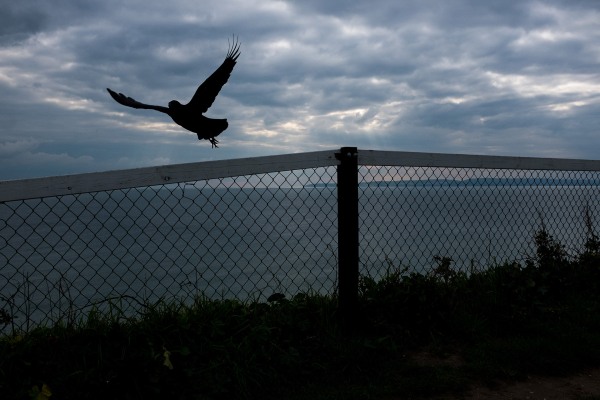
Crow takes flight from railings on the cliff tops at Fisherman's Walk,  Bournemouth. © Neil Turner, October 2015 © Neil Turner

Crow takes flight from the cliff tops at Fisherman’s Walk, Bournemouth. © Neil Turner, October 2015

Most photographers have personal projects that they spend their spare time working on. Mine is to document one of my favourite places on the world – the area of Bournemouth known as Fisherman’s Walk. It’s a lovely place that is very close to my heart and I often just pop along there (it’s three miles or so from home) with a camera or two over my shoulder and see what is happening.

The light by the sea is almost always interesting. No matter whether we have dull clouds or sparkling sunshine there will be something happening and that is why I keep going back to the beach, cliff tops and gardens that make up the area.

I have titled this piece ‘diminishing returns’ because that’s what happens with most projects: they start slowly and quickly develop with a flurry of great pictures and then it tails off again. That is unless you really work at it. Commercially speaking all projects need to have a finishing point. They need to have a date where you say ‘enough is enough’ and stop working on it. (more…)
Post production is all about the details

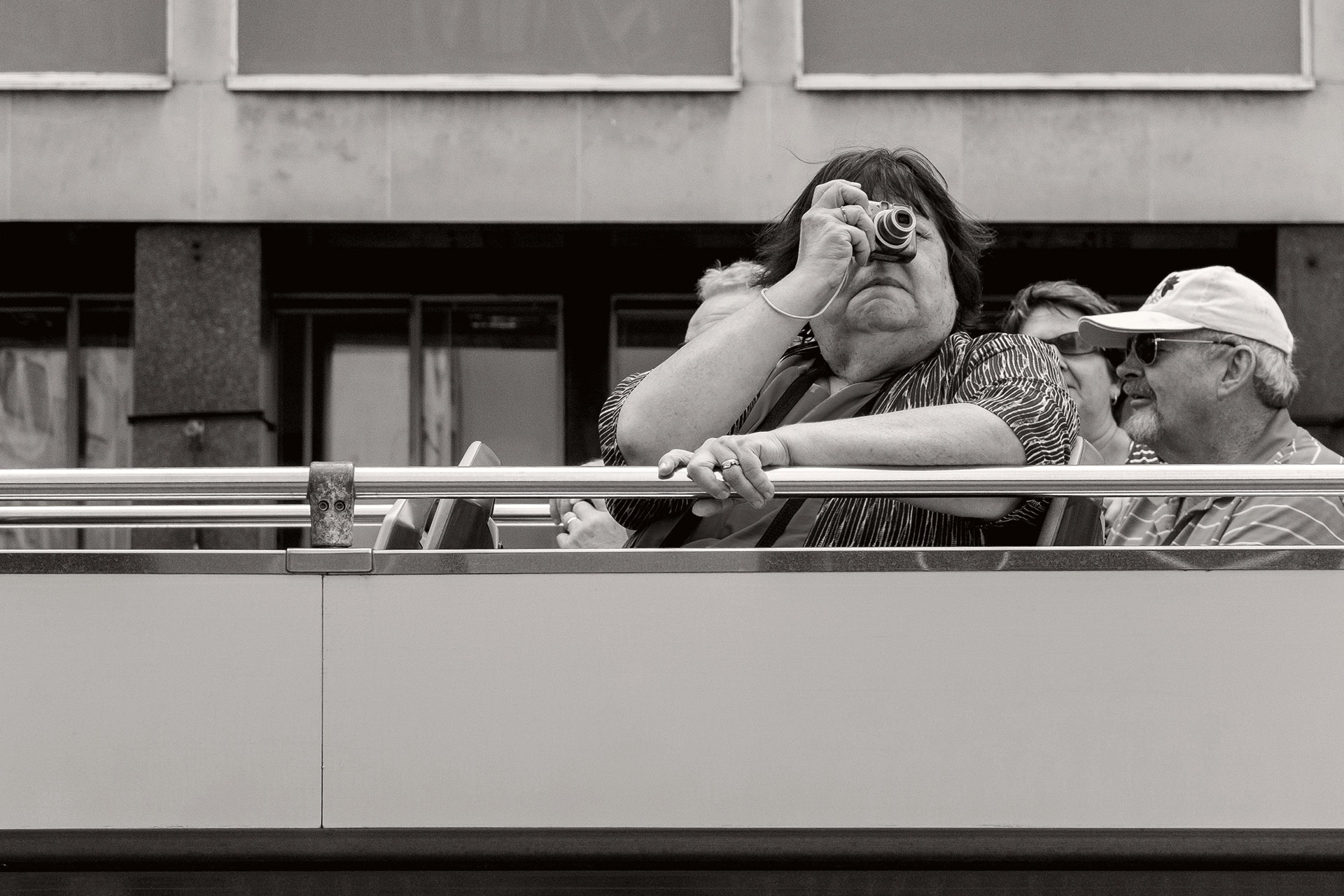
Passenger on the top deck of a tourist bus passing through Waterloo. © Neil Turner

Passenger on the top deck of a tourist bus passing through Waterloo.
© Neil Turner

I’ve read a lot about the ‘instagramisation’ of photography. I think that means taking slightly dull images, applying filters and presets to them and presenting them as bits of creativity. At the right time and in the right place those kinds of pictures have value and can make significant additions to creative campaigns and can go a long way towards making some elements of social media and social marketing more visually interesting. I’m not talking about that here – this blog post is all about choosing between making decisions about individual pictures or letting technology take over and ‘improve’ your work for you.

If you are on Facebook or any other social media that has targeted advertising you will probably get as many ‘suggestions’ as I do for people selling magical presets or add-ons to make my pictures instantly better. That’s great – or at least it would be if I wanted all of my images to exhibit a sameness with each other and with those of so many others. Trying to reduce professional post-production down to a series of mouse-clicks using algorithms and actions developed for others isn’t, in my opinion, a very good idea. (more…)

Back on Flickr

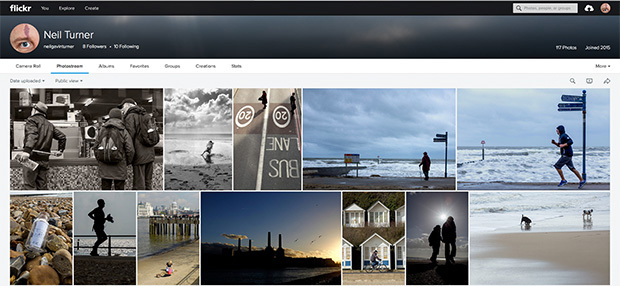
Screen grab of my new Flickr account

An important client recently asked me to do some preparation work ahead of a project with which I am involved. One part of that preparation was to find out all I could about sharing some of their content on Flickr. I decided that the best way to learn about it was to do it and so I established a brand new personal Flickr account and started to post some of my personal work.

Now, when I get five minutes to spare, I’m uploading new pictures, joining groups and generally playing around with the various options that the site has to offer and I’m getting close to the point where I can go back to the client and tell them what I know and get ready to set up their account ahead of the project.

Those of you that are using Flickr; what do you think? Have you got any hints or tips for me? I have the iPhone and iPad already set up to upload images and I have a new IPTC template for photographs so that the correct information gets placed into the right fields for the Flickr system. Please come and have a look at my pictures on the site, exchange “follows” with me and let me know what I need to do next.

You can find me at neilgavinturner .

The story behind a picture #1

Young England cross-country runners posing for a photograph in Winchester. © Neil Turner/TSL

Young England cross-country runners posing for a photograph in Winchester. © Neil Turner/TSL

Even after nearly thirty years shooting photographs I can almost always remember something about ‘being there’ on the job when I look back at the pictures. There’s also a story to be told about why a particular picture was shot, lit or composed in a certain way.

A while ago I was posting a “photography word of the day” on Twitter and one of the first was compromise. This photograph of two rising stars of cross country running is a classic example of compromising to get a decent shot.

When I arrived at the college where they were both studying neither of them had their kit with them to do an action shot. Luckily their England team tracksuits had arrived and so I had to manufacture an action portrait of them that left one important part out of the frame – their feet. Neither of them had suitable footwear to be photographed in action and so I had to find a way to shoot them without drawing attention to their lack of running shoes.

In front of the college was a large banked area of grass and playing fields. I realised quite quickly that I could get the best of the light (dusk was fast approaching), lose most of the buildings and hide their feet by getting down low and using one of the banked grass areas to fill the foreground as they ran towards the low angled sun whilst shooting on a long (ish) lens.

So that’s what I did. The two runners were amused by the lengths to which I was determined to go to get a decent shot. They had been photographed two days before but just wearing their street clothes and standing by the college sign and they had assumed that I’d do the same. They did about ten lots of the ten yard run that had them in the right place and I shot some of them horizontally and the others vertically to cover the possible shapes that the newspaper might use. I also shot it using a range of aperture and shutter speed combinations to get the depth of field right.

I did some static upper-body photographs as well as having them pose with their trophies (feet hidden) on the grass.

Technical stuff: Canon EOS1D MkII with a 70-200 f2.8L IS lens. ISO 320, 1/1000th of a second at f6.7

Getting pictures away quickly

Getting photographs to the client has always been one of the less glamorous aspects of being a professional photographer. From sticking a pile of prints into an envelope and handing them to a courier to scanning negatives before using clunky slow modems to deliver them right up until today’s relatively painless methods nobody in their right mind would list this part of the process as either satisfying or easy.

The arrival of social media and the realisation amongst better clients that using our work rather than their own smartphone snaps has meant that we have had to speed things up a lot. I’ve always liked Eye-Fi cards but more recently I have been working with clients and with projects where something even more reliable and configurable is required. The worst part of it is that there isn’t actually one simple solution or workflow that will satisfy all of them in all circumstances. For a lot of jobs transferring the pictures from the camera to a smartphone or tablet before captioning and shifting them to the client is quick enough and I’ve written about that workflow before. New software appears all of the time and I am always looking at ways to make things smarter and quicker by introducing some automation and cutting steps out.

Live Ingest window from Photo Mechanic 5.

Live Ingest window from Photo Mechanic 5.

(more…)

F4 and be there…

06 August 2015. Bournemouth, Dorset. Close up of part of a Canon 70-200 F4L IS lens. Hillcrest Road

06 August 2015. Bournemouth, Dorset. Close up of part of a Canon 70-200 F4L IS lens.

I’ve discussed zooms versus primes far too many times in far too many blog posts to rehearse the old arguments again and at the end of my recent post about zooming with your feet I mentioned investing in some new gear with a promise to follow it up with a blog post – so here it is.

The great New York press photographer Weegee is supposed to have said “F8 and be there” when asked how he got such great pictures. I’m not remotely interested in the debate about whether or not he actually said it but I am interested in the idea of apertures and, more importantly, maximum apertures.

For as many years as I’ve been shooting with zooms I’ve owned and used lenses pretty much exclusively with f2.8 maximum apertures. (more…)

Zooming with your…

©Neil Turner/Bupa 10,000. May 2015. A Police rider accompanies a detachments of Guards as they march back their barracks.

©Neil Turner/Bupa 10,000. May 2015.
A Police rider accompanies a detachments of Guards as they march back their barracks.

I was on a job the other day, standing next to a very young photographer in a ‘press pen’. He glanced over at the gear I was using and mentioned how much he would love to own the 135mm f2L lens that I had on one of my cameras. He said that he had never really got the hang of “zooming with his feet” in the way that so many of the photographers he admired had advised. He had also had it drummed into him by one of his tutors at college and it had left him wondering if he was doing something wrong.

Zooming with your feet is a great concept and it is one of the catchphrases in contemporary photography that appears to be beyond question. But is it? Is it actually as much a cliche as a universal truth?

There we were on a job where we couldn’t have zoomed with our feet even if either of us had the skills to do so. We couldn’t go forward – there was a metal barrier in the way. We couldn’t go backwards because there were other photographers and a couple of TV crews behind us – and behind them was another barrier. We had a tiny amount of sideways movement if we could change places with each other but, apart from that, we were in a very fixed position. (more…)

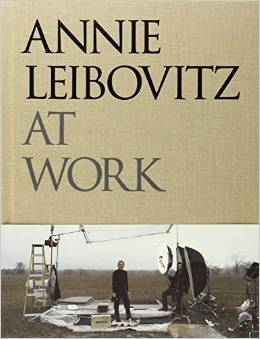
Having read “Annie Leibovitz At Work”

liebovitz_coverI doubt that you’ll be surprised to hear that the vast majority of the books sitting on my shelves at home are collections of photographs. I have books by most of the greatest photographers who ever lived and I find them to be a constant source of inspiration as well as a great help in keeping my feet on the ground. Every time that I need ideas I see what they did and every time I think I’ve done something great I realise that many other people did it before me and often better than me.

One of the biggest sections is the one devoted to Annie Leibovitz. I admire her and I admire her work. I don’t necessarily want to be the kind of photographer that she has become and I definitely don’t want to do the kind of work that she is most famous for but there is a great deal of inspiration there.

For my birthday a few months ago I was given a 2011 copy of her 2008 book “Annie Leibovitz At Work”. It is partly a biography, partly a summary of her professional life and an interesting insight into how she feels about the job that she has done since leaving college. There are also copies of many of her greatest pictures in it – although it’s the words that I want to talk about here.

When I read it a month or so ago I did so immediately after reading Roger Allen’s excellent “The Darkroom Boy 40 Years on Fleet Street” which is a funny and honest look at the life and career of one of the greatest exponents of the newspaper photographer’s craft. (more…)