camera

Define the word “PHOTOGRAPHER”

When does a person with a camera, even a person with an expensive camera, become a photographer?

Apologies if this seems to be getting a bit philosophical but it’s a question that someone casually threw at me a week or so ago and I’ve been struggling with it ever since. Let’s get the dictionary stuff out of the way…

Right now we can really get on with the real business of working out what a photographer is. I’ve always been a fan of simple definitions and I like the idea of making a comparison between things, so how about this:

Someone with a camera tries hard to get everything into the picture whilst a photographer does their level best to keep as much out of the picture as they can.

All that means is that there comes a point in your photographic journey where you realise that most pictures are much stronger when you leave absolutely everything out that doesn’t need to be in. In a paraphrase of the old saying “what doesn’t kill you makes you stronger” (which isn’t necessarily true by the way) we can come up with “what doesn’t add to the composition detracts from it”.

The dictionary definition above, which comes from the English dictionary built into the Apple OSX operating system, steers away from the word professional and I’m really glad that it does because there are an awful lot of superb photographers out there that take pictures for fun and not for a living. Being a good photographer is not the same as being a professional photographer. On balance, MOST professionals are good but there isn’t a direct relationship between earning a living and being proficient.

These days there is a belief that ‘everyone is a photographer’. I wouldn’t argue that almost everyone takes pictures and that almost all of them take two, three, four and even twenty times as many pictures as they would have done when we had to buy film. Someone who I once discussed photography with reminded of another old adage – the one about if you give enough monkeys enough paper, enough typewriters and enough time sooner or later one of them will create the complete works of Shakespeare. It doesn’t hold up here and I told him as much.

People with cameras are largely rational, intelligent and reasoning beings and so most will work out what they do and don’t like and then take better and better pictures over time. Their image making isn’t the random act of monkeys with no comprehension what they are doing – the point here is that when it comes to learning that less (content) is more (better pictures) some will figure it out for themselves , some will need to have it pointed out to them and the rest will remain blissfully ignorant of it.

For some lucky people the knowledge is instinctive. The rest of us have learned through trial and error and/or formal education to know a good picture when we see one. Those that take the next step by learning what makes it a good picture can call themselves “visually aware”. The final (and never ending) stage is to develop the skill to see the picture and make the best of it before and during the pressing of the shutter. Those people can call themselves photographers.

See also COMPOSITION
Seaside towns beginning with ‘B’…

I was born in Bournemouth, went to school in Bournemouth and I live there most of the time. I am, as they say, a Bawmuff Boy. There are a couple of other major seaside towns that also begin with ‘B’. Brighton is 94 miles along the coast and I have shot at least twice as many commissions there than in my home town in the last 25 years. Blackpool, on the other hand, is a long way from either Bournemouth or London and somewhere that I have only ever been sent to for party political conferences. Because of the distance I’ve never seen the place as it should be seen – without an overload of grey men in grey suits.

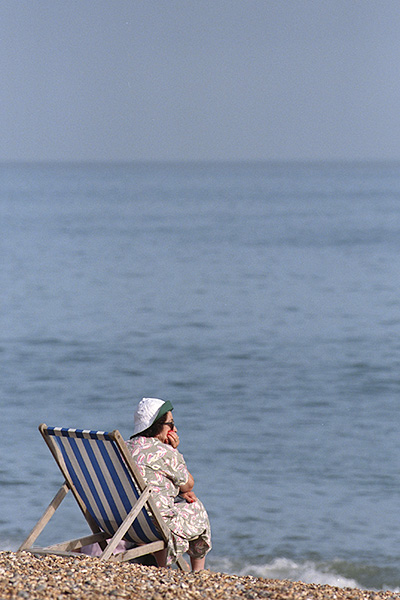
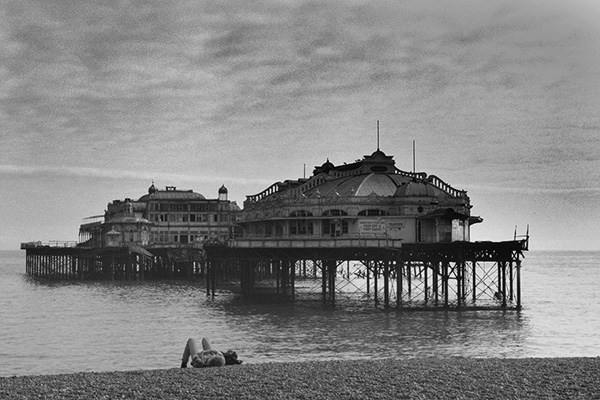
©Neil Turner/TSL. Brighton, July 1995 - a view that no longer exists.

I really like Brighton – it is a photogenic place and it seems to be a really media-savvy sort of town too. On one occasion in the summer of 1995 I was even sent there to shoot stock images of the place to accompany general articles about the town (now a city I believe) and about the county of East Sussex. It was the first in a series of similar days when the diary was empty and I went to Cambridge, Oxford, Birmingham, Bristol and Norwich during that summer. It’s not very often you get quite such relaxed brief but it was actually quite a challenge – generic images in three hours and away again. Cambridge and Oxford were a lot easier but Brighton was the one I’d choose to do again. If I were given a free hand it would have to be Blackpool though. Every time I see it on TV I think to myself “so many pictures to be taken…”

©Neil Turner/TSL. Brighton, July 1995

©Neil Turner/TSL. Brighton, July 1995. Timeless...

The man who wrote “The Very Hungry Caterpillar”

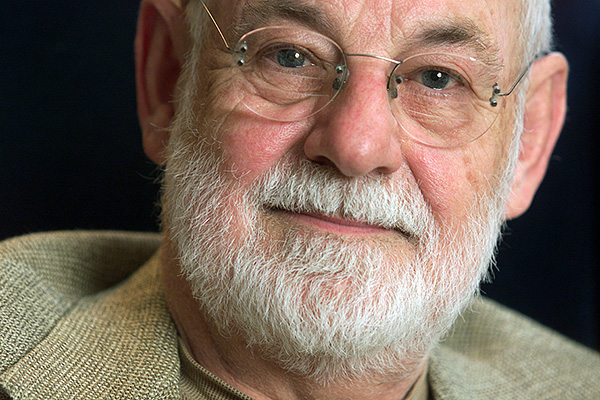
Everyone who has ever read books to very young children should have seen “The Very Hungry Caterpillar”. It’s an absolute classic and, back in 1999 I had five minutes to shoot a portrait of Eric Carle, the American writer and illustrator who created it at a London Hotel. I should have had longer but I was badly late because I’d been given the wrong address but he was charming, patient and his PR people were relaxed as well. At the time, he was 70 years old and the book was coming out as a 30th anniversary edition.

©Neil Turner/TSL. May 1999, London.

As soon as I got there, I set up my Lumedyne battery powered light with a simple shoot-through umbrella and started to work.  The author was sat in a high backed chair and I decided to work around where he was already sitting – he looked relaxed and I was still in “full apology mode”.

Although this was nearly 13 years ago I can still remember a random throughout that came into my head “if I were casting someone to be Santa Claus, it would be this guy”. From then onwards all I could see was a really nice bloke with a twinkle in his eye that children would adore. The fact that he must have illuminated millions of childhoods was certainly in my mind and we shot some very nice pictures very quickly.

©Neil Turner/TSL. May 1999, London.

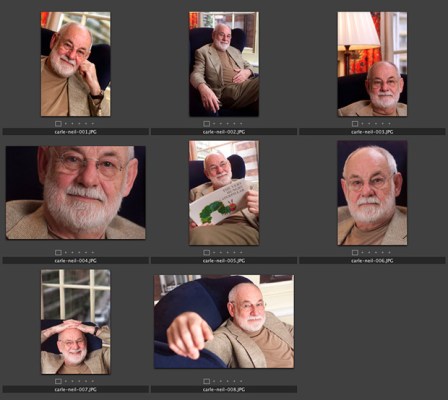
This set of eight pictures is all that remains from the shoot. Back in 1999 storage was still expensive and the company policy was to use Zip discs (remember them?). My laptop had a zip drive and I put the wider edit onto the “official” zip disc and kept the tight edit on another disc for my own records. The official disc with the Kodak RAW files was lost somewhere in the mists of time and we didn’t discover that it was gone until we started to upload the entire back catalogue into a managed and backed-up library a couple of years later. You learn from your mistakes.

I like the simple and innocent tight composition of frame 004 and I love the expression of frame 007. I have read his books to young members of the family ever since and I try really hard to do so with the same twinkle in my eye that the author had.

This was still the early days of digital and I was using a Kodak DCS520 (Canon D2000) with Canon 17-35, 28-70 and 70-200 f2.8 lenses. At 200 ISO, with good light and if you didn’t need to use the pictures too large the quality of the files was actually very good indeed.

The early days of digital

I took delivery of my first Kodak DCS520 digital camera in late November 1998. It was a revelation. I had used a previous model (DCS3) which was pretty poor and I wasn’t really that convinced about the whole process. After three days, I was a convert – the kind of convert who then sees it as their role to evangelise about their new-found wisdom/insight/faith. Based on the Canon EOS1n camera, the Kodak conversion replaced the whole of the back of the camera and quite a big chunk of the electronics too. It was expensive, relatively slow and it only had 1.9 megapixels. It had a tiny low resolution LCD screen on the back and it used enormous and expensive batteries that rarely lasted a whole day but I absolutely loved it from that first week!

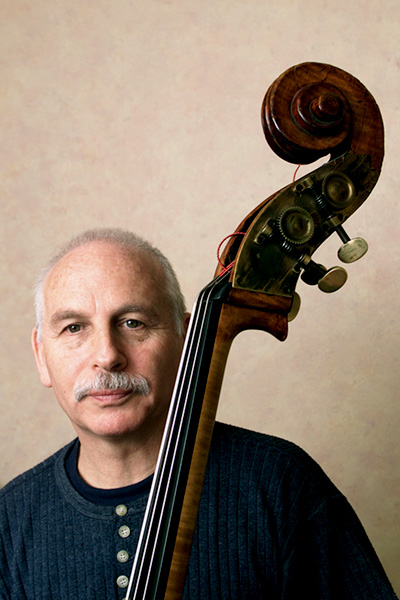
©Neil Turner/TSL. 10th December 1998

This was one of the first proper portraits that I shot with my first DCS520 (known as the Canon D2000 in some countries) and it was of a double bassist and jazz teacher in his own home. My conversion was so dramatic and so complete that I even remember sulking a little when I had to shoot on film for the glossy sections of the newspaper. We worked with these early cameras for nearly four years until the Canon EOS1D came out. Nikon had introduced the D1 in that period and the see-saw battle for supremacy between the two big manufacturers with input from Kodak and Sony began in ernest.

I quite often get asked what the big trigger was for digital in the newspaper industry. There are a few factors;

  • The arrival of cameras capable of shooting quality images
  • The money saved by newspapers getting rid of darkroom staff
  • The arrival of new health and safety laws that meant waste chemicals became very expensive to dispose of
  • The speed of turnaround of digital pictures
  • The ease of archiving digital images

Talking with others who used the Kodak DCS series camera from that era we all agree about one thing – how good Kodak’s software was. What a shame that they threw away their lead in professional digital photography. If they had even kept their software development going, they could possibly have avoided needing to file for bankruptcy protection in the US courts last week. I look back at the early days of digital with a real fondness – they really were the most exciting of times. There’s something very cool and very rewarding about being in the second row of pioneers!

Folio photo #14: Children on a bug hunt, south London, May 1999

©Neil Turner/TSL. May 1999, south London

This picture from a story about children from a local primary school going on a “bug hunt” in Nunhead Cemetery was shot for a special supplement to the TES about the environment. The outdoor lesson was led by Richard ‘Bugman’ Jones, a professional entomologist who undertook a residency at the school. Like a lot of my favourite pictures it doesn’t tell the whole story but it is a ‘moment’ that hopefully makes you want to know more.

I had switched to shooting most of my work digitally the previous year but the Picture Editor working on this section was still keen that we shoot pictures for these glossy extra sections on transparency film. I think that this was the last commission that I ever shot using a Leica M6. The wider shots were definitely on the Leica but I also shot some longer lens pictures using a Canon EOS5 and a fixed 85mm f.18 lens

Geek moment: Leica M6 with 35mm f2 Summicron and Fuji RDP100 transparency film.

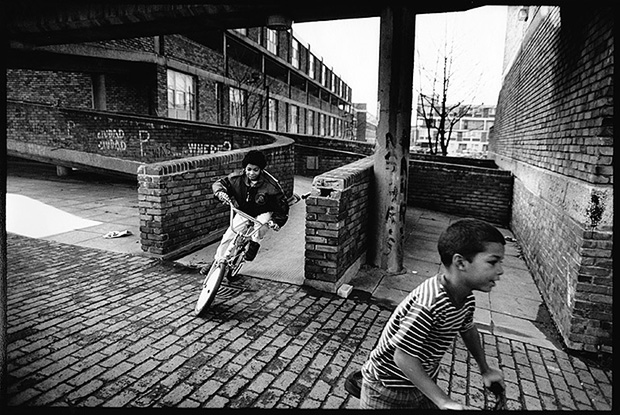
Archive photo: Brixton, July 1990

©Neil Turner. July 1990, Angell Town Estate, Brixton

I was shooting a piece about the work being done by some amazing community volunteers in conjunction with outreach workers employed by the Local Education Authority around one of Brixton’s many estates and we were being ‘buzzed’ by some boys on bicycles just out enjoying themselves. Neither of the boys in this picture were the subjects of the work involved so the picture didn’t really add to the story but I have always liked it and I thought that it would make a good picture to post here.

I had posted this image on Twitter a while ago and I think that I mis-captioned the date. Checking the negatives today, it should have said July 1990.

The camera would have probably been a Nikon F3P with a 24mm f2 Nikkor and Kodak Tri-X film but I am not entirely sure because at the same time I had FM2 bodies and a Leica M6 as well.

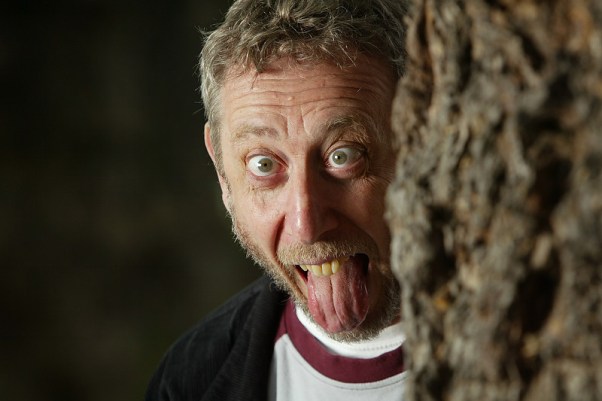
Folio photo #13: Michael Rosen, London, 2004

©Neil Turner/TSL. May 2004, London

Michael Rosen is a poet, author, broadcaster and all round brilliant bloke. I spent a good hour shooting a whole range of pictures of him at a park near his home in East London. I have photographed him about five times in total and it is always a joy to spend time with him. I have also been interviewed by him for his BBC Radio 4 programme about words and etymology. We did a special about photographer slang. This set of pictures is ripe for a future “contact sheet” too.

Geek moment: Canon EOS1D with Canon 70-200 f2.8L IS lens.

Having an eye for detail

The choice between taking the same photograph as everyone else and standing back and getting something different becomes a matter of survival when you work on a weekly newspaper and the other five photographers around you will be publishing the next morning. Even if that weren’t the dilemma of every photo-call I go to, I like to think that as a photographer I am an individual. It’s a pretty useful mindset to sign up to, no matter how much or little photography you do.

Photo: NEIL TURNER. ©TSL. 04/09/2000. TES news.

This photograph of an elephant’s eye is a classic example of taking a mental step back from the herd and shooting something different. It is also an advertisement for having more than one camera with different lenses on. There were five other photographers at the job. The story was about this young Indian elephant who paints pictures, and about how he was being used to launch an environmental art competition for schoolchildren. We were all trying to make the same picture of the elephant, three kids, some paint and an easel. The composition was looking messy, and there were just too many elements in it. We all had 16-35 lenses on and were getting nowhere. I was getting nowhere faster than the other five who would all go to press that night leaving me with two more days during which the story could easily get scrapped without a strong image. My second camera had my 70-200 on it and I grabbed it, zoomed in and the picture almost took itself. Strong, arresting, different and wide open for headline writers to do their thing. Just about every base covered. I shot some of a paint brush in the elephant’s trunk too, but this was the picture chosen.

When an image is competing for space on a newspaper page it has to stand out. The enlightened editors at our papers allow images to arouse the reader’s interest and don’t insist that photographs tell the whole story all of the time. This approach works on every level, from the family album through e-mailed postcards to published images. Getting in close works.

See also: MINDSET FOR NEWS PHOTOGRAPHERS