Neil

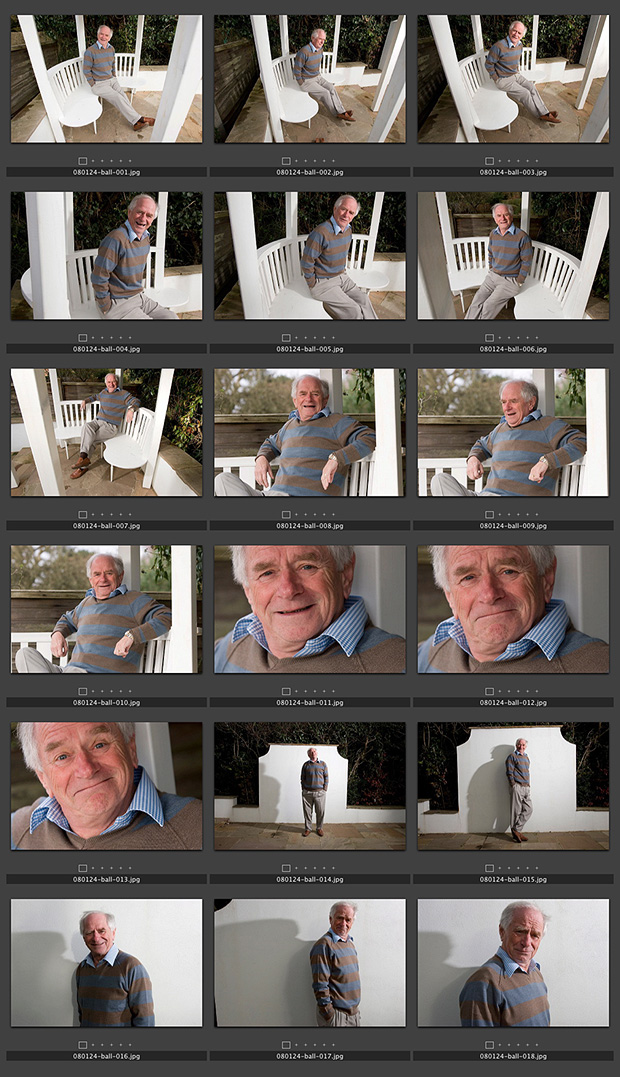
Professor Paul Black portrait – the “contact sheet”

When I shot these portraits for the Times Educational Supplement in 2008, Paul Black was Emeritus Professor of Science Education at King’s College London. He started his career as a physicist before teaching physics and then moving into the world of educational research. He wrote a policy document for the then Conservative Government in 1988 and was widely regarded as one of the country’s leading experts on all form of assessment.

©Neil Turner/TSL. April 2008, London

The photographs were taken in his office at King’s College and he was a wonderful humble man. Like a lot of people who have never really been the subject of media attention he was bemused, amused and slightly confused by the process of having his portrait taken. I very much enjoyed taking his picture – partly because he was such a nice man and partly because I was using a Canon 85mm f1.2L lens for the very first time.

Techie stuff: Canon EOS1D MkII cameras with 16-35 f2.8L, 24-70 f2.8L and 85 f1.2L lenses. Mostly available light but some with Lumedyne Signature series flash and a 70cm shoot through umbrella.

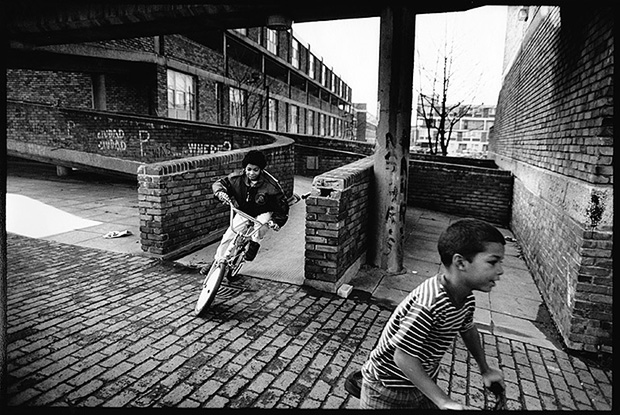
Archive photo: Brixton, July 1990

©Neil Turner. July 1990, Angell Town Estate, Brixton

I was shooting a piece about the work being done by some amazing community volunteers in conjunction with outreach workers employed by the Local Education Authority around one of Brixton’s many estates and we were being ‘buzzed’ by some boys on bicycles just out enjoying themselves. Neither of the boys in this picture were the subjects of the work involved so the picture didn’t really add to the story but I have always liked it and I thought that it would make a good picture to post here.

I had posted this image on Twitter a while ago and I think that I mis-captioned the date. Checking the negatives today, it should have said July 1990.

The camera would have probably been a Nikon F3P with a 24mm f2 Nikkor and Kodak Tri-X film but I am not entirely sure because at the same time I had FM2 bodies and a Leica M6 as well.

Johnny Ball portrait – the “contact sheet”

Johnny Ball was always on television when I was growing up. He was a wonderful performer who gave a very human face to science and mathematics and made some otherwise difficult and dull concepts a lot easier and a lot more fun. These days he seems to be better known as Zoe Ball’s Dad.

©Neil Turner/TSL. January 2008, Berkshire

In much the same way that the Vic Reeves set was shot this final edit of 18 images that were submitted are all landscape. The TES magazine had a set layout by this time for these interviews with interesting and famous people about their time at school. The shoot took place in the back garden of Mr Ball’s house in and around various structures that he himself had designed and built. It was one of the most relaxed shoots that I did for the magazine and, although I was only there for half an hour, I think we got a really good variety of images from it.

Techie stuff: Canon EOS1D MkII cameras with 16-35 f2.8L, 24-70 f2.8L and 70-200 f2.8L lenses. Lumedyne Signature series flash and a 23″x24″ Chimera soft box.

Having an eye for detail

The choice between taking the same photograph as everyone else and standing back and getting something different becomes a matter of survival when you work on a weekly newspaper and the other five photographers around you will be publishing the next morning. Even if that weren’t the dilemma of every photo-call I go to, I like to think that as a photographer I am an individual. It’s a pretty useful mindset to sign up to, no matter how much or little photography you do.

Photo: NEIL TURNER. ©TSL. 04/09/2000. TES news.

This photograph of an elephant’s eye is a classic example of taking a mental step back from the herd and shooting something different. It is also an advertisement for having more than one camera with different lenses on. There were five other photographers at the job. The story was about this young Indian elephant who paints pictures, and about how he was being used to launch an environmental art competition for schoolchildren. We were all trying to make the same picture of the elephant, three kids, some paint and an easel. The composition was looking messy, and there were just too many elements in it. We all had 16-35 lenses on and were getting nowhere. I was getting nowhere faster than the other five who would all go to press that night leaving me with two more days during which the story could easily get scrapped without a strong image. My second camera had my 70-200 on it and I grabbed it, zoomed in and the picture almost took itself. Strong, arresting, different and wide open for headline writers to do their thing. Just about every base covered. I shot some of a paint brush in the elephant’s trunk too, but this was the picture chosen.

When an image is competing for space on a newspaper page it has to stand out. The enlightened editors at our papers allow images to arouse the reader’s interest and don’t insist that photographs tell the whole story all of the time. This approach works on every level, from the family album through e-mailed postcards to published images. Getting in close works.

See also: MINDSET FOR NEWS PHOTOGRAPHERS

Vocabulary of photography

Language is an ever-evolving thing and a quick search for a famous quote on the nature of language brought up two very interesting thoughts. The first is accredited to Karl Albrecht – a German latter day renaissance thinker (I wish it were the co-founder of Aldi who had the same name)

“Change your language and you change your thoughts.”

This is an important idea when, as press photographers, we are trying to get the world, the rest of the media and the Leveson Inquiry to think about photographers differently. Words like paparazzi have been liberally used during the inquiry and by commentators about the inquiry. Fellow journalists and even some of our peers regularly use the words snap, snapper and snapped to talk about our work. As long as this kind of unhelpful vocabulary carries on being used we are almost bound to carry on having a problem. We are photographers, we take photographs and what we do is photography. Get a thesaurus out and there are plenty of other words that can be used (with increasing degrees of pompousness). It seems likely that it is up to us to start the ball rolling. It is one thing to use slang terms within the tight confines of our profession but an entirely different thing to propagate them elsewhere.

As professionals we owe it to ourselves and our colleagues to change our own vocabulary and to correct everyone else who falls into the lazy trap of using short snappy terms that are just not accurate. Take last Saturday’s Times for example. On the front page of one of their sections they had a line about “What really happened when Beaton snapped the Queen”. Did Sir Cecil Beaton really “snap” anything? The Victoria and Albert Museum, a cultural institution that would claim to respect photography has on their shop website a line about the same photographer saying that after her 1953 Coronation

“(he) snapped the Queen in all her coronation finery.”

As long as what we do is trivialised in this way we are going to have an uphill struggle. A couple of other searches on the web brought up equally depressing quotes – this one comes from a careers website www.allaboutcareers.com and their description of the job “Press Photographer”:

“Press photographers are employed by newspapers, magazines and other print and web publications. These snap-happy professionals are tasked with recording images of current events to support news stories or taking interesting photos to emphasise the point of featured articles.”

We could go on but that would only serve to labour the point. It is hard to think of another profession whose work is so universally undervalued, whose work is widely misunderstood and about whom the vocabulary used is to pejorative.

One final note: whilst looking for quotes about language I found this one attributed to Federico Fellini – the man credited so widely with the origins of the term “paparazzi”;

“A different language is a different vision of life.”

Our language is a very visual one but occasionally even we need to resort to words to make our point. If we aren’t careful, the rapid evolution of the English language will leave us behind and the regular and repeated use of poor and inaccurate phrases will become “correct”.

Folio photo #12: Vic Reeves, Kent, May 2006

©Neil Turner/TSL, May 2006

Comedian and writer Vic Reeves (aka Jim Moir) photographed in the back garden of his home in Kent on the day that he and his wife were moving out. We had to shoot in the garden because the house was full of removal men, boxes and the controlled chaos and stress that goes with moving house. He was the complete and consummate professional and I greatly enjoyed photographing him for a feature that was about his time at school. His biography of his early life was just being published as the feature came out.

Archive photo: Special needs school, March 1990

Following on from the March 1990 Conductive Education picture that I posted earlier in the week I remembered another special needs picture that I shot a short while later. As it turns out, exactly four weeks later. This shot isn’t as technically sound or as well composed as the previous picture but it does mean a lot to me – because there is a real story to go with it.

© Neil Turner | 30 March 1990 | Southampton

This boy had a target of learning to do up his own zip and was determined to succeed for the camera. I was touched by him and his determination and so I stayed with him whilst he kept trying. After nearly ten minutes he succeeded and I was very nearly in tears. One of the staff had been watching and she was in tears. I have never forgotten that moment.

For the geeks out there, the camera was a Nikon F3P, the lens was a 24mm f2 Nikkor and it was shot on Kodak Tri-X film.

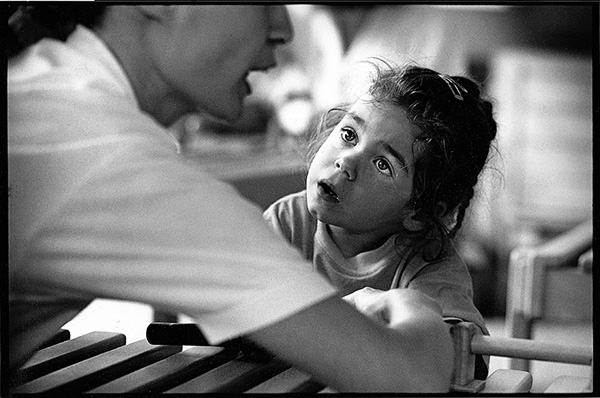
Archive photo: Conductive education, Sussex, March 1990

Please note that I have made a small correction to the caption. The pictures were taken a year later than I originally thought.

©Neil Turner, March 1990

This assignment opened my eyes to a whole world of education. I was fascinated by the ‘special needs’ systems that had grown up in the UK to try to provide a combination of tuition and therapies for children whose families were trying to do the very best for them. On this job I was working with a committed reporter who did her best to bring me up to speed on all of the terminology used in the field and years later I found myself telling younger reporters how things were. To this day, disability remains a topic that I get real satisfaction from showing to the world.

Young child who has cerebral palsy having a physiotherapy session at a residential school in West Sussex under the Conductive Therapy regime. This technique was brought to the UK from Hungary where therapists, known as conductors, use a range of very intensive methods to try to get children who have very badly compromised motor skills to walk unaided.

Judging from the date, I expect that this picture was shot on a Nikon FM2 with a 135mm f2 Nikkor. The film is Kodak Tri-X.