styles

The personal frames you shoot…

I have shot thousands of editorial portraits over the last 26 years and every once in a while I shoot a few “personal frames” at the end of a job. What I mean is that there are pictures that I shoot if I have time that I know the client would not publish in a million years and so I am doing them for my own amusement/sanity/experience/curiosity. When you start shooting pictures, everything you do is an adventure. Slowly you learn how to achieve the results that you (and your client) want and it becomes very easy to just take the pictures that you need to take without pushing any boundaries or trying anything new.

Professor Lewis Wolpert. London, March 2004. ©Neil Turner/TSL

I wrote an essay in 2004 about why black and white is so effective and why so many people profess to preferring it to colour for a lot of ‘serious’ pictures. The reason that I have always believed is that good photography is about giving people a view of your subject that they recognise but that, at the same time, is not how they themselves would have see the same scene. There are plenty of ways of achieving this but the one that non-photographers seem to respond to most positively is to show black and white pictures. For about two weeks after writing that for the first time I consciously shot pictures that I could convert to black and white to prove or disprove my theory. I even submitted a few black and white images with my edits to the newspaper I was working for.

The experiment developed a little and I started to try to actually mimic the feel of black and white film and prints. Lots of filters and plug-ins were appearing on the market at the time and I played with as many as I could get my hands on. The experiment ended when I shot this portrait of Professor Lewis Wolpert at the Department of Anatomy, University College London in March 2004. I had spent quite a while using Photoshop’s darkroom style tools to dodge, burn, correct contrast and generally make an otherwise ordinary picture look rather nice. I really liked the picture but I decided that the personal frames idea needed to head off in a different direction and so I stopped shooting with mono in mind for quite a while.

In common with almost all of the work that I was doing at that time, this was shot on a Canon EOS1D with a 70-200 f2.8L lens. It was shot at 640ISO (which for me was the highest you could go on the original EOS1D without getting a lot of noise) at 1/125th of a second at f2.8.
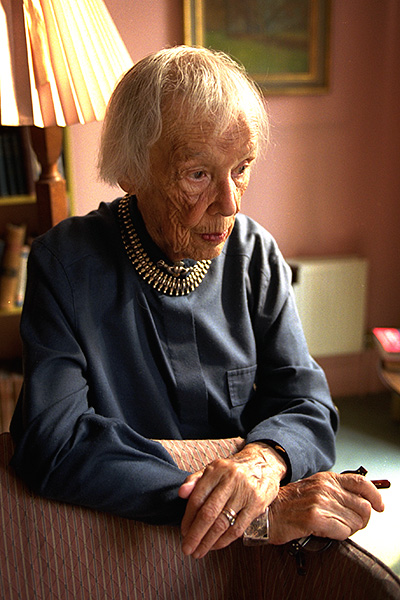
Archive photo: Frances Partridge, London, May 1995

Frances Partridge was the last surviving member of The Bloomsbury set when she died, aged 103 in 2004. She had lived an amazing life full of love and tragedy and had known the brightest and the best people of her generation. She was a writer and a famous diarist. I photographed her when she was a mere 93 in 1995 at her home in London.

©Neil Turner/TSL. London, 10th May 1995

When I arrived she seemed agitated, which I didn’t think was unusual given her age and the fact that she had a stranger in her home but it became obvious that something specific was bothering her. She told me that her only corkscrew had broken and that she hadn’t been able to have a glass of wine. Like all good photographers I had a Swiss Army penknife and so I was able to open her bottle – which cheered her up a little. The thing that really made the rest of the job go very well was that I was able to fix her corkscrew so that she would be able to have he wine the following day too.

Mrs Partridge looked old and she knew it. She had spent most of her life surrounded by artists and writers and had been photographed many, many times. She celebrated her age and was keen that I portray her in my own way. We spent a good deal of time working out where she should be in her flat and the light coming in in early May changed every few minutes. I tried to shoot as little flash as I could – not because she didn’t like it but because somehow I thought that ambient light was more in keeping with the ethos of the Bloomsbury group.

Geek moment… I was using two Canon EOS1n cameras with 28-70 and 70-200 f2.8 lenses and Fuji 800 ISO colour negative film without flash and the frames shot with flash were in Fuji 200 ISO colour negative film. The scans were done with a Kodak auto feed scanner onto a Photo CD.

Possibly the oddest picture I ever took…

©Neil Turner/TSL | London | January 2006

The story was simple: we were doing an anonymous interview with a man who needed to remain unidentifiable for legal reasons and we had to shoot a picture of him at a time and a place that wouldn’t give his identity away. It seemed to be important that it was actually him in the picture and that became obvious when I had to shoot a proper portrait at the same time just in case the court case was decided and we needed a proper picture of him to go with a future follow-up article. Still with me?

The reporter arranged that I meet the subject at a London tube station and to get around the problems of finding someone whose name you don’t know and who you don’t have a picture of I always describe myself and what I’m likely to be carrying and wearing because a) I’m probably going to be there first and b) I’m probably going to be easier to spot (being big and carrying a lot of kit).

The venue turned out to be quite close to where he works and we decided that if any of his colleagues happened to spot us the cover story was that we were doing a fashion vox-pop on what the well-dressed office worker was wearing that season. The cloak and dagger details just kept multiplying.

I decided to go with a silhouette (you can read my thoughts on them here) and just for good measure I added an extra twist with a bit of motion blur too. The result was quite striking if bafflingly anonymous!

The technique is pretty simple. It was a dull winter’s morning in the city and we found a under cover area. I used a Lumedyne flash kit to light the brick pillar and silhouetted the subject against it. Without the flash, he would still have been a shadowy outline but so would the pillar and the picture would have been pointless.

The light that was coming from either side of the pillar was OK but it wasn’t plentiful and so I decided to give it a bit of movement blur by zooming the lens whilst the shutter was open. I ended up with an exposure of 1/8th of a second at f13 on 200 ISO using a Canon EOS1D MkII with a Canon 16-35 f2.8L lens triggering the flash with a pair of Pocket Wizards. Zooming during an exposure as relatively short as 1/8th of a second means that you have to have quite a few attempts to get it right and it also pays to tell the subject what you are doing if you don’t want them to think that you are a lunatic!

In the end I was very happy with this genuinely odd picture. I had arrived at the assignment with almost no idea what I was going to do and pretty much made it up as I went along. That’s why I love my job…

Compose the picture and then wait

I have a folder full of images on my hard drive that I use for teaching. They aren’t always my best work but they help to illustrate a point better than others from my portfolio. This is a perfect example of that idea.

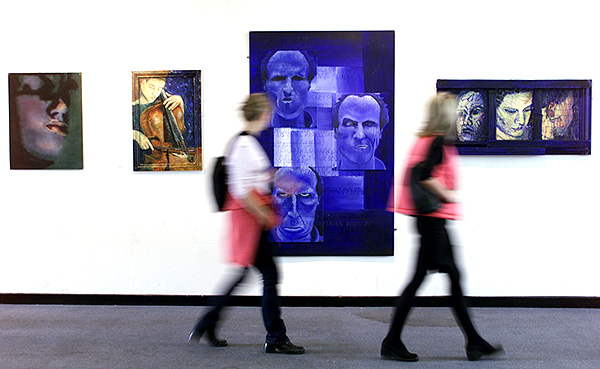
Sometimes you can see the potential for a picture but the picture isn’t happening. This is a common issue for news photographers who have to shoot pictures to go with stories about something quite specific but aren’t allowed to set a lot of shots up. This picture was to go with a very small story about an art exhibition that had been put on by some young female artists on a very tight budget. The venue was a shopping centre (mall if you are from the USA) and I could see that some human interaction with the work was the best way to cover it. I grabbed a tripod from the car and stuck my camera on it. Composing the frame was pretty easy and all I had to do was wait for the right people to walk past and look at the work. People came along and I tried various shutter speeds to get some blur in order to keep the ‘focus’ of the story on the art. Soon I was happy with my plan (1/10th of a second at f4.5 on 200 ISO) and I waited, shooting frames as people came past in ones, twos and threes.

©Neil Turner/TSL | London | October 1999

I could see these two women with very similar pink in their outfits coming. I could see that they were in perfect step and so the plan went from the occasional frame to a full burst (about 3 frames a second in those days) and got this shot. Of course I did a few more but the deep joy of those early digital SLRs was that you had great confidence in what you saw on the rear LCD.

The idea remains one that I use over and over again. I see pictures and I compose them around what’s there and then I just have to be patient and wait for someone or something to come along and complete the photograph. You can see the same idea here in an old post about walking with speed lights which has pictures taken a lot more recently!

For those who love detail, this was shot with a Kodak DCS520 camera (1.9 megapixels of class) and a Canon 17-35 f2.8L lens at the 35mm end of the range perched on a Manfrotto 055 tripod (which I still use).

Keeping it simple

The text books will all tell you that there are a number of rules for composing a photograph (or a painting for that matter) and it isn’t a bad idea to follow these rules 90% of the time. Working on a newspaper has taught me that simple compositions often work the best and that there are several ways of keeping it simple. One of my favourites is to work with a small depth of field. The human eye will always be drawn to the subject that is in sharp focus with a simple out of focus background. Usually this will mean that the background doesn’t contribute to the image, but every so often an out of focus background forms a really important part of the image.

©Neil Turner/TSL | Southampton | August 2001

This picture of three year old boy at a nursery school learning about some creatures that had been brought into the school is a perfect illustration of how throwing the background out of focus gives an enormous boost to the composition and helps to tell the story of the image. The chameleon is in focus, but because the lens (180mm on a 70-200 f2.8 zoom) was wide open at f2.8 the boy becomes an interesting blur. The added 1.6x focal length multiplication brought no change in the depth of field but narrowed the angle down to a 35mm equivalent of 288mm. On this particularly sunny day that meant a shutter speed of 1/4000th of a second on 200 ISO.

Techniques are there to be used, altered, modified and adapted. This one should become really useful to you once you have mastered it. When you are struggling to make an interesting composition it’s always worth considering narrowing your depth of field.

Folio photo #12: Vic Reeves, Kent, May 2006

©Neil Turner/TSL, May 2006

Comedian and writer Vic Reeves (aka Jim Moir) photographed in the back garden of his home in Kent on the day that he and his wife were moving out. We had to shoot in the garden because the house was full of removal men, boxes and the controlled chaos and stress that goes with moving house. He was the complete and consummate professional and I greatly enjoyed photographing him for a feature that was about his time at school. His biography of his early life was just being published as the feature came out.

Christmas at f1.4

Main Street, Hawkshead Village. ©Neil Turner

Whilst enjoying a few days away with the whole family in the Lake District over the holidays I shot a few pictures for my own pleasure and for the family album. For no other reason than “I wanted to” most of them were taken at the maximum aperture that the lens could manage – which, given that I mostly used a 50mm f1.4, was f1.4!!! It was great to be away from the big city for a while and take in the countryside and wander through some small towns and villages.

This was taken in Hawkshead Village – a large part of which was refreshingly closed…

Angry teacher portrait

©Neil Turner/TSL, April 2005

Back in April 2005 The TES had a great article written by a newly qualified teacher about how to avoid getting angry with pupils at an inner-city secondary school. It was clearly written from personal experience by a dedicated and keen young teacher working at a relatively tough school. He wanted to teach, he wanted to be good at it and he was working hard to achieve his goals.

When I arrived at the school it was the end of the day and both of us were a bit tired. We talked about how to illustrate the story and we decided that it would be great fun and have the desired amount of impact if he just stood there and yelled at me: full-on screaming. It was loud and, as it turned out, great therapy for him. All of the pent up emotion from the day came out is one long, loud and hilarious stream.

On my way home there was, coincidentally, a radio programme about anger management. None of the experts mentioned standing in an almost empty room screaming at a photographer while you had your picture taken. I couldn’t help thinking that they had missed out of an important therapy!

There’s nothing especially clever about the picture – a slightly desaturated image, lit simply an composed carefully but it had enormous impact on the page thanks to some brave and clever design.