technique

Twenty years ago… TODAY

Whilst memory lane is the venue I thought that I’d add this photograph of the former British Prime Minister, John Major along with his cabinet colleagues Kenneth Clarke and Michael Howard taken on the 20th of May 1991. This isn’t a particularly interesting picture except that it is from the set that became the very first ever colour front page on the Times Educational Supplement. This was almost three years before I actually joined the paper on the staff but it has always been a matter of pride that I was the one who shot the picture that changed the paper for ever.

John Major with members of his cabinet. ©Neil Turner, May 1991

This picture was at the press conference where John Major and his Government launched their new policy for post sixteen education. It wasn’t that long after Mr Major had taken over from Margaret Thatcher as Prime Minister and press photographers were still trying to get the hang of the new man and his rather relaxed style. It’s amazing to think that the man in the foreground (Ken Clarke) is once again a member of the government all of these years later and still clearly loving the cut and thrust of political life.

When we first started to shoot colour for the paper we just adapted the way that we already shot pictures for a variety of news magazines – on colour transparency stock. It was always funny to be rubbing shoulders with other photographers, almost all of whom were shooting fast black and white film, and having to get good pictures in often poor light with either 100 ISO Fuji RDP transparency film or Kodak’s rather good 160 ISO tungsten balanced slide film. This one was shot on the Kodak tungsten film pushed one f-stop to 320 ISO – which was about as high as you could go without getting washed up pictures. Back in the day the transparency would have been scanned by an expert on a very expensive drum scanner and the separate plates for the pages would have been made by other technicians. How things have changed.

London had a couple of very good 24 hour labs in those days and shooting transparency was, in a lot of ways, pretty relaxing once you had got the exposure correct. All you had to do was drop off the film, go and have a cup of coffee and pick up your processed images about an hour and a half later. The TES offices were very close to my favourite lab – Metro – and so you could either let the paper collect your film or go along yourself and do an edit before they saw them.

I have been filing some old pictures and found this one completely by chance twenty years down the line. I guess that my journey down memory lane is still going on!

1995 author portraits with new gear

It’s funny how you remember pictures that you have taken. I was rummaging through a box of Kodak Photo CDs that were in my loft and found a set of portraits of the wonderful children’s illustrator and author Helen Oxenberry that I took in March 1995 for The Times Educational Supplement. The pictures were taken during a period where I seemed to be photographing the entire back catalogue of authors and illustrators whose work was aimed at children and there are four things that I distinctly remember about these particular portraits.

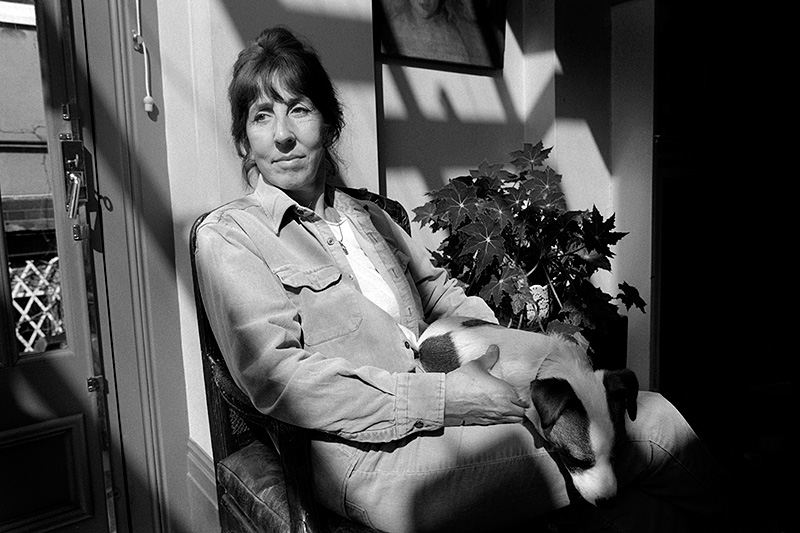
Helen Oxenberry with her dog, ©Neil Turner, March 1995

The first thing that I remember is that this was the first live job that I shot using Canon cameras. A few days before, I had taken delivery of a box full with 2 shiny new EOS1N bodies, a 28-70 f2.8L, a 20mm f2.8 USM and a 300mm f2.8L as well as two 540EZ flash units and a lot of other bits and pieces. The 70-200 f2.8L that we had ordered arrived a day or so after this shoot.

The excitement and mild terror of shooting with brand new gear that I had only tried out for the first time over the weekend was very real and so I also took along a Leica M6 with a 35mm f2 lens and a roll of Ilford XP2 black and white film that I had half used on another author portrait the previous week. The picture that you see above is a scan of the negative, made using an automated Kodak scanner that was set up for scanning colour negative film but I quite like the quality that this print-free process gave me.

Helen Oxenberry at her home. ©Neil Turner, March 1995

The second thing that I remember about this job was that she was a really lovely lady and that she made good coffee. When I arrived she was very apologetic that she had forgot to tell my Picture Editor that she lived in one of London’s more vicious residents’ parking permit areas and that there weren’t any public spaces nearby. I smiled and told her that I only lived 100 metres away and had the right permit, which seemed to confuse her – I imagine that she was trying to work out how a photographer could possibly afford Hampstead!

My third memory was that just after leaving I turned the radio on in the car and there was a programme about children’s literature where another author called Michael Rosen was talking about Helen Oxenberry. The phone rang and it was the Picture Editor telling me that I was going to photograph an author called Michael Rosen the next day!

The fourth and final memory was going back to Helen Oxenberry’s house about a month later to photograph her husband – another brilliant illustrator and author called John Burningham who went on to apologise for the lack of parking…

Back on Memory Lane again

I don’t know about you but I can put my finger on exact dates and point to pictures that changed the way that I shoot pictures. Aside from the obvious ones such as the day that I used a digital SLR for the first time and the day that I bought my first medium format camera one very special day and one picture made me think really hard about the kind of lighting that I wanted to use.

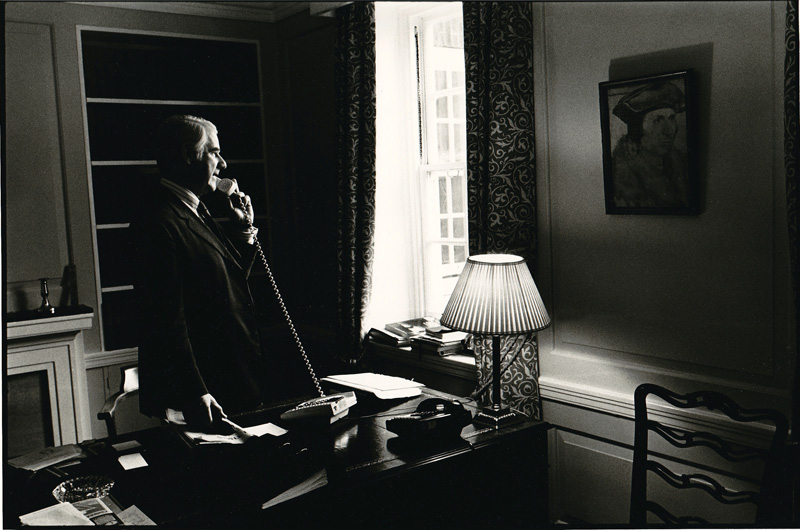
Desmond Fennell QC. ©Neil Turner

This black and white portrait of Desmond Fennell OBE QC was taken in his chambers at one of London’s famous Inns of Court – The Temple. It was shot for a newspaper and it was during a time in my career that I was using a single Elinchrom 23 flash head with a soft box and a bit of cable connecting the camera to the flash. Nothing unusual there I hear you thinking… how did this change Neil’s life?

Cue anecdote: I was sent to shoot a portrait so I took my standard gear. When I was shown in to the eminent man’s office I started to look around for a power point to plug my Elinchrom into. He answered the phone at that moment (he was chairing a major public enquiry at the time) and so I looked at the desk lamp and followed the cable to the socket in the wall. The trouble is that it was the wrong kind of socket… the UK standard three pin plug has rectangular prongs and his only socket had round holes. Square pegs, round holes… ohhh c**p.

It wasn’t that I was incapable of shooting with either a speedlight or just using the ambient light it was just a bit of a shock. This was actually the second frame that I shot – Nikon FM2 with a 35mm f2 Nikkor, Kodak Tri-X film pushed to 800 ISO.

I like to think that I learn from my professional mistakes and I like to think that after a few days a shock turns into an eye-opener and I remember coming away from this shoot with two lessons learned. The first was to always shoot some ambient light because it often makes stunning pictures – especially at quiet, off-guard moments and the second was to buy some battery powered lights. In truth, that took about three years to accomplish properly and I invested in a lot of extension leads in the mean time. I recall the day that my first Lumedyne kit went into action – complete with a Wein infra-red trigger. No cables. I shot a portrait of another lawyer and left her office singing one of the songs from the Disney version of Pinocchio – “I got no strings to hold me down…”

Street photography 1989 style

“Street photography is back” was the title of an email that I received today. Funny, I never knew that it went away. Having said that, the current exhibition taking place at The Museum of London has given the genre a bit of a boost. There are so many great exponents of street photography working in London today that even I have to admit that it isn’t so much back as resurgent. This got me thinking about some of my own work from early on in my career. I remember sitting in my office one day and a very old friend rang me and asked if I have any pictures of street markets that his younger sister could borrow for a school project. I had a few but, in the absence of anything better to do, I went off to Leather Lane market and shot a couple of rolls of film.

©Neil Turner

At that time I was part of a small agency and we had a rapidly growing library of images that was starting to make us some money. Stock photography was a good marketplace back in the late 1980s and early 1990s and I thought that it wouldn’t hurt to add a few market pictures.

This was my favourite frame of the lot. Shot on a Nikon FM2 with a 35mm f2 Nikkor lens and Kodak Tri-X film – a copy of this print made on old-fashioned bromide paper still hangs on my own office wall. The reasons that I like it are many and varied but the fact that it was born of a simple request from a very good friend (in fact, two years later he was my Best Man at my wedding) gives it extra weight for me. The fact that it has made me quite a bit of money as a stock image certainly doesn’t detract from its appeal but the other thing that makes me love this picture is that it reminds me just how simple photography can be. A mechanical camera with a fixed focal length lens, no automation whatsoever and time. Street photography is all about opportunity and patience.

Waiting for the moment to happen is part of the way that I shoot anyway but I also spend a lot of time looking around trying to anticipate good compositions, watching for the way that light hits surfaces and people. I have a very clear recollection of how this picture was made. I had seen the man walk up through the market and grabbed a couple of frames of him as he walked and shopped. Then I saw this nice gap between stalls and concentrated on framing it and I have the same composition with at least five different people passing through. Finally the interesting person that I really wanted came back and I clicked one frame of him (no motor drives on my FM2s that day). The little black border around the print is the rebate of the film which means, for those of you who are too young to have shot much in the pre-digital era, that this is the whole frame as it was shot – no post production cropping.

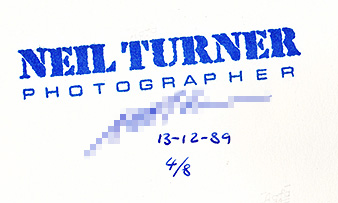
When I scanned the print this morning I noticed that this was one of a short edition of hand-prints that I made of this frame and you can see the stamp and date that were on the back with my pixelated signature.

©Neil Turner

Simple and happy days but I don’t particularly want them back. Opening a box of prints brought back the smell of the darkroom and the associated cough rather too vividly. I haven’t made a black and white print in a traditional darkroom since January 1994 and I don’t miss it one bit!

Two surprisingly similar portraits

©Neil Turner/TSL

The great challenge in photography for me is to keep shooting pictures without keeping shooting the same picture. There are thousands of ways of taking a photograph – let’s say that the number is, for argument’s sake, twenty-five thousand. What happens when you have shot two hundred and fifty thousand pictures – have you shot each possible picture ten times? I was looking back through a folder of favourite images today and found two that were taken at a similar point in my career and in a fairly similar location.

So are these two pictures the same, similar or different? It doesn’t matter really what anyone thinks but I really like to see them together. I like to see the similarities and the differences and once you get away from the fact that both are women sitting in a chair in a bay window in London with a quality rug on the floor the differences in the pictures start to matter much, much more. I promise that I haven’t cropped them to match – this is how they were in my folder.

The light comes from the side on both and, knowing the way that I work, that has a lot more to do with eliminating reflections in the glass in a hurry than any creative impulse. The amount of ambient light is higher on the left (yes, that is author Jacqueline Wilson) and the books make the picture feel a lot different to the harder light with less ambient, no books and peeling paint of the left hand portrait of blind sculptor Gohar Kordi.

I love looking at my own work, trying to get ideas for new work from examining old work and I know very well that there will come a time when I do the same (?) shot again and can picture these two frames and what they say in my mind. Next time I will use a longer lens. Next time I will pay even more attention to the symmetry of the composition. I can’t wait…

Undertaking assignments – a beginners guide

I’m not sure if this is a re-post, a re-repost or whether it is just a bit of efficient recycling of some old words. It was written in 2002 and put up on the pre-blog in 2009 anyway.

What does undertaking an assignment really mean? That was the question e-mailed to me by a third year photography degree student a while ago. At first I was shocked by her ignorance, but then I realised that nobody had really prepared me for my first one either. Some of what needs to be done is common sense and some is just experience. No two photographers work the same way, but here’s my approach…
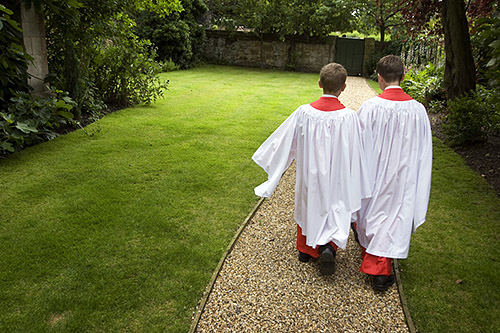
©Neil Turner/TSL, July 2008

Let’s start small, with a simple half-day portrait, and in theory it all begins with the brief that you receive from the picture editor or commissioning editor. The first contact normally comes over the phone and can be as much as days or weeks in advance or as little as minutes or hours.

In practice you can be getting ready for this commission before it exists by simply making sure that your kit is packed, that batteries are freshly charged and that you have either enough film or spare memory card capacity to last for a few hundred frames. If you use a car for your work, make sure it’s in good repair and has enough fuel in the tank and also make sure that you’ve got cash and cards just in case you need to buy anything. In the days before SatNav I always bought lots of street maps so I now have a comprehensive A-Z of most of the United Kingdom to hand. All of this comes under the tongue in cheek heading of OPERATIONAL READINESS!!!

Now, back to that brief. You are fairly comfortable that whatever is asked of you, you can get on with it without too much fuss so when the phone rings you can concentrate on the details being given to you. In time honoured photographer tradition, there is a catchy way of remembering what you need to know – the FIVE Ws: when, who, what, why and where. In these few words you have the essence of the job – when the job is, who to contact, what you have to shoot, why you are shooting it and where the job is.

There will be other important facts like what shape (if any) has been left on the page for the picture, what the deadline is, how many images the editor wants to choose from, is the story a positive one or is it critical of somebody or something. The more information that you go armed with, the better job you will have the potential to do. If possible get written conformation of what is being asked -especially if you have never worked for that editor before. I find an e-mail is a very useful aid and most picture desks are more than happy to send a quick confirmation e-mail if you ask nicely! You know what is wanted by now, and you need to go through a mental checklist of the equipment you need to take.

  • Is your standard kit enough?
  • If it isn’t, where can you rent the right hire kit?
  • If you have to rent a lens, who will be paying – you or the paper/magazine?
  • Would you be better of on the train?
  • Do you need to take a laptop?

Make sure that you can answer all of these questions for yourself before you leave – it might pay to design a “pre-flight” checklist and get a few dozen copies printed off so that you always go through all of the questions. The car boot is packed, you have the route worked out (sat-nav is great but make sure that you have keyed in the correct location, there is more than one Ashford and at least three Newcastles) and it’s off.

Travelling time isn’t dead time. It’s great to get some ideas while you travel, the outline of what you might like to do. These ideas often come to nothing, but you are starting to think about the job ahead and that’s good. If the story is likely to be news worthy it may come up on the radio, so travel with a good news station tuned in. If you have time before you leave check things out on the internet; “Google” the person’s name – a little knowledge is very useful when it comes to breaking the ice. When you arrive it’s important to come across as if you know what you are doing. If you are using lights you need to be familiar with them and the ability to continue a conversation whilst setting them up is a useful skill.

I have written elsewhere on this site about finding a (non-contentious) subject to chat about to buy yourself time to decide what you want to do and to relax your subject. If you are (outwardly) relaxed you will get more respect and trust from your subject. It’s important to not be told by them what to do, by all means listen to their ideas but be firm about what you have been sent to do. You might have to try their idea in exchange for shooting your own – it’s all a game, so learn to play it well. When the shooting starts, be decisive and shoot as many variations as you can. Don’t be afraid to refer to your brief and it’s important that you do what was asked of you as well as the much better picture that you think of.

This is the vital bit, anything that goes wrong now will probably stay wrong, no-matter how good your Photoshop skills are. When the shoot finishes, you pack up without forgetting anything and leave. Even if the person doesn’t have an unusual name check spellings and job titles so that your captions are thorough and authoritative.

It’s not all over. No matter how long to the deadline, get those pictures delivered as soon as possible whilst taking care to edit them well and caption them accurately. The paper will have a way that they like things done so make sure that you comply with their wishes, there is no better way to lose a client than to get these basics wrong. Keep copies of all digital files and archive them well. A courtesy call to check that everything arrived OK and that the editor was happy is always a good idea until you get your feet under the table and can the client a “regular”. Obviously you need to make notes of the distance you covered, the expenses you incurred and the time spent so that when it comes to submitting your invoice you aren’t making things up. If the editor offers you feedback on the job, take it. Be positive and don’t make excuses for anything that was avoidable that went wrong.

Get those batteries back on charge as soon as possible and get the kit ready for the next one. Now the job is over.

What they don’t teach you in college

This post was originally written in 2003. Things, sadly, haven’t really changed and so I thought that it deserved yet another airing.

For better or for worse, the vast majority of people entering the photographic profession are coming from college courses. I have no problem with that, I came from one myself and so did a lot of my favourite photographers. But…

I’ve been a working photographer since 1986 and based on a few things I have picked up since then I have come up with a list of things that they should have taught us that were not on the syllabus. A whole range of vital skills that go a long way to marking out the complete professional from the aspiring “not there yet”.

Obviously when it comes to choosing which lens to use, or selecting backgrounds and props – only experience and familiarity with your kit and brief will do, and colleges are good at telling their students that. There are, however, some skills that are never even mentioned that are vital.

  • People skills: The ability to handle anyone that you are either photographing, who have influence over those being photographed or who are just getting in the way.
  • More people skills: You need to be able to charm the ‘jobsworth’ security man and persuade the reluctant PR and to do it all without breaking into a fit of temper until such times as all else has failed and you have no other option
  • Even more people skills: As a news photographer you need to be able to communicate with anyone from a starving refugee to a pampered celebrity in a meaningful and constructive way – often on the same day! You have to get them to trust you, to do what you want them to do and achieve all of this with dignity and respect.
  • Advanced people skills: As a portraitist you have to have the ability to talk to absolutely anyone and to keep the conversation going at a light but interesting level whilst setting up equipment, making vital technical decisions and shooting the job.
  • Extended people skills: You need to have a sense of your own place in the scheme of things. It’s no use throwing a prima donna tantrum if you are not getting what you want and are never going to get it. It gets even worse when the person you are arguing with is a close personal friend of the editor. Know when to give in, to make another plan and get your shot anyway.

You are probably getting my drift by now. Once you have acquired all of the technical skills and bought all of the kit that you need all that’s required is to learn how to conduct yourself. I often refer to the photographer as the “Social Chameleon”, changing colours and attitude to suit their surroundings. This should be both physical – dressing appropriately so as not antagonize the people that you are dealing with, and mental – adopting the right attitude – be it meek or aggressive, as friendly or confrontational as the situation requires.

Maybe photographers should all adopt some of the techniques used by the best sales people and mix them with skills more common in the diplomatic service. I have watched charity workers running soup kitchens and marvelled at their ability to be both understanding and firm, and I have watched police officers and been stunned by the way that they get the information that they want whilst conducting an otherwise friendly conversation.

My biggest tip on this subject is to find some common ground with whoever you are talking to and work it. It might be sport, it might be the weather or the journey that you both had to get where you have met. If I’m in someone’s home I will often talk about a piece of art or furniture on display or their pet cat or dog. It doesn’t matter what you chat about, you are chatting and barriers are coming down. Avoid contentious subjects unless you are really sure of yourself.

So there you are, what they don’t teach you in college is how to handle people. It’s not just a skill needed by photographers – it’s a life skill. I think that’s why a lot of the greatest photographers have come from other careers where they have learned about people and use those skills in their new profession.

Six feet up is bad?

©Neil Turner, October 2000. Oxford.

©Neil Turner, October 2000. Oxford.

This was first published in the Autumn of 2000 on the DP Review website as a follow-up to a review I did of the original Canon G1 Powershot

It is very easy to hold the camera to your eye and take a picture. Good photography requires us all to think about where we are taking the picture from as well as what we are taking. The best photographs are made when the photographer chooses a vantage point to suit the subject, and it is surprising how few subjects are suited by the height of a human standing at their full five to six feet. This is compounded by the fact that when someone views the image they will see pretty much what they themselves would have taken because they haven’t been told about bending your knees or climbing a ladder to shoot better pictures.

It is no accident that many of the world’s best photographers wear denims most of the time, and I take pride in the fact that I spend so much of my time kneeling that I have “housemaids knee”. Sooner or later I will end up flat on my face or up on a chair to give something extra to a composition – namely a point of view that the person looking at the image would not have seen themself.

This image was shot in the beautiful University City of Oxford on a Canon G1 using the swivel LCD to get the camera at ground level without having to lie in the dirt myself. The lens was less that two inches from the cobble stones and this ultra low angle gives the image a dynamic quality that would have been missing had I been standing at my full five foot ten inches. The photograph is different from most pictures taken of this tourist magnet and I’m sure that my antics were the reason for the puzzled look on the passer by’s face.

My point is that when you get your camera out think about the height of the lens. If you end up shooting from a standing position, well that’s OK – but I will lay good money that 90% of pictures are better when taken from below four feet or over seven.