neil turner

Observational, interactional and ‘dictational’ photojournalism

If you believe the old saying, “there is more than one way to skin a cat” and if you want to carry that thought over into photographic journalism there is definitely more than one way to shoot a story. If you listen to some debates about photojournalism you would find that hard to believe but regular readers of my opinion pieces about photography will know that I am a big fan of the ‘black to white, left to right theory of just about everything’.

©Neil Turner. Bournemouth, Dorset. 11 minutes past 11 on the 11th of the 11th 2011

The idea goes like this: imagine a line from one side of a page to the other and that one extreme of something is placed at the left hand end of that line. Now imagine that the opposite extreme is placed at the right hand end of that line. For illustrative purposes, let’s make those two extremes black on the left and whit on the right. What have you got in between? Every tone of grey that you could imagine. You can have one smooth gradient or you can have it in steps – it really doesn’t matter but what you will have is a smooth transition from one extreme to the other. Salt to sweet. Short to tall. Narrow to wide. It really doesn’t matter.

So how does this translate to different ways of shooting photographs? We are talking about photojournalism here and so I’d like to place “observational” at the left hand end of our imaginary line and “interactional” in the middle with dictational at the other end. That’s the easy bit. What exactly are these three approaches and what else sits along our line?

Observational photography can be defined as a ‘fly-on-the-wall’ approach where the photographer is an almost ghost like figure who tries to have little or no impact on the situation and their subject matter. Some types of street photography where the photographer tries their best to remain unseen and unnoticed are classic examples of observational photography. Some would argue that a lot of sports photography fits these criteria too – after all, the cameras are there but nobody is changing their behaviour for them for 90% of the event. By definition observational photojournalists don’t seek any meaningful contact with their subjects whilst they are shooting and most would eschew contact once they have finished taking the pictures either.

Good photojournalism is nearly always accompanied by good and accurate captioning – which is easy if you are photographing a Manchester United game or the Olympic 100 metres final because the participants have names and/or numbers on their kit and they are all famous athletes. If you are taking pictures of people running from an approaching storm then you would like to know who they are and where they are heading but the only way to find that out is to ask. I can remember a number of occasions where I’ve shot lovely street photos whose value as works of curiosity is pretty high but whose value as a piece of photojournalism is a lot lower because I didn’t have the details of the people in the pictures. When I was young and keen I regularly followed people and plucked up the courage to get their name. These days I tend not to shoot the picture if having no details for the caption devalues the image.

So that’s observational photojournalism dealt with. What about it’s interactional cousin? This is where I’m happiest. Shooting pictures with the full knowledge and either permission or acquiesence of my subjects in ways that allow me to interact with them whilst maintaining the integrity of the pictures is, for me, the gold standard. You can tell stories, relay passions and miseries and generally get under the skin of people. Interesting people. By interacting with your subject the nature of your pictures changes and they will have a lot more of you and a lot more of your subjects soul in them.

Back to that pesky scale… you have observation at one end and interaction in the middle and dozens of shades of whatever you would call it in between. Then there’s the final form of getting the pictures: dictational – where you tell your subjects what you want them to do and then shoot it but I’d find it hard to label that as photojournalism at all. I’ve put it there on our scale miles away from observation and a fair distance from interaction too.

Let’s say that observation is the black on our scale and ‘dictatorial’ is white. What colour is interaction? 18% grey of course! (photographer joke – if you don’t get it, I apologise)
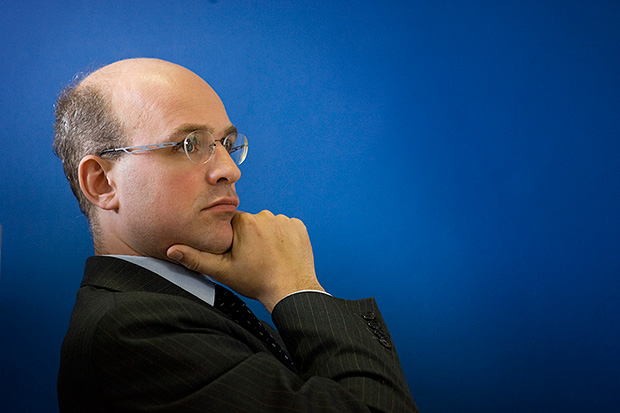
Folio photo #15: Thoughtful businessman, London, April 2008

©Neil Turner/TSL. London, April 2008

This portrait of Swedish businessman Anders Hultin was taken during an interview for The Times Educational Supplement. He worked for a Swedish company Kunskapsskolan who were working in the UK and are hoping to take control of two Academies in the London Borough of Richmond-Upon-Thames.

The interview took place in a small office in west London and, although his English was first class, he took time to consider the answer to each question allowing me to get a great range of thoughtful expressions from just about every angle. I chose this profile frame because I liked the blue background and its simplicity. All of the other angles had complex and intrusive backdrops which I used a range of lighting styles to hide. The available light was very good for a short period and so this is one of a dozen pictures taken without flash.

When I chose this picture for my portfolio it was one of three business style portraits that all had strong blue backgrounds. I like to pace the pictures in my folio and by having a small group of images with a theme it seems to give them more strength and help with the pacing of the selection.

Geek stuff: The whole shoot was done with two Canon EOS1D MkII cameras and my trusty set of three L series Canon zooms: 16-35 f2.8, 24-70 f2.8 and 70-200 f2.8.

The anguish of editing your own pictures

©Neil Turner. London, January 2011

I’ve written about this kind of thing many times but it seems to come to the forefront of my photographic consciousness over and over again so I hope that you will forgive me if none of this is new.

There are a lot of great reasons why photographers have to edit their own work. They are the only ones who truly know what was shot, why it was shot that way and how well the pictures reflect the situation. For news photographers the idea of someone else doing their edits is, largely, a far-fetched and even unwelcome notion. It is happening more and more though.

Some of the big wire agencies and more progressive newspapers are using direct wireless transmission from cameras to editors on big sports and news jobs where the time between shooting the pictures and getting them to market is absolutely critical.

If, however, time is not quite so much of an issue photographers like to sit down and go through their own pictures, make their own selections, add their own captions and prepare the files for delivery. That’s how I’ve worked for the last fifteen years or so and even before then I was often in charge of my own edits because that was how things were done.

Every once in a while (mostly on commercial shoots) someone else edits my pictures. I find it both liberating and scary in equal measure. The liberation is that I get to concentrate on shooting pictures and the scary bit is that someone else gets to see everything – the good, the bad and the downright indifferent. What if they miss the subtlety of that amazingly constructed picture on the second memory card? What if they don’t appreciate the ultra-shallow depth of field that I grafted so long and hard to realise?

There’s a good counter-argument to that of course: If a professional editor doesn’t get what I was trying to do, neither will the client, neither will the designer and neither will the viewer. There are some pictures that you take on almost every shoot that are there for you and for you alone. That is true but every once-in-a-while those pictures do get used. Every once-in-a-while somebody else gets your vision and loves the ‘weird one’ as much as you hoped that they would.

Editing your own work is a tough thing to do. Try editing a full set of someone else’s pictures and you will realise just how easy it is to be dispassionate and just how readily you are able to discard pictures that don’t work. Editing your own work can be a minefield. Every step can bring a very tricky decision. What about the pictures that you have a personal emotional connection with? What about the pictures that you have overcome huge technical challenges to secure? What about the pictures that don’t actually add to the edit or make sense as part of a set?

Taking a shoot and making sense of the pictures from that shoot is a skill that very few photographers ever truly get right. Those that do are blessed and really lucky because they avoid the regular pain and anguish of having to ignore their own ‘babies’.

I have four things that come into my mind every time I am struggling to decide about a single frame: light, composition, subject matter and technical quality. If all four are right the picture goes in. If three out of four are right it will probably make it too. Less than three and that’s where the anguish begins…

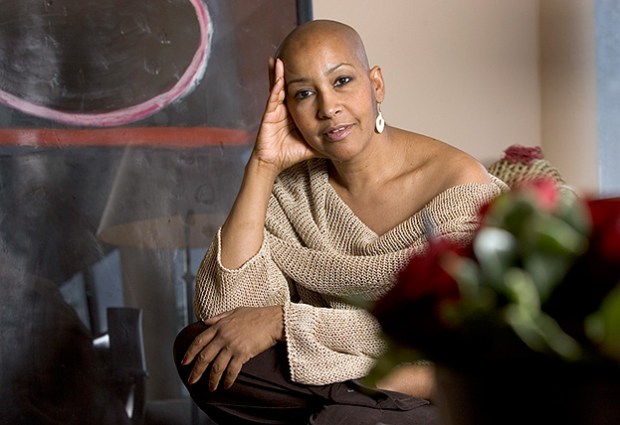
Portrait: Marsha Hunt, London, 2005

©Neil Turner/TSL, October 2005. London

Marsha Hunt is an actress, writer and model who shot to fame in 1969 when she was appearing in the musical “Hair”. She has a child with Mick Jagger and was famously photographed naked by Lord Lichfield. In the early part of the new century she had breast cancer and had a mastectomy. Her treatment became a documentary and she was photographed once more by Lord Lichfield. This set of pictures were taken for a feature in the TES Friday Magazine about her life and her memories of her own education at the London home of a close friend of hers.

This portrait was a lesson in letting the subject run the show. Marsha was lovely, as was our host. They were very old friends and chatted most of the way through the session. The wonderful thing was that she knew exactly when and how to look at me and at the camera. Models are good at this and actors, for my money, are better. It would seem that when someone has been successful as both an actor and a model they are better still. Some people are ultimately very comfortable in front of the camera and Marsha Hunt is in the top few percent of them. The shoot lasted a lot longer than it needed to – we chatted about all sorts of things and drank some rather good coffee too. It was a good day.

Geek stuff: In common with just about every other picture shot by me at the time, I was using a pair of Canon EOS1D MkII cameras with 16-35 f2.8L, 24-70 f2.8L and 70-200 f2.8L IS lenses. The lighting was Lumedyne Signature series packs and heads mixed with a fair amount of ambient light.

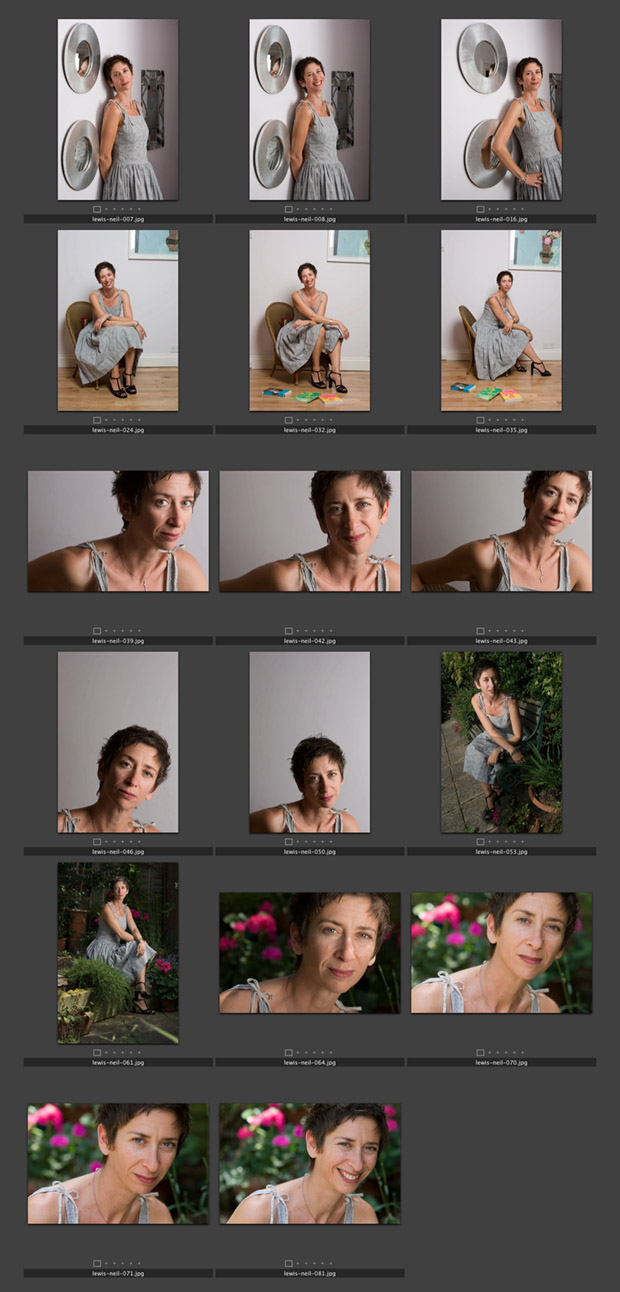
Reina Lewis – The contact sheet, June 2006

One of my favourite sets of portraits that I ever made was of a lady by the name of Reina Lewis who had just been appointed to a new post at The London College of Fashion to become Professor of Cultural Studies. The pictures were shot at her home and I could see when I got there that she was definitely aware of how important some good pictures in the right newspaper could be. We shot a range of images from some tight head and shoulders against a plain wall to some full-length sitting ones in one of the elegant chairs that she had.

©Neil Turner/TSL. London, June 2006.

All of the pictures that you see here are entirely uncropped. They were shot on a pair of Canon EOS1D MkII cameras with 24-70 f2.8L and 70-200 f2.8L lenses and lit using a single Lumedyne Signature series flash kit with a 24×32 inch Chimera soft box. The Canon CR2 RAW files were converted using Adobe Camera RAW in Adobe Photoshop CS3.

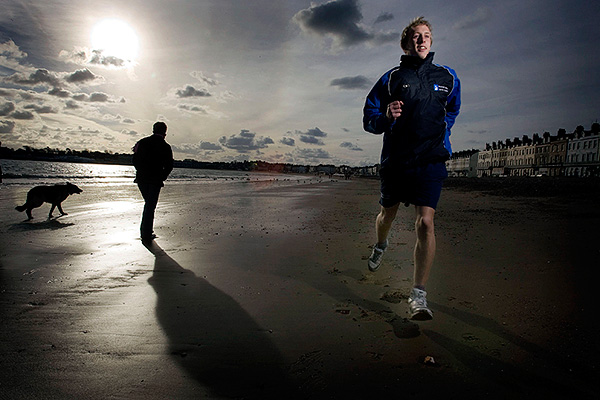
Training on Weymouth beach – an unusual portrait

Sometimes pictures come together without much effort and sometimes you almost kill yourself trying to get something just that little bit special. This portrait of a young athlete who was competing in the sport of Biathle for Great Britain at a junior level whilst studying at a college in Weymouth, Dorset definitely came along after a not insignificant struggle. Nothing to do with the subject – he was cooperative, willing and full of energy – I just tried to get pictures that didn’t seem to want to come off.

©Neil Turner/TSL. Weymouth Dorset, December 2007.

This frame was shot on a 16-35 f2.8L lens at its widest focal length on a Canon EOS1D MkII at 1/250th of a second at f22 and 200 ISO. I was using every joule of power from a Lumedyne Signature Series flash kit with no umbrella or soft box and I just had the power to get this. I have always liked the photo and I was always sad that the paper didn’t use this frame.

I guess that this picture is further proof that I love shooting beaches – especially Dorset beaches!

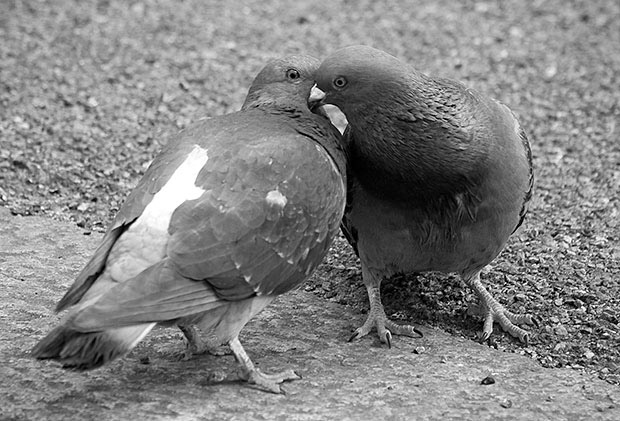
Fun picture – pigeons checking each other out, Bournemouth

©Neil Turner. February 2012. Bournemouth

I don’t know if spring is in the air but these two pigeons outside a supermarket in Dorset this morning look as if they were rehearsing for Valentines Day next week.

College Principal – the “contact sheet”

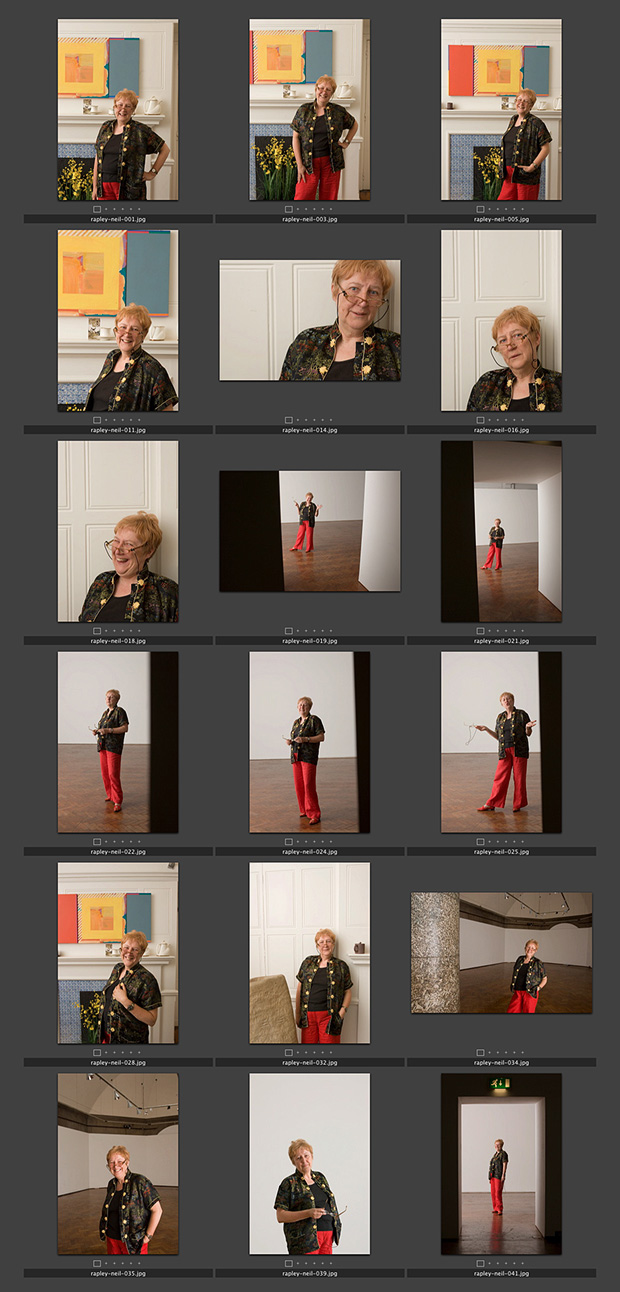
Within two hours of posting a portrait of College Principal Jane Rapley at Central St Martins on this blog, I’d had four emails asking to see the rest of the shoot. I can’t do that but I can share the rest of the edit.

©Neil Turner/TSL. London, July 2006

I’m not going to repeat everything that I wrote on the original blog posting but you can see that the image I selected to feature was very much the “odd one out”. I have always thought that this set represented a good selection of portraits from a single session but looking back five and a half years on I have realised how many uprights there are and how few horizontal compositions. I’d like to think that was because I knew that the newspaper wanted uprights but I’m not sure that’s the case. Anyway, to those of you who wanted to see this selection… I hope that you like them!