story

Christmas at f1.4

Main Street, Hawkshead Village. ©Neil Turner

Whilst enjoying a few days away with the whole family in the Lake District over the holidays I shot a few pictures for my own pleasure and for the family album. For no other reason than “I wanted to” most of them were taken at the maximum aperture that the lens could manage – which, given that I mostly used a 50mm f1.4, was f1.4!!! It was great to be away from the big city for a while and take in the countryside and wander through some small towns and villages.

This was taken in Hawkshead Village – a large part of which was refreshingly closed…

Angry teacher portrait

©Neil Turner/TSL, April 2005

Back in April 2005 The TES had a great article written by a newly qualified teacher about how to avoid getting angry with pupils at an inner-city secondary school. It was clearly written from personal experience by a dedicated and keen young teacher working at a relatively tough school. He wanted to teach, he wanted to be good at it and he was working hard to achieve his goals.

When I arrived at the school it was the end of the day and both of us were a bit tired. We talked about how to illustrate the story and we decided that it would be great fun and have the desired amount of impact if he just stood there and yelled at me: full-on screaming. It was loud and, as it turned out, great therapy for him. All of the pent up emotion from the day came out is one long, loud and hilarious stream.

On my way home there was, coincidentally, a radio programme about anger management. None of the experts mentioned standing in an almost empty room screaming at a photographer while you had your picture taken. I couldn’t help thinking that they had missed out of an important therapy!

There’s nothing especially clever about the picture – a slightly desaturated image, lit simply an composed carefully but it had enormous impact on the page thanks to some brave and clever design.

Table top still life and the news photographer

Most press photographers will have lost count of the number of times they have been called into the office of the newspaper they are working for to ‘do a quick still life’. These vary from the simplest product shot to some interesting concept ideas. I thought that I’d share a few with you here:

This slideshow requires JavaScript.

As you can see, I sometimes go to town with them and the stories you see illustrated here are about:

  • The risks of cloning and everyone looking and doing the same (rubber ducks)
  • Managing your credit (cutting up credit card)
  • Handling your savings (fist full of bank notes)
  • The aftermath of a school fire (melted clock)
  • A debate about healthy eating versus too many sweets (cauliflower and mars bar)
  • Reading the fine print in a new employment contract (magnifying glass)
  • Taking a chance with the school your child is going to (rolling the dice)
  • The high cost of housing in certain parts of the country (Monopoly houses on the map)

The main idea is to us decent light, keep the idea simple and not be tempted to try to do too large a picture in the cramped and messy confines of the office. I deliberately added the rolling dice idea because we had some giant dice available, I had an intern to help throw them and there was a nice piece of open ground nearby on a lovely sunny day.

Studio based still life photography is a tough discipline and we still get asked to do creative stuff that should be done “properly”. It has been said that press photographers make great all-rounders because we have to think on our feet and adapt all of the time: I won’t be arguing against that one!

Why dg28?

Originally posted on my pre-blog in 2009 but I still get so many people asking why that I thought I’d post it again…

Why would a photographer whose initials are NT call his website dg28? It’s a question that I get asked with amazing regularity and, for the eight years I have had the site, I have always enjoyed the mystique. I did a seminar last week for some London Strobists and the first question that I was asked was “why dg28?” Every time I tell the story it gets less exciting – unlike most anecdotes which seem to get longer, more interesting, more adventurous and even more heroic. I have finally decided to tell all. Right here, right now..

It all started back in 2000. I had a site hosted by AOL which had a domain name longer than anything you could properly remember and content which was attracting quite a bit of attention. I had written a couple of short pieces for Phil Askey at DPReview and sitting in a London bar he advised me to get some proper hosting and a snappy domain name. Good advice from someone who knows a thing or two about photography websites I thought.

A couple of days later I was doing one of my visiting lecturer appearances with some highly motivated post-graduate photojournalists telling them all about the digital process – something that I was already used to but few of them could get their heads around. It was a successful lecture and we ended up in another bar for a couple of drinks. We talked about photography, photographers and photojournalism for quite a while before the topic turned to the old chestnut of “what was the first record that you ever bought?”

I always like this one because I have a very good answer. One member of my family who has otherwise excellent taste started his collection with “Ernie and the fastest milk cart in the west” by Benny Hill – something which still embarrasses him. Being proud of my record I spoke first and told the students that I had bought Metal Guru by Marc Bolan and T-Rex at which point one of them (a young Canadian guy) said “that’s great. You bought Metal Guru and now you are our Digital Guru…” Cue light bulb moment… digitalguru would be a brilliant domain name.

The next day I got onto a registration website only to find that it was gone. As were several variations. Then I remembered Phil Askey saying that short is good so I tried variations on DG and finally settled on dg28.com because the dg bit is for digital guru and the 28 is for the day each month (the 28th) when I used to post updates.

You see what I mean, it’s not actually that interesting but it makes for a decent story – one which I hope to be telling less often in future.

A mission statement or two

Yesterday morning, The BBC presenter and former Economics Editor Evan Davis was sharing his approach to interviewing senior business people. He said that he wanted to relax them, tempt them into talking more openly and frankly than they might want to and because so few of them are media professionals he has a form of words that he uses to let them know what his role is. He says to them “I’m not here to make you look stupid but if you decide to make yourself look stupid it isn’t my job to stop you”. That, my friends, should be the mission statement of every editorial and news photographer working right across the world. And that got me thinking about some equally succinct statements for other kinds of photography and that in turn got me thinking about definitions of types of photography.

“I’m not here to make you look stupid but if you decide to make yourself look stupid it isn’t my job to stop you”. – Evan Davis

Thanks to the verbal clarity and dexterity of Evan Davis we have news and editorial photographers pretty much covered and the next category of photographers that I wanted to think about was PR photographers. For me this comes next for two reasons: firstly that I do quite a bit of PR work myself and also because so many of the good PR photographers here in the UK have a background as press and editorial photographers. The role of the PR photographer is to shoot editorial style images that show their client in a positive light. I don’t have the same ability with words that a senior BBC journalist does but I came up with the following:

“I’m here to help make you and your business look good by concentrating on the positives and ignoring the negatives.”

The cynic in me wanted to go with “he who pays the piper call the tune” but PR photography done well is a lot more than just pointing the camera where you are told and cashing the cheque. Next in line in both my life and in the photography that I do is commercial work. I guess that this differs from PR not so much in what I shoot but for where the pictures end up which is mostly in brochures, company reports and on their websites.

“I’m here to shoot the pictures that you want in the way that you want me to shoot them and to add my own input in achieving the right images”.

This process could go on and on and I have been trying to think of a mission statement for the paparazzi but the truth is I’m not actually sure what they do and why they do it – and I’m pretty sure that some of them are in the same boat. The best and most successful paps know exactly what they are about and that’s why they get paid the big money for the right pictures. My final thoughts on these definitions and mission statements goes to the names given to themselves by wedding photographers and which of the three mission statements above applies to them. I have something of a problem with “wedding photojournalist” because, for me a photojournalist is there to record events and to help tell the story to the wider world – warts and all. It’s those last three words that I cannot believe any wedding photographer can truly sign up to. Your client is normally the bride and groom or at least a close friend or relative of theirs and I’m pretty sure that they would not be happy for every single element of the big day to be recorded and published. I have no issues with the phrases “documentary style photography” or shooting in a “photojournalistic style” but can a wedding photographer really be a detached observer and recorder of events? Please don’t get me wrong here, I have the utmost respect and admiration for the best wedding photographers who have broken with the wooden and formulaic styles that were around when I and most of my friends were getting married. The quality and volume of the work that they produce in such demanding and unrepeatable situations is amazing but I really don’t like the hijacking of the title photojournalist for what is, essentially, very good PR.

Sticks and stones

My mother told me that “sticks and stones may break your bones, but names can never hurt you” and I spent the first 40+ years of my life without questioning that piece of maternal wisdom. At the ripe old age of 46 I started to realise that certain derogatory terms, when applied to groups of people, can have a bad effect.

not going to equate my profession with religious or ethnic groups who have suffered real physical and emotional harm from the constant repetition of terms deliberately designed to insult them and from name calling intended to isolate them or to incite others to be prejudiced against them. What I am going to do is try to make a case for the quiet burial of collective nouns and occupation based slang terms for photographers that only serve to devalue what we do for a living.

Before I get into the arguments I want to say that photographers often use many of these names for each other in what is meant to be a light hearted and affectionate way. Words get borrowed, used and then abused so we are doing ourselves no favours by perpetuating them. There are a whole raft of pseudo-tabloid terms for photographers that I object to;

  • Snapper – implies that we take snaps, which we don’t. We take photographs, we make photographs and we create photographs.
  • Lensman – what does this mean? It’s just a pointless term that gets trotted out by people who cannot be bothered to use a thesaurus.
  • Camera monkey – particularly offensive, and usually used by ill informed and self important writers.
  • Pap’ – shortened form of ‘paparazzi’, which is liberally used by the ignorant to refer to a wide range of news photographers. I have nothing against the paparazzi (literally translated means buzzing flies) but I object to the pejorative connotations of the word when applied to other photographers.
  • Reptiles – used once to my face by an ‘old school’ journalist who was politely informed that I objected to the term on the grounds that it may well have been used affectionately by him, but that it may not be used so kindly by others.

The list could go on but the point that I’m trying to make here is that words used in jest by friends of our profession get picked up by others and used to denigrate us all. All of this is happening at a time when we are struggling to present a unified, dignified and professional image to a world which at best doesn’t understand what we do and at worst regards us with contempt. The terms that we use to refer to one another are important. Not as important as avoiding undercutting other professionals, not as important as selling out on copyright and not as important as belonging to professional bodies, but in a world where everyone who owns a digital compact camera thinks that they can take ‘professional quality pictures’ every small action has an effect. It’s like the old, and probably untrue, story about a butterfly beating it’s wings in China causing a hurricane in Florida – some very small actions have very large consequences.

As photographers we owe it to ourselves and to our colleagues to avoid using terms for each other that can have negative connotations. When was the last time you heard a Doctor call a colleague a “sawbones” in public? When did you ever hear a lawyer, an accountant, a teacher or a systems analyst use a potentially damaging slang term for a fellow professional? I believe that the use of slang terms is a sign of professional insecurity and we can all help ourselves and our peers by refraining form making those signs.

Names may not hurt you or me individually, but they can eat away at our profession.

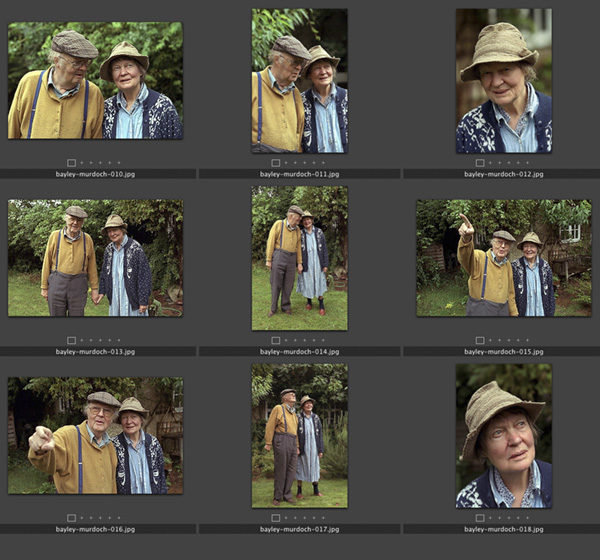
Contact sheet: Dame Iris Murdoch and John Bayley, Oxford, September 1998

When this set of photographs, one of the last of her, was taken Dame Iris was in the latter stages of Alzheimer’s and her husband described her as being like “a very nice 3-year-old,”. She died in Oxford on February 8, 1999. In his memoir “Elegy for Iris” John Bayley portrays his brilliant wife lovingly but unsentimentally. He was in turn very much in love with her and very caring about her when I spent a brief time shooting this set of pictures. She was unaware of who I was or what I was doing but his hand was always in hers and she seemed to accept that everything was OK because of that.

The original caption simply read: Professor John Bayley and Dame Iris Murdoch photographed in the back garden of their home in Oxford. 09.09.1998 photo: Neil Turner/Times Higher Education Supplement. ©News International

The Times Higher Education Supplement was running a review of Professor Bayley’s book about his wife and the Picture Editor had asked me to drive to Oxford to shoot his portrait. While I was driving between London and Oxford I was told that at least two other photographers would be shooting before me and that it was “unlikely” that Dame Iris would be in the pictures. I don’t mind doing portraits of authors on those days when you form an orderly queue with reporters and television crews for your chance to do the same five minute job but this one seemed a little less “organised”.

I arrived in that part of Oxford where it seems every second home is owned by a Nobel Prize winner or a celebrity academic to find their house looking a little sorry for itself. The front garden, the fences and the paintwork all needed some TLC and I quite like to shoot portraits around those areas. I had twenty minutes to wait and started to think about the light, the colours and watch for other photographers and journalists to come out. Nobody appeared so I grabbed my gear and knocked on the door. When Professor Bayley answered, he looked like the gardener but spoke exactly how you might imagine an Oxford Professor would.

In the film “Iris” which stars Dame Judi Dench as the older Iris Murdoch the house is untidy. Actually having been there I can tell you that untidy doesn’t even come close. There were books and newspapers everywhere. Televisions were on the BBC in almost every room and there was Dame Iris herself sitting quietly at the kitchen table. I was nervous about asking if she would be available for the pictures but Professor Bayley seemed to know what I wanted to ask and told me that he wanted her to be in the pictures with him but that she found flash disturbing. I was shooting 35mm colour negative film at the time and so we decided that the house was too dark and too untidy to be a good location for a portrait. Ironically these days I would have probably done some pictures on my 5D MkIIs using the small amount of available light indoors at 3200 ISO but there was no way that 800 ISO colour negative would cope.

The beauty of these pictures is that nobody from the publishers had been round to tidy up, dress them up or even attempt to sanitise the images. Because of that we were able to make some lovely portraits. We chatted about garden birds, foliage and the English weather. It was a surreal time.

In the end I shot 72 frames (two rolls of 200 ISO Fuji Colour Negative film) which I drove back to London where the film was processed by the newspaper darkroom and all scanned onto a Kodak Photo CD at a resolution unthinkable for a digital camera at the time – the equivalent of a 6 megapixel camera when the Kodak DCS520 was just becoming available with it’s 1.9 megapixel chip. The cameras used here were a Canon EOS1V and an EOS1N with 28-70 f2.8L and 70-200 f2.8L lenses.

Five people that I will never forget

Originally posted in July 2009, this was a very personal reflection on some very important people in my career.

I suspect that most professional photographers keep a pool of pictures that they use for promotional, exhibition and portfolio purposes. I have always had a folder full of my favourites and now that I am freelance one of my regular tasks is to update it. The death of Mr Henry Allingham who was, at the age of 113, the oldest surviving veteran of the First World War made me go through and think about some of the people that I have had the honour of meeting and photographing.

My folio folder had no fewer than five images of people who have died since being photographed by me. As a percentage, that’s not out of the ordinary and three of them were very elderly indeed. Each of the five people had a big effect on me for various reasons and I’d like to share some memories of them with you.

©Neil Turner/TSL

Dame Iris Murdoch was a brilliant novelist whose life story was made into a film “Iris” starring Dame Judy Dench. I photographed Iris Murdoch and her husband John Bayley in the garden of the home that they shared in Oxford where he was a professor of English. She was, by the time that this picture was taken in 1998, suffering from the latter stages of Alzheimers’ – which is a terrible disease that robs the intellect and then the personality of the sufferer and places a great strain on those who love and care for them.

Dr Bayley described her as being like “a very nice 3-year-old”. This picture was on the back cover of the book that he wrote about their life together.

The house had not been properly cleaned for a long time and there was a television in every room playing the same programme.

When I went to see the movie made of her life two women in the row behind me made comments about the house that they lived in and that she could not believe it could have been as bad as the film made out. The temptation to turn around and tell them that the film did not tell even half of the story was strong, but I resisted. She died in Oxford on February 8, 1999.
©Neil Turner/TSL

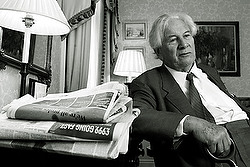
Sir Peter Ustinov was an actor, writer, director and raconteur. This picture was taken in his London hotel shortly before he died in 2004 aged 82. I’m not going to attempt to precis his life, but I’d like to tell my story about my time with him. I was searching for something to chat to him about and I used one of my “fallback” topics of what I had heard on the radio on my way to meet him.

Every morning BBC radio 4 has a news show called “The Today Programme” which that morning had a feature about the USA and communism. I mentioned Senator McCarthy and Sir Peter then delivered a wonderful and vitriolic soliloquy on the topic of McCarthyism – job done. I’m pretty sure that you would have had to pay a lot of money for a forty minute private performance from Sir Peter. I feel so privileged to have had it for free.

©Neil Turner/TSL

When I met and photographed Mr Henry Allingham he was already 112 years old. Despite his amazing age he was very coherent, had a very British sense of humour and was interested in everyone and everything around him.

I found meeting him very humbling and, when he died, I found myself counting the ways in which our world has changed during his lifetime. Cars, planes, computers, atomic bombs, heart-transplants have all become commonplace.

Queen Victoria was still on the throne of Great Britain when he was born and women did not get the vote until he was in his late twenties.

©Neil Turner/TSL

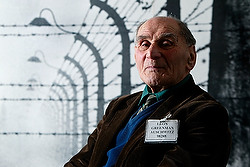
Leon Greenman OBE was the gentlest of men. Meeting him and being given a personal tour of the Holocaust Museum in London where there is a display featuring a large number of his personal possessions from before and during his time in the concentration camps had a profound and lasting effect on me.

His striped uniform with it’s Star of David, photographs of his wife and children who died in the camps, pictures of his life before the Nazis came and took the Jews away were there and he was there to talk about them in a factual but moving way.

I will never forget the day I met him and I hope that the amazing work he did to educate subsequent generations about the evils he witnessed goes on.
©Neil Turner/TSL

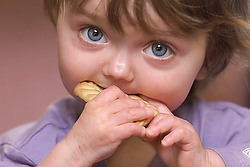
The death of people who have lived long and valuable lives is sad. The death of a child is far sadder. I met Fleur at a children’s hospice near Luton a few weeks before her untimely death. She was a sweet child who wanted to know all about everything.

Keech Cottage Children’s Hospice in Bedfordshire provides respite and terminal care for children with life limiting conditions. It is not a sad place. The children there are pretty much like any other children.

The families that I met had come to terms with the fact that they would lose the child that they loved and were making the most of their time together. I was welcomed, I was royally entertained and I would go back tomorrow if they’d have me.