equipment

Christmas at f1.4

Main Street, Hawkshead Village. ©Neil Turner

Whilst enjoying a few days away with the whole family in the Lake District over the holidays I shot a few pictures for my own pleasure and for the family album. For no other reason than “I wanted to” most of them were taken at the maximum aperture that the lens could manage – which, given that I mostly used a 50mm f1.4, was f1.4!!! It was great to be away from the big city for a while and take in the countryside and wander through some small towns and villages.

This was taken in Hawkshead Village – a large part of which was refreshingly closed…

Folio photo #05: CEO portrait with tungsten light, August 2006

©Neil Turner/TSL, August 2006

In 2006 Ian Smith was the Chief Executive Officer (CEO) of Oracle the software company based in the City of London. This business portrait was actually taken for the Times higher Education Supplement who were running a piece about Oracle’s connections with the education industry. The portrait itself was shot in under two minutes but I had set up with a ‘stand-in’ who posed for some test pictures for fifteen minutes before Mr Smith was available.

The really interesting thing about this portrait is that it was shot with deliberately mixed lighting: tungsten gelled flash on the subject and daylight behind with the camera on a custom white balance which was only concerned with the flash. I use this set of pictures a lot when I am teaching my location lighting seminars.

Mad sky, madder lighting…

Even though it was well over 12 years ago I can still remember standing on a pavement outside a rather dull new building on the University of Southampton campus which wasn’t actually open or even finished and thinking “how am I going to pull this one off?” Normally with architecture news jobs you can rely on having somebody walking past or an interesting view from inside out but on this one… nothing.

©Neil Turner/TSL, October 1999

I messed about for half an hour trying to get an angle on the structure that didn’t show cranes, builders doing the finishing touches or plastic barriers. Miserable failure. There was one redeeming feature though – the sky was a beautiful deep and even blue. I’m no great fan of polarising filters but this was calling out for that kind of treatment so I grabbed my flash gear from the car and decided to underexpose the sky and get as much light into the foreground as I could. That meant giving full power up into the street lamp that helped the composition which also meant that I could underexpose the sky nicely.

©Neil Turner/TSL, October 1999

After that my mind started racing and I decided to go for something so over the top that even I would have bet the Picture Editor would have laughed as she put it into the dustbin.

The red in the street lamp was achieved by using a red narrow cut colour effects lighting gel over the flash, which was on full power and raised as high as I could get it so that the red would balance against the saturated and underexposed sky.

This was the first time that I had tried anything like this and the great thing is that I was wrong. They used the mad picture…

Some 11 year old thoughts on lens selection…

Choosing the right lens for the job – written in 2000 for http://www.DPReview.com and it still pretty much stands up today – which cannot be said for everything that I thought that I knew when I’d only been in the profession for 14 years!

There are two ways that you can choose which of your lenses to stick on the camera:

  • You can say “there’s my subject and here I am, let’s see which focal length on my zoom works best”.  Sometimes at sports matches and political events you have your position and that is that, or…
  • You could say “I want the effect that my experience tells me a 28mm lens will give me so I’ll select that focal length and move to the right position to make that happen”.

Either of these could be a valid option and, in many cases, the first is decided for you by circumstance. Most news photographers use zoom lenses because it makes sense to have fewer lenses when you are never quite sure what kind of work you will be doing on any given day.

Personally, I use a combination of both approaches. If a position forces me to choose a certain lens then I’m with option 1. Given complete freedom to shoot what I want I’d go with 2. More often than not I’ll go with, say a 24-70mm lens intending to shoot at the 24mm end and get in a position to shoot that way. I will shoot several frames and then start to move around, zoom in and out and shoot a variety of similar images, each with subtle differences. I try to make a point of shooting with just about every focal length available to me on every job. Sometimes I am right about lenses first time but often I’m not. What had seemed like an obvious task for the 28mm ends up being a spectacular 200mm shot and vice-versa but the result is that you often end up with images that are just that bit better.

I nearly always shoot on location so I cannot preplan every detail. Going equipped with a range of lenses is vital. Your choice of lens will depend on so many questions running through your mind. How is this image going to be used? Big, small, upright, horizontal, front page? Double page, back page, website, magazine or newspaper? Is it going to have copy running over it? Will it have more than one usage?

If I cannot answer any or all of those questions, then I’ll shoot every variation I can. Shall I start with a long lens, if it’s a portrait then being further away may relax the subject and I’ll get in with the wide when they are more comfortable. Background, what’s behind them? Can I use a change of lens get rid of a poor background?

Answering self-set questions and making compromises is the key to news photography. Choosing the right lenses helps to reduce the number of technical compromises that you are forced to take, giving you more time to make the creative compromises that you want to make.

Folio photo #04: BMX rider, May 2011

©Neil Turner

©Neil Turner, May 2011

BMX rider Keegan Walker practicing his skills at the Ringwood skate park in the evening after work. This was shot as part of a technique ‘how to do it’ article for Photography Monthly magazine. I’ve had a really interesting relationship with the magazine for the past couple of years in which they have given me free reign to go and shoot pictures that I want to, write about how I did them and simultaneously earn some money AND get some pretty decent portfolio pictures too.

While shooting this particular assignment I found myself having to ask Keegan to be a little more conservative with the height he was getting off of the ramp. Too much space in between him and the ramp just looked silly – believe me, this guy is really good and was very capable of getting more ‘air’ than you see in my pictures. This shot was right at the end of the session when the sun had just gone down and the light was fading fast – my absolute favourite time of day to shoot pictures.

Table top still life and the news photographer

Most press photographers will have lost count of the number of times they have been called into the office of the newspaper they are working for to ‘do a quick still life’. These vary from the simplest product shot to some interesting concept ideas. I thought that I’d share a few with you here:

This slideshow requires JavaScript.

As you can see, I sometimes go to town with them and the stories you see illustrated here are about:

  • The risks of cloning and everyone looking and doing the same (rubber ducks)
  • Managing your credit (cutting up credit card)
  • Handling your savings (fist full of bank notes)
  • The aftermath of a school fire (melted clock)
  • A debate about healthy eating versus too many sweets (cauliflower and mars bar)
  • Reading the fine print in a new employment contract (magnifying glass)
  • Taking a chance with the school your child is going to (rolling the dice)
  • The high cost of housing in certain parts of the country (Monopoly houses on the map)

The main idea is to us decent light, keep the idea simple and not be tempted to try to do too large a picture in the cramped and messy confines of the office. I deliberately added the rolling dice idea because we had some giant dice available, I had an intern to help throw them and there was a nice piece of open ground nearby on a lovely sunny day.

Studio based still life photography is a tough discipline and we still get asked to do creative stuff that should be done “properly”. It has been said that press photographers make great all-rounders because we have to think on our feet and adapt all of the time: I won’t be arguing against that one!

In my camera bag

Nothing much has changed with my kit for everyday jobs, so here is a refresher of what I use…

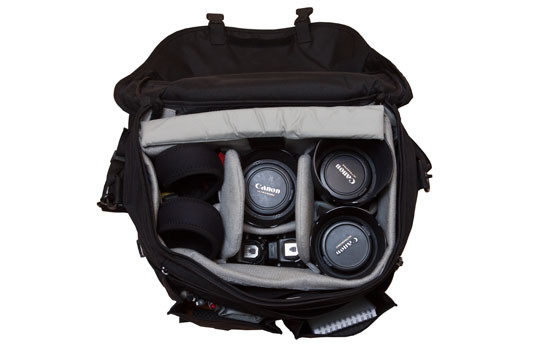
It seems to me that every web site about a photographer or photography has to feature a shot of the packed bag with an accompanying view of all of the kit laid out. I’m going halfway with the obligatory bag shot but you are going to have to settle for a bulleted list of the contents. We all know what an EOS 5d MkII looks like and I’m pretty sure that you can guess at what a pile of 8 Gb compact flash cards look like too. My old site has quite a bit of this stuff if you really need a fix!

©Neil Turner

So, what’s in your bag mister? (sorry Mr Lehman, I know that’s your line). The bag that I’m using most of the time is a Lowe Pro Stealth Reporter 650AW, and from the left the main items are:

  • Two Canon EOS 5D MkII bodies
  • Two Canon 580exII flash units
  • Canon 16-35 f2.8L sitting above a Canon 1.4x extender
  • Canon 70-200 f2.8L IS
  • Canon 24-70 f2.8L sitting on an ST-E2 flash transmitter

The back section is able to hold an Apple Macbook Pro 15.4 and the various cables will go into one of the front pockets if I need to pack a whole kit into the bag for travelling. There are plenty of bits and pieces in the bag:

  • Think Tank pixel pocket rocket CF card holder with 8 x Sandisk 8Gb CF cards
  • Notebook, pens, business cards
  • 16 x 2700 MaH AA rechargeable batteries
  • 2 x Spare Canon LP-E6 batteries
  • 2 x Honl Photo Speed Straps
  • 1 x Honl Photo Speed Gobo
  • 1 x Honl Photo Speed Snoot
  • Canon RS-80N3 Remote Switch
  • Various bits of coloured gel (red, green, blue, Full and 1/2 CTO orange, 1/2 CTO blue, purple)

Added together, this is one heavy bag. If it has the laptop and all of the computer accesories as well it is barely portable. If I’m travelling on the London Underground or having to do a lot of walking for a job I will try to cut things down and even spread the load in two bags. I’ve written before about the search for the perfect bag and all I can say is that the search continues.

Sometimes I use a nice small Domke J3 bag with two EOS5D MkIIs and some prime lenses – 28mm f1.8, 50mm f1.4 and 85mm f1.8 but most of the time I rely on zoom lenses.

Shooting in less than favourable weather.

Another re-posting; this time posted in April 2009 but from a job that I shot in 2006…

One of the best things about being a photographer is that you get to do some pretty odd things. Sometimes you climb to the top of a tall building and have a look at the view. At other times you get to meet interesting and amazing people and take their pictures. At other times you have to get up early on a bleak winter’s day, go to the beach, wade into the water just after dawn to get the tide and the picture. It all adds to the fun of the job.
©Neil Turner/TSL

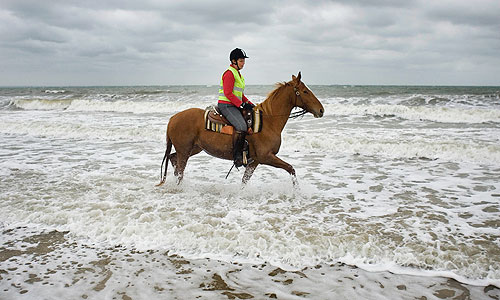
I shot this commission a while ago and I have been meaning to write it up since then. The story was about a school head teacher who owns a horse that she keeps in stables near the sea. She refers to her horse as her “work life balance” – something that we all need, but few of us have quite such a visible symbol of it!

Being a teacher, she is at school most days. During the holidays she gets away to the coast and rides whenever she can and if the tide is right she can ride on the beach. It was an October morning and we met at dawn in the car park near the stables. My brief was to get a double page spread for a magazine which showed her enjoying herself.

Of course photographers rarely get to choose the weather and it was raining with a reasonably strong wind. The tide was just right (we checked the tables in advance) and so we started to shoot some pictures of her riding on the sand. It’s a stretch of coast that I know well and I knew that there was a high chance of poor weather. There’s nothing that you can do when the deadline is tight except to shoot the best pictures that you can.

The picture above was taken towards the end of the session and by this time it was getting lighter. The exposure was up to 1/500th of a second at f3.5 on a 24-70 f2.8L lens. We had started at 1/125th at f2.8 and the light was doubling every twenty minutes or so. Unusually for me I shot this job without lights, without flash – just good old ambient. Had there been any sunshine, there would have been the complicating factor of having to shoot almost directly into the sun if I wanted to stay on the beach.

Most of the pictures were taken on a 70-200 f2.8L lens and I made use of a monopod whilst the light was low. I shoot on beaches quite a lot and I always take a large piece of plastic to sit my camera bag and anything else that I put down onto. If the plastic sheet is big enough, you can also use it to wrap everything but sand still gets in and salt still seems to coat everything.
©Neil Turner/TSL

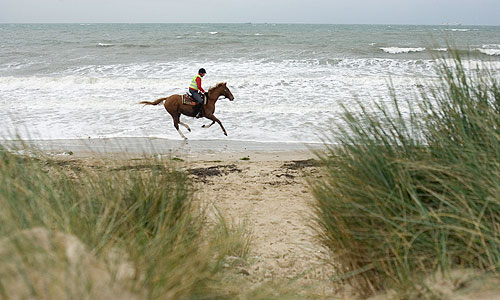
I always try to give picture editors a lot of choice and to give them small “drop-in” pictures to use if they need a second or third image for an article. The wider the variety of magazines and papers that I work for, the more I find that the drop-in picture gets used in unusual and creative ways. Magazine clients appreciate choice.
©Neil Turner/TSL

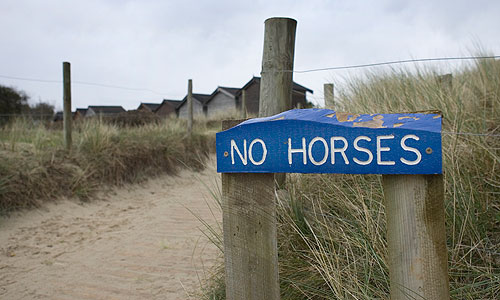
The reason that I wanted to mention this job was the combination of the early start, the poor light, the wind, the rain and getting absolutely soaking wet wading knee deep into the sea. Maybe it was because of all of these factors that I enjoyed it – who knows.

I wrote a while ago about my addiction to Timberland boots and I was very grateful for them on this job. My jeans were wet but my feet stayed dry.