equipment

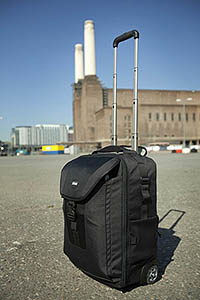
Testing a new camera bag

Much has been written about the shared fetish of professional photographers for equipment and their passion for finding the ever elusive perfect camera bag. We all know that its a myth, yet we all keep on plugging away buying new bag after new bag in the hope that we will somehow stumble upon THE ONE – the bag that is lightweight but protective, small but takes a huge amount of kit, good looking without attracting the wrong kind of attention. Recently I was offered the chance to try out an interesting new bag without laying out the cash first…

©Neil Turner, April 2011

I had responded to a blog posting on another photographer’s website about bags, back pain and my lack of experience with either rucksack or rolling bags when I got an email from the Think Tank team offering me the chance to try out their Airport Take Off which has wheels and back pack straps. I have looked at the Think Tank gear many times since it came onto the market and, to be honest, the only thing that has stopped me investing in one was failing to decide between back pack and rolling models.

These bags come with a curiously compelling life size poster of a couple of sample layouts of gear. One side shows some Canon kit packed into the main compartment and the other shows a set of very impressive Nikon gear. I spent almost two hours packing and re-packing my Canon gear until I was happy and I was amused that my configuration was nothing like either of the two samples. That doesn’t matter the “serving suggestion” poster helped me to work out my own system a lot quicker that I would otherwise have done – it’s only a detail, but its a nice touch.

The following day I went off for the very first time as a photographer with a rolling bag. The job was at London’s Battersea Power Station and it was the launch of a new video game called DiRT3 and the pictures were going to be of a couple of top class drivers doing some fast action slides, drifts and turns around the place. It was a very hot day (well, by London in April standards) and the amount of dust that the event promised to create was going to test everything.

There were photographers and film crews everywhere and, as an aside, I have never seen so many Canon DSLRs in one place being used to shoot video.

The 200 metre walk from the car park to the press area was easy enough and I started to work from the bag. I had 3 camera bodies, 4 lenses, 2 flash units, a MacBook Pro laptop and all of the bits and pieces that you would imagine needed packed into the bag and I found it surprisingly easy to work with the bag and a belt pack. I kept the Think Tank zipped up when I wasn’t accessing it and my prediction of much dust came true. There was not a speck of dust in the bag after an hour so I didn’t bother using the rain cover, which I would have done if I had been worried about dust getting in.

I was at the job for well over 8 hours and my back didn’t complain once. I was editing in the shade of a Ford tent quite a lot of the time and I even used the Airport Take Off as a seat for a while. To cut a very long story short, the bag passed the test with flying colours and it worked superbly well as a rolling bag on day one.

Day two was a shoot on a beach so sand rather than dust was one issue and the need to use the bag as a back pack rather than relying on the wheels was the other. It was a reasonably straightforward portrait and the bag again performed very well. I was dipping in and out a lot more on this shoot and keeping the bag zipped up wasn’t really possible. I would have used a top opening shoulder bag for this shoot in the past and, on balance, the top opening bag would have been easier to work out of. This is the compromise. This bag is easy to carry, easier to roll and in terms of getting to and from the job is far and away the best bag that I have ever used. On the first job where I was working with cameras over shoulders all day I didn’t miss the traditional bag style but on job two I did miss it a little.

I’m still deciding whether the ease of transportation outweighs the slight inconvenience of working from the bag and I suspect that the answer will be that it depends on what I’m doing that day. On the two other occasions that I used the Airport Take Off with camera gear in it the ease of transportation won rather easily, so it was 3-1 to the Think Tank rolling back pack.

Camera gear layout (left), Elinchrom Ranger Quadra layout (right) ©Neil Turner, April 2011

I think that by this stage I had made my mind up that the Airport Take Off is a great bag for carrying camera gear so I decided to see what it was like with my standard lighting kit in it. That consists of an Elinchrom Ranger Quadra pack, two heads, spare battery, triggers, charger, cables and various accessories. The bag swallowed the kit with plenty of room to spare and I almost managed to fit a second Quadra pack in too. With two packs it was heavy and, to be truthful, I rarely work with two packs anyway. This configuration is SUPERB. From the first minute of the first day I knew that I had found a new way to carry my lighting kit. It packs in easily, you can get it out quickly and the system that Think Tank supply for attaching a tripod doubles very well as a way of attaching a stand bag with two Manfrotto medium weight stands and a good sized soft box – and that’s without using the front pocket which is designed for a laptop.

Yesterday I went out with the bag fully loaded with lighting kit, with my MacBook Pro in the front pocket and a Domke J3 camera bag with two bodies, two lenses and a Speedlight resting on top as I rolled the bag to my destination. I can see that this is how I’m going to roll from now on (apologies for the pun) for a big percentage of my jobs.

I haven’t had the bag for long enough to have tested its durability. There are a few bits that I will be watching such as the folding handle and the plastic pouches on the inside of the lid (which now hold AA batteries, a flash meter and plenty of coloured gels). The handle is a miracle of engineering but I worry that it may not be as durable as the rest of the bag. Having said this, and knowing that the people behind the company are working photographers, I’m not put off at all. A little over a week in and I’m as happy as I have ever been with a bag – the fact that I’m likely to use it for a purpose that I hadn’t intended is a mere side issue!

Pier divers in Bournemouth

Several (actually all) of my recent blog postings have been about old pictures that I have found lying around or in searches for something else and why they are important to me. The latest one shows some young guys diving of of Bournemouth Pier in the early 1990s and it was part of a set that I did for a trades union magazine. The commission was as simple as it was vague – to produce images of the seafront at Bournemouth that could be used in a preview of the union’s annual conference that was being held in the town.

Bournemouth Pier divers. ©Neil Turner, June 1992

Commissions in those days always attracted expenses and that invariably included the cost of film and processing. The job was only a half-day but what a beautiful half day it was. The sun shone, the beaches were packed and nobody seemed to mind me wandering over and shooting their picture. The people diving from the pier made some great pictures but the dangerous nature of what they were doing meant that the client didn’t even want to consider them.

Shooting slide film in those days carried certain risks, not the least of which was that there was only one original. If that got lost or if the client decided to hold on to it there was nothing that could be done about it. Affordable scanners didn’t really exist and getting duplicate transparencies made was very expensive. These days we can just keep as many copies as we have hard drives and in the days of black and white it was always easy enough to knock out an extra print but there was that scary and even precarious time where you had to get the exposure spot on, hope that the film was processed correctly and that the couriers wouldn’t lose the package containing your work. It is quite amusing to think that “fast turnaround” was measured in hours and the three days or so that it would have taken me to get these images from the camera to the client would have seemed eminently reasonable.

How times have changed!

I’ve always liked this picture. It was shot on a Nikon F4S camera with a 24mm f2 Nikkor using Fuji RDP100 transparency film

Back on Memory Lane again

I don’t know about you but I can put my finger on exact dates and point to pictures that changed the way that I shoot pictures. Aside from the obvious ones such as the day that I used a digital SLR for the first time and the day that I bought my first medium format camera one very special day and one picture made me think really hard about the kind of lighting that I wanted to use.

Desmond Fennell QC. ©Neil Turner

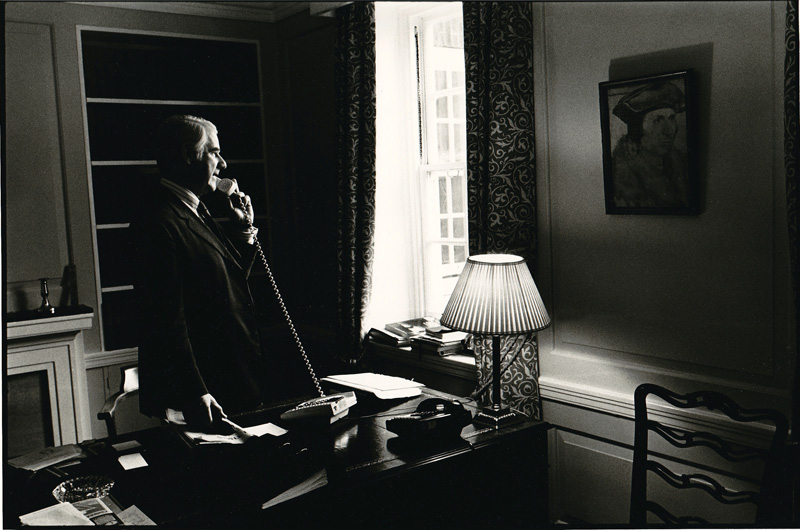
This black and white portrait of Desmond Fennell OBE QC was taken in his chambers at one of London’s famous Inns of Court – The Temple. It was shot for a newspaper and it was during a time in my career that I was using a single Elinchrom 23 flash head with a soft box and a bit of cable connecting the camera to the flash. Nothing unusual there I hear you thinking… how did this change Neil’s life?

Cue anecdote: I was sent to shoot a portrait so I took my standard gear. When I was shown in to the eminent man’s office I started to look around for a power point to plug my Elinchrom into. He answered the phone at that moment (he was chairing a major public enquiry at the time) and so I looked at the desk lamp and followed the cable to the socket in the wall. The trouble is that it was the wrong kind of socket… the UK standard three pin plug has rectangular prongs and his only socket had round holes. Square pegs, round holes… ohhh c**p.

It wasn’t that I was incapable of shooting with either a speedlight or just using the ambient light it was just a bit of a shock. This was actually the second frame that I shot – Nikon FM2 with a 35mm f2 Nikkor, Kodak Tri-X film pushed to 800 ISO.

I like to think that I learn from my professional mistakes and I like to think that after a few days a shock turns into an eye-opener and I remember coming away from this shoot with two lessons learned. The first was to always shoot some ambient light because it often makes stunning pictures – especially at quiet, off-guard moments and the second was to buy some battery powered lights. In truth, that took about three years to accomplish properly and I invested in a lot of extension leads in the mean time. I recall the day that my first Lumedyne kit went into action – complete with a Wein infra-red trigger. No cables. I shot a portrait of another lawyer and left her office singing one of the songs from the Disney version of Pinocchio – “I got no strings to hold me down…”

Street photography 1989 style

“Street photography is back” was the title of an email that I received today. Funny, I never knew that it went away. Having said that, the current exhibition taking place at The Museum of London has given the genre a bit of a boost. There are so many great exponents of street photography working in London today that even I have to admit that it isn’t so much back as resurgent. This got me thinking about some of my own work from early on in my career. I remember sitting in my office one day and a very old friend rang me and asked if I have any pictures of street markets that his younger sister could borrow for a school project. I had a few but, in the absence of anything better to do, I went off to Leather Lane market and shot a couple of rolls of film.

©Neil Turner

At that time I was part of a small agency and we had a rapidly growing library of images that was starting to make us some money. Stock photography was a good marketplace back in the late 1980s and early 1990s and I thought that it wouldn’t hurt to add a few market pictures.

This was my favourite frame of the lot. Shot on a Nikon FM2 with a 35mm f2 Nikkor lens and Kodak Tri-X film – a copy of this print made on old-fashioned bromide paper still hangs on my own office wall. The reasons that I like it are many and varied but the fact that it was born of a simple request from a very good friend (in fact, two years later he was my Best Man at my wedding) gives it extra weight for me. The fact that it has made me quite a bit of money as a stock image certainly doesn’t detract from its appeal but the other thing that makes me love this picture is that it reminds me just how simple photography can be. A mechanical camera with a fixed focal length lens, no automation whatsoever and time. Street photography is all about opportunity and patience.

Waiting for the moment to happen is part of the way that I shoot anyway but I also spend a lot of time looking around trying to anticipate good compositions, watching for the way that light hits surfaces and people. I have a very clear recollection of how this picture was made. I had seen the man walk up through the market and grabbed a couple of frames of him as he walked and shopped. Then I saw this nice gap between stalls and concentrated on framing it and I have the same composition with at least five different people passing through. Finally the interesting person that I really wanted came back and I clicked one frame of him (no motor drives on my FM2s that day). The little black border around the print is the rebate of the film which means, for those of you who are too young to have shot much in the pre-digital era, that this is the whole frame as it was shot – no post production cropping.

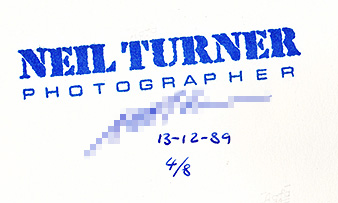
When I scanned the print this morning I noticed that this was one of a short edition of hand-prints that I made of this frame and you can see the stamp and date that were on the back with my pixelated signature.

©Neil Turner

Simple and happy days but I don’t particularly want them back. Opening a box of prints brought back the smell of the darkroom and the associated cough rather too vividly. I haven’t made a black and white print in a traditional darkroom since January 1994 and I don’t miss it one bit!

Two surprisingly similar portraits

©Neil Turner/TSL

The great challenge in photography for me is to keep shooting pictures without keeping shooting the same picture. There are thousands of ways of taking a photograph – let’s say that the number is, for argument’s sake, twenty-five thousand. What happens when you have shot two hundred and fifty thousand pictures – have you shot each possible picture ten times? I was looking back through a folder of favourite images today and found two that were taken at a similar point in my career and in a fairly similar location.

So are these two pictures the same, similar or different? It doesn’t matter really what anyone thinks but I really like to see them together. I like to see the similarities and the differences and once you get away from the fact that both are women sitting in a chair in a bay window in London with a quality rug on the floor the differences in the pictures start to matter much, much more. I promise that I haven’t cropped them to match – this is how they were in my folder.

The light comes from the side on both and, knowing the way that I work, that has a lot more to do with eliminating reflections in the glass in a hurry than any creative impulse. The amount of ambient light is higher on the left (yes, that is author Jacqueline Wilson) and the books make the picture feel a lot different to the harder light with less ambient, no books and peeling paint of the left hand portrait of blind sculptor Gohar Kordi.

I love looking at my own work, trying to get ideas for new work from examining old work and I know very well that there will come a time when I do the same (?) shot again and can picture these two frames and what they say in my mind. Next time I will use a longer lens. Next time I will pay even more attention to the symmetry of the composition. I can’t wait…

Good, bad and ugly purchasing decisions

If you talk to any photographer they will almost certainly tell you about the catalogue of bags, cases and pouches that they have bought thinking and hoping in equal part that their lives would be made better by owning and using the perfect holdall. We all know it’s a myth but we all keep buying in the hope that one day that elusive bag will be made and that it will (somehow) save our poor battered spines. Well that’s one kind of bad purchase that we will all own up to but I was put on the spot the other day by a young photographer and asked about my best and worst purchases of recent years. Hmmm…

My reply was that I had been pretty fortunate where cameras and lenses were concerned. I had made pretty good choices on the ‘big ticket’ items – my camera bag is full of the same kit that it was two years ago and (apart from getting newer versions of the same) I’m still happy with my gear. It’s the small things and the software where the good and bad choices seem to come – maybe because they are the nearest thing to impulse purchases that I make.

The Good, the bad and the ugly…

Software tops my list good purchases that I’ve made recently and at the very top is the invoicing software that I’ve been using since I went freelance again in 2008. I found BILLINGS as a ‘staff pick’ at the Apple Store on line and right from day one I have genuinely enjoyed using it and the development that has since taken place from version 2 to version 3 and the addition of an iPhone app has made a good package very good and there is nothing like getting your invoicing right to make you a happier photographer. My other good/great purchase was the iPhone itself. I had tried a Blackberry and I had used a Nokia smart phone but from day one the iPhone has proved itself. It seems as if I get a new ‘life enhancing’ app every week: from cinema bookings to a brilliant parking control app the iPhone becomes more and more important and having the back-up of Mobile Me really helps too.

Back to software – I have used Photo Mechanic for many, many years and I still love it. It is fast, intuitive and does exactly what I need it to do. One colleague refers to it as ‘old school’ and I’ve heard people say that it’s functions are available within newer programmes but I’m far from convinced. Workflow is completely central to the work that we do and so I’m a sucker for anything that is presented as a ‘better, faster, easier’ in the workflow area.

My first ‘bad’ purchase was Adobe Lightroom 3. There is nothing wrong with it. The RAW conversion is exactly the same in Photoshop CS5 but the rest of the file handling and workflow part of it’s capabilities require huge computing power and the patience of a saint. Out of the box it is set up to be thorough but that makes it really slow for the kind of work that I do. By working out the preferences you can decrease it’s thoroughness and speed it up quite a bit but it is still never going to replace Photo Mechanic in my life. That’s an expensive mistake to make but that’s life.

My next ‘bad’ purchase was Apple’s Aperture. Once it came down to just £45.00 in the App Store I was tempted and I gave in. Aperture was an attempt by Apple to take professional workflow, give it the Cupertino treatment and give us a workflow designed from scratch. From version 1 it was flawed and my first experiment with it left me feeling “if only” – in fact a whole list of “if onlys”. Version two came along and they had ticked a couple of boxes but left far too many questions to make it worth pursuing. I bought version 3.1 safe in the knowledge that several of my peers are using it, loving it and even teaching it. I wanted to love it. I tried for well over a month to get on with it but two weeks ago I finally admitted that it was never going to be. Aperture needs power – my Mac has plenty, a Core i5 processor and 8Gb of RAM, but it still never seemed enough. I think that the realisation that Aperture is only at it’s best when you have some expensive plug-ins was a turning point but I soldiered on.

You also need plenty of screen real estate to make the interface appear anything other than cluttered and I do half of my work on a 15″ laptop. I disliked the keyboard shortcuts to start with but got used to those but the reality check was that using Photo Mechanic plus Adobe Camera Raw just makes sense for me.

And here is the truth – what makes a ‘bad’ purchase for one photographer doesn’t mean that it was a bad product. I have owned an Canon 85mm f1.2L lens and sold it again because it didn’t suit me – it’s a hell of a lens, just not for me – I prefer the bargain 85mm f1.8.

So what about an ‘ugly’ purchase? I’m struggling to think of one in the software field. Had I actually bought version 1 of Aperture instead of doing the free trial, that would qualify but I didn’t. I cannot be bothered to list all of my ‘ugly’ camera bag mistakes and so I come to the countless times that I have bought cheap options and regretted them. If I’m shooting with Canon or Vivitar flash units on stands I use the bomb-proof Manfrotto Light-Tite adapters. I tried to use a couple of cheaper ones but they were rubbish and broke under heavy use.

Tripod heads are another way to spend money unwisely. When I left college in 1986 I bought a Manfrotto 155 tripod with a basic head. That got stolen and so I bought another one just the same. When I joined the staff on the newspaper they bought me a new tripod – exactly the same again but with a three-way pan and tilt head complete with a quick-release system and spirit levels. It was a good buy, it worked well and I still have it but I have always wanted an even easier to use tripod head and have bought and sold about half a dozen ball and socket, joystick, friction controlled and fluid heads. I did spend time watching eBay for a geared head at a good price – safe in the knowledge that it would be exactly what I didn’t need and I’ve abandoned the search.

My ugliest purchase ever was a Maxtor USB2 portable hard drive. It failed within days, having never really worked that well anyway. I took it back, they swapped it and the new one failed too. I didn’t lose any data and my only expense was two round trips to the shop to get drives replaced. After the second failure I got a LaCie Rugged drive which is still absolutely fine nearly four years on. I know that it will fail one day and I have duplicates and triplicates of the data stored on it but it has done it’s job.

Making purchasing decisions as a photographer is a tough job but when photography is your livelihood as well as your passion choosing when and what to buy becomes a really tough call. I have a basic kit and I have back-ups for most of it. I have rental accounts with four different companies and I have insurance that should cover my kit against loss, theft and breakages. But what about new, different or specialist gear? The more commercial work that I do, the more that I find myself needing to rent or borrow specialist kit. I have spent hundreds of pounds hiring Canon tilt and shift lenses over the last year or so. I need to seriously consider investing in one or two TSEs because the cost of renting might well be greater than buying, using and then selling on. If a lens costs £2000.00 to buy and it costs £50.00 a day to hire, how many days in a year should you hire before it becomes a better idea to buy? It isn’t 400 days because the lens can be sold. The depreciation on a £2000.00 lens would be somewhere between 1/3 and 1/4 over six months or between £500.00 and £700.00 which is only ten to fourteen days rental (if the days are not continuous) and maybe twenty to thirty days given that you would hire by the week from time to time.

To buy or not to buy, to rent or not to rent – a couple of big questions. One thing is for sure, had I ever been able to rent a Crumpler rucksack camera bag for a few days before lashing out £130.00 I would never, ever, have bought it!

Undertaking assignments – a beginners guide

I’m not sure if this is a re-post, a re-repost or whether it is just a bit of efficient recycling of some old words. It was written in 2002 and put up on the pre-blog in 2009 anyway.

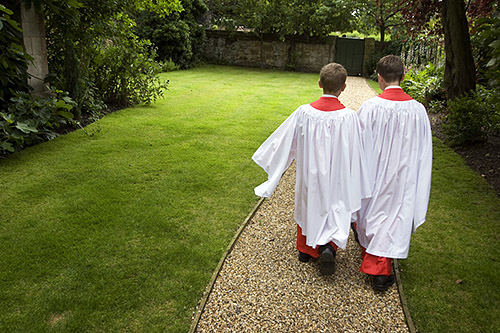
What does undertaking an assignment really mean? That was the question e-mailed to me by a third year photography degree student a while ago. At first I was shocked by her ignorance, but then I realised that nobody had really prepared me for my first one either. Some of what needs to be done is common sense and some is just experience. No two photographers work the same way, but here’s my approach…
©Neil Turner/TSL, July 2008

Let’s start small, with a simple half-day portrait, and in theory it all begins with the brief that you receive from the picture editor or commissioning editor. The first contact normally comes over the phone and can be as much as days or weeks in advance or as little as minutes or hours.

In practice you can be getting ready for this commission before it exists by simply making sure that your kit is packed, that batteries are freshly charged and that you have either enough film or spare memory card capacity to last for a few hundred frames. If you use a car for your work, make sure it’s in good repair and has enough fuel in the tank and also make sure that you’ve got cash and cards just in case you need to buy anything. In the days before SatNav I always bought lots of street maps so I now have a comprehensive A-Z of most of the United Kingdom to hand. All of this comes under the tongue in cheek heading of OPERATIONAL READINESS!!!

Now, back to that brief. You are fairly comfortable that whatever is asked of you, you can get on with it without too much fuss so when the phone rings you can concentrate on the details being given to you. In time honoured photographer tradition, there is a catchy way of remembering what you need to know – the FIVE Ws: when, who, what, why and where. In these few words you have the essence of the job – when the job is, who to contact, what you have to shoot, why you are shooting it and where the job is.

There will be other important facts like what shape (if any) has been left on the page for the picture, what the deadline is, how many images the editor wants to choose from, is the story a positive one or is it critical of somebody or something. The more information that you go armed with, the better job you will have the potential to do. If possible get written conformation of what is being asked -especially if you have never worked for that editor before. I find an e-mail is a very useful aid and most picture desks are more than happy to send a quick confirmation e-mail if you ask nicely! You know what is wanted by now, and you need to go through a mental checklist of the equipment you need to take.

  • Is your standard kit enough?
  • If it isn’t, where can you rent the right hire kit?
  • If you have to rent a lens, who will be paying – you or the paper/magazine?
  • Would you be better of on the train?
  • Do you need to take a laptop?

Make sure that you can answer all of these questions for yourself before you leave – it might pay to design a “pre-flight” checklist and get a few dozen copies printed off so that you always go through all of the questions. The car boot is packed, you have the route worked out (sat-nav is great but make sure that you have keyed in the correct location, there is more than one Ashford and at least three Newcastles) and it’s off.

Travelling time isn’t dead time. It’s great to get some ideas while you travel, the outline of what you might like to do. These ideas often come to nothing, but you are starting to think about the job ahead and that’s good. If the story is likely to be news worthy it may come up on the radio, so travel with a good news station tuned in. If you have time before you leave check things out on the internet; “Google” the person’s name – a little knowledge is very useful when it comes to breaking the ice. When you arrive it’s important to come across as if you know what you are doing. If you are using lights you need to be familiar with them and the ability to continue a conversation whilst setting them up is a useful skill.

I have written elsewhere on this site about finding a (non-contentious) subject to chat about to buy yourself time to decide what you want to do and to relax your subject. If you are (outwardly) relaxed you will get more respect and trust from your subject. It’s important to not be told by them what to do, by all means listen to their ideas but be firm about what you have been sent to do. You might have to try their idea in exchange for shooting your own – it’s all a game, so learn to play it well. When the shooting starts, be decisive and shoot as many variations as you can. Don’t be afraid to refer to your brief and it’s important that you do what was asked of you as well as the much better picture that you think of.

This is the vital bit, anything that goes wrong now will probably stay wrong, no-matter how good your Photoshop skills are. When the shoot finishes, you pack up without forgetting anything and leave. Even if the person doesn’t have an unusual name check spellings and job titles so that your captions are thorough and authoritative.

It’s not all over. No matter how long to the deadline, get those pictures delivered as soon as possible whilst taking care to edit them well and caption them accurately. The paper will have a way that they like things done so make sure that you comply with their wishes, there is no better way to lose a client than to get these basics wrong. Keep copies of all digital files and archive them well. A courtesy call to check that everything arrived OK and that the editor was happy is always a good idea until you get your feet under the table and can the client a “regular”. Obviously you need to make notes of the distance you covered, the expenses you incurred and the time spent so that when it comes to submitting your invoice you aren’t making things up. If the editor offers you feedback on the job, take it. Be positive and don’t make excuses for anything that was avoidable that went wrong.

Get those batteries back on charge as soon as possible and get the kit ready for the next one. Now the job is over.
Six feet up is bad?

©Neil Turner, October 2000. Oxford.

©Neil Turner, October 2000. Oxford.

This was first published in the Autumn of 2000 on the DP Review website as a follow-up to a review I did of the original Canon G1 Powershot

It is very easy to hold the camera to your eye and take a picture. Good photography requires us all to think about where we are taking the picture from as well as what we are taking. The best photographs are made when the photographer chooses a vantage point to suit the subject, and it is surprising how few subjects are suited by the height of a human standing at their full five to six feet. This is compounded by the fact that when someone views the image they will see pretty much what they themselves would have taken because they haven’t been told about bending your knees or climbing a ladder to shoot better pictures.

It is no accident that many of the world’s best photographers wear denims most of the time, and I take pride in the fact that I spend so much of my time kneeling that I have “housemaids knee”. Sooner or later I will end up flat on my face or up on a chair to give something extra to a composition – namely a point of view that the person looking at the image would not have seen themself.

This image was shot in the beautiful University City of Oxford on a Canon G1 using the swivel LCD to get the camera at ground level without having to lie in the dirt myself. The lens was less that two inches from the cobble stones and this ultra low angle gives the image a dynamic quality that would have been missing had I been standing at my full five foot ten inches. The photograph is different from most pictures taken of this tourist magnet and I’m sure that my antics were the reason for the puzzled look on the passer by’s face.

My point is that when you get your camera out think about the height of the lens. If you end up shooting from a standing position, well that’s OK – but I will lay good money that 90% of pictures are better when taken from below four feet or over seven.