news

On test: Vanguard Heralder 38 camera bag

When somebody offers me the chance to try out a new camera bag that is winning awards all over the place, I normally jump at that chance. An email from the people behind the Vanguard range of bags arrived in my inbox a few weeks ago and the Heralder 38 arrived at my home shortly afterwards. I have tried so many rucksack bags and been disappointed with the compromises that you have to make in order to get portability and so I keep coming back to shoulder bags – despite the best advice of people who know about back pain.
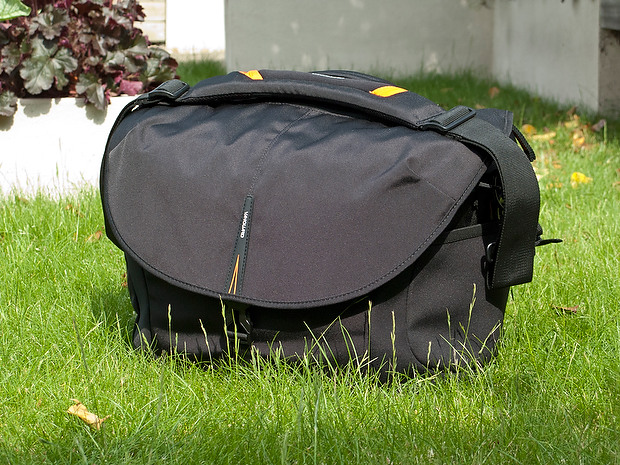
The Vanguard Heralder 38 camera kit + laptop shoulder bag.

Lets put this bag into some sort of context: I have used a Lowe Pro Stealth 650 as my main “carry everything” shoulder bag for many years now and I am used to it, quite like it and would buy the same again to replace it if Lowe Pro hadn’t done what they seem to love doing – which is to take a perfectly good design and “improve” it. The old Stealth 650 that I have is a good bag but the new Stealth 650 is really annoying!

Anyway, back to the review: The way that I test things is to use them in my everyday work and so the amount of testing depends entirely on what I’m up to at any given time. The last couple of weeks have been relatively quiet but I have had enough days out with this bag to have made a lot of important decisions about it. From my own experience of reading reviews, I know that a lot of people skip straight to the end and because of that there will be a “conclusions” section at the bottom.

Most people want their camera bags to be smaller than they need to be, to weigh less than the total of everything that they want to jam in, have super-easy access, look great and to be a joy to carry for several hours. I guess that’s why nobody has ever found the perfect bag. It’s impossible to make that bag on a commercial level because we all have subtly different needs and so the word compromise rears it’s head AGAIN!

What can you get in the bag?

If this bag is going to become my everyday carry everything bag then it needs to swallow my standard amount of kit: Two Canon EOS5D MkII bodies, 16-35 f2.8L, 24-70 f2.8L and 70-200 f2.8L lenses, two 580exII flash units and all of the bits, pieces and accessories that go to support that kit in the field. I also need to put either a 15.4″ Apple MacBook Pro or an 11″ MacBook Air plus gadgets in from time to time. The good news is that everything fits in and the bonus is that I can just fit the 70-200 standing up with its lens hood in place (I hate having to remove and reverse hoods every time you put a lens away).
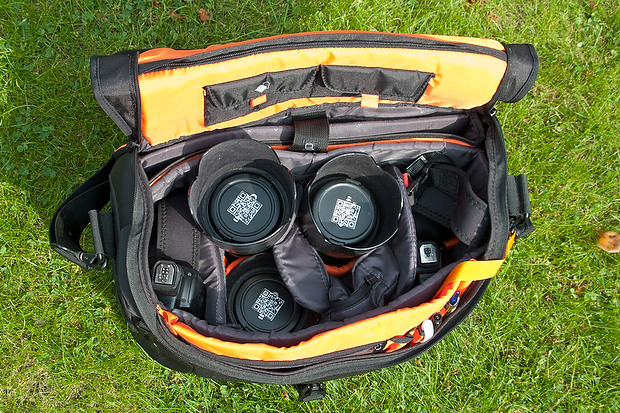
The Heralder 38 showing how my standard kit is laid out when loaded into it.

The bag itself doesn’t have too many pockets and hiding places for anything other than relatively small or flat items such as pens (x3), memory cards (x4) notebooks, passes and business cards. What it does have is a removable pouch which holds a couple of spare batteries for the camera, a couple of spare sets of AAs for the flash units and an electronic release for the camera. Because of this pouch and the excellent use of space within the main compartment of the bag the Heralder 38 passes this test rather comfortably – even with a laptop and related accessories on board.

Ease of Access
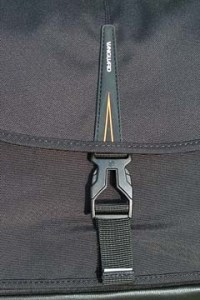
That less than perfect clip…

Shoulder bags are nearly always nicer to work from that rucksacks or rolling cases. I prefer my bags to have a simple method of closing them whilst working and a more secure method for securing the contents when I am simply travelling. The combination of a zip around the whole lid and a single snap-shut clip on this bag meets that requirement too. I suspect that the designers of this model have looked at the old LowePro Stealth bags and decided that they were on to something before designing their own similar solution.

It’s at this point that I found my first ‘issue’ with the Heralder 38. I like to be able to close the bag in work mode one handed. Every Domke and LowePro I have ever owned has the ability to do this in common and the Vanguard looks as if this wouldn’t be a problem either. So far I have struggled like mad with the plastic snap-shut clip fitted to this bag and I cannot work out why. I cannot seem to line it up as easily as the more square ones on my LowePro or on the Think Tank roller that now carries my lights everywhere. I’m still trying to master this clip and failing.

Beyond that niggle, getting kit in and out of the bag whilst moving is as easy as it has ever been on a bag that I’ve used. If they could source a less trendy looking clip I’d be well on the way to proclaiming this bag a massive success.

Carrying the bag

This is where the Heralder 38 comes into its own. Somehow they have made this a superbly comfortable bag to carry. The strap is excellent and the shape of the back of the bag means that it sits on my hip incredibly well. Vanguard have gone some of the way to fooling me into thinking that I am carrying less dead weight than I actually am and that is a huge advantage for this bag when comparing it to the other bags of a similar size that I have owned and/or tried out. Put simply, this is an easy bag to carry – possibly the easiest I’ve ever used.

Extra features

All bags these days come with clips and straps that allow you to attach tripods, monopods and other large and unwieldy accessories. To be honest I never want to be in a position to have to do that and so the bits an pieces that came with this bag that allowed me to do that were removed (where possible) and put into a cupboard.

The bag features lots of handy labels…

What the bag does have (in common with my old LowePro) is a rain cover tucked away in the back of the bag that can be fitted to keep the contents drier than would otherwise be the case. We are in the middle of a spell of beautiful weather here in the south of England and so I haven’t had a chance to test the rain cover yet but I can tell you that it is fast to fit and easy to pack away again. The great news is that it is detachable too – which is a big tick from me. I have had other bags where the rain cover is permanently attached – which means that when it stops rainy you have to leave it out to dry or pack it away wet.

The bag comes with a very stylish luggage tag and an elasticated end pocket that fits a small bottle of water rather well. As someone who carries his bag on the left shoulder, the elasticated pocket is on the wrong end but that’s just a small niggle and not a deal-breaker!

Looks and construction

I guess that when you design a camera bag you have two choices: you either go down the “it’s a camera bag so it should look like one” route or go the other way and design something that looks like a normal holdall. This bag is squarely in the former camp – to the extent that it would be hard to imagine that it was anything else. The black water resistant materials are of a great quality and the plastic base appears to be pretty tough. The orange colour of the interior may be off-putting for some people and I’d prefer something 18% grey myself (like my old LowePro) but it has the advantage of being very visible from a distance and being the colours of The BPPA.

The quality of the stitching and the fabrics tells me that this bag should last a long time. If they put a better snap-shut clip on the bag I think that they will have the whole construction sorted.

Conclusions

This is a very good bag. It is OK to look at, swallows a lot of kit and is easy to work out of. It appears to be well made and the biggest selling point for me is that it is supremely comfortable to carry. The number of distributors for these bags seems to be growing and a quick search of the internet found the best price is as low as £124.98 at Amazon– which is good value for money as far as I’m concerned.
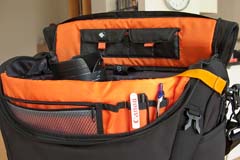
The Vanguard Heralder 38 in use.

So far I only have one real niggle: the snap-shut clip. Beyond that, for the first couple of days I thought that a couple of external pouches would be useful for when I have a few extra bits but I suspect that would alter the superb balance and usability of the bag rather than enhance it.

So that leads me to the big question: “Is this the best bag in its class that I have ever used?” The answer is very close… for portability and comfort of carrying the answer is a big yes. For ease of working is a marginal “no” BUT the bag that I would say beats this one has been modified by LowePro and the new version isn’t as pro’ friendly as the old one and so, if you needed to buy a shoulder bag to carry a decent amount of kit along with a laptop, I don’t know of anything that would beat the Vanguard Heralder 38. I haven’t found the camera bag equivalent of the holy grail yet but there is every chance that it is just a myth anyway.

Student work on show.

I’m very pleased to say that two of the students that I have been working with over the last year or so are showing some of their work in London over from tomorrow (Friday 27th April) until Tuesday 8th May. The work will be on the walls at Calumet Photographic’s Drummond Street showroom. The students have both now left the NCTJ Photojournalism course at Up To Speed in Bournemouth and are making their way into the industry.

©Deborah Yawetz

Deborah Yawetz – My interests are wide ranging; there is so much world to see, and people to walk in the shoes of! I enjoy news and wildlife photography: though seemingly different, both have a sense of immediacy, both are challenging and require patience, then finally responding to the moment. I have travelled a lot, most recently to Rwanda and the Serengeti.

I have published work in DV8 magazine in Bournemouth, Shed light events in London and a photo in the Daily ” Echo, Bournemouth. Work experience includes with Redactive publishing and The Times.

©Elizabeth Wainwright

Elizabeth Wainwright – I’ve worked on programmes for NGOs in the UK and in various African countries, and I saw a lot that never seemed to be documented by the media, or to donors. Combining this insight with recent editorial experience on the UK’s longest running environmental magazine, and of course the Photojournalism training, means I am well-placed to bridge the gap between theory and practice; truth and cliché; and do so in an informed, thoughtful way.

I am equally interested in finding homegrown stories: urban beekeeping and UK homelessness are two local stories I am working on. ” The power of storytelling to inspire and trigger change at whatever level – is ultimately what motivates my work.

You are invited to an exhibition featuring work by two new photographers from Friday 27th April until Tuesday 8th May inclusive.

  • Calumet Photographic, 93-103 Drummond Street, London, NW1 2HJ
  • ‘Meet the photographers’ evening on Thursday 3rd May, until 9pm, with drinks and nibbles.
  • The exhibition will be a chance to see a varied mix of work by two recently accredited NCTJ Photojournalists, and during the open evening, to chat more about their work and future projects.
  • More information: ejwainwright@gmail.com / 07841 529773

UK National Symposium on Photography 2012

The fourth National Symposium on Photography takes place this Friday, Saturday and Sunday in London. Timed to coincide with the World Photography Organisation Festival in London, the symposium will feature a very interesting range of debates and events.

I am going to be there, taking part in a panel debate about the future of news photography. The narrative for the debate on the UKNSP website says this:

The ethics of press and public photography, with particular reference to the implications of the Leveson Inquiry. At what stage does photography become harassment? Should there be controls? More broadly, where is the press heading in its use of photography? Should the press, citizen journalists, and members of the public all be treated the same or differently, whether in general or at newsworthy events? This panel discussion features a range of points of view – that of a photographer who gave evidence at the Leveson Enquiry, a leading picture editor and a champion of citizen photography.

It’s going to be a very interesting and maybe even passionate debate. This will be the third time in four years that I’ve taken part in the symposium and I firmly believe that it is developing into and very important event in the UK photography calendar. My fellow panellists are Alan Sparrow, Chairman of the Picture Editors Guild and Executive Picture Editor of Metro UK and Pauline Hadaway, Director of Belfast Exposed Photography and the debate will be chaired by Photographer Andrew Wiard.

The debate starts at 5pm on Friday 27th April at Somerset House in London. Tickets are available from Redeye or from the WPO.

Selling my EOS7D + BG-E7 grip

Selling great condition Canon EOS7D body + BG-E7 grip for £900.00 inc VAT

I am selling my Canon EOS7D body complete with BG-E7 grip. It has been a third/fourth body since new and has had light use because of that. The lure of the EOS5D MkIII is strong and I will be upgrading my MkII bodies later this summer. If you are interested in knowing more about this camera get in touch.

The selling price is £900.00 and that includes VAT. I have the original strap, instruction manual, charger and a single battery included with the camera or you can opt for the Op-Tech strap that I have been using it with. No boxes, no discs and no other cables I’m afraid.

The camera is in Bournemouth but I am regularly up and down the M3 on jobs and so may be able to make other arrangements.

The new Canon EOS5D MkIII – to buy or not to buy?

The heart says “YES” but the wallet asks “WILL IT PAY FOR ITSELF?”

One of the worst kept secrets in the photography world over the last few weeks seems to have been the exact specifications list of the new Canon ESO5D MkIII. When an email arrived in my inbox this morning it was headed “We’ve been listening, so now you can too!” An intriguing headline if ever I heard one… but what is it referring to? Could it be the addition of a headphone socket for video shooters? Could it be the vastly improved sound of the shutter over the slightly apologetic click and whirr of the mark 2? Maybe it is the rather good ‘silent’ shutter option? Who knows.

And to some extent, who cares? The decision that working professional photographers now need to make is whether or not buying one or two new camera bodies alone will be justified on purely financial grounds. I have written before about the calculations that you need to make before deciding to invest in new gear. The sums here are pretty easy to do:

  1. List price including VAT £2999.00
  2. Life expectancy of a pro body 36 months
  3. 3 years servicing costs £300

Take 1. and add 3. then divide by 2. = £91.64 which is the cost per month including VAT of owning the camera. Buy two and you double that. You could argue that the kit will have a residual value when you have finished with it and sell it on. I’ve just phoned a couple of dealers to see what my old Mark II bodies will be worth in part exchange. I was honest about their age and condition and was told that I’d be lucky to get £900 each. Factor that into the equation and the cost per month of the new camera would come down to £63.86 a month inc VAT each, which equates to £56.71 excluding VAT.

That’s the health warning over. What does this camera offer me? To start with I keep a Canon EOS7D as a back-up camera as well as for use when I need better auto focus that the 5D MkII can offer. I guess that the improved AF on the 5D MkIII will remove 50% of the need to have that 7D. The new camera also boasts improved low-light performance – which would be more than useful for me too. In fact, every improvement they have made is a definite bonus but exactly how I monetize those bonuses is a tough call. I know that I’d like to replace my three year old cameras with nice shiny new ones, now  all I have to do is to justify the costs. I look forward to the three hundred Canon EOS5D MkII Vs Nikon D800 comparisons. For most professionals swapping systems represents a massive cost and so it would take an awful lot for me to swap to the D800 – even if I thought that I could afford the extra storage space that using a 38 megapixel camera would mean. For me, the more important comparison will between the MkIII and the wonderful, if flawed, MkII.

I haven’t used the camera yet and so I will reserve judgement until I have. I’m not going to bother to cut and paste the whole press release either so if you want the opinion of someone who has handled the camera you can read what Getty Photojournalist Brent Stirton thought about using it on assignment in France or go to wedding photographer Jeff Ascough’s blog about it or if you want an anorak style description of what it does you can go to DP Review. I hope to get to play with it soon as well as the very interesting (if very expensive) new flash system that has also been announced today and when I do, I will be straight onto WordPress to blog about it.

To wrap it up, I just saw a great tweet originating from a user called @PolvoPolvo which said

5D3 could well go down as a gamechanger in the sense that’s its the first major release in memory not being described as a game changer

Every picture teaches a lesson

©Neil Turner. Poole, Dorset. September 2008

We all know that “every picture tells a story” but how many people think that, as photographers, every picture teaches us a lesson. Grab a picture – any picture – and really look at it. What’s good about it? What could you improve if you went back and re-shot it? If it’s perfect, why is it perfect?

I spent a lot of time yesterday shooting on mixed light with no real option of lighting the scene (a busy retail mall with dozens of shops and lots of people). Looking back at the best of the shoot this morning I could see that every frame had one major feature: one thing that was the single most important part of the composition and it was obvious that I should always get the white balance right there and let the rest of the scene do what it will. I already knew this but it doesn’t hurt to look and re-affirm what you already know.

Every time you shoot pictures and every time you look at other people’s work you can learn lessons. If you don’t know how something was shot – see if the photographer will tell you.

Look for the big four factors: subject matter, composition, light and technical quality. Work out how those factors come together to create the whole. Work out if the picture still works if one or more of those factors is deficient. It’s amazing how often the most eye-catching images are not perfect in every way and it is equally interesting that some pictures that score full marks in all categories just seem boring and “too good to be true”.

Analysing your own work on a regular basis is a great way to get better. Getting together with others and discussing each others work is great too but, for my money, going over your own work on your own is a fabulous way to find your style and motivate yourself to do better and better.