
Photo: Neil Turner/TSL Education. October 2005.
Marsha Hunt photographed at the home of her friend in St John’s Wood, London
As I get towards 100 imperfect portraits added to my Instagram feed I have had lots of nice messages about the pictures and the stories behind them. Along with those I have had a few requests for more of the ‘contact sheets’ such as the Dennis Healey one that I added to this blog last month. My portrait of Marsha Hunt has had three requests so I thought that I’d so that one first.
When I posted this on Instagram I added the following words;
It is hard to think of actress, model and writer Marsha Hunt without thinking about Patrick Lichfield’s photograph of her taken when she was starring in the musical “Hair”. In October 2005 when I arrived at the flat where she was staying in London I was a little surprised by her baldness but she has the most amazing presence that I forgot about it is seconds. The shoot was fun and she was just about the most professional subject I have ever been asked to shoot. It was tough to choose which frame to post but this one really shows how she was on the day. #lovemyjob #portraitphotography #archive #locationportraiture #editorial #canonukandireland #digitalevolution #imperfectportraiture #timeseducationalsupplement
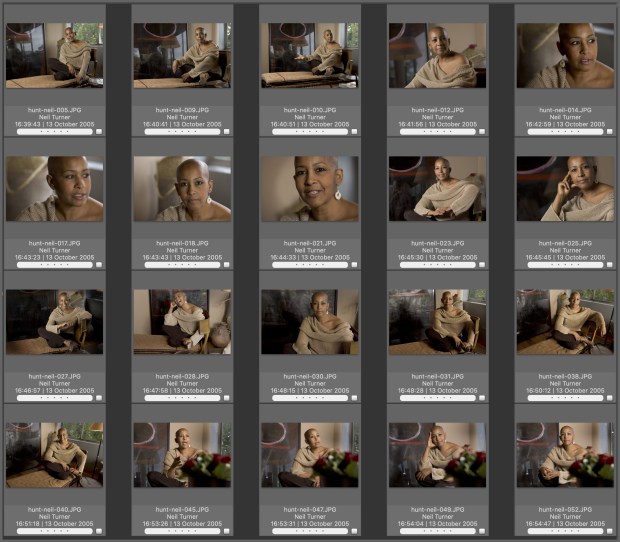
This is quite a wide edit but you can see that we didn’t change locations during the shoot at all. There were two reasons for this; the first is that Marsha had been having treatment for cancer and not been that well so we decided that once we had our location, we would work it. The second is that it wasn’t her home so nothing in the background added much to the story anyway.
The eagle-eyed lighting geeks amongst you will notice that the position and angle of the light changes a fair bit and that’s something of a feature of the ay that I shoot this kind of work – always fiddling with the (normally single) light source and combining it with the ambient in different ways as I go.
Technical notes: All of the lighting was with a single Lumedyne battery powered head and pack with a shoot-through umbrella on some and a 60cm x 80cm Chimera soft box on others. The cameras were Canon EOS1D MkII bodies with 16-35 f2.8L, 24-70 f2.8L and 70-200 f2.8L lenses


 Equipment and my equipment choices tend to evolve pretty slowly. Way back in the 1980s I was using a lot of off-camera flash on location and that meant either owning and running a lot of extension cables with my Elinchrom mains powered units, buying (or renting) a Norman system or using some basic flashguns (the term speed light hadn’t really entered common usage by then, other than as part of a Nikon model name) to do the job. I came across the Lumedyne range (old school) in the mid 1990s, although they had been around for a while by then. Before that I spent many happy years with my cobbled-together battery powered flash kit which was based around the already long-in-the-tooth Vivitar 285 system. I call it a system because there was a ton of accessories that you could get for it and it had some common connections that meant you could pair it up with almost anything you wanted to.
 Neil Turner Photographer