edit

A nice request for a picture

A few weeks ago I received a lovely email from the widow of a philosopher that I had photographed back in 1996. She had been looking through some of his papers and found a cutting from the Times Higher Education Supplement that had an interview with him along with my portrait of him. She saw the tiny 8 point byline and knowing that search engines are wonderful things she tracked me down. Emails went back and forth and today I got a photocopy of the cutting in the post.

I don’t have much of the work that I did between 1994 and 1998 but her luck was in and I had a Kodak Photo CD with some half decent scans from the job in my loft. It was an easy enough task to find the CD, grab the relevant image from it and get it ready to send to her. The old Kodak Photo CDs used an unusual and proprietary format that Photoshop doesn’t recognise so if anyone else comes across this issue I can confirm that the old Graphics Converter application will happily handle the format and convert your files into useful formats such as PSD, TIF or JPG.

Like most photographers I get regular requests for ‘free’ pictures and I am always wary but somehow a hand-written note from the widow of a very nice man where the words “please” and “thank you” chased away my cynicism rather easily. The portrait is of philosopher and Oxford Professor Bernard Williams (he became Sir Bernard a while after I shot the picture) and here it is…

©Neil Turner/TSL. Oxford, October 1996

Geek footnote: I was using a pair of Canon EOS1n bodies with Canon 28-70 f2.8L and 70-200 f2.8L lenses at the time and this was almost certainly shot on the 70-200. The film was Fuji 200 ISO colour negative scanned on a Kodak RFS scanner.
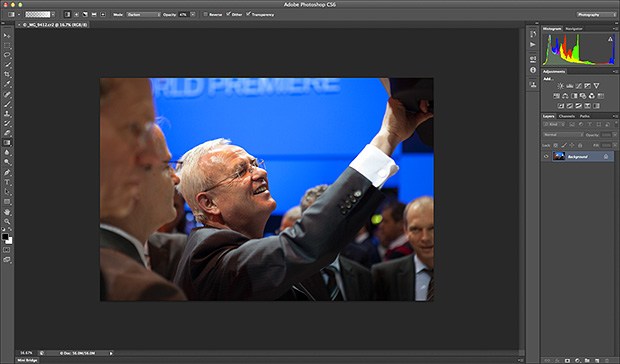
Adobe Photoshop CS6 Beta

Like half of the photo geeks around the world, I have downloaded and started to play with the public beta version of Adobe’s latest version of Photoshop: CS6. This is a major revision of the software in terms of the interface which looks a lot more like Lightroom than ever before and is also a lot less “freestyle” than those used to versions such as CS3 and earlier would be familiar with. We now have a fixed window rather than the floating elements of previous versions and this will take quite a bit of time for me to get used to. It isn’t that I don’t like it, it’s just that it is a change.

Screen shot of the main window


To be honest, my main use of Photoshop is Adobe Camera RAW. I use it to convert the RAW files that I shoot into whatever file format the job requires, fine tuning the colours, composition and various other elements as I go. At first sight Camera RAW 7 is very little changed from Camera RAW 6xx that I use every day in Photoshop CS5. At least that’s what I thought until I used it in anger on a proper edit.

Screen shot of Adobe Camera RAW 7


If you look closely at the main adjustments palette to the right of the window, you suddenly see what the changes are and what they will mean for every day workflow. Gone are the labels such as Recovery, Fill-light and Brightness to be replaced with a set including Highlights, Shadows and Whites. So far, they seem to perform very similar functions when used on every day files but I have only edited two sets of pictures (neither of which have been “live” jobs) and so it may well be that I have missed something. Here are the two palettes side by side:

Adobe Camera RAW adjustments palettes from CS5 (ACR6) on the left and CS6 beta (ACR7) on the right.


I will continue to play with CS6 and ACR7 as long as the beta phase continues and I’m sure that I will come up with plenty more observations. I only use Photoshop as an optimisation tool and I don’t do any serious retouching or image manipulation with it so don’t expect an in-depth assessment of layers, filters and content aware fill from me – there are plenty of other photo geeks out there who will be able to blog about that kind of stuff!

BMX Rider: Contact Sheet

©Neil Turner. Ringwood, Hampshire. 2011

©Neil Turner. Ringwood, Hampshire. 2011

This was a set of pictures shot on location as part of a “how to do it” technique piece for Photography Monthly magazine. The idea was simple – use flash to make something very cool from some sort of active sport. I was put in contact with the tier, Keegan Walker, through a young photographer that assists me from time to time on commercial shoots and we arranged to shoot at the skatepark near where they both live which is about ten miles from my own home.

I used a couple of Canon EOS5D MkII cameras with 16-35 f2.8L, 24-70 f2.8L and 70-200 f2.8L IS lenses as well as the excellent Elinchrom Ranger Quadra flash system supplemented by a couple of Canon 580exII Speedlights with Elinchrom Skyport receivers triggering them. There were plenty of clamps, gels and light modifiers in use too – including my rather lovely modified beauty dish and the equally great Chimera 24″ x 32″ soft box.

The sky at dusk is my favourite backdrop for all kinds of shoots and the May evening sky provided us with something special to work with. Keegan is pretty good at what he does and I had to ask him several times to actually get less height from the ramps so that my pictures looked better! Two hours on a nice evening messing around and shooting pictures is a pretty good way to make a living. The unfortunate part of this particular commission was that I had to write the words that described exactly what I had done and how I had done it. One day I will get around to reproducing the whole piece for you.

The anguish of editing your own pictures

©Neil Turner. London, January 2011

I’ve written about this kind of thing many times but it seems to come to the forefront of my photographic consciousness over and over again so I hope that you will forgive me if none of this is new.

There are a lot of great reasons why photographers have to edit their own work. They are the only ones who truly know what was shot, why it was shot that way and how well the pictures reflect the situation. For news photographers the idea of someone else doing their edits is, largely, a far-fetched and even unwelcome notion. It is happening more and more though.

Some of the big wire agencies and more progressive newspapers are using direct wireless transmission from cameras to editors on big sports and news jobs where the time between shooting the pictures and getting them to market is absolutely critical.

If, however, time is not quite so much of an issue photographers like to sit down and go through their own pictures, make their own selections, add their own captions and prepare the files for delivery. That’s how I’ve worked for the last fifteen years or so and even before then I was often in charge of my own edits because that was how things were done.

Every once in a while (mostly on commercial shoots) someone else edits my pictures. I find it both liberating and scary in equal measure. The liberation is that I get to concentrate on shooting pictures and the scary bit is that someone else gets to see everything – the good, the bad and the downright indifferent. What if they miss the subtlety of that amazingly constructed picture on the second memory card? What if they don’t appreciate the ultra-shallow depth of field that I grafted so long and hard to realise?

There’s a good counter-argument to that of course: If a professional editor doesn’t get what I was trying to do, neither will the client, neither will the designer and neither will the viewer. There are some pictures that you take on almost every shoot that are there for you and for you alone. That is true but every once-in-a-while those pictures do get used. Every once-in-a-while somebody else gets your vision and loves the ‘weird one’ as much as you hoped that they would.

Editing your own work is a tough thing to do. Try editing a full set of someone else’s pictures and you will realise just how easy it is to be dispassionate and just how readily you are able to discard pictures that don’t work. Editing your own work can be a minefield. Every step can bring a very tricky decision. What about the pictures that you have a personal emotional connection with? What about the pictures that you have overcome huge technical challenges to secure? What about the pictures that don’t actually add to the edit or make sense as part of a set?

Taking a shoot and making sense of the pictures from that shoot is a skill that very few photographers ever truly get right. Those that do are blessed and really lucky because they avoid the regular pain and anguish of having to ignore their own ‘babies’.

I have four things that come into my mind every time I am struggling to decide about a single frame: light, composition, subject matter and technical quality. If all four are right the picture goes in. If three out of four are right it will probably make it too. Less than three and that’s where the anguish begins…

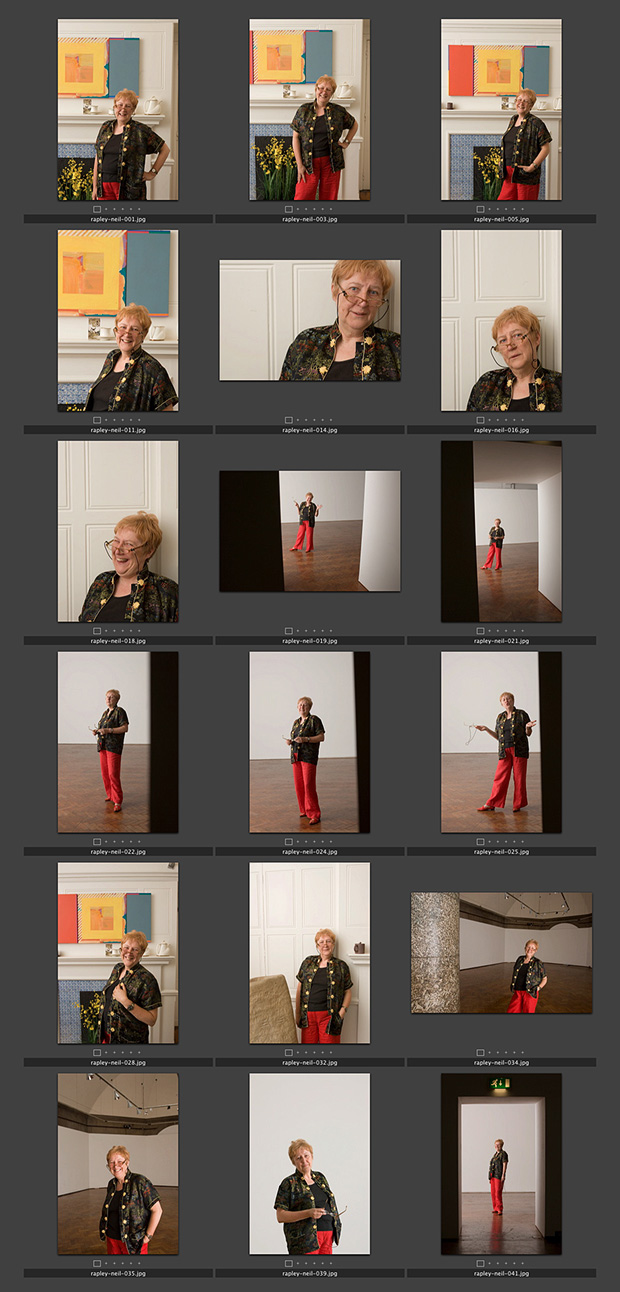
College Principal – the “contact sheet”

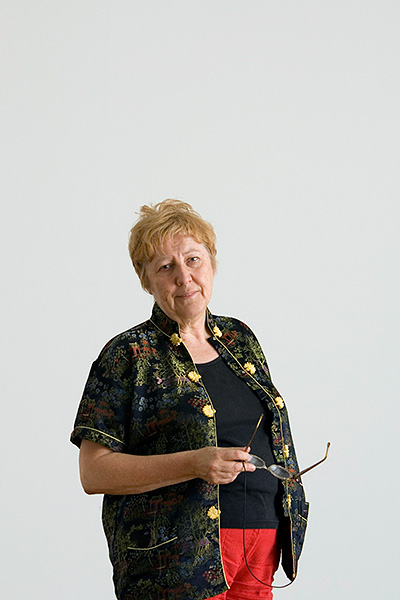
Within two hours of posting a portrait of College Principal Jane Rapley at Central St Martins on this blog, I’d had four emails asking to see the rest of the shoot. I can’t do that but I can share the rest of the edit.

©Neil Turner/TSL. London, July 2006

I’m not going to repeat everything that I wrote on the original blog posting but you can see that the image I selected to feature was very much the “odd one out”. I have always thought that this set represented a good selection of portraits from a single session but looking back five and a half years on I have realised how many uprights there are and how few horizontal compositions. I’d like to think that was because I knew that the newspaper wanted uprights but I’m not sure that’s the case. Anyway, to those of you who wanted to see this selection… I hope that you like them!

College Principal, July 2006, London

©Neil Turner/TSL. July 2006, London.

Jane Rapley was about to take over as the new head of Central St Martins College in London when I shot her portrait in July 2006. After 17 years at the famous arts college in a variety of posts she became the Principal in August 2007. I photographed her in her office and then in one of the galleries that they use for student shows at Central St Martins on Southampton Row in central London.

This particular frame was shot in case the designer wanted to use the portrait full page and run a headline and some text over the image itself. The rest of the shoot was more varied and included some very wide portraits, which seem to have been what I was interested in at that time. It is fascinating that when you look back at your own work on a chronological basis you can definitely see trends and fashions in the way you compose, light and post-produce pictures. This was one of my softer lighting periods!

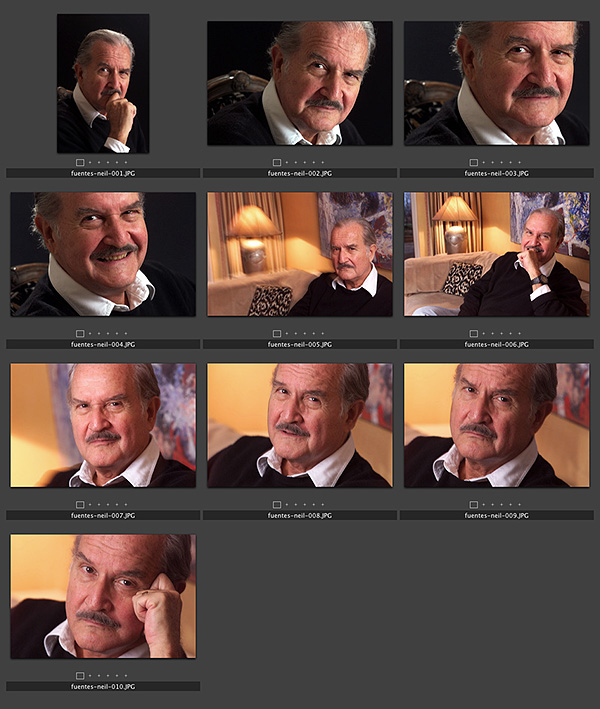
Carlos Fuentes portrait – the “contact sheet”

Going back through an old portfolio I was reminded of a lot of portraits that I used to love. One of them is this session with Mexican author Carlos Fuentes shot at his London home in December 1999. He was both charming and cooperative and his home was easily spacious enough to set up as much gear as I had been able to carry up the stairs.

©Neil Turner/TSL. December 1999. London

He had already been interviewed by a reporter to whom he was obviously a hero and I had spent a while asking her about him and his work. These were the days when the internet was just starting to become useful for background research. The trouble was that this was a last minute assignment and getting on line when you were on the road was a very tricky task. These days we all have smart phones with Google and Wikipedia but back then it was a lot tougher to become an instant expert of your subject. I looked his CV up later and was a bit embarrassed that I had never heard of him. I read a coupe of translations of his books over that Christmas break and I hope that I will never get caught out like that again.

Techie stuff: Kodak/Canon DCS520 cameras with 17-35 f2.8L, 28-70 f2.8L and 70-200 f2.8L lenses. All lit with a Lumedyne Classic series flash and a 70cm shoot through umbrella with the hair light in some frames provided by a Canon 550ex flash unit.