light

The personal frames you shoot…

I have shot thousands of editorial portraits over the last 26 years and every once in a while I shoot a few “personal frames” at the end of a job. What I mean is that there are pictures that I shoot if I have time that I know the client would not publish in a million years and so I am doing them for my own amusement/sanity/experience/curiosity. When you start shooting pictures, everything you do is an adventure. Slowly you learn how to achieve the results that you (and your client) want and it becomes very easy to just take the pictures that you need to take without pushing any boundaries or trying anything new.

Professor Lewis Wolpert. London, March 2004. ©Neil Turner/TSL

I wrote an essay in 2004 about why black and white is so effective and why so many people profess to preferring it to colour for a lot of ‘serious’ pictures. The reason that I have always believed is that good photography is about giving people a view of your subject that they recognise but that, at the same time, is not how they themselves would have see the same scene. There are plenty of ways of achieving this but the one that non-photographers seem to respond to most positively is to show black and white pictures. For about two weeks after writing that for the first time I consciously shot pictures that I could convert to black and white to prove or disprove my theory. I even submitted a few black and white images with my edits to the newspaper I was working for.

The experiment developed a little and I started to try to actually mimic the feel of black and white film and prints. Lots of filters and plug-ins were appearing on the market at the time and I played with as many as I could get my hands on. The experiment ended when I shot this portrait of Professor Lewis Wolpert at the Department of Anatomy, University College London in March 2004. I had spent quite a while using Photoshop’s darkroom style tools to dodge, burn, correct contrast and generally make an otherwise ordinary picture look rather nice. I really liked the picture but I decided that the personal frames idea needed to head off in a different direction and so I stopped shooting with mono in mind for quite a while.

In common with almost all of the work that I was doing at that time, this was shot on a Canon EOS1D with a 70-200 f2.8L lens. It was shot at 640ISO (which for me was the highest you could go on the original EOS1D without getting a lot of noise) at 1/125th of a second at f2.8.
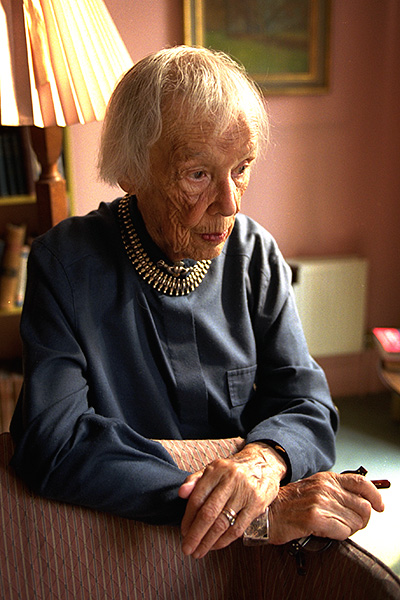
Archive photo: Frances Partridge, London, May 1995

Frances Partridge was the last surviving member of The Bloomsbury set when she died, aged 103 in 2004. She had lived an amazing life full of love and tragedy and had known the brightest and the best people of her generation. She was a writer and a famous diarist. I photographed her when she was a mere 93 in 1995 at her home in London.

©Neil Turner/TSL. London, 10th May 1995

When I arrived she seemed agitated, which I didn’t think was unusual given her age and the fact that she had a stranger in her home but it became obvious that something specific was bothering her. She told me that her only corkscrew had broken and that she hadn’t been able to have a glass of wine. Like all good photographers I had a Swiss Army penknife and so I was able to open her bottle – which cheered her up a little. The thing that really made the rest of the job go very well was that I was able to fix her corkscrew so that she would be able to have he wine the following day too.

Mrs Partridge looked old and she knew it. She had spent most of her life surrounded by artists and writers and had been photographed many, many times. She celebrated her age and was keen that I portray her in my own way. We spent a good deal of time working out where she should be in her flat and the light coming in in early May changed every few minutes. I tried to shoot as little flash as I could – not because she didn’t like it but because somehow I thought that ambient light was more in keeping with the ethos of the Bloomsbury group.

Geek moment… I was using two Canon EOS1n cameras with 28-70 and 70-200 f2.8 lenses and Fuji 800 ISO colour negative film without flash and the frames shot with flash were in Fuji 200 ISO colour negative film. The scans were done with a Kodak auto feed scanner onto a Photo CD.

Possibly the oddest picture I ever took…

©Neil Turner/TSL | London | January 2006

The story was simple: we were doing an anonymous interview with a man who needed to remain unidentifiable for legal reasons and we had to shoot a picture of him at a time and a place that wouldn’t give his identity away. It seemed to be important that it was actually him in the picture and that became obvious when I had to shoot a proper portrait at the same time just in case the court case was decided and we needed a proper picture of him to go with a future follow-up article. Still with me?

The reporter arranged that I meet the subject at a London tube station and to get around the problems of finding someone whose name you don’t know and who you don’t have a picture of I always describe myself and what I’m likely to be carrying and wearing because a) I’m probably going to be there first and b) I’m probably going to be easier to spot (being big and carrying a lot of kit).

The venue turned out to be quite close to where he works and we decided that if any of his colleagues happened to spot us the cover story was that we were doing a fashion vox-pop on what the well-dressed office worker was wearing that season. The cloak and dagger details just kept multiplying.

I decided to go with a silhouette (you can read my thoughts on them here) and just for good measure I added an extra twist with a bit of motion blur too. The result was quite striking if bafflingly anonymous!

The technique is pretty simple. It was a dull winter’s morning in the city and we found a under cover area. I used a Lumedyne flash kit to light the brick pillar and silhouetted the subject against it. Without the flash, he would still have been a shadowy outline but so would the pillar and the picture would have been pointless.

The light that was coming from either side of the pillar was OK but it wasn’t plentiful and so I decided to give it a bit of movement blur by zooming the lens whilst the shutter was open. I ended up with an exposure of 1/8th of a second at f13 on 200 ISO using a Canon EOS1D MkII with a Canon 16-35 f2.8L lens triggering the flash with a pair of Pocket Wizards. Zooming during an exposure as relatively short as 1/8th of a second means that you have to have quite a few attempts to get it right and it also pays to tell the subject what you are doing if you don’t want them to think that you are a lunatic!

In the end I was very happy with this genuinely odd picture. I had arrived at the assignment with almost no idea what I was going to do and pretty much made it up as I went along. That’s why I love my job…

Fun photo: Muscliff or Mogadishu

Out on a walk in semi-rural Dorset… Not the suburbs of Mogadishu.

20120114-114028.jpg

Muscliff, Bournemouth | ©Neil Turner | 14th January 2012

Archive photo: Inner London Education Authority, April 1990

When the Conservative Government finally abolished the Inner London Education Authority (ILEA) which had shared County Hall with the Greater London Council (GLC) Mrs Thatcher could finally look out of the House of Commons and not be reminded of the opposition that her party had faced from across the river. I was sent to shoot a picture of one of the last people still working at ILEA who had done an interview for the Times Educational Supplement about his work wrapping up the affairs of London’s last unitary body (until the Labour government reestablished a London Mayor’s office in May 2000).

I went equipped with a notional headline of “will the last person to leave County Hall please turn out the lights” and I was very pleased when it turned out that the desk where he was working was in a windowless room in the basement of the beautiful if tatty building. I was even more pleased when I had processed my film and had a look at my pictures.

©Neil Turner. September 1990

For the camera geeks: Nikon F3P with 85mm f1.4 Nikkor and Kodak Tri-X film

Archive photo: Conductive education, Sussex, March 1990

Please note that I have made a small correction to the caption. The pictures were taken a year later than I originally thought.

©Neil Turner, March 1990

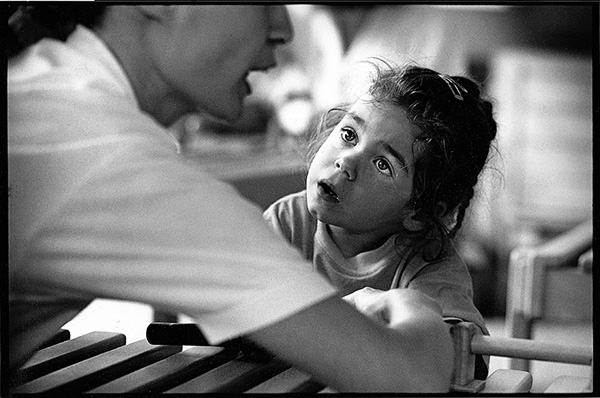
This assignment opened my eyes to a whole world of education. I was fascinated by the ‘special needs’ systems that had grown up in the UK to try to provide a combination of tuition and therapies for children whose families were trying to do the very best for them. On this job I was working with a committed reporter who did her best to bring me up to speed on all of the terminology used in the field and years later I found myself telling younger reporters how things were. To this day, disability remains a topic that I get real satisfaction from showing to the world.

Young child who has cerebral palsy having a physiotherapy session at a residential school in West Sussex under the Conductive Therapy regime. This technique was brought to the UK from Hungary where therapists, known as conductors, use a range of very intensive methods to try to get children who have very badly compromised motor skills to walk unaided.

Judging from the date, I expect that this picture was shot on a Nikon FM2 with a 135mm f2 Nikkor. The film is Kodak Tri-X.

Folio photo #09: Bournemouth grave digger, October 2008

©Neil Turner. October 2008

Dave Miller has been working for the cemetries service in Bournemouth since leaving school. These days he even lives in a house inside one of the local graveyards. Photographed at dusk in Bournemouth’s North Cemetry for The Guardian. They were running a whole series of pictures of people who do slightly unusual jobs and they times this particular feature to run at halloween.

This frame features four separate flash units – one of which is down inside the grave (which was otherwise empty). Dusk is my favourite time of year for shooting pictures and this particular sunset was very colourful. If you’d like to know even more about this picture, go to this technique page

Original dg28.com technique pages

Between January 2000 and June 2008 I posted a large number of technique examples taken from my daily work to show how I used light in an era where digital cameras were pretty poor at ISOs over 800 or even 400 in the case of the venerable Kodak DCS520. These days flash is a creative choice rather than a technical necessity but the techniques still stand up.

One of the technique pages was entitled simply “Why we use lights” and it is an extreme example of just how much difference some judiciously used flash can make. Early Autumn on a Friday evening in the UK isn’t often a time when the best opportunities to shoot great pictures present themselves. This one, was a real exception.

©Neil Turner/TSL

The subject of the portrait runs an educational organisation that serves a coastal area near where I was born. I should know the area like the back of my hand but I don’t and when my subject suggested that we went up on top of the Isle of Portland (not an island at all, just a peninsula!) I thought that it would make a decent enough backdrop but that the view might be obscured by mist. The two pictures below were taken with different lenses but they were taken within a few seconds of each other and show just how much of a difference a bit of flash can make.

Back in 2008 when I “retired” these pages I wrote the following as a background to my philosophy regarding portable location lighting:

A lot of news photographers don’t think that they are allowed enough time to light pictures, so they rely on their hot shoe mounted flash or on moving their subject into the daylight. If your kit is lightweight and well planned, if it’s reliable and quick to assemble then you can light as much of your work as you want to. I tend to specialize in editorial portraiture, so that is the area of work that I’m going to talk about.

When I was writing these pages my basic kit was one Lumedyne 200 joule pack, one Signature head, two regular batteries, one stand, an umbrella, a Chimera softbox and a Pocket Wizard kit – all in one sling bag. Since May 2009 that all changed and the Lumedyne kit was replaced by an Elinchrom Ranger Quadra system. I still like the Lumedynes but the Elinchrom is a few percentage points better! In October 2003 I added an Umbrella Box to my kit in the hope of replacing two light modifiers with one, which has worked in some ways but I have to confess that I go through phases of using each of the light modifiers for a while and then switching.

In the years when I was a staff photographer and posting regular monthly galleries as well as technique and opinion pages my website was getting up to 20,000 unique visitors a month. Numbers have clearly dropped off now that new content hasn’t been added for three and a half years but I’m still amazed by the the fact that in one day last month the technique home page still got 996 unique visitors.

Some day, I am going to write a book – yeah, I know – we all say that… The backbone of that book will be an up-to-date explanation of the theory behind some the 60+ technique samples posted on the original dg28.com. In the meantime, be my guest – follow the link below to the old technique pages and have look around. Be warned: one very well known blogger claims to have lost an entire night’s sleep doing just that.

ORIGINAL DG28 TECHNIQUE PAGES