lighting

Elinchrom Ranger Quadra Update

What do you call it when something that was already very good gets quite a lot better? Well I guess that would be an upgrade. That’s exactly what happened yesterday when I changed to the new Lithium Ion batteries on my Elinchrom Ranger Quadra kit.

New lithium ion on the left and the old lead gel on the right.

New lithium ion on the left and the old lead gel on the right.

From the picture above, you can see that there is an appreciable size difference – which is always handy but there’s no way that I would have swapped them out just because of that – after all, they weren’t exactly huge to start with. There are four real reasons that I swapped:

  1. My old batteries were over four years old and had stopped holding a full charge – especially in the cold weather
  2. Elinchrom claim a higher capacity of up to 320 full-power flashes per charge for the new battery compared to only 150 for the old ones
  3. Faster recycle times. I’m going to have to believe Elinchrom and my own gut feeling here because you cannot compare brand new batteries to four year old ones in any meaningful way but at full power the recycle time appears to have halved to just over 1.5 seconds
  4. They weigh a lot less – 892 grammes less each. The new battery is 784 grammes compared to the old one which was 1,676 grammes. With two batteries in my kit I have saved a massive 1,792 grammes

Less weight, even in a rolling case, has got be a good thing 99% of the time and I am really looking forward to having to carry less. Of course I have always loved using the pack and battery to weight the base of the lighting stand down when working outdoors. I might have to find a few rocks and bricks lying around to supplement the pack more often that I used to but that’s fine by me.

I’ve only managed to shoot two small jobs with them so far and the speed of the recycling is great – even with my four year old Ranger Quadra pack and S heads. Some portraits yesterday afternoon shot indoors and on a lower power setting had the kit recycling in a fraction of a second which made the job go very smoothly indeed.

I have yet to try out the new Quadra Hybrid pack which promises all sorts of extras that I don’t think that I need. Elinchrom offer an upgrade to packs as old as mine to get the brighter display but my purchasing decisions these days are made on a perceived need rather than on wanting the shiniest and newest kit.

I’ve blogged about this Elinchrom kit before. The first time was in May 2009 when I’d only had the kit a short while. 32 months later I blogged again and, in what has become my most popular posting ever, I gave my considered review of the kit. One of the first comments on that posting alerted me to the new batteries being on their way. It’s taken me twelve months to get around to getting the new batteries and having the small modifications done to the S heads and I’m a happy man.

In the “32 months on” review I mentioned a few other things that I’d like to have seen produced to go with this kit. In the last six months I have become less and less pleased with the Skyport remote system that comes with the Ranger Quadra. The original triggers were prone to falling out of the hot shoe and the controls on the mark two version are tough to see in low light. I know that the whole raison d’être of this system is to be small and lightweight but they went too far with the Skyport transmitter – so much so that I’ve gone back to using Pocket Wizard Plus III transceivers a lot of the time at the expense of being able to remotely control the power.

So, Elinchrom – I hope that some senior managers are reading this… if you really want to make my happiness complete, can you please produce a transmitter that works with the EL Skyport receiver built into my Quadra pack that takes AA batteries, is about the size and weight of the Pocket Wizard Plus III unit with a digital display that has all of the functionality of the small Skyport transmitter but that is easy to use in subdued light, doesn’t require a tough-to-find button battery and that stays in the hot shoe properly. Pretty please?

Bouncing balls, hosepipes and shadow puppets.

This is not an attempt to secure higher rankings by filling the title full of potential seedy euphemisms. I came up with the title when I was teaching a flash workshop this morning and I was trying hard to come up with ways of explaining some very basic concepts regarding the best way to think about how best to use light.

We all know what bounce flash is and most of us use it from time to time. It isn’t a difficult concept to explain either but I have always referred to school science lessons (Physics in my case) when explaining the best way to angle a flash to get the optimum effect. That drew a couple of blank stares today and I had to come up with an alternative (and it appears better) way to explain it. I’m convinced that this isn’t an original concept but I came up with the bouncing ball; simply put, if you stand two people three metres apart (or 2.8 metres for anyone who has ever been to one of my seminars) and one of them wants to bounce a ball to the other and have it reach them at the same height it left at then the optimum point for the bounce is 1.5 metres from the thrower or 1.5 metres from the receiver or exactly half way. The same goes with flash; point the flash at a midway point and you will get the greatest amount of light.

Of course that doesn’t tell the whole story… and thats where the hosepipe comes in. It is entirely possible that bouncing the light at the half-way point isn’t desirable because there is a chance that the angle of the reflector on the flash means that some light will actually hit the subject without having been bounced – light from the very edge of the flash. If you imagine a powerful hosepipe and pointing the stream of water at the wall the water will mostly bounce in the same way that a rubber ball might but the spray of the water will fan out in the same way that flash light does. If your object is to soak the subject, you aim the hose directly at them. If you have to bounce it, then you pick the halfway point. If you want to get them wet without the water going where you don’t want it to go then you pick an aiming point which might not provide the greatest amount of water but will allow you the most control. Obviously, the same goes for light. Direct flash might give you f16 and the halfway point bounce might reduce that to f8 but the nicest light might be a couple of f-stops weaker still at f4 but that might not actually matter.

©Neil Turner, October 2010. Bouncing flash off of a warm-toned brick wall.

©Neil Turner, October 2010. Bouncing flash off of a warm-toned brick wall.

Put simply we are talking about the difference between quantity and quality of light. By deliberately avoiding using the most efficient bounce we often end up with a more pleasing light quality. I often bounce off of walls and surfaces six, seven, eight or more metres away and for that you need to make the bounce as efficient as you can but when the wall is only three or four metres away you have many more options. Suddenly efficiency isn’t the main concern and you can often sacrifice some quantity in favour of quality.

One of my favourite ways of teaching bounce flash is to pick very unlikely surfaces such as wood panelling or brick walls and bounce the flash off of those. Of course you often get a colour caste but a good bit of RAW shooting and/or custom white balancing will sort that out pretty quickly. Above is a sample of a picture shot bouncing the flash off of some yellow-coloured medium toned bricks. It was taken at a University a couple of years ago when I was working on a project with some very cool students.

So what about shadow puppets? Well, we were also talking about creative options and casting deliberate shadows in all sorts of shapes and the best way that I could demonstrate was to throw shadow puppet type shapes in front of the digital projector onto the screen. You can make all sorts of cool shapes from card, through venetian blinds, through windows and doors and even through the back of a wooden chair. If you get the light right, you can do some very creative stuff and all with a basic flash unit off camera.

During lighting workshops I talk about a lot of other stuff but I was amused that in one day I came up with three new ways (new to me that is) of explaining techniques and concepts – techniques and concepts that I normally have no problem describing by referring the school science lessons. Maybe they aren’t teaching science in the same ways that people my age remember any more.

Hero portraits

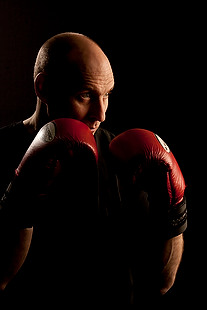
A few months ago I got a call from a designer who wanted me to shoot some pictures at a gym in east London that would be used in many different ways but primarily as huge prints in the window of their high street premises. My instructions were to shoot what he called “hero portraits” of some of the gym staff and of the two owners who are both fitness experts. That was the extent of the advanced briefing.

©Neil Turner. March 2012, London

The designer was there on the day to act as art director and I turned up with plenty of kit: cameras, lighting, backgrounds, clamps, clips, gels and plenty of batteries. The day started with a quick chat, a couple of test shots and then we decided to shoot “black on black on black” – the team were all wearing black gym kit, we made use of the black rubberised floor in the free weights area and I brought in a six foot by four foot matt black folding Lastolite background. We settled on a mixture of strong side and back-light with some very warm gels being used in different ways in each of the four main shots.

Shot one was of one of the owners who uses boxing and boxing training to work with many of his clients and with some of the group classes he teaches. We went for a simple composition with him putting up his guard as if the 24”x36” soft box that was about four feet away from him was his opponent. That gave us the main light and I used a second head with a grid diffuser behind him to accentuate the shape of his shoulders, neck and head. The first few shots featured black boxing gloves but that was just one bit of black too far and so we swapped them for red and the resulting images were very pleasing.

Shot two was his business partner who does fitness classes and we featured her with a large blue medicine ball, three quarter length and slightly less side lighting.

©Neil Turner. London, March 2012

Shot three was of another male instructor who specializes in power training and he suggested that we used a variation on the American Football quarterback starting position. This was the most fun image to shoot because the shapes were instantly graphic and the light was almost instantly correct. The floor featured in this shot for the first time and so I needed to make sure that it didn’t dominate the composition. In the end I made sure that only the smallest area around his feet had any light on it at all and some nearby kit was used to “flag” the area – stopping unwanted light hitting the rubber tiles.

The fourth and final of the hero portraits was about physiotherapy and for that we had a client sitting on one large blue ball using a blue soft tube across his shoulders to stretch and twist. Four very large prints now feature in the window of the gym. Heroic!

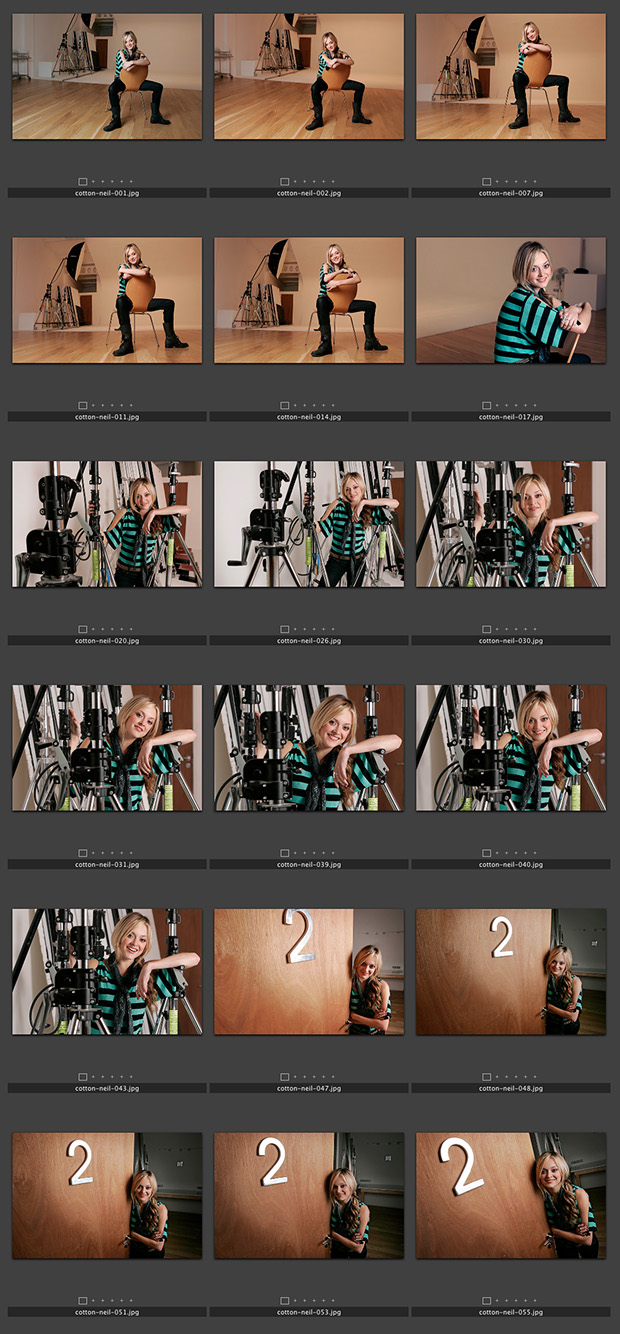
Fearne Cotton – The contact sheet, October 2004.

Back in 2004 Fearne Cotton was enjoying a very rapid rise in her profile and her career was really taking off. The TES Magazine had done an interview with her for their “My Best Teacher” feature and I was sent to a studio in west London to shoot a portrait to go with it.

©Neil Turner/TSL. October 2004, London.

It turned out that it was a hire studio where she had been shot for a BBC magazine earlier in the day and they were (rightly) less than happy about another photographer coming in and piggy-backing onto another shoot. In the end we reached a deal where I shot using all of my own lights in the main studio and in the dressing room as long as I was in and out in twenty-five minutes. I think that the shoot in the studio was over in less than ten minutes and the whole job was completed in fifteen. Fearne had had a long day and the weather outside was dreadful. Neither of us wanted to prolong the job and, even at an early age, she was such a good professional that it was a very successful shoot.

These portraits were shot using a Canon EOS1D camera with 16-35 f2.8L, 24-70 f2.8L and 70-200 f2.8L lenses and lit using a single Lumedyne Signature series flash kit with a 24×32 inch Chimera soft box. The job was shot in the days when I was happy to shoot JPEGs straight out of the camera.

Elinchrom Ranger Quadra – 32 months on…

Most of the camera equipment reviews that you read are written after using the kit for a few days – or even a few minutes in extreme cases. I know. I’ve done several two or three day reviews myself. I was looking at my kit the other day and thought that it would be very useful to write a few lines about my Elinchrom Ranger Quadra system which I have been using for very nearly three years and which has been used on hundreds of assignments.

Build Quality:

When I wrote my first “mini-review” about the system in June 2009 I had only been using it for a couple of weeks but, after years of using the similarly specified Lumedyne Signature and Classic outfits, I can safely say that the Elinchrom fitted straight into my way of working very quickly. Back then I decided to talk about build quality first:

MAY 2009: The first point is to re-emphasise just how small and light this kit is compared to most other portable flash equipment – even Canon and Nikon Speedlights with external battery packs aren’t that much bigger or heavier.

The second point is that being small and light doesn’t appear to make this gear any less robust or well made than anything else. As a long time user of Lumedyne kit I can vouch that the combined weight of a Lumedyne Signature pack and head is almost identical to the Elinchrom Ranger Quadra. The Elinchrom pack, however, seems infinitely more robust with it’s rubberised edges and properly weather resistant control panel whilst the head is both simple and tiny. Connecting the two is a sensible and nicely made piece of cable with easy to use fittings. I have just been and tried the “heavy winter gloves test” and can report that it is very easy to attach and detach the cable with them on.

At this point I had better introduce a small criticism, lest anyone think that I’m doing a PR puff for the manufacturers. I like to attach my packs to the stand to give a bit more stability in the wind and the Lumedyne packs had very functional ‘D’ rings at either end that allowed you to attach a strap and anchor the pack to the stand. The Elinchrom Ranger Quadra pack has well made but small eyelets through which you have to slot either a large split ring or the small karabiner type ring that was supplied with my kit. Neither is a good solution and I will be on the lookout for a better way of attaching a small strap.

Whilst I’m doing the criticism thing, I have an admission to make: I wasn’t all that keen on the battery catches when I first got the kit. I found them to be stiff and not easy to use. Something has happened and I’m now completely fine with them. Maybe they have loosened off a touch or I have just worked out my technique. Probably a bit of both, but the end result is that the batteries come on and off nicely now and I withdraw my earlier criticism.

Now in 2012, to be completely honest, my opinion has barely changed. The battery clips have eased a little more and the ‘D’ rings still bug me. The screw caps that cover the two power lead sockets have survived all this time and still work very well and are still attached. I know that Elinchrom have made a few design changes since I got my kit but these three things have not changed at all.

The size and weight of the heads was flagged up as a potential issue by a couple of early reviewers but I can honestly say that 32 months on I have not had any problems other than a bad drop of a head which buckled the small ‘spill-kill’ reflector to the extent that I had to replace the reflector. No damage to the head, the flash tube or the modelling light. I had early reservations about the strength of the stand adapter on the heads and for a while I chose to remove the swivel completely and replace it with a brass stud which then fitted into a Manfrotto Light-Tite. In the end, my worries abated and I went back to the original tilt mechanism.

Not long after buying the kit I experimented with ways of attaching a soft box without buying the Elinchrom adapter. You can see my best attempt in the picture to the left. It was a complete fluke that the spill-kill reflector wedged directly into a blank Photoflex Speed Ring and I still use this IF I need two soft boxes on a single shoot. In the end I gave in and bought it and I now feel rather silly that I didn’t do it straight away. The adapter is a decent option and it works very well with my Elinchrom and Chimera soft boxes.

Thirty-two months down the line and the kit still looks great and works like new. I have looked after it, kept it in decent bags and cases and always put it away properly. The few times that I have used it in the rain, I have used plastic covers made from heavy duty PVC and freezer bags to keep the rain off. There are a few bits of paint missing on the pack and the batteries. The one exception, and the main reason that I chose to write this now, is that the two batteries are starting to lose power. I have no idea how many charge cycles they have been through but it is a large enough number for me to start to think about replacing them. Three years is a good life for this kind of batteries and I’m not going to hold any loss of capacity after that time against Elinchrom. The cables are tough and well made and all of mine are still OK.

In Use:

After a few months I fed some thoughts back to Elinchrom via the folks at The Flash Centre in London and those were:

  1. that the digital display was hard to see in bright light
  2. that lining up the power leads with the sockets was difficult in low light
  3. that the Skyport triggers needed a locking ring so that they didn’t keep popping out of the camera’s hot shoe.

I wasn’t the only person making these suggestions and in an upgrade they fixed the display issue and the Skyport trigger issue as well. But what else did I think back 32 months ago?

MAY 2009: That’s the construction out of the way. What about actually using them? I have read through the manuals for the head, pack and Skyport remote trigger system and it is all pretty logical. If you buy this kit, I would strongly recommend that you go through a few practice sessions before going live because some bits of the menu system are not too obvious without the book. Changing stuff like the duration of the beep that signifies that the pack has recharged or whether the readout is in f-stops or watt/seconds isn’t too much of a problem but switching Skyport channels for the first time isn’t all that easy. Getting the hang of how the asymmetrical flash output works with two heads attached to one pack isn’t something is obvious either.

The manual is well written and it doesn’t take long to master these functions once you know what goes where and which button to press first. It isn’t second nature yet, but that will come soon. Much excitement has been generated by the LED modeling light and the idea that it can double as a video light. I have a pair of Canon EOS5D MkII bodies and am starting to shoot some video with them. The amount of fill light that these LEDs put out is very useful and I would argue that they give the Elinchrom a really strong market advantage over other systems. The real joy of this system is the light that it puts out.

The light quality is great in every measurable way. Every flash at a given setting gives out an identical amount of light and the colour of the light doesn’t change when you dial the power up or down. The colour temperature of the tubes seems to be about 5300K and so I have set up a custom balance on my cameras for that. The only light modifier that I’ve used with it so far has been an Elinchrom 40″ (100 cm) shoot through umbrella and my gut feeling is that I will use this combination a lot over the next few weeks. The maximum power output is 400 w/s and for my money that figure is accurate. More importantly, it seems to be more than 1 f-stop more powerful than my old Lumedyne 200 w/s outfits. There could be any number of reasons for this but the outcome remains that I have more power at my disposal than I had before. Having the audible charge indicator is great and being able to turn it off is also a bonus. I have already made use of that function on more than occasion. The recycle time is a little slower than the Lumedyne 200 w/s kit and I found on the first couple of shoots that this was a possible issue. It has gone away now and I am getting used to the extra half second delay – especially when using the audible indicator.

The final point that I wanted to make was about the Skyport system. The pack has a Skyport receiver built-in as well as a synch socket (3.5 jack) and an optical slave. My kit came with a single skyport trigger and I have bought a second one along with a receiver that will work with either a Canon speedlight or one of my old Vivitar 285s. The system seems to work very well and I am not missing my Pocket Wizards enough to get them out of the boot and connect them up. My only criticism of the Skyports is that the transmitters don’t lock into your hot shoe and can be knocked out relatively easily. I’d like to see a transmitter with a lever style lock on the market from Elinchrom so that the system is foolproof rather than just very good.

In practice, 400 watt/seconds is quite a lot of power. Whether it is enough for every eventuality is debatable but in 32 months I have only found it wanting (by a stop or two at most) on two occasions and even then I made it work. Most of my work is portraiture and most of that is lit with this system and I have a real confidence in the kit that makes doing my job a lot easier.

If I were designing this system from scratch I would probably have not bothered with the complete miniaturisation of the heads. I think that I would have gone for a larger head with the standard Elinchrom bayonet fit and a stronger tilt mechanism. Of course that is based entirely on the way that I work and what I use the kit for. I have got used to the tiny heads and, for me, it would make sense for Elinchrom to bring out a version of the head built into the larger Ranger housing as well as this small version. That would eliminate any issues with adaptors as well as maximum umbrella size. It would also remove the need to only use Elinchrom’s own narrower shafted umbrellas.

The newer version of the Skyport trigger solved one problem and introduced a different one. It now stays in the shoe nicely but the words are now moulded in instead of being painted on which makes actually changing some settings quite tricky in low light. I’d also prefer a slightly larger version of the trigger with easier to change channels, a battery level indicator, AA or AAA batteries and at least 50% more range.

In my 2009 review I was confident that I would learn all of the functions and not need to bring the manual with me. I was WRONG. I have never completely mastered the menu system and I have a paper version of the instructions in the case as well as a PDF version on my iPhone. I don’t need to consult it often but when I want to do something in the menu it is helpful to have the manual there with me.

Conclusions:

In May 2009 I was “a happy bunny”. Not much has changed there. Actually, nothing has changed there.

I have some minor niggles but I still love using the Elinchrom Ranger Quadra and I would still advise any photographer in the market for a portable battery powered system to strongly consider it. In value for money terms, it is hard to beat. In light quality terms it is excellent and it passes the most important test of all – it is portable enough to actually take with you, even if you are a photographer working alone and a long way from the car.

If the folks at Elinca came to me with their notebooks and asked me to advise them where to take this system next, I’d be very happy to talk to them. This is a 9/10 product for the kind of work that I do. I have even used my own kit a dozen times when teaching location lighting courses with groups of six to eight people and nobody has managed to break it. I’m glad that the version two pack is better than my nearly three year old one which makes it even easier for me to recommend. There are half a dozen accessories that I would find useful – ranging from an adapter to be able to use a Canon or Nikon Speedlight with the Elinchrom bayonet mount accessories to a properly fitted rain jacket for the pack and a mains AC battery eliminator for when I am using the kit indoors for long periods.

BMX Rider: Contact Sheet

©Neil Turner. Ringwood, Hampshire. 2011

©Neil Turner. Ringwood, Hampshire. 2011

This was a set of pictures shot on location as part of a “how to do it” technique piece for Photography Monthly magazine. The idea was simple – use flash to make something very cool from some sort of active sport. I was put in contact with the tier, Keegan Walker, through a young photographer that assists me from time to time on commercial shoots and we arranged to shoot at the skatepark near where they both live which is about ten miles from my own home.

I used a couple of Canon EOS5D MkII cameras with 16-35 f2.8L, 24-70 f2.8L and 70-200 f2.8L IS lenses as well as the excellent Elinchrom Ranger Quadra flash system supplemented by a couple of Canon 580exII Speedlights with Elinchrom Skyport receivers triggering them. There were plenty of clamps, gels and light modifiers in use too – including my rather lovely modified beauty dish and the equally great Chimera 24″ x 32″ soft box.

The sky at dusk is my favourite backdrop for all kinds of shoots and the May evening sky provided us with something special to work with. Keegan is pretty good at what he does and I had to ask him several times to actually get less height from the ramps so that my pictures looked better! Two hours on a nice evening messing around and shooting pictures is a pretty good way to make a living. The unfortunate part of this particular commission was that I had to write the words that described exactly what I had done and how I had done it. One day I will get around to reproducing the whole piece for you.

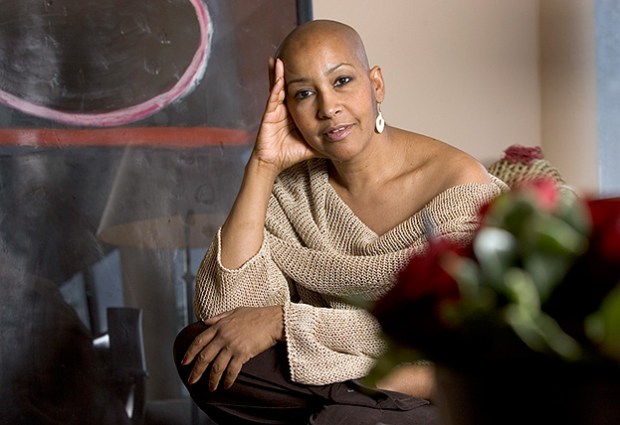
Portrait: Marsha Hunt, London, 2005

©Neil Turner/TSL, October 2005. London

Marsha Hunt is an actress, writer and model who shot to fame in 1969 when she was appearing in the musical “Hair”. She has a child with Mick Jagger and was famously photographed naked by Lord Lichfield. In the early part of the new century she had breast cancer and had a mastectomy. Her treatment became a documentary and she was photographed once more by Lord Lichfield. This set of pictures were taken for a feature in the TES Friday Magazine about her life and her memories of her own education at the London home of a close friend of hers.

This portrait was a lesson in letting the subject run the show. Marsha was lovely, as was our host. They were very old friends and chatted most of the way through the session. The wonderful thing was that she knew exactly when and how to look at me and at the camera. Models are good at this and actors, for my money, are better. It would seem that when someone has been successful as both an actor and a model they are better still. Some people are ultimately very comfortable in front of the camera and Marsha Hunt is in the top few percent of them. The shoot lasted a lot longer than it needed to – we chatted about all sorts of things and drank some rather good coffee too. It was a good day.

Geek stuff: In common with just about every other picture shot by me at the time, I was using a pair of Canon EOS1D MkII cameras with 16-35 f2.8L, 24-70 f2.8L and 70-200 f2.8L IS lenses. The lighting was Lumedyne Signature series packs and heads mixed with a fair amount of ambient light.

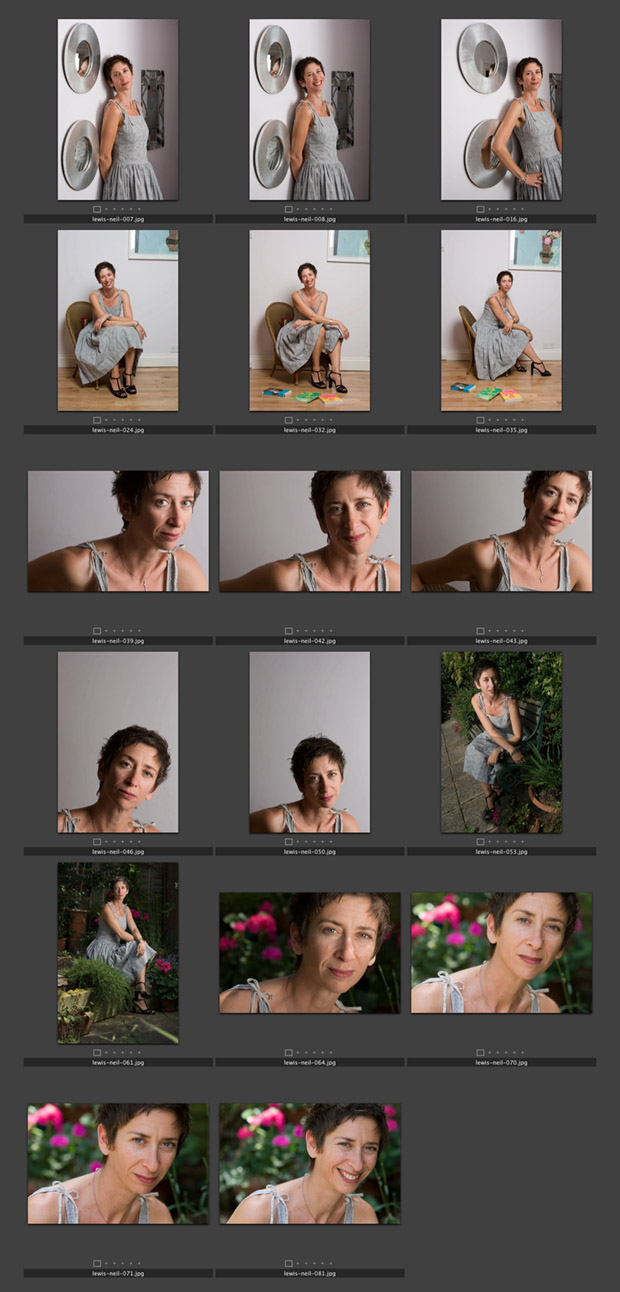
Reina Lewis – The contact sheet, June 2006

One of my favourite sets of portraits that I ever made was of a lady by the name of Reina Lewis who had just been appointed to a new post at The London College of Fashion to become Professor of Cultural Studies. The pictures were shot at her home and I could see when I got there that she was definitely aware of how important some good pictures in the right newspaper could be. We shot a range of images from some tight head and shoulders against a plain wall to some full-length sitting ones in one of the elegant chairs that she had.

©Neil Turner/TSL. London, June 2006.

All of the pictures that you see here are entirely uncropped. They were shot on a pair of Canon EOS1D MkII cameras with 24-70 f2.8L and 70-200 f2.8L lenses and lit using a single Lumedyne Signature series flash kit with a 24×32 inch Chimera soft box. The Canon CR2 RAW files were converted using Adobe Camera RAW in Adobe Photoshop CS3.