Out on a walk in semi-rural Dorset… Not the suburbs of Mogadishu.

Muscliff, Bournemouth | ©Neil Turner | 14th January 2012
Out on a walk in semi-rural Dorset… Not the suburbs of Mogadishu.
Muscliff, Bournemouth | ©Neil Turner | 14th January 2012
One of the great joys of being a photographer is the wonderful array of gear, technology and toys we get to use on a daily basis. It is also one of the curses of being in business. If I went out and bought every new camera, every new lens, every new application and every new computer that I fancied I would have no home, no car and no life.
 That doesn’t stop me looking. The CES show in the USA has thrown up lots of new “I want one of those” moments and a quick calculation says that I would make a £20,000 hole in my finances if I went and bought it all. The serious point here is that for many photography is a hobby and buying new gear is a matter of “I want it, I’m going to have it”. For professional photographers there is a simpler test which asks “will that piece of kit pay for itself, pay my bills and work how it’s supposed to work?”
I’ve said many times that a lot of my clearest thinking comes from teaching and I’m currently updating my notes for teaching some business studies to my NCTJ Photojournalism group at Up To Speed Media in Bournemouth. In many ways the formula is simple: A. you need to take the cost of purchasing the item, insuring and servicing it and divide that by B. the number of days you work in an average year. Dividing A by B gives you C. To get the final figure D. You decide how many years the item might remain useful (longer for lenses, less time for camera bodies, computers and software). Finally, you divide C by D and that figure is the cost of that piece of kit per working day.
An example: Telephoto zoom lens
The final figure for owning that particular lens is £3.09 per working day IF you shoot for 468 days over three years. The cost goes down if you work more and it goes up if you work less. Of course one lens isn’t much use without the rest of the kit and so you can go through your whole stash of gear and do the same calculation for each. I tend to go for 2 years for camera bodies and computers, 3 years for heavy use lenses, 5 years for light use lenses and only 1 year for software including upgrades.
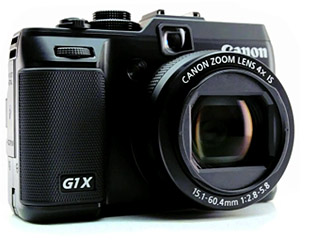
How depressing was that? Let’s end on a lighter note: objects of desire… well… the Canon G1X looks very, very cool, as does the limited edition all black Fujifilm X100. Of course the Canon EOS1DX has to go on the list and I’d love to give the Nikon D4 (and a kit of lenses) a spin. The list is actually a lot longer but nobody reads this far down… do they?
When the Conservative Government finally abolished the Inner London Education Authority (ILEA) which had shared County Hall with the Greater London Council (GLC) Mrs Thatcher could finally look out of the House of Commons and not be reminded of the opposition that her party had faced from across the river. I was sent to shoot a picture of one of the last people still working at ILEA who had done an interview for the Times Educational Supplement about his work wrapping up the affairs of London’s last unitary body (until the Labour government reestablished a London Mayor’s office in May 2000).
I went equipped with a notional headline of “will the last person to leave County Hall please turn out the lights” and I was very pleased when it turned out that the desk where he was working was in a windowless room in the basement of the beautiful if tatty building. I was even more pleased when I had processed my film and had a look at my pictures.

©Neil Turner. September 1990
For the camera geeks: Nikon F3P with 85mm f1.4 Nikkor and Kodak Tri-X film
Yesterday and today have been largely spent doing accounts. Three months worth of VAT return and my tax return for 2010/2011 (year 3 as a freelance this time around). I feel pretty confident that I have got the numbers right thanks to a combination of decent invoicing software (Billings), some easy to use spreadsheets (Numbers) and a very nice calculator that was a free gift from Canon a few years ago (thanks Canon UK). All of this software and hardware is great but the one piece of advice that I would give to anyone starting out as a freelancer here in the United Kingdom is to book yourself onto as many of the free workshops and seminars that Her Majesty’s Revenue and Customs lay on as you can.
When I was having a month off between leaving my staff job and starting out as a freelancer I managed to get myself onto three of these very handy courses. The first was led by a former Tax Inspector and the theme of the seminar could have been subtitled “how to avoid getting a visit from one of my former colleagues”. The other people on the course were a couple of cab drivers, eBay traders, a golf teacher, a musician and a freelance administrator. Put simply, it was a half day course on the basics of being self-employed:
 What records to keep
A very useful day and at the end of it we were given the business card of the HMRC seminar leader so that we could ask him follow-up questions.
The second course was all about VAT and VAT registration. If you aren’t from the EU and you are wondering what VAT is, well it is Value Added Tax – similar to US sales tax I guess. The seminar leader on this one went through the advantages and disadvantages of registering voluntarily for people whose business turnover is below the limit at which you have to become registered as well as the various different schemes for calculating how much you have to pay the Government four times a year. There were people on the course who had no intention of registering unless that were forced to but the course is still useful because we all pay VAT on everything we buy and knowing how the system works is a big advantage.
The final course that I did was about how to fill in your annual tax return. These forms are legendarily complex and half a day spent with an expert gives you a fair amount of confidence that you can do it. Of course the other angle is that knowing about the form makes it easier to deal with an accountant if you use one. Again, the various options are covered and I left that course wanting to use the on-line systems for everything I do with HMRC.
You can get a couple of the course handouts here and you can book courses at your local tax centre on the telephone. Three half-days doesn’t make you a bookkeeper or an accountant but what they do provide is a sound basic grounding from which it is a lot easier to move forward. The vast majority of photographers that I know are, or have been, self-employed and almost all of them would have benefited from doing these seminars.
Working as a photographer you often shoot pictures of people before they become famous and then get to shoot them again once they have “made it”. I don’t know if you can really categorise a poet as ‘famous’ but the British Poet Laureate is about as famous as you can get for poetry. In 2008 and towards the end of his term as Laureate, I photographed Andrew Motion at his London home but this wasn’t my first “one-to-one” with him. Back in 1992 when he was already established as a poet, and just ahead of the publication of his biography of Phillip Larkin, I had taken pictures of him at a different London home.

©Neil Turner/Insight | London | 14th September 1992
A lot of people are a lot more accommodating and easier to photograph before they become famous. They are often friendlier, more likely to offer you a cup of tea and are generally easier to work with. That wasn’t the case with Mr Motion. Back in 1992 I had caught him on a bad day – or at least a day when he had far more pressing matters to attend to than getting his picture taken whereas fifteen and a half years later he was well used to being photographed and had developed an easy manner when dealing with people like me. It could be that I was also fifteen and a half years older and more able to handle myself but whatever the reasons, shooting him in 2008 was a lot easier.

©Neil Turner/TSL | London | 28th March 2008
Of course the technology had moved on: in 1992 I was shooting with Nikon F4S cameras and some lumpy f2.8 Nikkor zoom lenses (35-70 f2.8 and 80-200 f2.8) on black and white film. By 2008 I was onto Canon EOS1D MkII and 20D cameras with some lovely L series Canon lenses and shooting digitally. The quality difference is also very noticeable and I wouldn’t want to shoot film on a job like this again.
On the day that I got my very first mobile phone I was sent to photograph a student anti-loans demonstration in London. Nobody was expecting anything other than a march by angry students on a very grey day in London. Part of the way through the march there was a large break away group that decided to head for Parliament – which was not on the agreed route. By the time they had broken away and reached the west side of Westminster Bridge the Metropolitan Police already had a cordon across with vans, horses and a large number of officers. Scuffles, charges and fights ensued but the police line held and the students never made it to Parliament – less than 200 metres away.
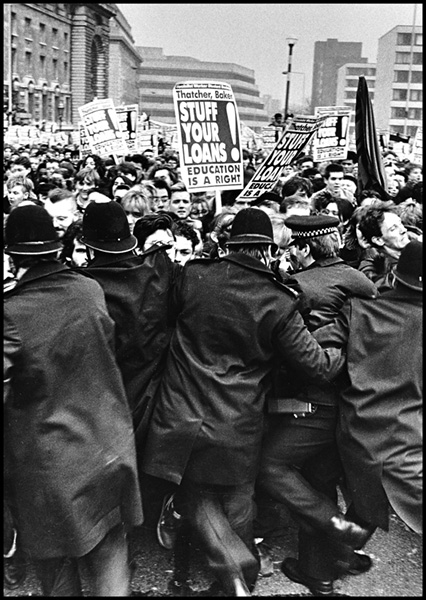
Photo: © Neil Turner | 24 November 1988
Contrast this photo with the student riots of 2011: the police are wearing no special clothing, no high visibility jackets, no shields and there was no overt photographing or filming of the students either. No buildings were ransacked, damaged or invaded and the whole thing felt relatively civilised. It did feel weird to be able to talk to reporters, other photographers and even the picture desk on the phone in the middle of a mini-riot: my phone was a Motorola 8000s which was known as the “City Brick” because it was so big and bulky.
Unfortunately, the story doesn’t have a happy ending (apart from two front pages and a ‘congratulations’ from the editor). A few years before, I had broken a toe playing cricket and during the demo I had the same toe re-broken when a police horse moved backwards and trapped me between it and a van, crushing my toe. As a freelance, I couldn’t afford any time off so I limped from job to job over the following three or four weeks to Christmas. I also had a lens damaged and wasn’t properly insured so my old 35mm f2.8 Nikkor was replaced with a newer 35mm f2.
The camera and lens combo here was a Nikon FM with a 35mm f2.8 Nikkor using Kodak Tri-X film.

Sir Paul Stephenson at New Scotland Yard. ©Neil Turner, February 2009
This portrait was made when Sir Paul Stephenson had been in post as the Commissioner of The Metropolitan Police for less than two hours. He had been acting Commissioner but this was taken when he was actually given the job. This frame was right at the end of the session where I had already shot quite a wide variety of pictures in the time allotted. Having packed 90% of my gear away I was told that I still had a couple of minutes and so I did this picture with a press officer holding a Canon Speedlite off to my left with the head zoomed in to create this pool of light effect. Sir Paul has now left the post but this picture is staying in my folio. Shot using a Canon EOS5D MkII with a Canon 24-70 f2.8L lens and a single 580exII flash triggered by a Canon ST-E2 transmitter.
Every software package has its fans, its designers and its detractors. If we all loved the same system then there would be no choice. I wanted to blog about Photo Mechanic and to say how much I like it. That isn’t to say that the others are rubbish – that would childish and purile – just that I find this one application suits me and what I do extremely well. So what is Photo Mechanic? I thought that the description on the company’s own website was hard to beat:
Photo Mechanic is a standalone image browser and workflow accelerator that lets you view your digital photos with convenience and speed. Photo Mechanic displays your “thumbnails” in a familiar “contact sheet” display window. Photo Mechanic helps you find the best photo amongst several similar shots in a preview display that lets you flip through a group of selected photos at high resolution.
Photo Mechanic’s super fast browsing enables you to quickly compare multiple images and select the best ones from a sequence. Its powerful batch processing, full support for image variables, IPTC and Exif metadata, make it the perfect tool for any digital photographer.
Before this becomes an advert and a love-in, there are a few tiny issues with the current (4.6.8) version that I’d love to get sorted. The trouble is that we quickly revert to the “love-in” because the team at Camerabits who design, code and sell Photo Mechanic are second-to-none when it comes to listening to the views, issues and suggestions of their customers. Got a problem? Email Camerabits and nine times out of ten they sort it the same day and the other one out of ten times sees a resolution in the next upgrade.

Screen grab of a Photo Mechanic "contact sheet" window.
Anyway, what do I use it for? Photo Mechanic is the package that I use to import RAW images from my memory cards, edit out the bad pictures, IPTC caption, batch rename, edit again and then send the selected RAW files to my RAW converter of choice (which happens to be ACR in Photoshop CS5.5 but that isn’t important right now). Once the files are converted there they are right back in Photo Mechanic where I can save them to a separate folder, create HTML web galleries, burn discs, FTP or email images to clients or pretty much whatever I might need to do with photographs.
I can hear people saying that there are plenty of packages that can do all or some of the above and even ones that remove the need for a separate RAW converter – all true, but that misses the point. I want my workflow to be fast, repeatable, adaptable and generally hassle free. I want to rely on the trackpad or the mouse as little as possible and have a good, strong set of keyboard shortcuts instead. Bingo – that’s what I get from Photo Mechanic.
In an earlier post I talked about how teaching helps you to get your own practice right and this is very true with using software. If I had to work without Photo Mechanic tomorrow I have a good knowledge of Apple’s Aperture and a very good knowledge of Lightroom and I would never try to dissuade anyone from using those packages. Having had to buy and learn other software has made me appreciate what I have.
The Camerabits website says that version 5 of the software is due in the early part of 2012 and that there will be a separate but interconnected cataloguing application available too. That’s two things from my wish list sorted out – all we need now is a version of Photo Mechanic for the Apple iOS and that would be another thing ticked off that list.
 Neil Turner Photographer