pearls

The best lens for portraits?

On a photographers’ forum last week there was a lot of discussion about the best lens for portraits. Can of worms opened. Mac vs PC or Nikon vs Canon style debate well and truly started.

I have written before about portrait lenses and I won’t bore you with repeating my previous post (if you missed it, catch up here) except to say that when people ask this question they normally mean headshots or mug shots where the subjects head and shoulders will fill most of the frame.

©Neil Turner, February 2012. Bournemouth.

This portrait of a local artist was shot using an 85mm f1.8 Canon lens wide open but what lens should you use for this kind of picture. The debate will rage and answers anywhere between 85mm and 135mm (all measured on full-frame cameras) will be given, supported, doubted and even ridiculed. Most arguments that don’t get broad agreement also don’t have a simple answer. Sure there’s something lovely about the feel of a portrait shot on an 85 but what about the degree to which you have to invade the subject’s ‘personal space’ to get the composition? What about those 85mm lenses where the close focus isn’t good enough to get that bit tighter still? With a 135mm lens the personal space issues largely go away and the close focus issues almost always go away too – but is the effect as nice? Can you ever include something of the environment in those pictures? Would you even want to?

The actual answer (as always) is that it depends on you, your technique and your own taste in pictures. A few weeks ago I was looking back at some corporate headshots that I had shot and I had to tell another photographer on the other side of the world how I had shot them so that he could replicate them so that when his pictures and my pictures were printed on the same page nobody (hopefully) could tell that two photographers were involved. One of the things I needed to give him was the focal length of the lens used so I got the pictures, went through the EXIF data and noted it all down. I had used a 70-200 f2.8L lens and so the actual focal length was between 120mm and 130mm.

I was a little surprised that it was that long and so I grabbed a folder of images that I keep on my hard drive of corporate portraits to show prospective clients some examples of what I have done in the past and looked through the EXIF on those. These were pictures that, by definition, I really like and it quickly transpired that the tighter compositions were all shot between 120mm and 150mm on the 70-200. Again, quite a surprise – I had always seen myself as an 85mm lens user!

Well, one thing led to another and I decided to do a quick ‘audit’ of all of my favourite environmental portraits to see what lenses I have favoured. This was less of a shock because in the folder of 120 of my favourites the widest lens used was 16mm (on a 1.3x crop body, so we’ll call that 21mm for the purposes of this exercise) and the longest was a 300mm (on a 1.6x crop body which becomes 480mm in this context). There was a lot of bunching in the 35-45mm area and some more around the 120-150 area but the spread of focal lengths was otherwise pretty even – which pleased me greatly because it confirmed what I always say to others;

“There is no such thing as THE perfect portrait lens”.

This exercise is a bit time-consuming but it could have a lot of uses in professional photography. For example, anyone used to zooms wanting to buy a couple of prime lenses should think about going through the exercise to help them decide which ones would suit their style. Anyone wanting to know what lenses to replace as a matter of priority in these cash-strapped times could also benefit from a focal length analysis. The reverse is also true – a photographer who wants to change the way they do stuff could see what they normally shoot with and deliberately avoid those focal lengths. The possibilities are endless once you start to think and we can all do with a bit of style analysis from time to time. How we choose and use lenses has always been a preoccupation of mine and this exercise has helped me to rationalise that.

Indeed why stop there? EXIF data is amazingly useful and so you could also do an aperture comparison. My quick one revealed that I shoot a surprisingly large amount of pictures using three apertures f2.8, f8 and f22. In my sample, those three apertures accounted for over 50% of my pictures. I’m not sure what to make of it but I will work it out one day.

©Neil Turner/TSL. January 2008, London. 173mm focal length on a 1.3x crop body = 225mm

What started out as a simple answer to a simple question somehow turned into statistical analysis. Many people would say that is the exact opposite (they might even use the word antithesis) of what we, as creative people, should be doing. I have a lot of sympathy for that argument but, in a world where there are tens of thousands of great photographers vying for work, every little advantage we can eek out for ourselves and every piece of information that we have to work with could just be worth it’s weight in fluorite glass.
Get yourself some defaults

©Neil Turner/TSL. London, May 2005.

Surprise, surprise – yet another blog post in response to a question! I was asked “what one single piece of advice could I give to someone who had already read the previous “one piece of advice” blog post on here?”

That’s a really cheeky and rather good question and, having shot myself in both feet by saying that I was a sucker for people who used please and thank you I felt duty bound to answer.

In three words I’d say “default staring point”. What’s that? you ask… “Good question” I respond. It is the notion that every time you go to do something you have two choices: you can mess about working out where to start and what to do first OR you can go to your default starting point and get stuck in straight away.

In photography this takes a wide variety of forms. For example, when I’m shooting a lot portrait my default position for placing a light is parallel to my subject’s torso – imaging that their chest is one line and the front of my light source is another, those two line would be parallel. Another example is “what gear shall I use today” the answer (if you are lucky enough to have sufficient kit that you need to choose) is my default kit: two 5D MkII bodies with 24-70 and 70-200 f2.8L lenses and a couple of 580exII flashes in the bag with a 16-35 “just in case”.

Every part of the job has a default setting. From the preferences locked into Photo Mechanic and Adobe Camera RAW to leaving my cameras on daylight white balance and 200 ISO. Default starting positions. I know that if I start there I can move away as soon as my imagination starts to flow and as soon as I start to get a feel for the situation. Sometimes the defaults get changed with seconds but it is amazing how often they stay a lot longer.

One photographer I explained this concept to a few years ago compared it to putting his left sock on first, followed by his right sock and then his trousers. No real reason why, it just means that you can concentrate on the interesting stuff safe in the knowledge that you have the basics covered.

When you really start to think about it we all have defaults in every area of our lives. Toothpaste onto wet brush, small amount of cold water onto that and away I go. Why would I do it any other way? Off to shoot a portrait, tightish head shots on a long lens first to avoid spooking the subject and then gradually get closer and wider. It makes sense to me and that’s my default.

I could go on with the list but I’m guessing that you have the idea by now. A default starting position for everything just helps you to organise your thoughts and get stuff done. Good advice?

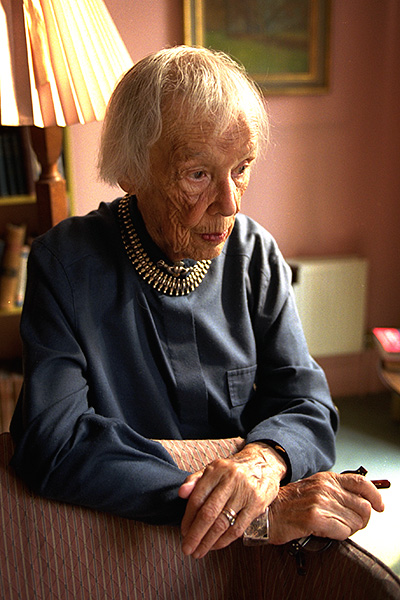
Archive photo: Frances Partridge, London, May 1995

Frances Partridge was the last surviving member of The Bloomsbury set when she died, aged 103 in 2004. She had lived an amazing life full of love and tragedy and had known the brightest and the best people of her generation. She was a writer and a famous diarist. I photographed her when she was a mere 93 in 1995 at her home in London.

©Neil Turner/TSL. London, 10th May 1995

When I arrived she seemed agitated, which I didn’t think was unusual given her age and the fact that she had a stranger in her home but it became obvious that something specific was bothering her. She told me that her only corkscrew had broken and that she hadn’t been able to have a glass of wine. Like all good photographers I had a Swiss Army penknife and so I was able to open her bottle – which cheered her up a little. The thing that really made the rest of the job go very well was that I was able to fix her corkscrew so that she would be able to have he wine the following day too.

Mrs Partridge looked old and she knew it. She had spent most of her life surrounded by artists and writers and had been photographed many, many times. She celebrated her age and was keen that I portray her in my own way. We spent a good deal of time working out where she should be in her flat and the light coming in in early May changed every few minutes. I tried to shoot as little flash as I could – not because she didn’t like it but because somehow I thought that ambient light was more in keeping with the ethos of the Bloomsbury group.

Geek moment… I was using two Canon EOS1n cameras with 28-70 and 70-200 f2.8 lenses and Fuji 800 ISO colour negative film without flash and the frames shot with flash were in Fuji 200 ISO colour negative film. The scans were done with a Kodak auto feed scanner onto a Photo CD.

Space makes you think

In general I am a fan of tighter compositions, but there are some subject matters that are just crying out for space. A large area of foreground or background can lend an enormous amount of emphasis to an image. Placing a small subject in a large space helps you to tell a story. If you place a person in one of the bottom corners you might suggest loneliness or vulnerability, whereas placing them at the top may well imply the opposite.

©Neil Turner | Bournemouth | January 2005

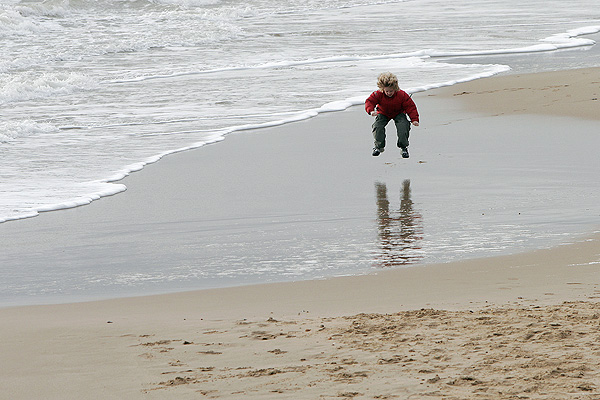
This photograph of a child playing on the beach in the winter suggests that he is really enjoying his freedom. The photograph was taken from quite a height (maybe 25 feet) to isolate the sand from the confusing background and the fact that he is nearer the right of the frame suggests that he has a lot more room to head into. The oldest rule about composition – the rule of thirds – is being observed.

If the space around the child in the photograph was full of details then the impact of the composition would be lost. You would inevitably give the image more than one subject and spoil the simplicity which is the real secret of the picture. Of course if the child’s mother was in another area of the otherwise empty frame then that would give another message altogether, the space would still be making you think – but differently.

Cluttered photographs are much harder to pull off, simple images are often more effective and this image proves that simple doesn’t necessarily mean tight.

Mindset – small word, big concept for news photographers

©Neil Turner/TSL, March 2004

Written in 2002, this opinion piece still holds very true nearly ten years later…

What’s the difference between a photographer who takes pictures for fun, another who struggles as a professional and one who is on top of their game? The answer, well there are many but the top of my list is….mindset

It’s a pretty innocuous word, but it makes a massive difference. As I sit here writing this I’m trying to formulate some thoughts ahead of a talk to a group of postgraduate news photographers. Snappy titles are always a good start – according to the “Lecturing for Dummies” handbook so “Mindset” it is.

Next step – arresting opening sentence. That will have to wait until I have better formulated my ideas, but my handbook tells me that if you get people’s attention at the beginning you have won fifty percent of the battle and if you don’t you will waste a lot of time getting it back. Well, that’s a bit like writing and (spot the cheasy link) an awful lot like being a news photographer.

The narrative that runs through a well shot photo story or a well written essay is remarkably similar. I have been trying to find a way of telling eager “news photographers in the making” that the message is more important than the way it is delivered and I have decided that it’s worth keeping the writing analogy going.   Nobody denies that poetry is literature and everyone has respect for well written short stories. Good authors are comfortable with their medium, they structure their work and use words economically. Good photographers mirror this. The common thread is mindset; shaping what you have into what you want it to be. I’m not saying that you pre-judge an issue, but rather that you should edit before you shoot, as you shoot and after you shoot to tailor your pictures to a particular format.

If you are working towards an exhibition you work one way – adopting the right mindset, and if you are shooting a single image story you work a completely different way.  And then there are the differences between making and taking photographs, between being a welcome guest wherever you are or an unwanted intruder. News photography is a very broad church, with room for many ways of working and a lot of photographers find it very difficult to switch between the various sub-genres. It can be done.  The temptation for photographers new to journalism to assume that only great long complicated narratives qualify as news photography is understandable. It is also one hundred and eighty degrees out. The thought that it takes real skill to tell a story in a single picture is a difficult concept to master but the greatest story-tellers know that less can often be a whole lot more.

It’s all in the mind.  If you have a month to shoot a spread you can afford a few days (let’s say three to make the comparison easy) to acclimatise. If you have an hour to shoot a single image story and you take the same percentage of the job time to settle in, you’ve only got six minutes. You know what the score is, so you adopt the right approach before you start.  News photography, when it’s stripped down, is a really simple idea. You take pictures and you make pictures that tell stories. You can use photographs to spell out what you want to say, you can use them to intrigue the viewer or you can use them to infer things.

Good journalism often uses words, but it uses photographs just as often. If the photographer is thinking straight and can concentrate on the end product, good photography becomes great news photography.

Final step – the clever conclusion. I would advise anyone coming into the profession to read some good poetry and a few good novels, to work out how they were structured and to try adapting the simplicity of poetry to their photography. Why? The answer is all too simple, photography is all about creativity and it’s all about mastering the technical aspects but most of all it’s about a state of mind – a mental process – mindset.

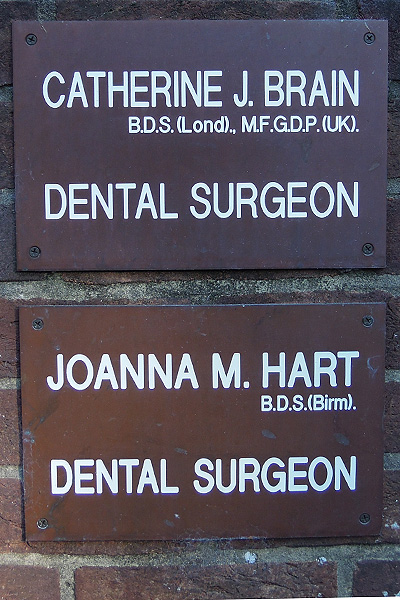
Fun pictures – Brain & Hart…

Like most working photographers I sometimes take pictures for the sheer joy of it. Sometimes I even get my iPhone out and do fun pictures. From time to time on this blog I hope to ad a few of the silly, odd and downright comical pictures that I sometimes see.

A lot of my favourites are actually not that good as pictures; I am often amused by wordplay in pictures – like this one…

©Neil Turner, October 2011

Words of wisdom

Back in 2004 I was pretty prolific. I was writing technique and opinion pieces on my website at least once a month, if not more. Times have changed, I’ve become less prolific and I have a lot less spare time on my hands too. Going back through some of the gems (and some of the cringe-making stuff) I am re-posting (and re-re-posting others) because they still represent what I think. As I say, from 2004…

It has happened again. I have had a letter from a student of photography asking me a really simple question, and I have spent so much time over-complicating the reply that it has ended up here on my web site.

“…so” said the innocuous e-mailed question “what is the best piece of advice anyone has ever given you about either being a professional or about photography in general”.

Innocent question? No! I have spent ages formulating my reply, and I’m still not sure that I’ve cracked it…but, for what it’s worth, here is my reply. The answer is in the last sentence.

 There is a stage in your career where you learn so fast that your head spins at 6,400 rpm at the end of every day. Slowly your learning rate goes down, but the quality of the newly found knowledge probably goes up. Similarly, when you are a real “newbie” there seems to be a queue forming right around the block to deposit sage truths right into your knowledge bank. (I am mixing my metaphors here, but I think it make sense anyway). Once you have been around a while it takes more courage on the part of the “old hand” to dish out the advice until one day you find yourself imparting more gems of truth than you will ever receive again. Sadly I’ve been at that latter stage for so long now that I really should get myself a Gandalf beard, but I do remember a time when I did qualify for the advice soup kitchen.

In chronological order here a few of the more choice bits of advice that I received before my career got going and I hope that you are either informed or amused by them.

  • There’s no money in photography – school careers counselor 1980
  • Never shoot wider than f8 – manager of the camera shop where I was working 1983
  • There’ll always be a market for pictures of nude women – sleazy shop customer 1983
  • My career will be over long before newspapers shoot colour – local newspaper photographer 1983 (still working)
  • Nobody will offer you a place at college with a folio like this – admissions tutor 1984

Early advice and comment fell way wide of the mark. There was plenty more to be had, but it was all as bad. Once I had been accepted onto a college photography course, the quality of the advice picked up and the staff lecturers were full of wisdom, the best example of which I still remember…”Don’t listen to anything I say, but hang on every word of the visiting professionals we bring in to talk to you”. My peers and I did listen to the wise words that came our way, and we quickly worked out which were worth obeying, which needed to be stored for later and which could be safely forgotten. Some of our visiting tutors gave great practical tips…

  • Keep every receipt. Claim everything against tax and make sure you get paid.
  • The business is full of sharks. You have been warned.
  • Get a great portfolio, keep it up to date and never let it gather dust.
  • It’s good to know how to make beautiful prints, but only so you can tell your printer where he’s going wrong.
  • A distinctive style is good, just as long as it doesn’t go out of fashion.
  • Spend as much time looking at other people’s work as you do fretting about your own.
  • Only buy enough equipment to do the bread and butter jobs. Renting makes sense.

I’ve lost count of the photographers who told me which developer to process my Tri-x in, or which pro lab did the best job on transparency film. Valuable though these things can be, they aren’t going to get you noticed. The people whose advice did the most were those who took the time to look through my folio and be constructive, those who would show you their work and talk candidly about it and those who would have a drink with you and tell anecdotes. Stories give context to advice, real life situations add relevance. Photographers who can tell you which picture editor likes what and who can advise you who to talk to are saints, but some of the best advice came from my peers. People at roughly the same stage in their careers as me were always worth listening to and my respect for the whole concept of “peer learning” is huge.

These days it seems that we are constantly forging new paths and breaking new ground. The whole digital experience has taught me that there is somebody somewhere who has just worked through the problem that you are currently experiencing. Sure, you need to work out who is a reliable source and who is full of BS but the information is out there.

Now for the one piece of advice, well the best three. In reverse order they are.

  • Whilst it might seem a privilege to make your living in such a wonderful job, you still have to pay the bills.
  • Its not good enough to take good photographs most of the time, you have to take great ones all of the time to survive
  • Never take advice on photography from someone who tells you that there is only one way to do something!!!

Sticks and stones

My mother told me that “sticks and stones may break your bones, but names can never hurt you” and I spent the first 40+ years of my life without questioning that piece of maternal wisdom. At the ripe old age of 46 I started to realise that certain derogatory terms, when applied to groups of people, can have a bad effect.

not going to equate my profession with religious or ethnic groups who have suffered real physical and emotional harm from the constant repetition of terms deliberately designed to insult them and from name calling intended to isolate them or to incite others to be prejudiced against them. What I am going to do is try to make a case for the quiet burial of collective nouns and occupation based slang terms for photographers that only serve to devalue what we do for a living.

Before I get into the arguments I want to say that photographers often use many of these names for each other in what is meant to be a light hearted and affectionate way. Words get borrowed, used and then abused so we are doing ourselves no favours by perpetuating them. There are a whole raft of pseudo-tabloid terms for photographers that I object to;

  • Snapper – implies that we take snaps, which we don’t. We take photographs, we make photographs and we create photographs.
  • Lensman – what does this mean? It’s just a pointless term that gets trotted out by people who cannot be bothered to use a thesaurus.
  • Camera monkey – particularly offensive, and usually used by ill informed and self important writers.
  • Pap’ – shortened form of ‘paparazzi’, which is liberally used by the ignorant to refer to a wide range of news photographers. I have nothing against the paparazzi (literally translated means buzzing flies) but I object to the pejorative connotations of the word when applied to other photographers.
  • Reptiles – used once to my face by an ‘old school’ journalist who was politely informed that I objected to the term on the grounds that it may well have been used affectionately by him, but that it may not be used so kindly by others.

The list could go on but the point that I’m trying to make here is that words used in jest by friends of our profession get picked up by others and used to denigrate us all. All of this is happening at a time when we are struggling to present a unified, dignified and professional image to a world which at best doesn’t understand what we do and at worst regards us with contempt. The terms that we use to refer to one another are important. Not as important as avoiding undercutting other professionals, not as important as selling out on copyright and not as important as belonging to professional bodies, but in a world where everyone who owns a digital compact camera thinks that they can take ‘professional quality pictures’ every small action has an effect. It’s like the old, and probably untrue, story about a butterfly beating it’s wings in China causing a hurricane in Florida – some very small actions have very large consequences.

As photographers we owe it to ourselves and to our colleagues to avoid using terms for each other that can have negative connotations. When was the last time you heard a Doctor call a colleague a “sawbones” in public? When did you ever hear a lawyer, an accountant, a teacher or a systems analyst use a potentially damaging slang term for a fellow professional? I believe that the use of slang terms is a sign of professional insecurity and we can all help ourselves and our peers by refraining form making those signs.

Names may not hurt you or me individually, but they can eat away at our profession.