UK

Archive photo: Special needs school, March 1990

Following on from the March 1990 Conductive Education picture that I posted earlier in the week I remembered another special needs picture that I shot a short while later. As it turns out, exactly four weeks later. This shot isn’t as technically sound or as well composed as the previous picture but it does mean a lot to me – because there is a real story to go with it.

© Neil Turner | 30 March 1990 | Southampton

This boy had a target of learning to do up his own zip and was determined to succeed for the camera. I was touched by him and his determination and so I stayed with him whilst he kept trying. After nearly ten minutes he succeeded and I was very nearly in tears. One of the staff had been watching and she was in tears. I have never forgotten that moment.

For the geeks out there, the camera was a Nikon F3P, the lens was a 24mm f2 Nikkor and it was shot on Kodak Tri-X film.

Folio photo #11: Sir Paul Stephenson, February 2009

Sir Paul Stephenson at New Scotland Yard. ©Neil Turner, February 2009

This portrait was made when Sir Paul Stephenson had been in post as the Commissioner of The Metropolitan Police for less than two hours. He had been acting Commissioner but this was taken when he was actually given the job. This frame was right at the end of the session where I had already shot quite a wide variety of pictures in the time allotted. Having packed 90% of my gear away I was told that I still had a couple of minutes and so I did this picture with a press officer holding a Canon Speedlite off to my left with the head zoomed in to create this pool of light effect. Sir Paul has now left the post but this picture is staying in my folio. Shot using a Canon EOS5D MkII with a Canon 24-70 f2.8L lens and a single 580exII flash triggered by a Canon ST-E2 transmitter.

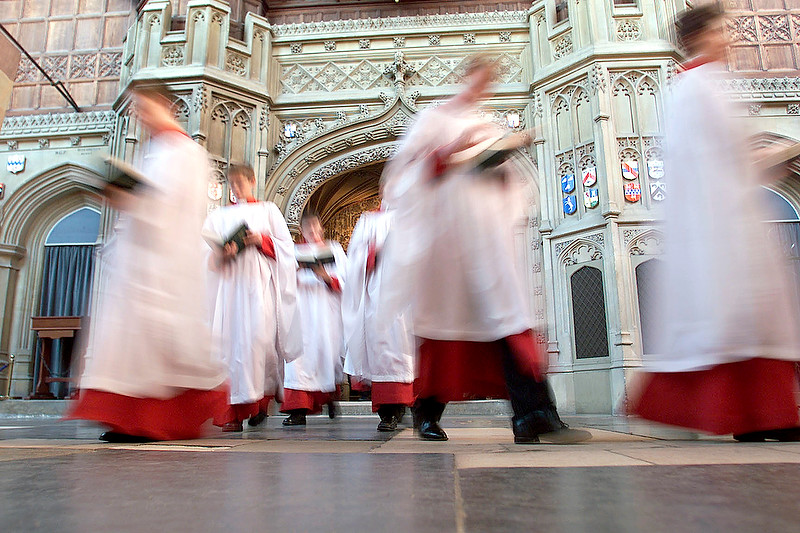
Folio photo #10: Eton College Choir, March 2004

©Neil Turner/TSL, March 2004

©Neil Turner/TSL, March 2004

Choristers leaving the College Chapel after early morning prayers at Eton College, Berkshire. The famous public school is offering junior music scholarships in an attempt to attract bright and musically gifted boys to the school. The blur was used in this case to anonymise the pupils. The camera was sat on the ground, propped up with a the lens hood because I didn’t have a tripod and wanted the motion blur. The lens was a Canon 16-35 f2.8L and the camera was an EOS1D.

The BPPA and The Leveson Inquiry

I have been involved in writing, amending and publishing a second submission on behalf of The British Press Photographers’ Association to the Leveson Inquiry into  the culture, practice & ethics of the press in the United Kingdom. It has been a huge task and the work of propagating it using social media has now begun.

Lord Justice Leveson’s inquiry was founded to look into the phone hacking scandal that brought about the closure of The News of The World and other unsavoury practices in play within the UK news media. In the first week of evidence it turned into a “photographer bashing” event and The BPPA had to respond on behalf of the thousands of perfectly well behaved and law abiding news photographers out there. Lots of countries have a problem with rogue paparazzi or “stalkerazzi” as they have been memorably named by one UK academic.

If you are a lover of great news photography, please follow @TheBPPA on Twitter like The BPPA on Facebook and read The BPPA blog here on WordPress. The industry is at a crossroads and we need our friends and colleagues to help us get where we need to go.

When Time Out did real news…

Right back in the early days of Insight Photographers, the small agency that we ran from an office in the rather un-trendy (how times change) Hoxton area of London, we used to shoot a lot of stories for Time Out magazine. Some weeks they would have five or six pages of real news and they used to commission some nice work too. One of my favourites from that era was this picture of a man who was part of a group of residents and squatters trying to stop the Department of Transport from bulldozing their houses to build a new piece of road in the Archway/Highgate area intended to speed up the journey up the A1 from Holloway (bear with me if the geography of north London bores you). When I arrived on a hot day from the a brisk walk up from the underground station the bailiffs had gone.

Archway Jack. ©Neil Turner/Insight, May 1989

I found this chap looking rather pleased with himself and asked what had gone on. He just smiled and said “we’ve seen them off”. I asked him if it was OK if I shot his portrait and he agreed. After that, I got my notebook out and asked him his name. He thought about it for a few seconds and then said “call me Jack… Archway Jack”. Of course I asked if that was his real name but he smiled and walked off trying to whistle a tune.

The News Editor somehow tracked him down, got some good quotes from him and the story probably got more space than a simple eviction piece would have. A definite case of “just because the story you were expecting didn’t work out, it doesn’t mean you haven’t got a good story anyway”. All of the Time Out news reporters and editors that I recall went on to do great things. I guess that it was a mix of choosing the right people and being a great place to hone those journalism skills. Quite a few of the freelance photographers that they used did OK too.

This was shot on Kodak Tri-X film using a Nikon FM2 camera and a 24mm f2 Nikkor lens

Folio photo #09: Bournemouth grave digger, October 2008

©Neil Turner. October 2008

Dave Miller has been working for the cemetries service in Bournemouth since leaving school. These days he even lives in a house inside one of the local graveyards. Photographed at dusk in Bournemouth’s North Cemetry for The Guardian. They were running a whole series of pictures of people who do slightly unusual jobs and they times this particular feature to run at halloween.

This frame features four separate flash units – one of which is down inside the grave (which was otherwise empty). Dusk is my favourite time of year for shooting pictures and this particular sunset was very colourful. If you’d like to know even more about this picture, go to this technique page

The day after a bad day at the pool

When we first went digital back in 1998 there were a lot of lessons that we had to learn for ourselves. There hadn’t been much work done by others and there were a lot of mistakes that we made and learned from. One of the worst things to happen to me wasn’t until June of 2006 – long after we all arrogantly thought that we had learned what there was to learn.

I went to shoot some pictures at a swimming event and the atmosphere was loaded with what smelled like chlorine. My cameras had got steamed up quickly and took a while to de-mist and I thought nothing of it, shot the event on a pair of Canon EOS1D MkII cameras and edited my pictures as normal. Nothing wrong… so far. The next day I went to shoot portraits of a young student who had been shortlisted for a writing award – totally run-of-the-mill. The job went well, the pictures looked great on the back of the cameras but when I imported the files from the first camera into the computer I went as white as a sheet.

Dirt on the chip was a common problem, the odd bit of dust that showed up when you stopped the lens down but nothing had prepared me for the amount of spots that were on these pictures.

A small part of the frame before spotting. ©Neil Turner/TSL, June 2006

Thousands of small, circular bright spots in the same place on every single frame. I was swearing, sweating and worrying in equal measure as I put the memory card from the second camera into the card reader. If they were as bad, this job was going to take weeks to edit and retouch. Massive relief… the second camera hadn’t suffered from the same fate. The tighter pictures shot on the longer lens all had the spots whilst the wider pictures shot with a wider lens had none of them. The bonus was that some frames on the spot-free camera were also shot on a longer lens so I had a few spot-free tight portraits too. The panic was almost over but it was clear that at least two or three of the heavily spotted pictures should be in the edit so I spent most of that evening and night painstakingly getting rid of the spots. One-by-one.

The same image after a lot of work getting rid of the spots. ©Neil Turner/TSL, June 2006

After a thorough clean by FIXATION UK the camera was as good as new. The spots were crystallised chlorine and quite why they were only on one of my two cameras used on the bad day at the pool I will never know. People have theorised about having taken the lens off of one and not the other, damaged weather seals, some sort of coating on the chip of one camera that either attracted or repelled the crystals – who knows?

The morals of this story are these:

  • Shooting with two cameras is always a good idea
  • Using a professional to clean problem dirt off of the chip is a great idea
  • Shooting with some wide and some long lens images on both cameras is a good idea too
  • Be careful when taking lenses on and off in unclean environments
  • Retouching spots is a right royal P.I.T.A

That camera went on to give great service for two more years and was sold on having been cleaned and serviced. These days I use a pair of 5D MkII bodies which don’t have the same environmental seals as the 1D series. If I were a rich man, I’d want to own the new 1DX when it comes out!

Folio photo #08: Peter Snow, London, May 2004

©Neil Turner/TSL, May 2004

Peter Snow, BBC sephologist, journalist and newsreader photographed after an interview at a central London hotel for a “My Best Teacher” feature for the TES Magazine.

He had a book and a TV series with his historian son at the time and the interview was one of a long series that he had already done that day. The room was cramped and poorly lit and so I used a medium sized soft box very close to him to keep as much light off of the background as possible. One picture editor that I worked with used to call this very tight crop the “egg cup” because it was as if someone had flattened the top just like one.