wisdom

The new Canon EOS5D MkIII – to buy or not to buy?

The heart says “YES” but the wallet asks “WILL IT PAY FOR ITSELF?”

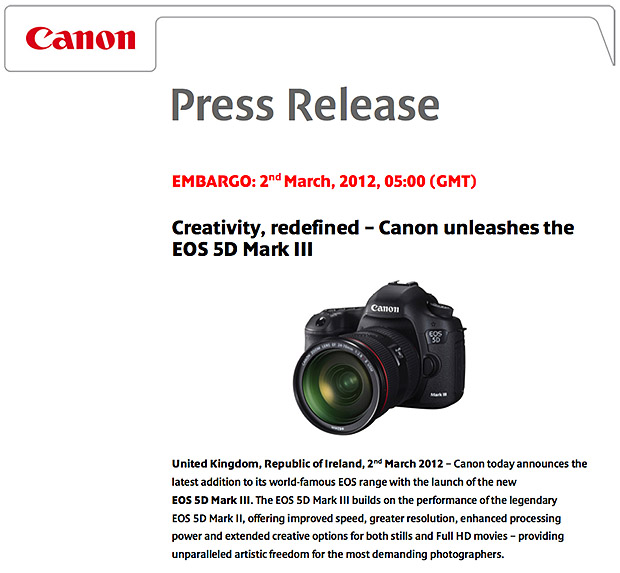
One of the worst kept secrets in the photography world over the last few weeks seems to have been the exact specifications list of the new Canon ESO5D MkIII. When an email arrived in my inbox this morning it was headed “We’ve been listening, so now you can too!” An intriguing headline if ever I heard one… but what is it referring to? Could it be the addition of a headphone socket for video shooters? Could it be the vastly improved sound of the shutter over the slightly apologetic click and whirr of the mark 2? Maybe it is the rather good ‘silent’ shutter option? Who knows.
And to some extent, who cares? The decision that working professional photographers now need to make is whether or not buying one or two new camera bodies alone will be justified on purely financial grounds. I have written before about the calculations that you need to make before deciding to invest in new gear. The sums here are pretty easy to do:

  1. List price including VAT £2999.00
  2. Life expectancy of a pro body 36 months
  3. 3 years servicing costs £300

Take 1. and add 3. then divide by 2. = £91.64 which is the cost per month including VAT of owning the camera. Buy two and you double that. You could argue that the kit will have a residual value when you have finished with it and sell it on. I’ve just phoned a couple of dealers to see what my old Mark II bodies will be worth in part exchange. I was honest about their age and condition and was told that I’d be lucky to get £900 each. Factor that into the equation and the cost per month of the new camera would come down to £63.86 a month inc VAT each, which equates to £56.71 excluding VAT.

That’s the health warning over. What does this camera offer me? To start with I keep a Canon EOS7D as a back-up camera as well as for use when I need better auto focus that the 5D MkII can offer. I guess that the improved AF on the 5D MkIII will remove 50% of the need to have that 7D. The new camera also boasts improved low-light performance – which would be more than useful for me too. In fact, every improvement they have made is a definite bonus but exactly how I monetize those bonuses is a tough call. I know that I’d like to replace my three year old cameras with nice shiny new ones, now  all I have to do is to justify the costs. I look forward to the three hundred Canon EOS5D MkII Vs Nikon D800 comparisons. For most professionals swapping systems represents a massive cost and so it would take an awful lot for me to swap to the D800 – even if I thought that I could afford the extra storage space that using a 38 megapixel camera would mean. For me, the more important comparison will between the MkIII and the wonderful, if flawed, MkII.

I haven’t used the camera yet and so I will reserve judgement until I have. I’m not going to bother to cut and paste the whole press release either so if you want the opinion of someone who has handled the camera you can read what Getty Photojournalist Brent Stirton thought about using it on assignment in France or go to wedding photographer Jeff Ascough’s blog about it or if you want an anorak style description of what it does you can go to DP Review. I hope to get to play with it soon as well as the very interesting (if very expensive) new flash system that has also been announced today and when I do, I will be straight onto WordPress to blog about it.

To wrap it up, I just saw a great tweet originating from a user called @PolvoPolvo which said

5D3 could well go down as a gamechanger in the sense that’s its the first major release in memory not being described as a game changer

The anguish of editing your own pictures

©Neil Turner. London, January 2011

I’ve written about this kind of thing many times but it seems to come to the forefront of my photographic consciousness over and over again so I hope that you will forgive me if none of this is new.

There are a lot of great reasons why photographers have to edit their own work. They are the only ones who truly know what was shot, why it was shot that way and how well the pictures reflect the situation. For news photographers the idea of someone else doing their edits is, largely, a far-fetched and even unwelcome notion. It is happening more and more though.

Some of the big wire agencies and more progressive newspapers are using direct wireless transmission from cameras to editors on big sports and news jobs where the time between shooting the pictures and getting them to market is absolutely critical.

If, however, time is not quite so much of an issue photographers like to sit down and go through their own pictures, make their own selections, add their own captions and prepare the files for delivery. That’s how I’ve worked for the last fifteen years or so and even before then I was often in charge of my own edits because that was how things were done.

Every once in a while (mostly on commercial shoots) someone else edits my pictures. I find it both liberating and scary in equal measure. The liberation is that I get to concentrate on shooting pictures and the scary bit is that someone else gets to see everything – the good, the bad and the downright indifferent. What if they miss the subtlety of that amazingly constructed picture on the second memory card? What if they don’t appreciate the ultra-shallow depth of field that I grafted so long and hard to realise?

There’s a good counter-argument to that of course: If a professional editor doesn’t get what I was trying to do, neither will the client, neither will the designer and neither will the viewer. There are some pictures that you take on almost every shoot that are there for you and for you alone. That is true but every once-in-a-while those pictures do get used. Every once-in-a-while somebody else gets your vision and loves the ‘weird one’ as much as you hoped that they would.

Editing your own work is a tough thing to do. Try editing a full set of someone else’s pictures and you will realise just how easy it is to be dispassionate and just how readily you are able to discard pictures that don’t work. Editing your own work can be a minefield. Every step can bring a very tricky decision. What about the pictures that you have a personal emotional connection with? What about the pictures that you have overcome huge technical challenges to secure? What about the pictures that don’t actually add to the edit or make sense as part of a set?

Taking a shoot and making sense of the pictures from that shoot is a skill that very few photographers ever truly get right. Those that do are blessed and really lucky because they avoid the regular pain and anguish of having to ignore their own ‘babies’.

I have four things that come into my mind every time I am struggling to decide about a single frame: light, composition, subject matter and technical quality. If all four are right the picture goes in. If three out of four are right it will probably make it too. Less than three and that’s where the anguish begins…

Define the word “PHOTOGRAPHER”

When does a person with a camera, even a person with an expensive camera, become a photographer?

Apologies if this seems to be getting a bit philosophical but it’s a question that someone casually threw at me a week or so ago and I’ve been struggling with it ever since. Let’s get the dictionary stuff out of the way…

Right now we can really get on with the real business of working out what a photographer is. I’ve always been a fan of simple definitions and I like the idea of making a comparison between things, so how about this:

Someone with a camera tries hard to get everything into the picture whilst a photographer does their level best to keep as much out of the picture as they can.

All that means is that there comes a point in your photographic journey where you realise that most pictures are much stronger when you leave absolutely everything out that doesn’t need to be in. In a paraphrase of the old saying “what doesn’t kill you makes you stronger” (which isn’t necessarily true by the way) we can come up with “what doesn’t add to the composition detracts from it”.

The dictionary definition above, which comes from the English dictionary built into the Apple OSX operating system, steers away from the word professional and I’m really glad that it does because there are an awful lot of superb photographers out there that take pictures for fun and not for a living. Being a good photographer is not the same as being a professional photographer. On balance, MOST professionals are good but there isn’t a direct relationship between earning a living and being proficient.

These days there is a belief that ‘everyone is a photographer’. I wouldn’t argue that almost everyone takes pictures and that almost all of them take two, three, four and even twenty times as many pictures as they would have done when we had to buy film. Someone who I once discussed photography with reminded of another old adage – the one about if you give enough monkeys enough paper, enough typewriters and enough time sooner or later one of them will create the complete works of Shakespeare. It doesn’t hold up here and I told him as much.

People with cameras are largely rational, intelligent and reasoning beings and so most will work out what they do and don’t like and then take better and better pictures over time. Their image making isn’t the random act of monkeys with no comprehension what they are doing – the point here is that when it comes to learning that less (content) is more (better pictures) some will figure it out for themselves , some will need to have it pointed out to them and the rest will remain blissfully ignorant of it.

For some lucky people the knowledge is instinctive. The rest of us have learned through trial and error and/or formal education to know a good picture when we see one. Those that take the next step by learning what makes it a good picture can call themselves “visually aware”. The final (and never ending) stage is to develop the skill to see the picture and make the best of it before and during the pressing of the shutter. Those people can call themselves photographers.

See also COMPOSITION

Darts legend teaches mathematics… using a dartboard

©Neil Turner/TSL. June 2008, Kent.

Bobby George is a showman. He drives a flash car, he wears more rings than I could lift and he has made a nice life for himself playing professional darts. He went to Langley Park School for Boys in Beckenham , Kent in June 2008 to talk to GCSE maths students about how much he has gained from good mental arithmetic. He kept an audience of teenaged boys, most of whom weren’t even born when his career was at its height, engaged and even managed to get most of them to realise that maths, probability and mental agility were actually ‘quite cool’.

Some posts are “a bit Marmite”…

When I started to migrate my old blog over to WordPress I also began to watch the site statistics that are there to help you understand what kind of content on your blog is popular. Obviously announcing new posts on Twitter, Facebook and LinkedIn helps but the figures for days when you don’t do any plugging probably tell you more about what people search for and find.

Having shifted so many old postings (anything listed before December 8th 2011) I have been watching to see whether the ‘old’ stuff gets many viewings. The answer, sadly, is no. More interestingly, blog posts that aren’t about specific photographs don’t get a lot of viewings either.

British readers of this blog will be familiar with the concept of something being “a bit like Marmite” (or Vegimite if your are from the Antipodes). It means something you either love or hate, nobody is indifferent to it.

Drawing comparisons between a savoury spread and blog posts is probably a bit tenuous but I still like the idea! I think that there is some interesting material back there so I’ve decided to go through the viewing figures and publish links to some of my favourite and your least favourite oldies.

That’s half a dozen to be getting along with. I goes that they share a certain ‘wordiness’ but they are the kind of things that I want to to talk about and so I hope you give one or two of them a go.

Compose the picture and then wait

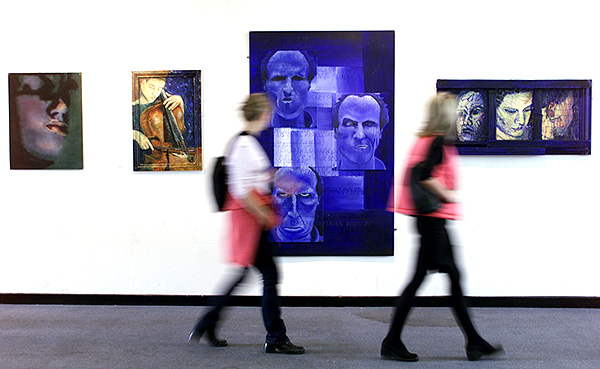
I have a folder full of images on my hard drive that I use for teaching. They aren’t always my best work but they help to illustrate a point better than others from my portfolio. This is a perfect example of that idea.

Sometimes you can see the potential for a picture but the picture isn’t happening. This is a common issue for news photographers who have to shoot pictures to go with stories about something quite specific but aren’t allowed to set a lot of shots up. This picture was to go with a very small story about an art exhibition that had been put on by some young female artists on a very tight budget. The venue was a shopping centre (mall if you are from the USA) and I could see that some human interaction with the work was the best way to cover it. I grabbed a tripod from the car and stuck my camera on it. Composing the frame was pretty easy and all I had to do was wait for the right people to walk past and look at the work. People came along and I tried various shutter speeds to get some blur in order to keep the ‘focus’ of the story on the art. Soon I was happy with my plan (1/10th of a second at f4.5 on 200 ISO) and I waited, shooting frames as people came past in ones, twos and threes.

©Neil Turner/TSL | London | October 1999

I could see these two women with very similar pink in their outfits coming. I could see that they were in perfect step and so the plan went from the occasional frame to a full burst (about 3 frames a second in those days) and got this shot. Of course I did a few more but the deep joy of those early digital SLRs was that you had great confidence in what you saw on the rear LCD.

The idea remains one that I use over and over again. I see pictures and I compose them around what’s there and then I just have to be patient and wait for someone or something to come along and complete the photograph. You can see the same idea here in an old post about walking with speed lights which has pictures taken a lot more recently!

For those who love detail, this was shot with a Kodak DCS520 camera (1.9 megapixels of class) and a Canon 17-35 f2.8L lens at the 35mm end of the range perched on a Manfrotto 055 tripod (which I still use).

Nikon Vs Canon (no, really, honest…)

A Wise man said to me recently that the best way of getting a shed load of traffic to your blog was to make the title something like “Canon versus Nikon” of something along those lines. Well, as it happens, I actually do want to write about Canon versus Nikon – or at least to make the point that with the imminent arrival of both the Nikon D4 and the Canon EOS1DX (at least on specification and raison d’être) the two camera giants will have a broadly competitive and similar offering for the first time since the Nikon F3 and the Canon F1n did battle back in the early to mid 1980s. Both of those cameras were built like tanks, had optional and fast motor drives and were principally designed for heavy duty professional use.

The new offerings have remarkably similar specifications – knock for knock, these are the most similar cameras on the pro market for thirty years. There are a few differences of course: Nikon have stuck their necks out and gone for a dual memory card slot with one of them being for a new and largely untried format. Both cameras have the odd quirk here and there but it will all be about personal preference when purchasing decisions need to be made.

Of course one manufacturer might have exactly the lens range you want or the other might just feel better in your hands but, the bottom line is that for the first time in the digital era and maybe even for the first time since the original EOS1 film camera hit the shelves we don’t have a clear leader. Can’t wait to try them out…