I've been a full-time editorial & corporate photographer since 1986 and I'm still as passionate about the work now as I was then. These days I also write about photography, teach photography and act as a consultant on all things photographic - so, basically, photography is my professional life.
The year is rapidly drawing to a close and everyone is looking back at 2025 with the familiar mix of joy, regret and thankfulness. We all have high hopes for 2026 and that goes for both our personal and professional lives.
So how has 2025 been for me and my work? Well – a mixture of joy, regret and thankfulness sums it up surprisingly accurately. It has been quieter than the previous three or four years with a little less travel and fewer peaks of excitement but my clients both new and old have presented me with moments that I will treasure and memories that will stay with me for a long time.
The joy of being out there, cameras in hand and doing what I love to do is just as real and just as strong as it ever was. Combine that with the joy of seeing my work used well and widely it’s been a good year.
In my career (39½ years and counting) I have shot a lot of portraits and probably as many headshots. I’m not going to go back over my definitions of either or the subtle differences between them right here but when I point my cameras at the subjects there’s one question that I get asked. A lot.
“How should I look?”
For the first bit of my career I didn’t have a stock answer so I would often turn the question back on them: “How do you want to be seen?” It worked sometimes, occasionally failed miserably but mostly solved nothing. “Just relax and pretend that there isn’t a big bloke with a big camera and a few lights pointing at you” was never going to become the simple and snappy response that I required. It didn’t even worked on the few occasions that I tried to inject some humour with it.
I started to make mental notes about who asked the question, what kind of person they were and one thing started to become really obvious – those who had been photographed professionally a few times before rarely asked whilst those who hadn’t often did. Not entirely surprising, but interesting nevertheless.
Whilst doodling around on the internet the other day I was looking at a few reels on Instagram. Now it probably won’t come as much of a surprise that that my Instagram feed is filled up with great photographers and so it will equally make sense that the all-powerful algorithm serves me up photography related content most of the time. One of the reels was from a relatively young and relatively inexperienced photographer proclaiming that he had discovered a new technique. It went on to show a technique that is, to me, as old as the hills. Dragging the shutter to create a deliberate blur.
I was just about to type something that gently and constructively pointed out that this wasn’t anything new and that an old hand like me rarely (if ever) sees anything that’s truly new when I decided to see what other viewers of the reel had commented first. Sure enough, there was a small number of constructive and supportive comments but the vast majority of them were not even remotely constructive and way too many were downright dismissive. I breathed a huge sigh of relief that I hadn’t been that person – the one who sought to boost their own sense of self-importance by squashing the joy and enthusiasm of someone who had discovered a potentially exciting technique that was new to them.
I’ve had laptops since the mid 1990s and I have used each of them until they were no longer capable of doing their job quickly and efficiently. Most of that work has involved editing photographs and the vast majority of the time those edits have been completed away from the office. The title of this post is “The laptop cycle” and I called it that because my needs from a laptop vary over time. Things are changing again and it appears that I am just rotating into a period where I am doing a lot of editing on the road.
For the last couple of years I have either been uploading direct from my cameras and then doing a considered edit when I am back at my desk or doing some very simple and quick edits on my 2021 M1 MacBook Air. I bought it as a back up for a fully loaded 2017 MacBook Pro and to have as a lightweight travel companion. In 2022 I invested in an M1 Mac Studio for the office and the older MacBook Pro (which still works fine) was relegated to being a back up itself. The 2017 machine which felt relatively lightweight when I bought it now feels pretty cumbersome and so I haven’t carried it on a job since early in 2021.
Writing a blog for over a quarter of a century means occasionally repeating yourself and/or celebrating anniversaries of things. Back in 2011 a regular follower of my posts used my “Ask Me a Question” link to enquire about what was in my day-to-day camera bag. I duly wrote a post called “In My Camera Bag” in which I listed everything that was in my go-to bag of choice at the time. A couple of Canon EOS5D MkII bodies, two 580ex II flash units and 16-35, 24-70 and 70-200 f2.8 L lenses lived in a LowePro Stealth Reporter 650AW bag along with a Mac laptop and quite a few accessories. That was a heavy bag.
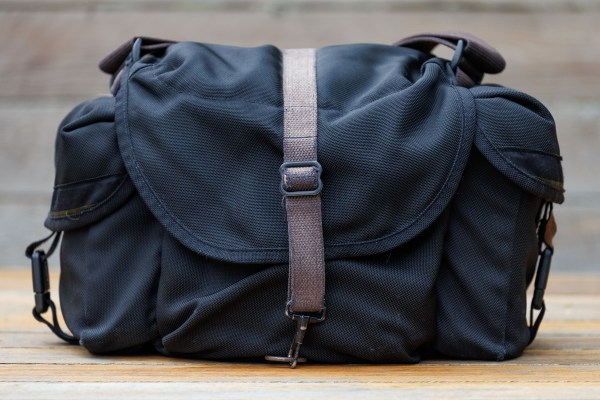
Fast forward seven years to 2018 and my much loved and rather ancient Domke J3 camera bag (pictured above) was filled with two EOS5D MkIV bodies, 16-35, 24-70 and 70-200 f4L lenses with two 600EX RT II flashes. By this time my laptops were carried in a tiny little rucksack because I’d been through some bad experiences with a spinal issue and didn’t necessarily need to carry it all of the time. I’m not sure when I bought the bag but it was well over twenty years ago and when I wrote the 2018 remix version of what I carried in my camera bag of it was already my well-worn favourite.
So, a further seven years on, here are some short updates on a few bits of kit that still spend a considerable amount of time in the same old bag.
Canon EOS R6 MkII camera bodies
Canon EOS R5 MkII camera bodies
Canon RF 14-35 f4L lens
Canon RF 24-105 f4L lens
Canon RF 70-200 f4L lens
Canon RF 100-500 f4.5 – 7.1 L lens
Canon EL5 Speedlites
Canon ST-E10 Speedlite transmitters
Out of the two R6 MkII and two R5 MkII bodies there will be a total of two in the bag at any given time. I leave it packed with one of each just in case I get a short notice job and need to run out of the door but I rarely work that way and so I will pack the right bodies for the job before I leave and keep the others in the rolling bag with the rest of the spare kit because not all of it can be accommodated at the same time, and even if it could that would be a seriously heavy bag. Laptops live in small rucksacks or a Think Tank rolling bag depending on what I’m doing. I’m not going to mention the other gear sitting in a cupboard in my office but there are a few camera bodies, a dozen or so lenses and more flash units than any sane person should own. So, if you like the shortened version of the kit review – it goes like this:
A couple of months ago I wrote about the increasing number of RAMS (risk assessment and method statements) that photographers are having to submit. As is often the case, that prompted a question from someone who’d read the piece asking about a similar matter. This time it was NDAs or non-disclosure agreements. Oh boy! That opened up a can of worms. Some colleagues claiming that they always refuse to sign them, others saying that they often edited them before signing and others, like me, realising that they’ve become a fact of life and barely skimming them before adding their signature.
Before 2008 I genuinely don’t remember ever having had to sign an NDA. I always took it as read that if some confidential information was shared with me, it stayed confidential (I guess that would be unless there was some illegality involved but that never came up). A lot of my work was (and still is) editorial and releases are often embargoed – a system that I have always respected and abided by.
I signed my first NDA in late 2008 and ever since then the number, frequency and length of the documents has grown considerably. My first one was about half a sheet of A4 paper in a reasonably sized font. Some of the more recent ones have been two, three and four pages of tightly packed A+ legalese. Times change and lawyers get to dictate a lot of the changes.
Having just finished three weeks editing other people’s pictures at Wimbledon and a further six days doing the same for the Open Championship golf the topic of workflow and getting pictures to look good, be accurately captioned and delivered efficiently wasn’t too far from my mind when a conversation with another photographer prompted me to write this. In the last month (and in the last eleven or so years that I’ve edited other people’s work) I’ve edited files from all of the professional cameras from Canon, Nikon and Sony. On a less intensive basis I’ve edited pictures shot on Leica, Fujifilm and Hasselblad and probably a few others that I can’t recall right now and so anything I say is based on the notion that a good workflow isn’t all that dependent on what types of files you have.
I’ve said it before and I will, no doubt say it again but having a good workflow is absolutely central to the business of photography. In fact, when I speak to colleagues and friends most will excitedly tell me that their personal workflow is as good as it gets and surprisingly few will openly accept that they might just be able to do it that little bit better with a bit of training and practice. Personally I lean the other way; spending way too much time looking at different software, trying different techniques and generally trying to get my workflow a few percentage points better.
A couple of weeks ago I shot some portraits of The Bishop of Salisbury, Rt Revd Stephen Lake, in the grounds of Salisbury Cathedral. The first few frames were for part of a release to the press along with an extended caption explaining a conference he had hosted that was exploring the relationship between the Church of England and Gypsy, Roma and Traveller communities. I also shot some of the outdoor activities that went along with the event.
The rest of the images of The Bishop were for stock and I really enjoyed shooting them. He and I had met before, we are almost exactly the same age and grew up just a couple of miles from one another and so it is no surprise that we got on pretty well. As we chatted I shot pictures. What you see above is fifteen of the edited frames including a much needed headshot but as I carried on shooting I got closer and closer to what I really wanted to achieve – which is the frame below.(more…)