news

Updating my folio and painting the Forth Bridge

folio_screen_grab

In the UK we have a saying that describes a never-ending task “painting the Forth Bridge”. The idea is simple; once the painters have finished painting the bridge, it’s time to start back at the other end which has been weathering for a number of years by then. Keeping your own portfolio up-to-date is a similar task. There are so many ways to present your work and none of them are perfect and so I keep tinkering with content, layout and even the technology. Five years ago it was Flash and then basic HTML code and then a bit of Javascript and now it is a combination of everything except Flash. My idea is that I want to be able to update easily and regularly without having to format and code stuff. Preparing the images is done using a couple of Photoshop Actions and then the images themselves are inserted into a “slider” which is set to play automatically but which can be stopped and images can be picked out for a closer inspection.

I would be very interested in any views and opinions that anyone has about the site and the way it works. It isn’t an exact science but I think that I’m getting closer to understanding how it all works. Of course photographers are their own worst editors and I suspect that the content will annoy many of you. Whatever you think, let me have it.

The bridge is freshly painted, I’m having a day or two off and then I’m going to start again. One of these days I might even change the colour…

Poor old Photographer B

There is a heated discussion about the winner of this year’s Taylor Wessing Portrait prize on a photographers’ forum at the moment. Some people love Spencer Murphy’s picture and other’s don’t get it – which makes it a perfect demonstration that personal taste is a major factor in “liking” an image. One thread of the debate is the winning photographer’s use of large format film and The Guardian having quoted him as saying “I chose to shoot the series on a large format film, to give the images a depth and timelessness that I think would have been hard to achieve on a digital camera.” Hard to achieve? Hard for whom?

All of this prompted me to expand a little on something that is happening in photography right now that frustrates me: To make myself clear – I applaud photographers who find ways to make an overcrowded and homogenised market work for them and I applaud the way that they are using different methods to enable them to “see” better.

The idea is gaining momentum that just because something is shot on film it somehow has greater validity and greater truth. This really angers me.

If Photographer A likes the way that they work with film and that there is a market for that work then Photographer A has found a niche and I’m happy for them. Photographer B on the other hand creates great work without resorting to film but potential clients who have bought into the myth about the validity of film are already starting to question why Photographer B isn’t going with the fashion and using Photographer C who is happy to take the money but doesn’t work better on film. Basically, we are in a situation where the means of production could overtake the end result as the goal of the commission. Nobody wins – especially photographers D-Z.

The place where this is most frightening is in our colleges and universities where the small resurgence of film is being leapt upon by lecturers who are miles out of their depth in the digital world supported by managers who are desperate to validate their investments in silver based facilities and avoid having to spend on up-to-date digital ones. We have a generation of students being equipped for professional life in the 1980s based on the achievements of a tiny number of photographers achieving critical acclaim by “seeing differently” and then talking nonsense about it to a small clique of art lovers who lap up all of this stuff so that they can repeat it at Islington dinner parties and sound as if they know what they are talking about.

I come from a newspaper background where there is a good deal of nostalgia for shooting film. Happily most of us who wish to can indulge in this kind of work as part hobby and part self-expression. Each to their own and vive la difference and so on. We owe it to ourselves and each other to take the utmost care that our professional lives are not going to get hijacked by a notion that film – or “heritage media” as I quite mischievously like to call it – is better. After all, there’s a lot of truth in the old saying “be careful what you wish for.”

For the record I like Spencer Murphy’s work and I don’t blame him for mining the niche that he has helped to create. Portraiture should be about telling the subject’s story and not about how we shot the picture. I’ve been guilty on many occasions of shooting pictures where you notice the “how” before the “who” and the “why”. Photographic portraiture is as difficult as you want to make it. Spencer Murphy suggests that he has made a virtue out of simple by shooting with what is in truth a complex medium. My head hurts…

Five years of freelancing

cutoutsIt’s quite hard to believe that I’m celebrating five years of freelancing this week. I hinted at it when I wrote about anniversaries a couple of weeks ago and I thought that it might be a good time to think about how things have gone and how things are going.

The first thing that comes to mind is that I still adore being a photographer. I hope that anyone who has read any of my blog posts since 1999 would have worked that out for themselves but I wanted to get that in first just in case anyone is in any doubt.

The second thing is that the timing of my move into self-employment couldn’t possibly have been worse: the economic meltdown in much of the developed world was pretty much at its zenith in September 2008 and I’m pretty sure that life would have been considerably easier had I left the staff job a couple of years earlier. That’s life.

Thirdly I want to mention the way that our industry works. Every photographer, picture editor and buyer of photography will tell you about a golden era. I really think that no such thing actually existed. That’s not quite right; I think that the invention of photography spurred a “silver” era which is still in progress and that there may have been a few golden spikes in that time. The industry has been in a constant state of change for well over a hundred years and it will continue to react to social and technological changes as long as the need for imagery exists.

So how has the last five years actually been for me? Ups and downs, feast and famine, peaks and troughs are all phrases that readily come to mind. One week I might work one day and the next I have four or even five days work. Sometimes it’s all editorial and others it’s all corporate. I’ve calculated that I’ve made 88% of my income taking pictures and the other 12% either writing about photography, teaching it or doing some consultancy work. I’ve learned the importance of having a portfolio ready to go and I have recently spent a lot of time getting my online presence to work smarter for me.

I suspect that none of the above is new to you and that none of it comes as a surprise. To be honest, I am pretty content with my new life and the only things I actually miss about being a staff photographer are:

  • I now have to buy my own car and camera gear
  • I have to do my own paperwork
  • I’m no longer an integral part of a big team.

The variety of assignments has been great, the travel has been interesting and getting to spend a lot more time at home has been wonderful. My hair has lightened to an even lighter grey but that is probably more to do with age than stress and I now have to wear glasses a bit more often than I did but that’s probably due to my age as well.

I’m not the only one who has made the move from staff to freelance and I’m certainly not the only one who did so due to newspapers and magazines reorganising and doing away with staffers. There was a discussion a few days ago about the pros and cons of being freelance and the general consensus was that it suits some people more than it suits others. I miss the team, I miss shooting every single day and I’d love to have someone there to buy me some new gear but apart from that I’m looking forward with child-like excitement about what comes next.

Neil Turner Photographer, the Facebook page

Social media … is it working yet?

A little over two years ago I wrote a blog post about social networking where I asked largely rhetorical questions about whether there was a point to it, which platforms were the right ones and whether or not it made any difference. About three weeks ago I wrote on Twitter that I’d spent half a day integrating my social media – getting my Tweets to show up on LinkedIn and getting my photos posted on EyeEm to show up on Facebook and then getting every single platform to react to one another when I wanted them to. Not only did I set all of that up on the desktop and laptop computers but I also did it on the iPad and the iPhone. Boy, am I ever integrated now!

This morning I added a post on a LinkedIn group about explaining to reluctant businesses why they should be using social media:

“The simplest way to explain it to the doubters is to point to the utter stupidity of NOT using social media in the world in which we currently live. You didn’t need it ten years ago and theres’ a chance it might be past it’s best in ten years time but right here, right now it is the method chosen by a massive proportion of the population for making choices, doing research and engaging with business.”

So… is social media working yet? You wouldn’t expect me to give a clear and unequivocal answer to a direct question that I posed myself would you? Of course not – except there is an answer that I have given a few times when talking about this:

“It isn’t not working”.

How do I explain that? I’d be worried if social media was having a negative effect on my business and career but I have been really careful to avoid the stupidity of posting banal, overly-personal or critical observations on any platform unless they were going to have a positive effect – which is almost never. On a few closed Facebook groups I might be a little less guarded and in private messages I might use the odd bit of cussing but on the whole my social media profiles have been kept clean. That has meant very little controversy, relatively few spikes in activity and a lower profile than I might have gained had I been happy to upset a number of people. That’s all OK but why would I imply that all wasn’t well with social media? Well, the hours spent plugging away haven’t been directly rewarded with more business and it would be hard to quantify the actual benefits of getting out there in the worlds of social media. So in the two years since I first blogged about this I have got a lot better at doing it, gained a few jobs here and there and generally promoted myself positively. I’m going to keep on doing it because I genuinely believe that to avoid social media is a very bad thing.

The irony is that this blog is the one thing that I want people to see, read and interact with. That’s my strategy and that’s why I wanted to get the integration going – the other platforms are there to boost the blog and the blog is there to raise my profile. Whether or not that circle is vicious or virtuous is something only others can decide upon.

©Neil Turner, May 2013. First seen on EyeEm - there are so many ways to promote your business these days!

©Neil Turner, May 2013. First seen on EyeEm – there are so many ways to promote your business these days!

New work – an answer

A few weeks ago now I posted an open invitation for anyone to ask me a question. I received a few and saved some of them until I was ready to answer them. This one has been playing on my mind for quite a while:

“Why don’t you post new pictures on your blog in the way that you used to when dg28.com was the first website I looked at every week?”

That is what I call a question! There are so many parts to the answer that I have decided to list them as bullet-points:

  • I don’t shoot as much editorial work as I used to and a lot of corporate clients don’t want me to post the images shot for them.
  • I don’t have quite as much time to work on websites as I used to.
  • One of the main reasons that I stopped posting new work was that much of it stopped looking ‘new’ and I wrote about that on this blog.
  • Another reason that I stopped was the number of times people asked me to take pictures down.

Now that I am a freelance photographer I need to be very careful about what I post. Social media, blogs and websites are very public forums for thoughts and ideas and it is far too easy to do or say something that harms your business and freelancing as a photographer is very much a business. There’s also an element of protecting ideas. I published fifty technique examples in the period between 1999 and 2008 and I get emails from photographers all over the world saying that some of those lessons changed their practice. I still meet photographers who tell me that they read those pages over and over again when they were trying to develop their own techniques for using portable flash and that is gratifying but now I’m playing a few of my cards a bit closer to my chest because I have developed a few new ways of working that I’m not ready to share outside of my portfolio.

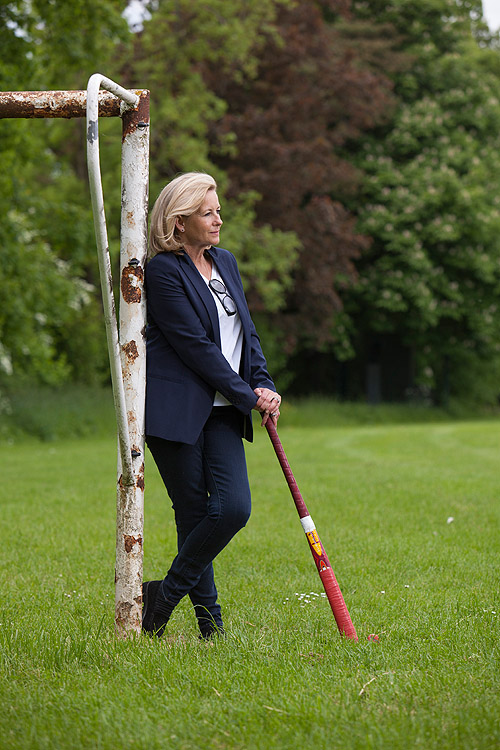
Like I said – there’s no single reason why I stopped posting and I certainly don’t rule out posting some more ‘new’ work over time. As a response to the question that was asked I have decided to post one new portrait that I made a couple of months ago for a women’s magazine. Te story was about three women who had written very personally about their time at school and how that had influenced their later lives. One of the women was journalist and author Gill Hornby and I was asked to photograph her with her dislike of school and team sports in mind. We had a few minutes at a playing field on a less than sunny day and this is the photograph that I liked most:

©Neil Turner. 07 June 2013. Gill Hornby is the author of The Hive (Little Brown).

©Neil Turner. June 2013. Gill Hornby is the author of The Hive (Little Brown).

The Press Photographer’s Year

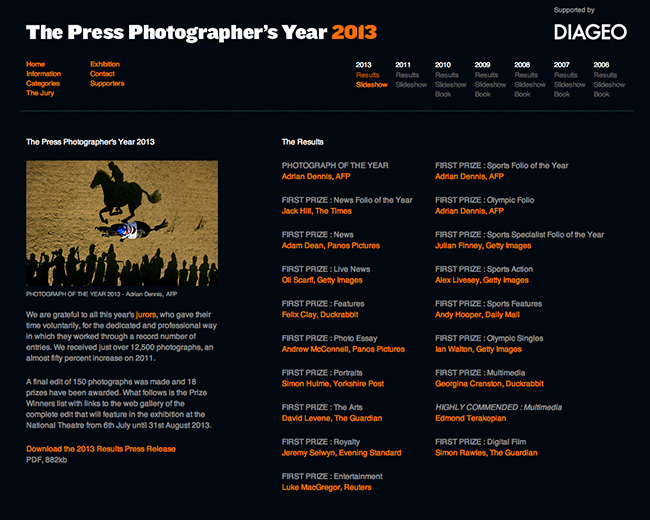
ppy_2013_grab

I always have a look at who has won various competitions and I’m always interested to see what the judges go for. Most competitions leave me a little cold but The Press Photographer’s Year is different. Well thought out categories, independently judged (I have to say that, I’ve been on the Jury twice myself) and backed by The BPPA I have always been part jealous and part proud of the winners. Jealous because I never seem to win anything and proud because I can call most of the winners my colleagues and friends

Press photography has a tough time in the UK. It’s undervalued by the publishers and misunderstood by a lot of the public. This year’s batch of winning and selected images will go on show at The Royal National Theatre next Saturday the 6th of July for seven weeks where it will be seen by a huge number of people who wouldn’t necessarily go to a photography exhibition. Please take some time to look at the winners’ slide show on The PPY website and please try to make some time to go to the exhibition and see for yourself just how good the work that these guys produce on a daily basis is.

So, congratulations to Adrian Dennis of AFP, Jack Hill of The Times and all of the other winners and thank you to Diageo for supporting this great project. Maybe next year I’ll actually enter!

Fujifilm X20 – a summary of my thoughts

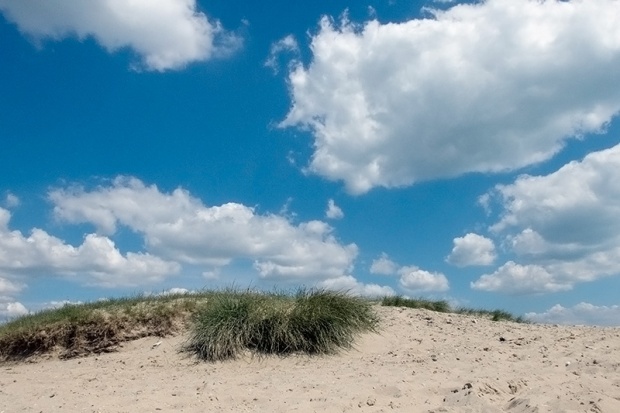
©Neil Turner, May 2013. Mudeford Spit, Dorset

©Neil Turner, May 2013. Mudeford Spit, Dorset

Just over five weeks after taking delivery of my Fujifilm X20 I’m sitting here trying to gather my thoughts and opinions about this intriguing little camera. It is far from perfect and it doesn’t fulfil all of the requirements that I thought that I had when I bought it. In several areas its performance is below par and working with the RAW files is not as easy as it could or should be. All of that having been said, it has become my constant companion almost everywhere I go and I still find myself adoring using it.

Put simply, there’s something about this camera that you’d struggle to put your finger on but that makes taking pictures with it an absolute pleasure. A couple of weeks ago I posted my first update about the X20 and my experiences using it. I tried to summarise the good and the bad points of the camera. You probably won’t be surprised to find out that my opinions have barely changed:

  • The video is still a pain to use and a bigger pain to import and edit.
  • The high ISO performance is still no better than any other camera with a small chip – awful.
  • The RAW file format .raf is not particularly easy to work with and the screen resolution previews in Adobe Camera RAW are worse than slow to generate.
  • The battery life has graduated to awful from appalling now that I have the menus set up better. I have twice got through two batteries in a single day.
  • The build quality of the battery clip is still suspect.

In fact I could have just cut and paste what I wrote back in April with the slight change that the battery life is marginally less awful than first thought. So those are the negatives. What about the positives? You’ll probably have guessed that they have barely changed either. Colours, tonal range, handling and the sheer joy of using it are all very positive comments that I made before and would support still.
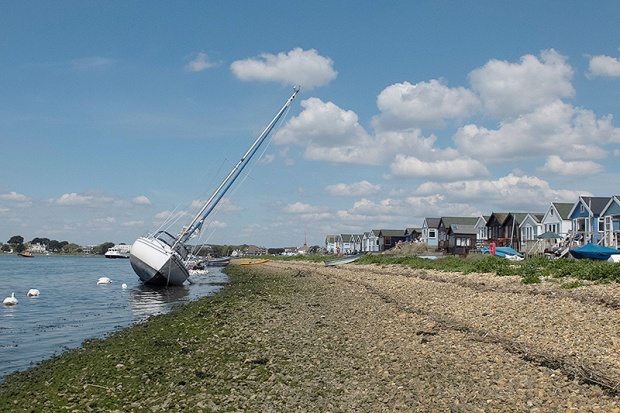
©Neil Turner, May 2013. Mudeford Spit, Dorset

©Neil Turner, May 2013. Mudeford Spit, Dorset

I guess that I will never make it as a camera reviewer. The thought of shooting test charts and ISO range comparisons fill me with dread. In a digital world where figures and absolute measurements are the lifeblood of so many websites you should definitely go to DPReview if you want the numbers laid out and explained.

As someone who owns and uses some of the finest DSLR cameras ever made on a daily basis I want something very different from my compact ‘walkabout’ camera. I make the vast majority of my income from taking pictures and I make the rest from teaching, writing and consulting about photography. For me to want to go out and just take pictures for the joy of it, the camera has to be fun to use. And it is on that simple point that Fujifilm are getting it so completely right with their x-series range. The X100 was a great start and the X10 was a brilliant companion. Since then we’ve had the X Pro1, the XE1, X100s and this X20 to enjoy. The single factor that unites all of these cameras is the pleasure you can take from using them when you spend so much time using other (better?) cameras.

That brings me to the next point. There’s no way that I’d use the X20 instead of a Canon EOS5D MkII or MkIII for a normal assignment but on my own time, taking pictures for pleasure and for the family the Fujifilm X20 is wonderful. It will be beaten at some point and it remains true that it isn’t the best compact  in terms of image quality, speed, flexibility or any of a dozen other quantifiable factors. I propose to introduce a new scale based on the likelihood that you’ll actually bother to take the camera out and use it willingly and with a smile on your face. On that measure, and that measure alone, the Fujifilm gets a perfect ten. Right now, I’m off to the shops to get my morning paper; on foot and with my X20 over my shoulder…
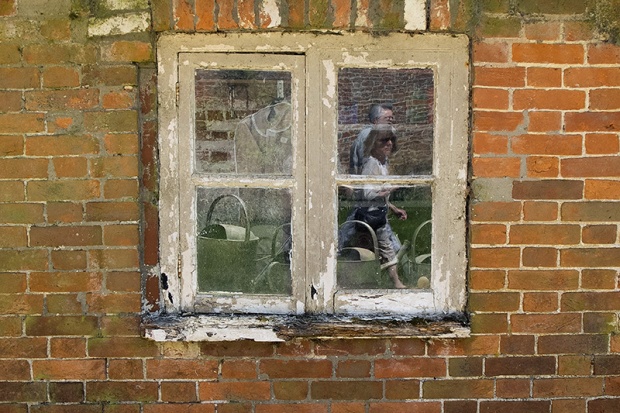
©Neil Turner, May 2013. Stourhead, Somerset.

©Neil Turner, May 2013. Stourhead, Somerset.

Final footnote… I was disappointed with the built-in flash and so I decided to buy a small hot-shoe unit to supplement it. I found that one online retailer was selling the Fujifilm EF20 flash that was designed for the X series cameras at under £90.00 and so I bought it. Not a bad investment; I’ve used it quite a bit and it makes a lot of sense to have it because it fits into a pocket without too much difficulty and even has a limited bounce facility. I’ll try to post something cool shot with it soon.
No such thing as professional?

yahoo_screen

Yahoo’s CEO Marissa Meyer made a stupid remark yesterday whilst announcing a complete overhaul of their Flickr photo-sharing website service. She actually said was that “…there’s really no such thing as professional photographers anymore”. Like many people who used to think that they were professional photographers I became very angry.

What I’d love to happen next is to get commissioned to shoot her portrait for a major newspaper or magazine and to prove her wrong. That’s unlikely to happen, which is a shame. Within a few hours of hearing what she had said I had deleted my Flickr account and let my Twitter followers know that I had done it and why I had done it.

Did Ms Meyer really mean to upset hundreds of thousands of hard-working professionals? Does she really think that our profession has ceased to exist? I suspect that what actually happened is that she made her remark with the subtlest of hints of humour in her voice in order to promote her company’s new-look product. I doubt that it has done too much harm but why do corporates continually keep doing this kind of thing? Gerald Ratner famously compared his company’s gold jewellery to  a prawn sandwich wiping millions of pounds off of its share value and ultimately leading to his downfall. Time after time people at the top who believe their own hype and who think that they can be funny in order to sell their products make this same mistake.

Flickr’s owners won’t apologise. They have sought to make light of her remark because it was ‘light-hearted’ – or at least it was light-hearted in her mind. At a time when the value of photography is, in many ways, at an all-time low the owner of one of the biggest sites based on photography has unwittingly reinforced that perception. Stupid and un-thinking throw-away remarks do damage in ways that only become apparent over time

My business model isn’t based on Flickr. I had about thirty folio images up there simply because it probably pays to have a presence on all of the social media sites. I have probably shot myself in the foot by deleting my account but anger leads to gesture and the biggest gesture that I could make was to leave Flickr.

The point that I really want to make here is that photography does have value. Good photography is, in fact, invaluable. Maybe if the Board of Yahoo realised that they’d actually get their CEO to apologise.