photography

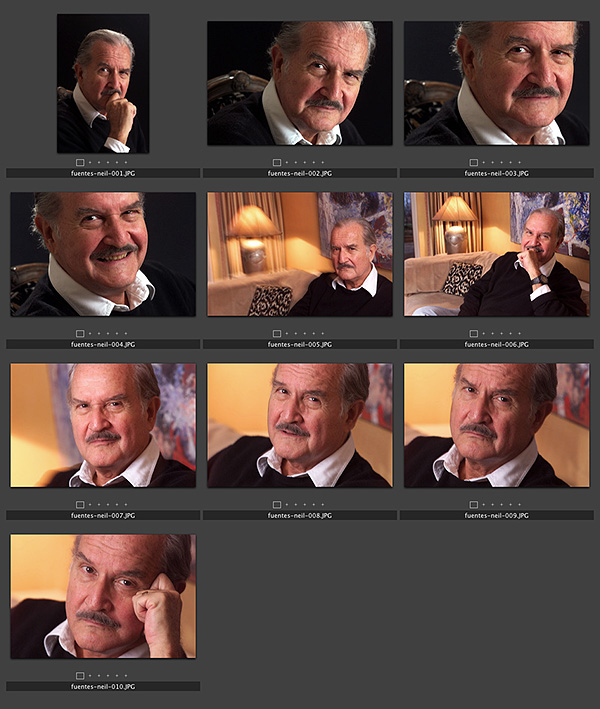
Carlos Fuentes portrait – the “contact sheet”

Going back through an old portfolio I was reminded of a lot of portraits that I used to love. One of them is this session with Mexican author Carlos Fuentes shot at his London home in December 1999. He was both charming and cooperative and his home was easily spacious enough to set up as much gear as I had been able to carry up the stairs.

©Neil Turner/TSL. December 1999. London

He had already been interviewed by a reporter to whom he was obviously a hero and I had spent a while asking her about him and his work. These were the days when the internet was just starting to become useful for background research. The trouble was that this was a last minute assignment and getting on line when you were on the road was a very tricky task. These days we all have smart phones with Google and Wikipedia but back then it was a lot tougher to become an instant expert of your subject. I looked his CV up later and was a bit embarrassed that I had never heard of him. I read a coupe of translations of his books over that Christmas break and I hope that I will never get caught out like that again.

Techie stuff: Kodak/Canon DCS520 cameras with 17-35 f2.8L, 28-70 f2.8L and 70-200 f2.8L lenses. All lit with a Lumedyne Classic series flash and a 70cm shoot through umbrella with the hair light in some frames provided by a Canon 550ex flash unit.

Define the word “PHOTOGRAPHER”

When does a person with a camera, even a person with an expensive camera, become a photographer?

Apologies if this seems to be getting a bit philosophical but it’s a question that someone casually threw at me a week or so ago and I’ve been struggling with it ever since. Let’s get the dictionary stuff out of the way…

Right now we can really get on with the real business of working out what a photographer is. I’ve always been a fan of simple definitions and I like the idea of making a comparison between things, so how about this:

Someone with a camera tries hard to get everything into the picture whilst a photographer does their level best to keep as much out of the picture as they can.

All that means is that there comes a point in your photographic journey where you realise that most pictures are much stronger when you leave absolutely everything out that doesn’t need to be in. In a paraphrase of the old saying “what doesn’t kill you makes you stronger” (which isn’t necessarily true by the way) we can come up with “what doesn’t add to the composition detracts from it”.

The dictionary definition above, which comes from the English dictionary built into the Apple OSX operating system, steers away from the word professional and I’m really glad that it does because there are an awful lot of superb photographers out there that take pictures for fun and not for a living. Being a good photographer is not the same as being a professional photographer. On balance, MOST professionals are good but there isn’t a direct relationship between earning a living and being proficient.

These days there is a belief that ‘everyone is a photographer’. I wouldn’t argue that almost everyone takes pictures and that almost all of them take two, three, four and even twenty times as many pictures as they would have done when we had to buy film. Someone who I once discussed photography with reminded of another old adage – the one about if you give enough monkeys enough paper, enough typewriters and enough time sooner or later one of them will create the complete works of Shakespeare. It doesn’t hold up here and I told him as much.

People with cameras are largely rational, intelligent and reasoning beings and so most will work out what they do and don’t like and then take better and better pictures over time. Their image making isn’t the random act of monkeys with no comprehension what they are doing – the point here is that when it comes to learning that less (content) is more (better pictures) some will figure it out for themselves , some will need to have it pointed out to them and the rest will remain blissfully ignorant of it.

For some lucky people the knowledge is instinctive. The rest of us have learned through trial and error and/or formal education to know a good picture when we see one. Those that take the next step by learning what makes it a good picture can call themselves “visually aware”. The final (and never ending) stage is to develop the skill to see the picture and make the best of it before and during the pressing of the shutter. Those people can call themselves photographers.

See also COMPOSITION
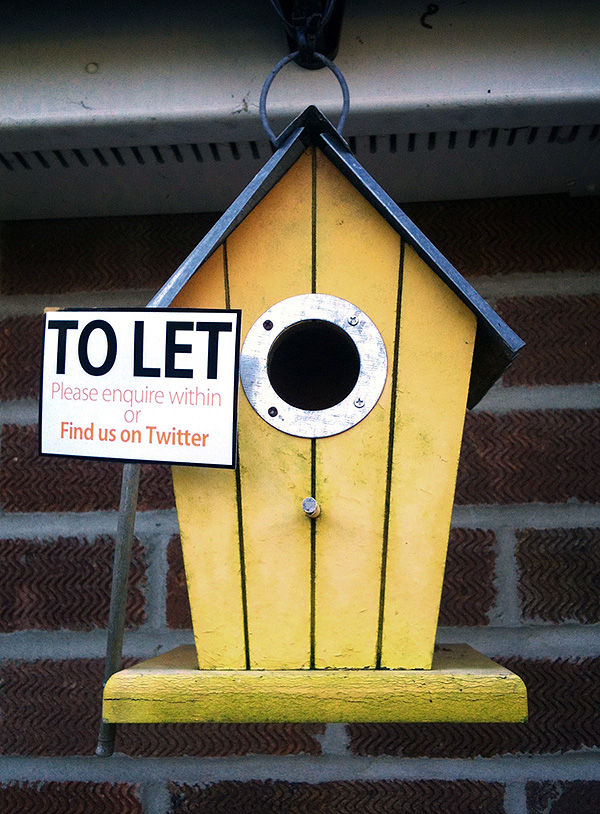
Fun picture: bird house to let

©Neil Turner. February 2012, Bournemouth

Completely staged photo opportunity this morning in Bournemouth…

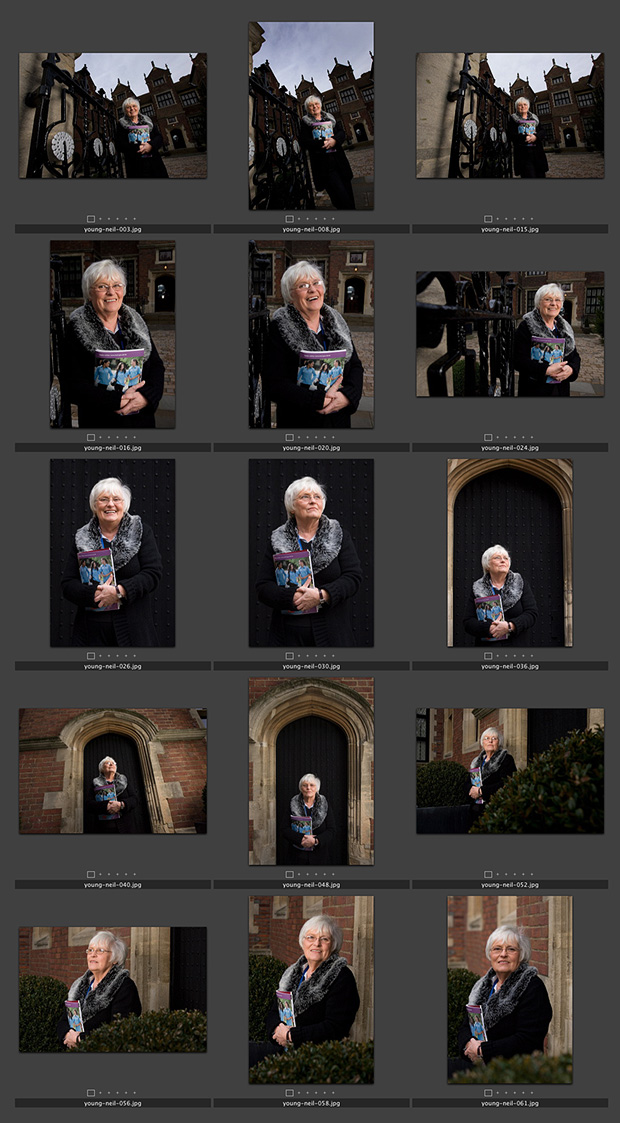
Choice adviser – the “contact sheet”

This is another contact sheet that doesn’t quite fit in with my previous postings. The lady in the portraits is a “Choice Adviser” whose job it is to work with children and their parents to help them choose which secondary schools are best for them and to help them make their applications to their chosen schools. Part of her job is to hold workshops and the pictures were taken outside the most beautiful of the buildings where she does those workshops.

©Neil Turner/TSL. December 2006, Kent.

The portraits were done quite late in the afternoon on a cold and miserable December day back in 2006. I chose to shoot with quite a lot of light and there were two Lumedyne packs and heads used on most of these images balancing the flash with the ambient light. My brief was just to shoot nice portraits and I had no idea what kind of shape or even where in the newspaper they would go and so I had to give the Picture Editor as much choice as I could.

I wouldn’t normally choose to shoot someone in a black coat against a black door but on this occasion I really like the effect. For my money, making good portraits with people who are shy and who are unused to being photographed on cold, damp December days is a lot tougher than working with celebrities.

Techie stuff: Canon EOS1D MkII cameras with 16-35 f2.8L, 24-70 f2.8L and 85 f1.2L lenses. Mixture of available light with two Lumedyne Signature series flashes, a small soft box and a 70cm shoot through umbrella.

Darts legend teaches mathematics… using a dartboard

©Neil Turner/TSL. June 2008, Kent.

Bobby George is a showman. He drives a flash car, he wears more rings than I could lift and he has made a nice life for himself playing professional darts. He went to Langley Park School for Boys in Beckenham , Kent in June 2008 to talk to GCSE maths students about how much he has gained from good mental arithmetic. He kept an audience of teenaged boys, most of whom weren’t even born when his career was at its height, engaged and even managed to get most of them to realise that maths, probability and mental agility were actually ‘quite cool’.

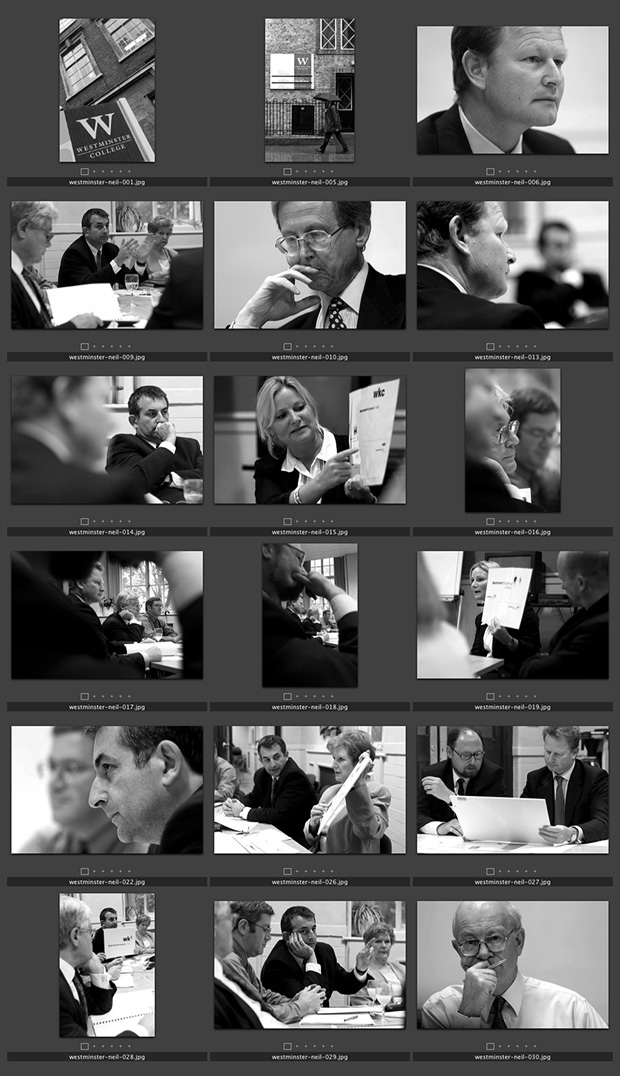
Merger talks – the “contact sheet”

Until now all of the ‘contact sheets’ that I have blogged have been from portrait assignments. Whilst looking back through some old pictures that haven’t seen the light of day in many years I came across this set of images. I was commissioned to do a sort of ‘fly-on-the-wall’ coverage of a Board meeting of the combined Westminster and Kingsway College governors.

©Neil Turner/TSL. July 2000, London.

The idea was that two medium sized central London colleges were to merge and become a single large institution on multiple sites and a series of meetings like this one were taking place to make important decisions about almost every aspect of the way that the new Westminster Kingsway College would function. This particular meeting was about the logo. My task was to get a whole series of black and white images (even if they were shot on a digital camera in colour) that could be used through a multiple page article about the merger once it was complete.

Moving around the room as quietly as possible, using no flash and getting a set of pictures that represented the meeting was my goal and it was actually a fairly tense meeting, which made my job all the more difficult. In the end I left the meeting before I was asked to. It was only a matter of time before I got the “tap on the shoulder” anyway and I thought that I wasn’t going to get anything very different and a voluntary departure would be a good move.

The magazine actually ran nine pictures across three pages in the end and I was very keen to repeat the exercise. Sadly, it didn’t really happen in the same way again for many years.

Techie stuff: Kodak/Canon DCS520 cameras with Canon 17-35 f2.8, 28-70 f2.8 and 70-200 f2.8L lenses at 640 ISO and colour converted to black and white using the Kodak DCS Acquire software.

Important news for press photography in the UK

dg28's avatarTheBPPA

Here’s a date for your diary: Tuesday the 7th of February. “Why?” I hear you ask, well it is the day when The BPPA will finally get to appear before the Leveson Inquiry into the culture, practice & ethics of the press.

In our main submission to Lord Justice Leveson’s Inquiry we proposed a four-pronged solution to the issues raised in connection to photography at the hearings to date:

  • Make the publishers of websites, blogs, magazines and newspapers and their editors financially and professionally responsible for any lack of due diligence in checking how, where and why pictures that they are publishing were taken. Photographs acquired from citizen journalists, CCTV systems and inexperienced photographers should have a clear and strict series of tests applied before publication to verify their provenance
  • Images purchased from holders of UK Press Cards or from reputable agencies that are members of a United Kingdom…

View original post 506 more words