photography

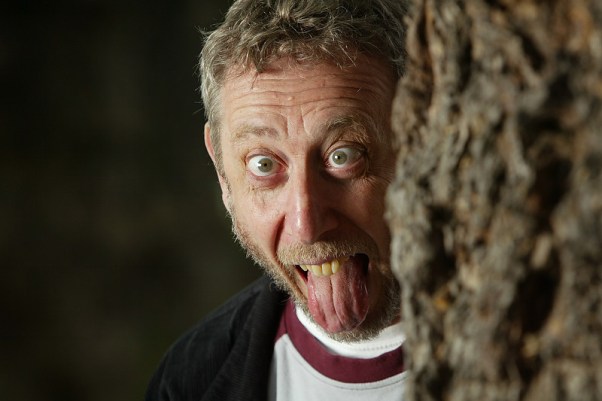
Folio photo #13: Michael Rosen, London, 2004

©Neil Turner/TSL. May 2004, London

Michael Rosen is a poet, author, broadcaster and all round brilliant bloke. I spent a good hour shooting a whole range of pictures of him at a park near his home in East London. I have photographed him about five times in total and it is always a joy to spend time with him. I have also been interviewed by him for his BBC Radio 4 programme about words and etymology. We did a special about photographer slang. This set of pictures is ripe for a future “contact sheet” too.

Geek moment: Canon EOS1D with Canon 70-200 f2.8L IS lens.

Having an eye for detail

The choice between taking the same photograph as everyone else and standing back and getting something different becomes a matter of survival when you work on a weekly newspaper and the other five photographers around you will be publishing the next morning. Even if that weren’t the dilemma of every photo-call I go to, I like to think that as a photographer I am an individual. It’s a pretty useful mindset to sign up to, no matter how much or little photography you do.

Photo: NEIL TURNER. ©TSL. 04/09/2000. TES news.

This photograph of an elephant’s eye is a classic example of taking a mental step back from the herd and shooting something different. It is also an advertisement for having more than one camera with different lenses on. There were five other photographers at the job. The story was about this young Indian elephant who paints pictures, and about how he was being used to launch an environmental art competition for schoolchildren. We were all trying to make the same picture of the elephant, three kids, some paint and an easel. The composition was looking messy, and there were just too many elements in it. We all had 16-35 lenses on and were getting nowhere. I was getting nowhere faster than the other five who would all go to press that night leaving me with two more days during which the story could easily get scrapped without a strong image. My second camera had my 70-200 on it and I grabbed it, zoomed in and the picture almost took itself. Strong, arresting, different and wide open for headline writers to do their thing. Just about every base covered. I shot some of a paint brush in the elephant’s trunk too, but this was the picture chosen.

When an image is competing for space on a newspaper page it has to stand out. The enlightened editors at our papers allow images to arouse the reader’s interest and don’t insist that photographs tell the whole story all of the time. This approach works on every level, from the family album through e-mailed postcards to published images. Getting in close works.

See also: MINDSET FOR NEWS PHOTOGRAPHERS

Possibly the oddest picture I ever took…

©Neil Turner/TSL | London | January 2006

The story was simple: we were doing an anonymous interview with a man who needed to remain unidentifiable for legal reasons and we had to shoot a picture of him at a time and a place that wouldn’t give his identity away. It seemed to be important that it was actually him in the picture and that became obvious when I had to shoot a proper portrait at the same time just in case the court case was decided and we needed a proper picture of him to go with a future follow-up article. Still with me?

The reporter arranged that I meet the subject at a London tube station and to get around the problems of finding someone whose name you don’t know and who you don’t have a picture of I always describe myself and what I’m likely to be carrying and wearing because a) I’m probably going to be there first and b) I’m probably going to be easier to spot (being big and carrying a lot of kit).

The venue turned out to be quite close to where he works and we decided that if any of his colleagues happened to spot us the cover story was that we were doing a fashion vox-pop on what the well-dressed office worker was wearing that season. The cloak and dagger details just kept multiplying.

I decided to go with a silhouette (you can read my thoughts on them here) and just for good measure I added an extra twist with a bit of motion blur too. The result was quite striking if bafflingly anonymous!

The technique is pretty simple. It was a dull winter’s morning in the city and we found a under cover area. I used a Lumedyne flash kit to light the brick pillar and silhouetted the subject against it. Without the flash, he would still have been a shadowy outline but so would the pillar and the picture would have been pointless.

The light that was coming from either side of the pillar was OK but it wasn’t plentiful and so I decided to give it a bit of movement blur by zooming the lens whilst the shutter was open. I ended up with an exposure of 1/8th of a second at f13 on 200 ISO using a Canon EOS1D MkII with a Canon 16-35 f2.8L lens triggering the flash with a pair of Pocket Wizards. Zooming during an exposure as relatively short as 1/8th of a second means that you have to have quite a few attempts to get it right and it also pays to tell the subject what you are doing if you don’t want them to think that you are a lunatic!

In the end I was very happy with this genuinely odd picture. I had arrived at the assignment with almost no idea what I was going to do and pretty much made it up as I went along. That’s why I love my job…

Vic Reeves portrait – the “contact sheet”

No sooner had I posted the folio photo of comedian Vic Reeves than I received an email asking to see more of the set. I have all of my work from that period backed up and catalogued and so it was really easy to lay my cursor on them. How to display them was less obvious. WordPress has plenty of gallery and slide show options but I wanted something a bit more “old school”  something like a contact sheet.

©Neil Turner/TSL | May 2006

The final edit of 18 images that were submitted. This job was slightly unusual for me because there are no upright images – everything was landscape because the magazine double page had already been laid out with the copy written, headline in place and the designer was just waiting for my pictures to be slotted in and sent to the plate makers. I have always had a soft spot for frame 004 but the page went with a slight crop of 015. I actually shot about 80 frames on the job but I’m afraid that even I don’t keep everything.

If this page gets some “likes” and positive comments I will see if I can find the time to do a few more things in a similar vein.

Techie stuff: Canon EOS1D MkII cameras with 16-35 f2.8L, 24-70 f2.8L and 70-200 f2.8L lenses. Lumedyne Signature series flash and a 23″x24″ Chimera soft box.

Fun picture: stray apostrophes, London.

When the news broke that UK booksellers Waterstone’s were going to drop the apostrophe from their logo to “make things simpler” the story was greeted with a mix of horror, outrage and cynicism. I was part of the cynical camp: what better way to get your company on the news than to pull a stunt like that? Leak a story that you might be about to do something and then sit back and watch it go viral and, more importantly, go viral amongst the very people who would be your core market. It was either brilliant, fortunate or (the least likely in my view) a genuine story.

©Neil Turner/TSL | London | October 2003

I was reminded of the last time that I was involved in a “stray apostrophe” outrage story. Back in 2003, yet another report on the use of punctuation in grammar singled out signs and posters for special criticism and so I was asked to go and find some examples. For a city reputed to have “thousands” of examples I struggled and it wasn’t until I was in the second hour of driving around looking that I finally found this gem on a secondhand video, DVD and CD shop near King’s Cross. The shop was on a one way system with almost no chance of stopping and very little parking nearby but I was desperate and so I went around again, found a parking meter and shot some pictures of the sign. The cafe next door was also the perfect place to have a quick coffee and send my pictures. Job done.

Compose the picture and then wait

I have a folder full of images on my hard drive that I use for teaching. They aren’t always my best work but they help to illustrate a point better than others from my portfolio. This is a perfect example of that idea.

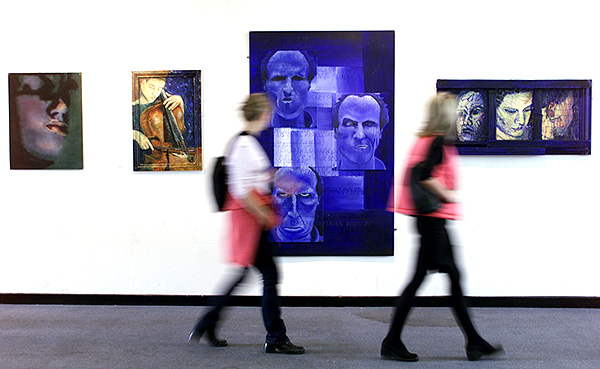
Sometimes you can see the potential for a picture but the picture isn’t happening. This is a common issue for news photographers who have to shoot pictures to go with stories about something quite specific but aren’t allowed to set a lot of shots up. This picture was to go with a very small story about an art exhibition that had been put on by some young female artists on a very tight budget. The venue was a shopping centre (mall if you are from the USA) and I could see that some human interaction with the work was the best way to cover it. I grabbed a tripod from the car and stuck my camera on it. Composing the frame was pretty easy and all I had to do was wait for the right people to walk past and look at the work. People came along and I tried various shutter speeds to get some blur in order to keep the ‘focus’ of the story on the art. Soon I was happy with my plan (1/10th of a second at f4.5 on 200 ISO) and I waited, shooting frames as people came past in ones, twos and threes.

©Neil Turner/TSL | London | October 1999

I could see these two women with very similar pink in their outfits coming. I could see that they were in perfect step and so the plan went from the occasional frame to a full burst (about 3 frames a second in those days) and got this shot. Of course I did a few more but the deep joy of those early digital SLRs was that you had great confidence in what you saw on the rear LCD.

The idea remains one that I use over and over again. I see pictures and I compose them around what’s there and then I just have to be patient and wait for someone or something to come along and complete the photograph. You can see the same idea here in an old post about walking with speed lights which has pictures taken a lot more recently!

For those who love detail, this was shot with a Kodak DCS520 camera (1.9 megapixels of class) and a Canon 17-35 f2.8L lens at the 35mm end of the range perched on a Manfrotto 055 tripod (which I still use).

Keeping it simple

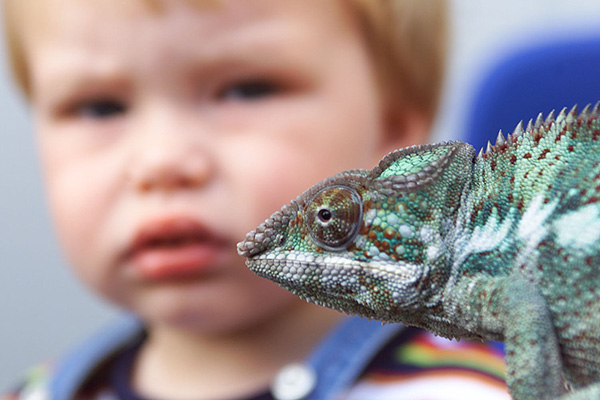
The text books will all tell you that there are a number of rules for composing a photograph (or a painting for that matter) and it isn’t a bad idea to follow these rules 90% of the time. Working on a newspaper has taught me that simple compositions often work the best and that there are several ways of keeping it simple. One of my favourites is to work with a small depth of field. The human eye will always be drawn to the subject that is in sharp focus with a simple out of focus background. Usually this will mean that the background doesn’t contribute to the image, but every so often an out of focus background forms a really important part of the image.

©Neil Turner/TSL | Southampton | August 2001

This picture of three year old boy at a nursery school learning about some creatures that had been brought into the school is a perfect illustration of how throwing the background out of focus gives an enormous boost to the composition and helps to tell the story of the image. The chameleon is in focus, but because the lens (180mm on a 70-200 f2.8 zoom) was wide open at f2.8 the boy becomes an interesting blur. The added 1.6x focal length multiplication brought no change in the depth of field but narrowed the angle down to a 35mm equivalent of 288mm. On this particularly sunny day that meant a shutter speed of 1/4000th of a second on 200 ISO.

Techniques are there to be used, altered, modified and adapted. This one should become really useful to you once you have mastered it. When you are struggling to make an interesting composition it’s always worth considering narrowing your depth of field.

Vocabulary of photography

Language is an ever-evolving thing and a quick search for a famous quote on the nature of language brought up two very interesting thoughts. The first is accredited to Karl Albrecht – a German latter day renaissance thinker (I wish it were the co-founder of Aldi who had the same name)

“Change your language and you change your thoughts.”

This is an important idea when, as press photographers, we are trying to get the world, the rest of the media and the Leveson Inquiry to think about photographers differently. Words like paparazzi have been liberally used during the inquiry and by commentators about the inquiry. Fellow journalists and even some of our peers regularly use the words snap, snapper and snapped to talk about our work. As long as this kind of unhelpful vocabulary carries on being used we are almost bound to carry on having a problem. We are photographers, we take photographs and what we do is photography. Get a thesaurus out and there are plenty of other words that can be used (with increasing degrees of pompousness). It seems likely that it is up to us to start the ball rolling. It is one thing to use slang terms within the tight confines of our profession but an entirely different thing to propagate them elsewhere.

As professionals we owe it to ourselves and our colleagues to change our own vocabulary and to correct everyone else who falls into the lazy trap of using short snappy terms that are just not accurate. Take last Saturday’s Times for example. On the front page of one of their sections they had a line about “What really happened when Beaton snapped the Queen”. Did Sir Cecil Beaton really “snap” anything? The Victoria and Albert Museum, a cultural institution that would claim to respect photography has on their shop website a line about the same photographer saying that after her 1953 Coronation

“(he) snapped the Queen in all her coronation finery.”

As long as what we do is trivialised in this way we are going to have an uphill struggle. A couple of other searches on the web brought up equally depressing quotes – this one comes from a careers website www.allaboutcareers.com and their description of the job “Press Photographer”:

“Press photographers are employed by newspapers, magazines and other print and web publications. These snap-happy professionals are tasked with recording images of current events to support news stories or taking interesting photos to emphasise the point of featured articles.”

We could go on but that would only serve to labour the point. It is hard to think of another profession whose work is so universally undervalued, whose work is widely misunderstood and about whom the vocabulary used is to pejorative.

One final note: whilst looking for quotes about language I found this one attributed to Federico Fellini – the man credited so widely with the origins of the term “paparazzi”;

“A different language is a different vision of life.”

Our language is a very visual one but occasionally even we need to resort to words to make our point. If we aren’t careful, the rapid evolution of the English language will leave us behind and the regular and repeated use of poor and inaccurate phrases will become “correct”.