photography

Original dg28.com technique pages

Between January 2000 and June 2008 I posted a large number of technique examples taken from my daily work to show how I used light in an era where digital cameras were pretty poor at ISOs over 800 or even 400 in the case of the venerable Kodak DCS520. These days flash is a creative choice rather than a technical necessity but the techniques still stand up.

One of the technique pages was entitled simply “Why we use lights” and it is an extreme example of just how much difference some judiciously used flash can make. Early Autumn on a Friday evening in the UK isn’t often a time when the best opportunities to shoot great pictures present themselves. This one, was a real exception.

©Neil Turner/TSL

The subject of the portrait runs an educational organisation that serves a coastal area near where I was born. I should know the area like the back of my hand but I don’t and when my subject suggested that we went up on top of the Isle of Portland (not an island at all, just a peninsula!) I thought that it would make a decent enough backdrop but that the view might be obscured by mist. The two pictures below were taken with different lenses but they were taken within a few seconds of each other and show just how much of a difference a bit of flash can make.

Back in 2008 when I “retired” these pages I wrote the following as a background to my philosophy regarding portable location lighting:

A lot of news photographers don’t think that they are allowed enough time to light pictures, so they rely on their hot shoe mounted flash or on moving their subject into the daylight. If your kit is lightweight and well planned, if it’s reliable and quick to assemble then you can light as much of your work as you want to. I tend to specialize in editorial portraiture, so that is the area of work that I’m going to talk about.

When I was writing these pages my basic kit was one Lumedyne 200 joule pack, one Signature head, two regular batteries, one stand, an umbrella, a Chimera softbox and a Pocket Wizard kit – all in one sling bag. Since May 2009 that all changed and the Lumedyne kit was replaced by an Elinchrom Ranger Quadra system. I still like the Lumedynes but the Elinchrom is a few percentage points better! In October 2003 I added an Umbrella Box to my kit in the hope of replacing two light modifiers with one, which has worked in some ways but I have to confess that I go through phases of using each of the light modifiers for a while and then switching.

In the years when I was a staff photographer and posting regular monthly galleries as well as technique and opinion pages my website was getting up to 20,000 unique visitors a month. Numbers have clearly dropped off now that new content hasn’t been added for three and a half years but I’m still amazed by the the fact that in one day last month the technique home page still got 996 unique visitors.

Some day, I am going to write a book – yeah, I know – we all say that… The backbone of that book will be an up-to-date explanation of the theory behind some the 60+ technique samples posted on the original dg28.com. In the meantime, be my guest – follow the link below to the old technique pages and have look around. Be warned: one very well known blogger claims to have lost an entire night’s sleep doing just that.

ORIGINAL DG28 TECHNIQUE PAGES

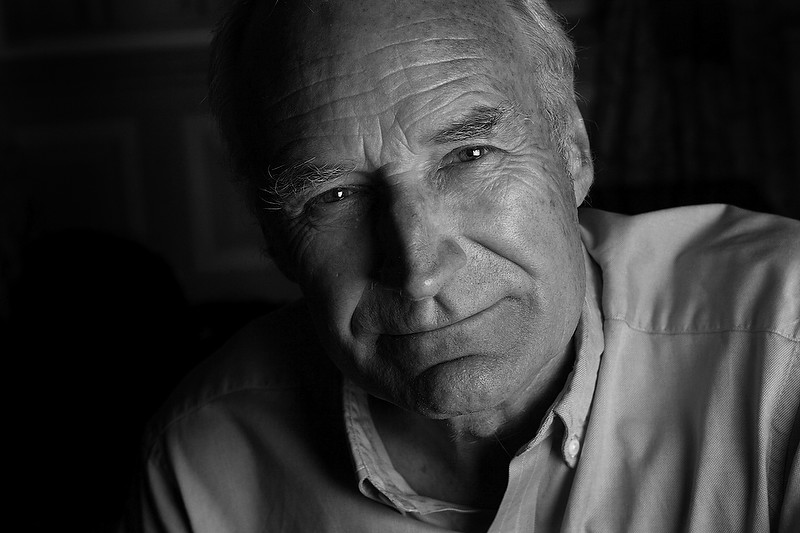
Folio photo #08: Peter Snow, London, May 2004

©Neil Turner/TSL, May 2004

Peter Snow, BBC sephologist, journalist and newsreader photographed after an interview at a central London hotel for a “My Best Teacher” feature for the TES Magazine.

He had a book and a TV series with his historian son at the time and the interview was one of a long series that he had already done that day. The room was cramped and poorly lit and so I used a medium sized soft box very close to him to keep as much light off of the background as possible. One picture editor that I worked with used to call this very tight crop the “egg cup” because it was as if someone had flattened the top just like one.

Education… over on EPUK…

I write a lot for other websites and towards the end of last year the Editor of the Editorial Photographers UK site asked me to write something about photography education. It started like this:

What price your dream?

In Britain a staggering 1600 photography courses will be touting for students in 2012. Neil Turner, professional photographer and tutor on a new photojournalism course that starts in Bournemouth this month, asks whether enough of these courses actually prepare students for the harsh realities of professional photography today.

If you get a dozen professional photographers together and ask them about the state, standard and suitability of photographic education in this country you’ll get two dozen anecdotes about graduates who don’t know their arse from their f-stop, and a consensus that higher education is failing the students and the industry. Is this true? Are we missing something, or is the system getting it wrong big-time?

If you’d like to read the rest, you can go to THE EPUK WEBSITE

Mindset – small word, big concept for news photographers

©Neil Turner/TSL, March 2004

Written in 2002, this opinion piece still holds very true nearly ten years later…

What’s the difference between a photographer who takes pictures for fun, another who struggles as a professional and one who is on top of their game? The answer, well there are many but the top of my list is….mindset

It’s a pretty innocuous word, but it makes a massive difference. As I sit here writing this I’m trying to formulate some thoughts ahead of a talk to a group of postgraduate news photographers. Snappy titles are always a good start – according to the “Lecturing for Dummies” handbook so “Mindset” it is.

Next step – arresting opening sentence. That will have to wait until I have better formulated my ideas, but my handbook tells me that if you get people’s attention at the beginning you have won fifty percent of the battle and if you don’t you will waste a lot of time getting it back. Well, that’s a bit like writing and (spot the cheasy link) an awful lot like being a news photographer.

The narrative that runs through a well shot photo story or a well written essay is remarkably similar. I have been trying to find a way of telling eager “news photographers in the making” that the message is more important than the way it is delivered and I have decided that it’s worth keeping the writing analogy going.   Nobody denies that poetry is literature and everyone has respect for well written short stories. Good authors are comfortable with their medium, they structure their work and use words economically. Good photographers mirror this. The common thread is mindset; shaping what you have into what you want it to be. I’m not saying that you pre-judge an issue, but rather that you should edit before you shoot, as you shoot and after you shoot to tailor your pictures to a particular format.

If you are working towards an exhibition you work one way – adopting the right mindset, and if you are shooting a single image story you work a completely different way.  And then there are the differences between making and taking photographs, between being a welcome guest wherever you are or an unwanted intruder. News photography is a very broad church, with room for many ways of working and a lot of photographers find it very difficult to switch between the various sub-genres. It can be done.  The temptation for photographers new to journalism to assume that only great long complicated narratives qualify as news photography is understandable. It is also one hundred and eighty degrees out. The thought that it takes real skill to tell a story in a single picture is a difficult concept to master but the greatest story-tellers know that less can often be a whole lot more.

It’s all in the mind.  If you have a month to shoot a spread you can afford a few days (let’s say three to make the comparison easy) to acclimatise. If you have an hour to shoot a single image story and you take the same percentage of the job time to settle in, you’ve only got six minutes. You know what the score is, so you adopt the right approach before you start.  News photography, when it’s stripped down, is a really simple idea. You take pictures and you make pictures that tell stories. You can use photographs to spell out what you want to say, you can use them to intrigue the viewer or you can use them to infer things.

Good journalism often uses words, but it uses photographs just as often. If the photographer is thinking straight and can concentrate on the end product, good photography becomes great news photography.

Final step – the clever conclusion. I would advise anyone coming into the profession to read some good poetry and a few good novels, to work out how they were structured and to try adapting the simplicity of poetry to their photography. Why? The answer is all too simple, photography is all about creativity and it’s all about mastering the technical aspects but most of all it’s about a state of mind – a mental process – mindset.

Folio photo #07: Ugandan primary school, April 2005

©Neil Turner/TSL, April 2005

Asaba Primary School, Masindi, Uganda. This private primary school has 1000 pupils aged from 3 to 12. Parents in this remote and poor area go to great lengths to give their children the best education that they can afford. Class sizes at Asaba are as small as thirty or forty which compares very favourably to the free schools where eighty or even a hundred children in one class is common.

I was in Uganda to shoot a feature to coincide with a television series about rural African education and Masindi is a very interesting place with the huge contrasts between the locals and the aid agencies, many of whom have regional offices in the town, and their brand new four-wheel drive vehicles which are parked outside their offices.

Fun pictures – Brain & Hart…

Like most working photographers I sometimes take pictures for the sheer joy of it. Sometimes I even get my iPhone out and do fun pictures. From time to time on this blog I hope to ad a few of the silly, odd and downright comical pictures that I sometimes see.

A lot of my favourites are actually not that good as pictures; I am often amused by wordplay in pictures – like this one…

©Neil Turner, October 2011

Folio photo #06: 10 Downing Street, November 2001.

©Neil Turner/TSL November 2001

Children from a Leicestershire nursery school try to hand in their petition against closure to No.10 Downing Street.

This was a very ordinary story about yet another petition being handed in at No.10 which became extraordinary when the Police Officer on duty allowed the two children to try to knock on the door and then stood back and laughed as they kept trying.

It was a very cute moment on a day where the world’s media were not watching and the reflection of the officer in the shiny black door makes this a favourite picture of mine. They never reached the door knocker and so the officer eventually helped them out by knocking it for them.

…and we’re off

20120101-200818.jpg

©Neil Turner, March 2010

The sub heading of this blog is “me writing about photography because I want to” and that’s the truth. Post number 47 and it’s the start of month two.

2012 is underway and I’m planning to do quite a lot of blogging as the year goes by. I’m going to talk about education, press photography, photojournalism, light, technology, workflow, software, cameras and just about anything else that I come across in the day job.

If you read the blog and come up with any questions for me please let me have them. In the mean time, let’s hope that 2012 serves us all well.