portrait

Back on Memory Lane again

I don’t know about you but I can put my finger on exact dates and point to pictures that changed the way that I shoot pictures. Aside from the obvious ones such as the day that I used a digital SLR for the first time and the day that I bought my first medium format camera one very special day and one picture made me think really hard about the kind of lighting that I wanted to use.

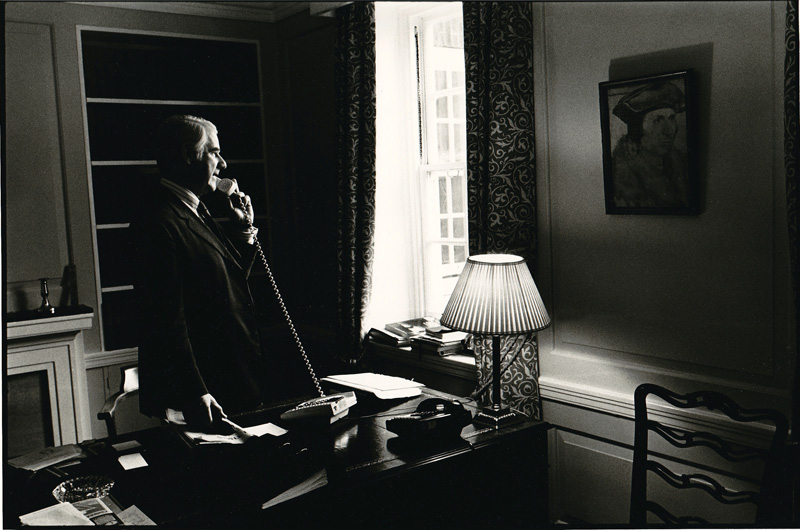
Desmond Fennell QC. ©Neil Turner

This black and white portrait of Desmond Fennell OBE QC was taken in his chambers at one of London’s famous Inns of Court – The Temple. It was shot for a newspaper and it was during a time in my career that I was using a single Elinchrom 23 flash head with a soft box and a bit of cable connecting the camera to the flash. Nothing unusual there I hear you thinking… how did this change Neil’s life?

Cue anecdote: I was sent to shoot a portrait so I took my standard gear. When I was shown in to the eminent man’s office I started to look around for a power point to plug my Elinchrom into. He answered the phone at that moment (he was chairing a major public enquiry at the time) and so I looked at the desk lamp and followed the cable to the socket in the wall. The trouble is that it was the wrong kind of socket… the UK standard three pin plug has rectangular prongs and his only socket had round holes. Square pegs, round holes… ohhh c**p.

It wasn’t that I was incapable of shooting with either a speedlight or just using the ambient light it was just a bit of a shock. This was actually the second frame that I shot – Nikon FM2 with a 35mm f2 Nikkor, Kodak Tri-X film pushed to 800 ISO.

I like to think that I learn from my professional mistakes and I like to think that after a few days a shock turns into an eye-opener and I remember coming away from this shoot with two lessons learned. The first was to always shoot some ambient light because it often makes stunning pictures – especially at quiet, off-guard moments and the second was to buy some battery powered lights. In truth, that took about three years to accomplish properly and I invested in a lot of extension leads in the mean time. I recall the day that my first Lumedyne kit went into action – complete with a Wein infra-red trigger. No cables. I shot a portrait of another lawyer and left her office singing one of the songs from the Disney version of Pinocchio – “I got no strings to hold me down…”

Two surprisingly similar portraits

©Neil Turner/TSL

The great challenge in photography for me is to keep shooting pictures without keeping shooting the same picture. There are thousands of ways of taking a photograph – let’s say that the number is, for argument’s sake, twenty-five thousand. What happens when you have shot two hundred and fifty thousand pictures – have you shot each possible picture ten times? I was looking back through a folder of favourite images today and found two that were taken at a similar point in my career and in a fairly similar location.

So are these two pictures the same, similar or different? It doesn’t matter really what anyone thinks but I really like to see them together. I like to see the similarities and the differences and once you get away from the fact that both are women sitting in a chair in a bay window in London with a quality rug on the floor the differences in the pictures start to matter much, much more. I promise that I haven’t cropped them to match – this is how they were in my folder.

The light comes from the side on both and, knowing the way that I work, that has a lot more to do with eliminating reflections in the glass in a hurry than any creative impulse. The amount of ambient light is higher on the left (yes, that is author Jacqueline Wilson) and the books make the picture feel a lot different to the harder light with less ambient, no books and peeling paint of the left hand portrait of blind sculptor Gohar Kordi.

I love looking at my own work, trying to get ideas for new work from examining old work and I know very well that there will come a time when I do the same (?) shot again and can picture these two frames and what they say in my mind. Next time I will use a longer lens. Next time I will pay even more attention to the symmetry of the composition. I can’t wait…

Undertaking assignments – a beginners guide

I’m not sure if this is a re-post, a re-repost or whether it is just a bit of efficient recycling of some old words. It was written in 2002 and put up on the pre-blog in 2009 anyway.

What does undertaking an assignment really mean? That was the question e-mailed to me by a third year photography degree student a while ago. At first I was shocked by her ignorance, but then I realised that nobody had really prepared me for my first one either. Some of what needs to be done is common sense and some is just experience. No two photographers work the same way, but here’s my approach…

©Neil Turner/TSL, July 2008

Let’s start small, with a simple half-day portrait, and in theory it all begins with the brief that you receive from the picture editor or commissioning editor. The first contact normally comes over the phone and can be as much as days or weeks in advance or as little as minutes or hours.

In practice you can be getting ready for this commission before it exists by simply making sure that your kit is packed, that batteries are freshly charged and that you have either enough film or spare memory card capacity to last for a few hundred frames. If you use a car for your work, make sure it’s in good repair and has enough fuel in the tank and also make sure that you’ve got cash and cards just in case you need to buy anything. In the days before SatNav I always bought lots of street maps so I now have a comprehensive A-Z of most of the United Kingdom to hand. All of this comes under the tongue in cheek heading of OPERATIONAL READINESS!!!

Now, back to that brief. You are fairly comfortable that whatever is asked of you, you can get on with it without too much fuss so when the phone rings you can concentrate on the details being given to you. In time honoured photographer tradition, there is a catchy way of remembering what you need to know – the FIVE Ws: when, who, what, why and where. In these few words you have the essence of the job – when the job is, who to contact, what you have to shoot, why you are shooting it and where the job is.

There will be other important facts like what shape (if any) has been left on the page for the picture, what the deadline is, how many images the editor wants to choose from, is the story a positive one or is it critical of somebody or something. The more information that you go armed with, the better job you will have the potential to do. If possible get written conformation of what is being asked -especially if you have never worked for that editor before. I find an e-mail is a very useful aid and most picture desks are more than happy to send a quick confirmation e-mail if you ask nicely! You know what is wanted by now, and you need to go through a mental checklist of the equipment you need to take.

  • Is your standard kit enough?
  • If it isn’t, where can you rent the right hire kit?
  • If you have to rent a lens, who will be paying – you or the paper/magazine?
  • Would you be better of on the train?
  • Do you need to take a laptop?

Make sure that you can answer all of these questions for yourself before you leave – it might pay to design a “pre-flight” checklist and get a few dozen copies printed off so that you always go through all of the questions. The car boot is packed, you have the route worked out (sat-nav is great but make sure that you have keyed in the correct location, there is more than one Ashford and at least three Newcastles) and it’s off.

Travelling time isn’t dead time. It’s great to get some ideas while you travel, the outline of what you might like to do. These ideas often come to nothing, but you are starting to think about the job ahead and that’s good. If the story is likely to be news worthy it may come up on the radio, so travel with a good news station tuned in. If you have time before you leave check things out on the internet; “Google” the person’s name – a little knowledge is very useful when it comes to breaking the ice. When you arrive it’s important to come across as if you know what you are doing. If you are using lights you need to be familiar with them and the ability to continue a conversation whilst setting them up is a useful skill.

I have written elsewhere on this site about finding a (non-contentious) subject to chat about to buy yourself time to decide what you want to do and to relax your subject. If you are (outwardly) relaxed you will get more respect and trust from your subject. It’s important to not be told by them what to do, by all means listen to their ideas but be firm about what you have been sent to do. You might have to try their idea in exchange for shooting your own – it’s all a game, so learn to play it well. When the shooting starts, be decisive and shoot as many variations as you can. Don’t be afraid to refer to your brief and it’s important that you do what was asked of you as well as the much better picture that you think of.

This is the vital bit, anything that goes wrong now will probably stay wrong, no-matter how good your Photoshop skills are. When the shoot finishes, you pack up without forgetting anything and leave. Even if the person doesn’t have an unusual name check spellings and job titles so that your captions are thorough and authoritative.

It’s not all over. No matter how long to the deadline, get those pictures delivered as soon as possible whilst taking care to edit them well and caption them accurately. The paper will have a way that they like things done so make sure that you comply with their wishes, there is no better way to lose a client than to get these basics wrong. Keep copies of all digital files and archive them well. A courtesy call to check that everything arrived OK and that the editor was happy is always a good idea until you get your feet under the table and can the client a “regular”. Obviously you need to make notes of the distance you covered, the expenses you incurred and the time spent so that when it comes to submitting your invoice you aren’t making things up. If the editor offers you feedback on the job, take it. Be positive and don’t make excuses for anything that was avoidable that went wrong.

Get those batteries back on charge as soon as possible and get the kit ready for the next one. Now the job is over.

What they don’t teach you in college

This post was originally written in 2003. Things, sadly, haven’t really changed and so I thought that it deserved yet another airing.

For better or for worse, the vast majority of people entering the photographic profession are coming from college courses. I have no problem with that, I came from one myself and so did a lot of my favourite photographers. But…

I’ve been a working photographer since 1986 and based on a few things I have picked up since then I have come up with a list of things that they should have taught us that were not on the syllabus. A whole range of vital skills that go a long way to marking out the complete professional from the aspiring “not there yet”.

Obviously when it comes to choosing which lens to use, or selecting backgrounds and props – only experience and familiarity with your kit and brief will do, and colleges are good at telling their students that. There are, however, some skills that are never even mentioned that are vital.

  • People skills: The ability to handle anyone that you are either photographing, who have influence over those being photographed or who are just getting in the way.
  • More people skills: You need to be able to charm the ‘jobsworth’ security man and persuade the reluctant PR and to do it all without breaking into a fit of temper until such times as all else has failed and you have no other option
  • Even more people skills: As a news photographer you need to be able to communicate with anyone from a starving refugee to a pampered celebrity in a meaningful and constructive way – often on the same day! You have to get them to trust you, to do what you want them to do and achieve all of this with dignity and respect.
  • Advanced people skills: As a portraitist you have to have the ability to talk to absolutely anyone and to keep the conversation going at a light but interesting level whilst setting up equipment, making vital technical decisions and shooting the job.
  • Extended people skills: You need to have a sense of your own place in the scheme of things. It’s no use throwing a prima donna tantrum if you are not getting what you want and are never going to get it. It gets even worse when the person you are arguing with is a close personal friend of the editor. Know when to give in, to make another plan and get your shot anyway.

You are probably getting my drift by now. Once you have acquired all of the technical skills and bought all of the kit that you need all that’s required is to learn how to conduct yourself. I often refer to the photographer as the “Social Chameleon”, changing colours and attitude to suit their surroundings. This should be both physical – dressing appropriately so as not antagonize the people that you are dealing with, and mental – adopting the right attitude – be it meek or aggressive, as friendly or confrontational as the situation requires.

Maybe photographers should all adopt some of the techniques used by the best sales people and mix them with skills more common in the diplomatic service. I have watched charity workers running soup kitchens and marvelled at their ability to be both understanding and firm, and I have watched police officers and been stunned by the way that they get the information that they want whilst conducting an otherwise friendly conversation.

My biggest tip on this subject is to find some common ground with whoever you are talking to and work it. It might be sport, it might be the weather or the journey that you both had to get where you have met. If I’m in someone’s home I will often talk about a piece of art or furniture on display or their pet cat or dog. It doesn’t matter what you chat about, you are chatting and barriers are coming down. Avoid contentious subjects unless you are really sure of yourself.

So there you are, what they don’t teach you in college is how to handle people. It’s not just a skill needed by photographers – it’s a life skill. I think that’s why a lot of the greatest photographers have come from other careers where they have learned about people and use those skills in their new profession.

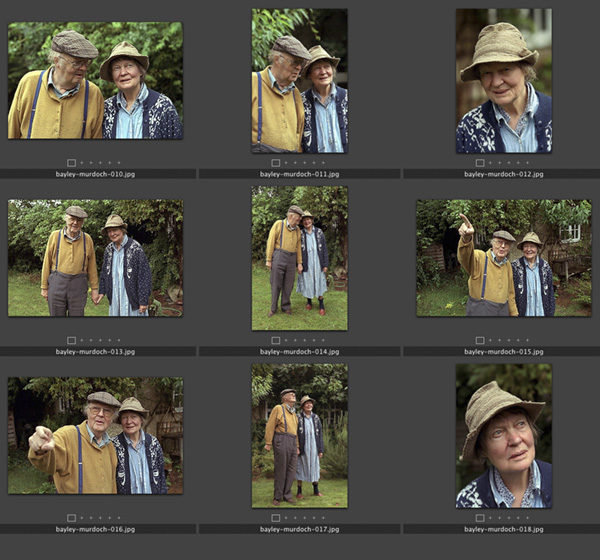
Contact sheet: Dame Iris Murdoch and John Bayley, Oxford, September 1998

When this set of photographs, one of the last of her, was taken Dame Iris was in the latter stages of Alzheimer’s and her husband described her as being like “a very nice 3-year-old,”. She died in Oxford on February 8, 1999. In his memoir “Elegy for Iris” John Bayley portrays his brilliant wife lovingly but unsentimentally. He was in turn very much in love with her and very caring about her when I spent a brief time shooting this set of pictures. She was unaware of who I was or what I was doing but his hand was always in hers and she seemed to accept that everything was OK because of that.

The original caption simply read: Professor John Bayley and Dame Iris Murdoch photographed in the back garden of their home in Oxford. 09.09.1998 photo: Neil Turner/Times Higher Education Supplement. ©News International

The Times Higher Education Supplement was running a review of Professor Bayley’s book about his wife and the Picture Editor had asked me to drive to Oxford to shoot his portrait. While I was driving between London and Oxford I was told that at least two other photographers would be shooting before me and that it was “unlikely” that Dame Iris would be in the pictures. I don’t mind doing portraits of authors on those days when you form an orderly queue with reporters and television crews for your chance to do the same five minute job but this one seemed a little less “organised”.

I arrived in that part of Oxford where it seems every second home is owned by a Nobel Prize winner or a celebrity academic to find their house looking a little sorry for itself. The front garden, the fences and the paintwork all needed some TLC and I quite like to shoot portraits around those areas. I had twenty minutes to wait and started to think about the light, the colours and watch for other photographers and journalists to come out. Nobody appeared so I grabbed my gear and knocked on the door. When Professor Bayley answered, he looked like the gardener but spoke exactly how you might imagine an Oxford Professor would.

In the film “Iris” which stars Dame Judi Dench as the older Iris Murdoch the house is untidy. Actually having been there I can tell you that untidy doesn’t even come close. There were books and newspapers everywhere. Televisions were on the BBC in almost every room and there was Dame Iris herself sitting quietly at the kitchen table. I was nervous about asking if she would be available for the pictures but Professor Bayley seemed to know what I wanted to ask and told me that he wanted her to be in the pictures with him but that she found flash disturbing. I was shooting 35mm colour negative film at the time and so we decided that the house was too dark and too untidy to be a good location for a portrait. Ironically these days I would have probably done some pictures on my 5D MkIIs using the small amount of available light indoors at 3200 ISO but there was no way that 800 ISO colour negative would cope.

The beauty of these pictures is that nobody from the publishers had been round to tidy up, dress them up or even attempt to sanitise the images. Because of that we were able to make some lovely portraits. We chatted about garden birds, foliage and the English weather. It was a surreal time.

In the end I shot 72 frames (two rolls of 200 ISO Fuji Colour Negative film) which I drove back to London where the film was processed by the newspaper darkroom and all scanned onto a Kodak Photo CD at a resolution unthinkable for a digital camera at the time – the equivalent of a 6 megapixel camera when the Kodak DCS520 was just becoming available with it’s 1.9 megapixel chip. The cameras used here were a Canon EOS1V and an EOS1N with 28-70 f2.8L and 70-200 f2.8L lenses.

A rant against dull and predictable photography

Originally posted in November 2002, this was a classic rant against dull and predictable photography…

I’m afraid that I get quite excited by a good argument. The cut and thrust of intellectual discourse is both stimulating and fulfilling, but I have decided that there really is no point in arguing with a disciple!

Discussion forums are great places to spend five minutes, pick up a few tips and dispense some of one’s own “wisdom”. I visit a few photography forums from time to time, and I hope that advice that I have given has helped a few people get more from their photography. The thing that upsets me, however, is the prevalence of self appointed experts who follow the teachings of photographic gurus.

A couple of months ago I wrote about various bits of advice that I have been given in my time wielding a camera. I came to the unremarkable conclusion that the best bit of advice had been to ignore advice from somebody who claims that there is only one way to achieve something in photography. The world of High Street photography seems to be fertile territory for gurus and their disciples. One or two high profile photographers have established ways of doing family portraiture that have barely moved on since the 1980s. Whole industries have grown up manufacturing the cliche’d accessories that keep the cult of posing guide and lighting ratios going. No matter which High Street around the world you go to, there they are… the blotchy canvas backdrops and fake bookcases, posing cushions and fake rugs that are featured in the “How You Must Do Portraiture” videos.

As a production line and money making business model these methods of portraiture are singularly successful. Every home in the world seems to have some images produced by the “factory photographers”, but just like factory farming you get bland and often tasteless products churned out by people who either don’t care, have lost sight of why they did the job in the first place or just see it as a way to make money. Whilst this all saddens me a great deal, it is a good business model and you have to make a living and pay your bills somehow.

What really upsets me about this kind of work is that there is a massive number of people out there who are exposed to this kind of work and follow the gurus. They go out and buy the video because that’s what they believe portraiture is all about, they buy the blotchy canvases because they feature heavily in the videos and they finally get sucked into thinking that this is what photography is all about. I want to kick and shout and make people realise that you don’t have to have battery hens to get eggs. If you want battery eggs, go to the supermarket and buy them – but if you want something better, something tastier then you have got to start keeping your own chickens. Photography at all levels of ability allows you to produce what you want to. Creative and interesting portraiture is just around the corner as long as you don’t get suckered into believing that there is anything remotely original about canvas backdrops and set lighting ratios.

I was working in a school the other day and a parent had come to collect their child’s “portrait” taken at school. She picked it up and went to leave when the receptionist called after her to say that she had picked up the wrong child. The parent replied “…does it matter, all the kids look the b****y same in these snaps anyway!” I wanted to applaud her, she was so right. The “individually created” portrait is no better unless the photographer is going to create a new canvas back cloth for each client and then dispose of them straight afterwards.

I hope that the people pedaling the lie that this kind of work is somehow “classic portraiture” all over the internet will throw off their robes and admit that there just might be another way of achieving wonderful and desirable images.

My call goes out – Amateur photographers, wannabes and bored professionals everywhere… rise up, burn those backdrops, dump those videos and escape the cult now. There is a world of interesting, unique and occasionally truly original work to be done out there. Before you know where you are, that chant (ommmm-mainlight,fill light,hair light,backlight-ommmm) will just be a distant and mildly embarrassing memory.

©Neil “don’t copy me, just learn from my mistakes” Turner.

Five people that I will never forget

Originally posted in July 2009, this was a very personal reflection on some very important people in my career.

I suspect that most professional photographers keep a pool of pictures that they use for promotional, exhibition and portfolio purposes. I have always had a folder full of my favourites and now that I am freelance one of my regular tasks is to update it. The death of Mr Henry Allingham who was, at the age of 113, the oldest surviving veteran of the First World War made me go through and think about some of the people that I have had the honour of meeting and photographing.

My folio folder had no fewer than five images of people who have died since being photographed by me. As a percentage, that’s not out of the ordinary and three of them were very elderly indeed. Each of the five people had a big effect on me for various reasons and I’d like to share some memories of them with you.

©Neil Turner/TSL

Dame Iris Murdoch was a brilliant novelist whose life story was made into a film “Iris” starring Dame Judy Dench. I photographed Iris Murdoch and her husband John Bayley in the garden of the home that they shared in Oxford where he was a professor of English. She was, by the time that this picture was taken in 1998, suffering from the latter stages of Alzheimers’ – which is a terrible disease that robs the intellect and then the personality of the sufferer and places a great strain on those who love and care for them.

Dr Bayley described her as being like “a very nice 3-year-old”. This picture was on the back cover of the book that he wrote about their life together.

The house had not been properly cleaned for a long time and there was a television in every room playing the same programme.

When I went to see the movie made of her life two women in the row behind me made comments about the house that they lived in and that she could not believe it could have been as bad as the film made out. The temptation to turn around and tell them that the film did not tell even half of the story was strong, but I resisted. She died in Oxford on February 8, 1999.
©Neil Turner/TSL

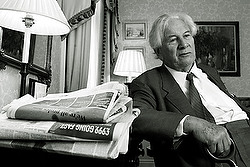
Sir Peter Ustinov was an actor, writer, director and raconteur. This picture was taken in his London hotel shortly before he died in 2004 aged 82. I’m not going to attempt to precis his life, but I’d like to tell my story about my time with him. I was searching for something to chat to him about and I used one of my “fallback” topics of what I had heard on the radio on my way to meet him.

Every morning BBC radio 4 has a news show called “The Today Programme” which that morning had a feature about the USA and communism. I mentioned Senator McCarthy and Sir Peter then delivered a wonderful and vitriolic soliloquy on the topic of McCarthyism – job done. I’m pretty sure that you would have had to pay a lot of money for a forty minute private performance from Sir Peter. I feel so privileged to have had it for free.

©Neil Turner/TSL

When I met and photographed Mr Henry Allingham he was already 112 years old. Despite his amazing age he was very coherent, had a very British sense of humour and was interested in everyone and everything around him.

I found meeting him very humbling and, when he died, I found myself counting the ways in which our world has changed during his lifetime. Cars, planes, computers, atomic bombs, heart-transplants have all become commonplace.

Queen Victoria was still on the throne of Great Britain when he was born and women did not get the vote until he was in his late twenties.

©Neil Turner/TSL

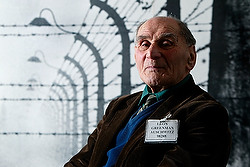
Leon Greenman OBE was the gentlest of men. Meeting him and being given a personal tour of the Holocaust Museum in London where there is a display featuring a large number of his personal possessions from before and during his time in the concentration camps had a profound and lasting effect on me.

His striped uniform with it’s Star of David, photographs of his wife and children who died in the camps, pictures of his life before the Nazis came and took the Jews away were there and he was there to talk about them in a factual but moving way.

I will never forget the day I met him and I hope that the amazing work he did to educate subsequent generations about the evils he witnessed goes on.
©Neil Turner/TSL

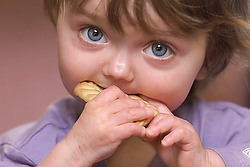
The death of people who have lived long and valuable lives is sad. The death of a child is far sadder. I met Fleur at a children’s hospice near Luton a few weeks before her untimely death. She was a sweet child who wanted to know all about everything.

Keech Cottage Children’s Hospice in Bedfordshire provides respite and terminal care for children with life limiting conditions. It is not a sad place. The children there are pretty much like any other children.

The families that I met had come to terms with the fact that they would lose the child that they loved and were making the most of their time together. I was welcomed, I was royally entertained and I would go back tomorrow if they’d have me.
Brutal architecture and portraits

I have an admission to make… I love shooting portraits on cloudy days around concrete buildings with urban skylines. There, I’ve said it. As a photographer I find brutal architecture and grey winter days both challenging and creatively stimulating. Combine the two and you have a blank canvas for interesting images – as long as you have a cooperative subject.

©Neil Turner, February 2009

This portrait is of an academic working at a central London research and teaching institute. The building is a classic modern brutal concrete one and I have shot pictures there dozens of times over the years. I have never managed to get access to the roof before and I have always imagined that it would be a great place to shoot, with decent views of the surrounding skyline.

It was a windy and dark February day and so I wanted to find a spot out of the wind. The roof features a couple of large concrete towers which contain lift machinery and other services and the southerly one has a short walkway running through it. On a sunny day this would be perfect shade in which to place your subject. On this day it was equally perfect shelter from the wind and probable rain. There are also railings which are perfect for attaching lighting stands to so that they don’t blow away.

The picture above wasn’t the first that I shot. I had tried quite a few angles to get the London skyline in but the wind forced a retreat into the covered walkway. I decided that being out of the wind gave me the chance to shoot with a 24″ x 36″ (60cm x 90cm) Chimera soft box on my Lumedyne flash head. The softbox is old and has both the inner and outer diffusers permanently sewn in and I wanted to make use of it’s softness so I placed it as close to the subject as possible. In this frame it is about three feet (90cm) from his face off at about a 45 degree angle to the left of the camera with the bottom of the softbox about level with his chin.

I always try to start with an available light reading for the sky which came out at about 1/250th of a second at f5.6 on 200 ISO. I wanted the sky to be darker and so I decided to shoot at f8 instead. This meant that I had to adjust the power output on the flash to give me the aperture that I wanted and that meant 1/4 power (50 watt/seconds). The first test shot told me that I needed some separation between his hair and the dirty grey concrete and so I set a second flash (Vivitar 285 HV) on a stand directly behind him on 1/16th power to give him a fairly aggressive hair/rim light. This isn’t a technique that I use very often but in this case it made the difference between a muddy image and one with some real edge. The combination of the big soft light and the hard hair light gives the portrait a particular mood which compliments the sky and the architecture.

Like many of the techniques that I use, this one needs to be used sparingly so that it has maximum effect when it does get used.